
The rapidly expanding energy and computing sectors are driving demand for high-performance semiconductor materials. Organic Semiconductors (OSCs) have emerged as attractive candidates for opto-electronic devices, thanks to their high carrier mobility, stability and tunability. However, accurate and independent quantification of charge carrier density and mobility has been an ongoing challenge in the OSC community. Working to overcome this challenge, recent research by Hermosilla-Palacios et al. presents a novel method for determining charge carrier characteristics in semiconducting single-walled carbon nanotubes (s-SWCNTs), a subtype of OSCs.
In this study, a nuclear magnetic resonance (NMR)-based approach is proposed to directly quantify charge carrier density and indirectly quantify carrier mobility (Fig. 1). The study puts forward a combined method utilizing 19F NMR and optical absorption measurements on s-SWCNTs in the presence of F-containing molecular dopants. The researchers demonstrated that changes in carrier density affect charge delocalization, resulting in a carrier density-dependent mobility, in contrary to that expected for mobility limited by ionized impurity scattering. This combined approach simplifies the measurement of carrier density in doped s-SWCNTs, constituting a valuable tool to the OSC community.
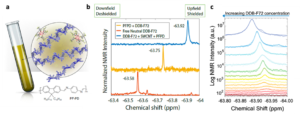
Fig. 1 (a) Cartoon showing the NMR tube sample composition: polymer dispersed s-SWCNT, excess polymer (in blue) and DDB-F72 molecules associated with a hole on the doped s-SWCNTs. Repeating unit of the polymer PF-PD is also presented for clarity. (b) Spectra corresponding to 19F NMR for neutral DDB-F72 dopant in d8-toluene (6 mM, bottom), PF-PD polymer used to disperse s-SWCNTs with added DDB-F72 (6 mM, middle), and dispersed s-SWCNTs with added DDB-F72 (6 mM, top). Numbers show specific chemical shift. (c) Spectra corresponding to 19F NMR for doping series of s-SWCNT. Spectra are arbitrarily displaced along the y axis to show the different doping steps clearly. Lower dopant concentration (red) to higher dopant concentrations (blue). Reproduced from DOI: 10.1039/D3NH00480E with permission from the Royal Society of Chemistry.
While this study presents significant strides in measuring carrier density in s-SWCNTs, whether it can be effectively applied to a wide range of OSCs beyond s-SWCNTs remains to be seen. It should also be noted that the downfield shift observed with increasing dopant concentration may be complicated by factors other than charge delocalization of the hole distribution, such as dopant binding dynamics. The mechanistic origin of the chemical shift changes in the presence of dopants with NMR -active nuclei may refine our understanding of the local micro-environment around the redox-doped s-SWCNTs, prompting further investigations in this area.
In summary, this study develops an NMR-based method to quantify charge carrier density in s-SWCNTs and illustrates that the hole mobility in doped s-SWCNT networks increases with growing carrier density. The ability to tune, quantify, and optimize carrier density opens new avenues for applications such as photovoltaics, sensors, light-emitting diodes, field-effect transistors, and thermoelectric devices. The method’s potential applicability to various p-conjugated semiconductors using suitable NMR-active dopants makes it a versatile tool for the field. As the scientific community embraces this innovative approach, it heralds a new chapter in the design and development of high-performance semiconductor materials.
To find out more, please read:
Carrier density and delocalization signatures in doped carbon nanotubes from quantitative magnetic resonance
M. Alejandra Hermosilla-Palacios, Marissa Martinez, Evan A. Doud, Tobias Hertel, Alexander M. Spokoyny, Sofie Cambré, Wim Wenseleers, Yong-Hyun Kim, Andrew J. Ferguson and Jeffrey L. Blackburn
Nanoscale Horiz., 2024, Advance Article
About the blogger

Albert Liu is an Assistant Professor at the University of Michigan, and a member of the Nanoscale Horizons Community Board. Prof. Liu’s research group studies the effects of micro-confinement in nano-structured low dimensional materials, to address challenges in sustainability, robotics, and healthcare. You can follow Albert on Twitter @Albert_T_Liu |