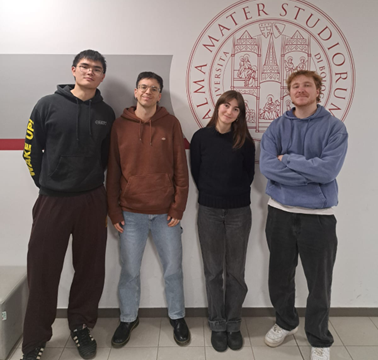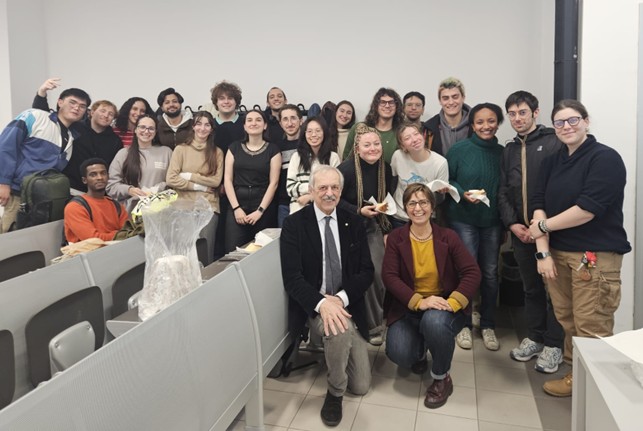
Advisory board member Lucia Maini and her mechanochemistry students at the University of Bologna have selected their favourite articles from RSC Mechanochemistry. The students’ perspectives on the articles and the field of mechanochemistry will be presented in a series of six blog posts. The fourth group of students will discuss:
Solvent-free mechanochemical conversion of CO2 into mesoporous SiC: a green route to high-performance catalysts
This article introduces a new solvent-free mechanochemical synthesis, in line with the principles of green chemistry, to produce mesoporous silicon carbide (SiC), using CO2 as a sustainable carbon feedstock and SiO2/Mg as earth-abundant precursors.
SiC is a fundamental material for catalytic, electronic, and structural applications. It is typically commercially produced by the energy-consuming Acheson process, which involves a long direct carbothermic reaction of quartz sand and petroleum with low commercial yields working at extremely high temperatures (2200–2400 °C). In the approach introduced by the considered work, a mixture of nano-SiO2 particles and Mg (used as a reductant) is initially converted to Mg2Si, a highly reactive intermediate, via ball milling. The strong interaction between Mg2Si and CO2 activates the subsequent transformation of Mg2Si into mesoporous SiC. This new route achieves a high CO2 conversion efficiency of 84% at only 10% of the energy cost of conventional methods.
The obtained mesoporous SiC has been validated as a highly stable and thermally conductive support for Ni catalysts in dry reforming of methane (DRM), able to convert the two most significant greenhouse gases, CH4 and CO2, into industrially valuable syngas H2 and CO, all while maintaining performance over 100 hours with minimal coke formation.
The work explores the process with multiple characterization techniques and approaches via high-resolution transmission electron microscopy (HR-TEM), scanning electron microscopy (SEM), X-ray diffraction (XRD), N2-adsorption and desorption isotherms, thermogravimetric analysis (TGA), Brunauer-Emmett-Teller (BET) analysis and plasma-optical emission spectrometry. On top of this, density functional theory (DFT) calculations were run on the energetics of CO2 binding and dissociation on the surface of Mg2Si nanoparticles, confirming that the activation of CO2 is thermodynamically driven.
In summary, this work introduces a green, scalable route to synthesize, through self-activated solid-gas reaction, high-value SiC. The overall process integrates CO2 utilization and catalyst development while obtaining value-added products, all according to the principles of green chemistry.
What drew you to study Mechanochemistry initially, and what areas have you found most interesting?
What initially drew us to mechanochemistry was its role as a new frontier in inorganic, and more broadly synthetic, chemistry; it offers an innovative way to address long-standing challenges in traditional solution-based methods. Furthermore, its ability to reduce or eliminate solvents, operate at lower temperatures, and decrease both energetic and economic costs, makes it highly aligned with the principles of green chemistry. We are particularly fascinated by how mechanochemical approaches can yield products that are normally unobtainable via conventional routes (as an example, in this work they have been able to obtain β-SiC rather than the α-SiC product of the solution-based method). Since the field is still developing, it offers substantial room for advancing both fundamental understanding and practical applications.
Why did you choose this article, did you find anything surprising?
This article is particularly interesting to us because it brings together sustainability, high efficiency, and real industrial potential. What is noteworthy, in our view, is that the reaction proceeds adiabatically, i.e. without any external energy input; a fundamental consequence is that it leads to a remarkable reduction in energy costs compared to previous methods, while staying fully aligned with green-chemistry principles. We were also largely impressed by the study performed on different forms of reactants, including those derived from biomasses, resulting in a versatile reaction. Moreover, the activation of inert CO2 was another unexpected outcome, showing how powerful and adaptable this mechanochemical approach can be. Finally, the effective performance of the SiC produced by this method as a support for Ni catalysts highlighted not only the study’s innovative nature but also its practical relevance in catalytic applications.
Why is this article important, what gap in the literature does this research aim to fill?
In our perspective, the importance of the considered article lies in the provision of a truly sustainable and potentially scalable alternative to the energy-intensive Acheson process, which exhibits high power consumption, low carbon efficiency, and poor control over SiC morphology. This research fills this gap by introducing an adiabatic mechanochemical route that achieves much higher conversion of CO2 (84%) while using only about 10% of the energy normally required, even with higher control on the product morphology.
The present study also addresses the problem of CO2 overabundance by its conversion into more valuable products: in this context, the presented method has both environmental and practical relevance, since CO2 sequestration is spatially limited in the locations where the process can occur. The work also fills a key need in catalyst development: the mesoporous SiC produced shows excellent stability; furthermore, Ni catalyst supported on SiC displays very low coke deposition, solving one of the major issues in dry methane reforming catalysis.
Consider the real-world applications or implications of this article, what are the strengths and/or limitations of this article that may need to be explored further?
This article demonstrates solid potential for practical applications, but several issues need further study before industrial use. The process is labeled as scalable, yet all tests were done on gram-scale batches in a 500-cc mill: therefore, up to now, a major challenge remains to adapt the method to continuous, ton-scale production and control of fast adiabatic reactions safely. The required acid-base leaching step also raises questions about cost, efficiency, and liquid-waste management at large scale.
Maintaining high conversion over a larger scale will also demand further optimization of solid-gas contact, including CO2 pressure and milling-chamber design. Furthermore, although the Ni/SiC catalyst performs well for 100 hours, true industrial deployment requires much longer stability tests (up to thousands of hours). To conclude, the concept is strong, but large-scale engineering is an essential next step for long-term validation.

Elia Zoffoli, Martina Casalini, Cristina Bagnacavalli and Gian Maria Selleri
Behind this blog post, there are four different “photochemists-to-be”: Cristina, Martina, Gian Maria and Elia. Cristina is a music addicted archer with the dream of pursuing a career in theoretical chemistry. Martina loves to be in the wild doing sports and in her free time she happens to be a brilliant chemist. Gian Maria not only loves physical chemistry but he’s also a student in the conservatoire of our city. Last but not least, Elia is an adventurer that knows how to orientate in every place he goes, and with no doubt in the future will be our boss. We know it may seem like a chaotic biography, but we also know that entropy is actually a state of mind.
Check out the article, published in RSC Mechanochemistry:
Solvent-free mechanochemical conversion of CO2 into mesoporous SiC: a green route to high-performance catalysts
Hae In Lee, Myung Won Seo, Dong Hyun Kim, Hyuk Choi, Ju Hyeok Lee, Mi Yoo, Min-Jae Kim, Yong-Sik Ok, Siddheshwar Dadarao Raut, Dong Hyun Lee, Hyun You Kim, Kyubock Lee and Won-Chul Cho
RSC Mechanochem., 2026, 3, 76-82
Discover all of the selected articles in the RSC Mechanochemistry Students’ Choice collection.
 |
|
Are you ready to contribute to the future of mechanochemistry? RSC Mechanochemistry offers you an inclusive and dedicated home for the ideas, scientific language and approaches that cut across the many disciplines mechanochemistry touches. Here we are seeking to build knowledge, as well as foster innovation and discovery at this forefront of chemistry. Whether you are seeking to understand the fundamentals of mechanochemistry, or you are excited by its applications and potential, this journal is for you. All of the content in this journal is gold open access, which means that you can read every article for free, and we are covering all publication costs until mid-2026.
|
Comments Off on Students’ Choice: Solvent-free mechanochemical conversion of CO2 into mesoporous SiC