Archive for the ‘Boards’ Category

Meet our new Advisory Board Member – Dr Ina Vollmer

We are thrilled to introduce you to our new RSC Mechanochemistry Advisory Board Member,  Dr Ina Vollmer. Dr Vollmer is Associate Professor at Utrecht University, Netherlands.

We asked Dr Vollmer why researchers should submit to RSC Mechanochemistry, who gave the following response;

By submitting to RSC Mechanochemistry you join a very vibrant community. And I think it is nice that we see more and more research that is broadly interesting for the mechanochemistry field being published as it is focused on the fundamental mechanisms underlying mechanochemistry.

Read some of Dr Vollmer’s recent research:

Sebastian Rejman, Bert M. Weckhuysen, Ludo Boot, James Strohm, Jeroen van der Linden, Ina Vollmer*
Applied Catalysis B: Environment and Energy, 2026, 383, 126059


Sebastian RejmanTim MeijerHamid Seyed KhabbazAli GooneieAdriaan J. A. DuijndamJohan H. van de MinkelisIna Vollmer*Bert M. Weckhuysen
ChemistryEurope, 2026, 4, e202500317


RSC Sustainability, 2025, 3, 5346–5355


Chem. Sci., 2025, 16, 16511–16521

Submit to RSC Mechanochemistry today! We welcome you to submit your latest research in mechanochemistry to our journal! All content in this journal is gold open access and we are covering all publication costs until mid-2026. Check out our author guidelines for information on our article types or find out more about the advantages of publishing in a Royal Society of Chemistry journal.

Keep up to date with our latest HOT articles, Reviews, Collections & more by joining our group on LinkedIn and BlueSky. You can also keep informed by signing up to our E-Alerts.

Editor’s pick collection – Evelina Colacino

RSC Mechanochemistry is delighted to share with you this Editor’s pick collection, selected by Associate Editor Evelina Colacino (University of Montpellier). Our Editor’s pick series showcases exciting research published in the journal, handpicked by our Associate Editors and Editorial Board members. This month we have a selection of recent articles chosen by Evelina Colacino.


Evelina’s main research activities concern the development of eco-friendly mechanochemical processes for the preparation of value-added compounds for the industry, with a focus on active pharmaceutical ingredients
‘The selected articles cover a diversity of transformations occurring under mechanical stress, confirming the broad spectrum of its applications in organic/polymer/medicinal chemistry or crystal engineering. This collection demonstrates:
  • Deconstruction of polymers to access oligomeric glycans, as valuable alternative to sugars, diarylacetonitrile radicals were generated for applications in luminescent materials.
  • Preparation of three-component polymorphic systems and a key intermediate of an Active Pharmaceutical ingredient.
  • Implementation of well assessed reactions in solution, such as nucleophilic aromatic substitutions or diazotization, within mechanochemical devices.’

We hope you enjoy reading this collection!


Check out this selection of articles that feature in Evelina’s Editor’s Pick

Graphical abstract: A method to predict binary eutectic mixtures for mechanochemical syntheses and cocrystallizations

A method to predict binary eutectic mixtures for mechanochemical syntheses and cocrystallizations

Michele Prencipe, Paolo P. Mazzeo and Alessia Bacchi

RSC Mechanochem., 2025,2, 61-71

DOI: 10.1039/D4MR00080C

Graphical abstract: Mechanochemical kilogram-scale synthesis of rac-ibuprofen:nicotinamide co-crystals using a drum mill

Mechanochemical kilogram-scale synthesis of rac-ibuprofen:nicotinamide co-crystals using a drum mill

Jan-Hendrik Schöbel, Frederik Winkelmann, Joel Bicker and Michael Felderhoff
RSC Mechanochem.
, 2025,2, 224-229

DOI: 10.1039/D4MR00096J

Direct arylation of gem-difluorostyrenes using in situ mechanochemically generated calcium-based heavy Grignard reagents

Xihong Wang, Yamato Fukuzawa, Pan Gao, Julong Jiang, Satoshi Maeda, Koji Kubota and  Hajime Ito

RSC Mechanochem., 2025,2, 256-262

DOI: 10.1039/D4MR00135D

Graphical abstract: Solvent-free mechanochemical synthesis of azo dyes

Solvent-free mechanochemical synthesis of azo dyes

Lin Zhang, Qinglang Song, Yanxian Wang,  Rui Chen, Yu Xia, Bin Wang, Weiwei Jin, Shaofeng Wu, Ziren Chen, Azhar Iqbal, Chenjiang Liu and Yonghong Zhang
RSC Mechanochem.
, 2024,1, 447-451

DOI: 10.1039/D4MR00053F


Discover some of Evelina’s research published in RSC journals:

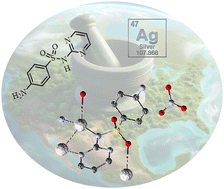
Graphical abstract: Modulating the crystalline forms of silver–sulfadiazine complexes by mechanochemistry

Modulating the crystalline forms of silver–sulfadiazine complexes by mechanochemistry

Daniela R. Ferreira, Anaïs Portet, Paula C. Alves, Patrícia Rijo, Clara S. B. Gomes, M. Teresa Duarte, Ivan Halasz, Evelina Colacino, Franziska Emmerling and Vânia André

CrystEngComm, 2025, Advance Article

DOI: 10.1039/D5CE00572H


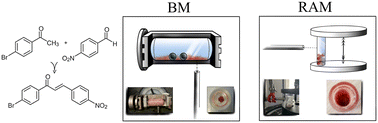
Graphical abstract: In situ Raman spectroscopy for comparing ball milling and resonant acoustic mixing in organic mechanosynthesis

In situ Raman spectroscopy for comparing ball milling and resonant acoustic mixing in organic mechanosynthesis

Leonarda Vugrin, Christos Chatzigiannis, Evelina Colacino and Ivan Halasz

RSC Mechanochem., 2025,2, 482-487

DOI: 10.1039/D5MR00016E


Graphical abstract: Chemoselectivity switch by mechanochemistry in the base-catalysed dione-acylation

Chemoselectivity switch by mechanochemistry in the base-catalysed dione-acylation        

Sally Nijem, Alexander Kaushansky, Svetlana Pucovski, Elisa Ivry, Evelina Colacino, Ivan Halasz and Charles E. Diesendruck

RSC Mechanochem., 2025,2, 419-425

DOI: 10.1039/D4MR00141A


Submit to our journal

We welcome you to submit your latest research in mechanochemistry. Article Processing Charges (APCs) are currently waived for RSC Mechanochemistry, so you can publish your article Gold Open Access without any cost to you as the author.

Submit your manuscript

Read our publications

Follow us on social media


For any questions do not hesitate to contact us at RSCMechanochem-RSC@rsc.org

Keep up to date with the latest journal news, collections and more by following us on LinkedIn and BlueSky, or by signing up to our E-Alerts.


New Advisory Board Member – Dr Matej Baláž

We are thrilled to introduce you to our newest RSC Mechanochemistry Advisory Board Member, Dr Matej Baláž, Institute of Geotechnics, Slovak Academy of Sciences, Slovakia.

Read our interview with Dr Baláž below;

•  What made you want to become involved with the journal?

I am working in the field of mechanochemistry during my whole academic career (since 2011) and it has always been the cornerstone in my work. Therefore, it is of utmost pleasure to be involved with the journal devoted to this topic.

  • What do you envision to be the benefits of publishing in the journal?

Going through the articles published in RSC Mechanochemistry provides an up-to-date information on recent advancements in the field. Publishing our own research here brings about the sense of community-being. Moreover, since the journal is Open Access for now, the details of unique mechanochemical studies are available to anyone.

  • Why should researchers choose to submit to the journal?

If the newcomers to the field manage to publish their work in RSC Mechanochemistry, it will be read by already established readership of experienced mechanochemists and new collaborations can be thus fostered in the future. Thus, the community can further grow in this way.


Read some of Dr Baláž’s recent research:

Lavender-mediated solvent-free biomechanochemical synthesis of antibacterially active Ag/AgCl nanoparticles using a Taguchi design
Zdenka Bedlovičová, Patrik Siksa, Mária Kováčová, Radovan Bureš, Ľudmila Tkáčiková, Róbert Džunda, Imelda Octa Tampubolon, Ľudmila Balážová & Matej Baláž*
Adv. Nat. Sci: Nanosci. Nanotechnol. 16, 015018

Enhanced photocatalytic activity of mechanically synthesized GdFe1−xCrxO3
Kairat Kenges*, Zhandos Orazov, Matej Baláž & Ekaterina Tugova
Inorganic Chemistry Communications, 2025, 173, 113803

Coupling mechanisms of plasmon resonance and Bi3+ emission in YAG: Bi, Ce, Yb epitaxial films at low temperatures
Markiyan Kushlyk, Yaroslav Shpotyuk*, Volodymyr Tsiumra, Yaroslav Zhydachevskyy, Lev-Ivan Bulyk, Volodymyr Haiduchok, Ihor Syvorotka, Dmytro Sugak, Matej Baláž & Andrzej Suchocki
Sci Rep., 2025, 15, 1477

Submit to RSC Mechanochemistry today! We welcome you to submit your latest research in mechanochemistry to our journal! All content in this journal is gold open access and we are covering all publication costs until mid-2026. Check out our author guidelines for information on our article types or find out more about the advantages of publishing in a Royal Society of Chemistry journal.

Keep up to date with our latest HOT articles, Reviews, Collections & more by joining our group on LinkedIn and BlueSky. You can also keep informed by signing up to our E-Alerts.

 

Meet our new Advisory Board Member – Professor Roman Boulatov


We are thrilled to introduce you to our new RSC Mechanochemistry Advisory Board Member, Professor Roman Boulatov. Professor Boulatov is a Professor the University of Liverpool, UK

We asked Professor Boulatov why researchers should submit to RSC Mechanochemistry, who gave the following response;

‘By setting the highest standards for rigor and innovation, RSC Mechanochemistry is creating a dedicated forum for this exciting and growing field. It provides both an attractive venue to publish foundational research and a means unite the global community of mechanochemists’

Read some of Professor Boulatov’s recent research:

Strain-dependent enantioselectivity in mechanochemically coupled catalytic hydrogenation
Xujun Zheng, Chun-Yu Chiou, Robert T. O’Neill, Chenghao Duan, Yichen Yu, Jack Malek, Nelson A. Rivera Jr, Roman Boulatov*, Stephen L. Craig* & Ross A. Widenhoefer*
Nat. Synth., 2025, 4, 1319–1328

Autonomic Self-Healing of Polymers: Mechanisms, Applications, and Challenges
Chenxu Wang & Roman Boulatov*
Molecules 2025, 30(3), 469

Mechanochemical Approaches to Fundamental Studies in Soft-Matter Physics
Robert T. O’Neill & Roman Boulatov*
Angew. Chem. Int. Ed. 2023, 63, e202402442

Productive chemistry induced by mechanochemically generated macroradicals
Chenxu Wang*, Cai-Li Sun & Roman Boulatov*
Chem. Commun., 2024,60, 10629-10641

Submit to RSC Mechanochemistry today! We welcome you to submit your latest research in mechanochemistry to our journal! All content in this journal is gold open access and we are covering all publication costs until mid-2026. Check out our author guidelines for information on our article types or find out more about the advantages of publishing in a Royal Society of Chemistry journal.

Keep up to date with our latest HOT articles, Reviews, Collections & more by joining our group on LinkedIn and BlueSky. You can also keep informed by signing up to our E-Alerts.

 

Meet our new Advisory Board Member, Professor Judith A. Harrison


We are delighted to introduce you to our new RSC Mechanochemistry Advisory Board Member, Professor Judith A. Harrison.

Professor Harrison is presently a Professor of Chemistry at the United States Naval Academy, Annapolis MD USA.


Read some of Professor Harrison’s recent research:

Degradable polyacetals and polyacetal/polycyclooctene Co-polymers from a novel dioxepin
Andrew Mazza, Brian H. Morrow, Judith A. Harrison & Julia Pribyl*
Polym. Chem., 2025,16, 4136-4143

Effects of –H and –OH Termination on Adhesion of Si–Si Contacts Examined Using Molecular Dynamics and Density Functional Theory
J. David Schall, Brian H. Morrow, Robert W. Carpick & Judith A. Harrison*
Langmuir, 2024, 40, 9, 4601–4614

Interfacial Properties of Linear Alkane/Nitrogen Binary Mixtures: Molecular Dynamics Vapor–Liquid Equilibrium Simulations
Brian H. Morrow & Judith A. Harrison*
J. Phys. Chem. B, 2022, 126, 23, 4379–4388

Molecular Dynamics Examination of Sliding History-Dependent Adhesion in Si–Si Nanocontacts: Connecting Friction, Wear, Bond Formation, and Interfacial Adhesion
J. David Schall, Zachary B. Milne, Robert W. Carpick & Judith A. Harrison*
Tribol Lett., 2021, 69, 52

Thermophysical Properties of Two-Component Mixtures of n-Nonylbenzene or 1,3,5-Triisopropylbenzene with n-Hexadecane or n-Dodecane at 0.1 MPa: Experimentally Measured Densities, Viscosities, and Speeds of Sound and Molecular Packing Modeled Using Molecular Dynamics Simulations
Dianne J. Luning Prak*, Judith A. Harrison & Brian H. Morrow
J. Chem. Eng. Data, 2021, 66, 3, 1442–1456

Submit to RSC Mechanochemistry today! We welcome you to submit your latest research in mechanochemistry to our journal! All content in this journal is gold open access and we are covering all publication costs until mid-2026. Check out our author guidelines for information on our article types or find out more about the advantages of publishing in a Royal Society of Chemistry journal.

Keep up to date with our latest HOT articles, Reviews, Collections & more by joining our group on LinkedIn and BlueSky. You can also keep informed by signing up to our E-Alerts.


Tianbao Ma joins the RSC Mechanochemistry Advisory Board

RSC Mechanochemistry is delighted to welcome Tianbao Ma (Tsinghua University, China) to its Advisory Board.

Read some of their recent publications:


Revealing the low-temperature friction behavior and mechanisms of hydrogenated amorphous carbon films with Al/Cr/Si doping

Quansheng Ma, Chengjun Huang, Wei Cai, Jiaxu Zhang, Weiqi Chen, Jie Jin, Yuan Xia, Yi Xu and Tianbao Ma

Tribol. Int. 2024, 198, 109911


Observing and Modeling the Wear Process of Heterogeneous Interface

Xin Tang, Aisheng Song, Haijun Wu, Kaili Feng, Tianmin Shao and Tianbao Ma

Nano Lett. 2024, 24, 6965-6973


Interfacial tribochemical kinetics: A new perspective on superlubricity of diamond-like carbon films

Weiqi Chen and Tianbao Ma

Sci. China Technol. Sci. 2024, 67, 2050-2052


RSC Mechanochemistry offers you an inclusive and dedicated home for the ideas, scientific language and approaches that cut across the many disciplines mechanochemistry touches. Here we are seeking to build knowledge, as well as foster innovation and discovery at this forefront of chemistry. Whether you are seeking to understand the fundamentals of mechanochemistry, or you are excited by its applications and potential, this journal is for you.


Meet our inaugural Advisory Board

We are delighted to introduce you to the inaugural Advisory Board for RSC Mechanochemistry, the first journal dedicated to the study of mechanochemistry.


Dario Boffito, Elena Boldyreva, Dario Braga, Adam Braunschweig, Carsten Bolm, Duncan Browne, Robert Carpick

Find out why they are excited about RSC Mechanochemistry

“I’m thrilled to be joining the inaugural advisory board of RSC Mechanochemistry. The combination of the prestigious heritage of the Royal Society of Chemistry as a publisher and the visionary leadership of distinguished scientists as editors strongly motivated me to get involved with the journal. It is an honor to be associated with it. Researchers should consider publishing their work in RSC Mechanochemistry for the same reasons. RSC as a publishing powerhouse and dedicated scientists as editors are together committed to publishing high level papers and enhancing them so that they stand out.”

Daria Boffito, Polytechnique Montreal, Canada


“I have been active in the field of mechanochemistry for a very long time. I started my research career in the 1980s and I am still active. I belong to the Siberian research school on mechanochemistry that has been founded by my father, Professor Vladimir Boldyrev, who was also the founding President of the International Mechanochemical Association under IUPAC in 1988. It is always a benefit to publish one’s work in journal where it will be read and evaluated by experts in the field. It is an additional benefit when the journal at the same time attracts experts from different fields and a very broad audience. RSC Mechanochemistry is exactly such a journal. I am confident that it will become a very high-impact journal in a short time.”

Elena Boldyreva, Boreskov Institute of Catalysis, Russian Federation


“The community of mechanochemists was in great need of a forum where results and ideas in this burgeoning field can be shared. I am happy to be able to contribute to promoting the journal. By publishing in RSC Mechanochemistry the authors are sure to reach the rapidly growing community of researchers interested in more sustainable and/or alternative methods to advance chemistry. The RSC knows how to promote good science and the importance of a speedy and reliable reviewing process.”

Dario Braga, University of Bologna, Italy


“This is very exciting opportunity for me to be involved in the emerging field of mechanochemistry, understand new directions, and see new ideas evolve through the publication process. I also believe that there is a pressing need for a mechanochemistry journal to set standards for a field that has researchers entering from all different backgrounds, and in doing so, help catapult forward this important area of research. I think that RSC Mechanochemistry will give visibility and credibility to researchers working in the field. To have a paper published in RSC Mechanochemistry will mean that it has been reviewed by experts in the field and that an important contribution has been made.”

Adam Braunschweig, City University of New York, USA


“It’s an exciting time for the science of mechanochemistry and still much to do to understand the full potential and opportunities that this age-old technique offers. The new journal will help to provide a central platform to develop and explore this promising science.”

Duncan Browne, University College London, UK


“I’m excited and honored to part of the Advisory Board of this brand-new journal. Mechanochemistry is undergoing a renaissance, driven both by new discoveries and research tools, and by the urgency to transform chemical processes to sustainable approaches, where mechanochemistry is showing tremendous promise. I’m particularly energized by the potential for impact by publishing interdisciplinary work, where people from different disciplines – chemistry, mechanics, physics, and engineering – combine their knowledge to make breakthroughs that are not possible by working alone. RSC Mechanochemistry is a place for those discoveries to be presented.”

Robert Carpick, University of Pennsylvania, USA


Stephen Craig, Deborah Crawford, Aurora Cruz-Cabeza, Graeme Day, Guillaume De Bo, Mario Del Pópolo, Ivan Halasz

Get their thoughts on RSC Mechanochemistry

“I’m happy to support the great editorial team as they build RSC Mechanochemistry into a leading venue for this vibrant field.”

Stephen Craig, Duke University, USA


RSC Mechanochemistry provides a monumental step forward in the field, contributing to the narrative of innovation and pushing the boundaries of scientific exploration. This journal is an exciting platform to publish the latest advancements in the area of mechanochemistry.”

Deborah Crawford, University of Birmingham, UK


“I am so fascinated about the fact that we can make new crystals by breaking old crystals. Mechanochemistry is an exciting technology with endless applications, intriguing fundamentals, and a welcoming community -now with its own high-quality journal supported by the RSC. Exciting times!”

Aurora Cruz-Cabeza, Durham University, UK


“It’s great to see a journal dedicated to mechanochemistry and I personally look forward to following developments in theory and modelling in this area. Authors will know that publishing their work in RSC Mechanochemistry will reach the relevant community of readers to ensure that their work has impact.”

Graeme Day, University of Southampton, UK


“Mechanochemistry is a thriving and diverse research field and I expect RSC Mechanochemistry to be the venue of choice for the global mechanochemistry community.”

Guillaume De Bo, University of Manchester, UK


“As an advocate for the integration of molecular simulations in mechanochemistry, I am eager to contribute to RSC Mechanochemistry‘s mission. The field of computational physical chemistry is crucial for unveiling the mechanistic details and predicting the outcomes of mechanochemical reactions. This journal offers an exciting interdisciplinary platform for a comprehensive exploration of chemical reactivity under mechanical stress.”

Mario Del Pópolo, CONICET & National University of Cuyo, Argentina


“Understanding that solid materials are viable reactants that just need a push or a crush is something that is changing the thinking of chemists about synthesis. It pleases me to be able to contribute to the development of mechanochemistry and the dedicated journal that can become a reference point for experienced mechanochemists seeking the latest developments as well as newcomers trying to grasp the state of the art.”

Ivan Halasz, Ruđer Bošković Institute, Croatia


Timothy Hanusa, Dritan Hasa, José Hernández, Stuart James, Jeung Gon Kim, Seong Kim, Frédéric Lamaty

Hear from these Advisory Board members

“A framework for coordinating mechanochemical research and developments has emerged in RSC Mechanochemistry. Rather than trying to decide what “audience” will be reached by publishing in a more specialized journal—organic, inorganic, materials, or other, RSC Mechanochemistry offers a platform where everyone interested in mechanochemical transformations will see it. It’s a journal designed to reflect the vibrancy of this rapidly evolving field.”

Timothy Hanusa, Vanderbilt University, USA


RSC Mechanochemistry uniquely represents a coronation of one of the most vibrant subfields of modern chemistry. The multidisciplinary research published in this peer-reviewed journal will profoundly impact on the entire lifecycle of many specialty chemicals, starting from the innovative synthesis of unique molecules, optimisation of their physicochemical desirable properties and industrial production; everything naturally conciliated with ecological sustainability, health safety and environmental protection.”

Dritan Hasa, University of Trieste, Italy


“The evolution of past RSC initiatives into renowned scientific journals has intrigued me. For me, this represents an invaluable opportunity to help craft a dynamic platform for researchers working on diverse areas of mechanochemistry to share their discoveries.”

José Hernández, Universidad de Antioquia, Colombia


“Mechanochemistry’s time has come – as a recognisable scientific discipline that can help to create a more sustainable future. This journal is unique in being devoted to mechanochemistry in its various forms, and will be at the forefront of the area at this exciting time.”

Stuart James, Queen’s University Belfast, UK


“This is the right place for mechanochemists to publish alongside world-leading colleagues and to further advance their research findings.”

Jeung Gon Kim, Jeonbuk National University, Republic of Korea


“In his Bakerian lecture in 1862, H. C. Sorby addressed “mechanical force had been resolved into chemical action in the same way as, under other circumstances, it may be resolved into heat, electricity, or any other modification of force.”[1] He argued that if mechanical force can be produced by chemical action, the converse should be possible. Since then, efforts to understand how mechanical forces facilitate chemical reactions and utilize such mechanisms for synthesis of new materials or better synthesis of existing materials have grown into an important subfield of chemistry. RSC Mechanochemistry provides the main forum for scientists and engineers to advance fundamental knowledge and discover new potentials.”
[1] Proceedings of the Royal Society of London, Vol. 12, pp. 538-550 (1862 – 1863)

Seong Kim, The Pennsylvania State University, USA


“Mechanochemistry is an ancient discipline whose surface has barely been scratched. Recently, applications of mechanochemistry in many fields have been developing, but there is still a long way to go to understand this science at the molecular level, to be able to implement reactions optimally, and popularize its use in research laboratories and production facilities. RSC Mechanochemistry is the ideal forum for sharing various viewpoints on the subject and for bringing together the wide-ranging expertise of many chemists to contribute to this field.”

Frédéric Lamaty, Institute of Biomolecules Max Mousseron, France


Danielle Laurencin, Erli Lu, Lucia Maini, Adam Michalchuk, Audrey Moores, Karthik Nagapudi

Find out what they think RSC Mechanochemistry will bring to the community

“Mechanochemistry is a rapidly growing field, which brings together scientists of very different backgrounds, including synthetic chemists, spectroscopists, mechanical engineers, and computational modelling experts. Being able to publish both fundamental and more applied research in this field in a dedicated journal like RSC Mechanochemistry should help increase the visibility of some of the most recent investigations, and also favour the emergence of new interdisciplinary research.”

Danielle Laurencin, CNRS Montpellier, France


“Mechanochemistry provides a unique route to access otherwise impossible chemistry, not to mention its sustainability merits. I totally enjoyed the mechanochemistry community, which is extremely diverse, inclusive and encouraging. RSC Mechanochemistry is the first, and so far the only, dedicated mechanochemistry journal. I’d like to serve the community and help to boost the community by serving the Advisory Board. Maybe the top benefit is impact, not only in the mechanochemistry community, but reaching out to the wider communities. This is perfect reflected by our Editorial team members: we are inorganic, organic, physical and polymer chemists, but we are also all mechanochemists. It’s the only dedicated mechanochemistry journal, and its launch in early 2023 has attracted immense interest from the wider chemistry research community. This will ensure the impact of the journal—which is the top consideration when choosing a place to publish. And the journal is backed by the top-tier business-standard RSC Publishing services, such as initial assessment, peer-reviewing and Open-Access.”

Erli Lu, University of Newcastle, UK


“Mechanochemistry has demonstrated its efficacy in producing numerous new materials; however, the methods involved in this process remain somewhat unclear and are occasionally reliant on trial and error. I regard RSC Mechanochemistry as a secure and inspiring platform (journal) for exchanging ideas, seeking support, and receiving constructive suggestions aimed at elucidating the intricacies of the grinding process. I believe that publishing in this journal allows strengthening the sense of belonging to the community, and for young researchers, it can be a good stepping stone.”

Lucia Maini, University of Bologna, Italy


“The launch of RSC Mechanochemistry is an exciting time for the field, providing the first dedicated home for the research being done by the diverse and rapidly growing global community. By publishing research in this journal, colleagues can be certain to reach across the wide-reaching community, and I am delighted to be a part of shaping the journal as it grows to reflect the exceptional work being done in all areas of mechanochemistry.”

Adam Michalchuk, University of Birmingham, UK


“Mechanochemistry is such an exciting research field to explore at the moment. It forces us to rethink how we understand reactivity, activation energy and equilibrium. This journal will be a fantastic place where we can have these new conversations, I’m so excited to be part of it!”

Audrey Moores, McGill University, Canada


“I have been working in the field of pharmaceutical mechanochemistry for over 15 years now. I am a passionate advocate of green chemistry in industrial applications and I am confident that mechanochemistry is going to be a big part of our green transition in the next decade. I am very excited to be a part of this new journal in mechanochemistry and I hope we can bring our community of mechanochemists together with this journal.”

Karthik Nagapudi, Genentech Inc., USA


Maxwell Robb, Ferdi Schüth, Vladimir Šepelák, Weike Su, John Warner, Claudia Weidenthaler

Hear why they wanted to be part of our Advisory Board

“The launch of RSC Mechanochemistry captures the excitement and potential of this rapidly growing discipline and affords a unique opportunity to showcase the diversity, creativity, and impact of the field.”

Maxwell Robb, California Institute of Technology, USA


“Mechanochemistry is highly interesting both from a fundamental science perspective, since many basic questions are still not answered, and an application point of view, since mechanochemical processes will become industrially more important in the conversion to more sustainable production. RSC Mechanochemistry will cover both – and other aspects – which is the reason why I was so interested to become closer involved with the journal.”

Ferdi Schüth, Max-Planck-Institut für Kohlenforschung, Germany


“I am very pleased and honored to have the opportunity to serve for RSC Mechanochemistry. The field of mechanochemistry, in addition to its fascinating history, promises exciting original and innovative results in the future that can be published in the specialized journal under the umbrella of the leading scientific society. I hope that RSC Mechanochemistry will provide a comprehensive platform for mechanochemistry in a way that captures its breadth, realized impact and vast potential.”

Vladimir Šepelák, Karlsruhe Institute for Technology, Germany


“As the first pioneering journal in the field of mechanochemistry, RSC Mechanochemistry offers an attractive platform for scholars engaged in mechanochemistry research to communicate and publish innovative work.”

Weike Su, Zhejiang University of Technology, China


“Mechanochemistry is literally at the chemical frontier, providing hope for new reaction mechanisms and new options for green chemistry.”

John Warner, Technology Greenhouse, LLC, USA


“In recent years, the field of mechanochemistry has become increasingly important for the “green” synthesis and modification of materials. It was therefore time to launch a dedicated journal. A special journal will make it much easier for the community to get an overview of ongoing activities in the field of mechanochemistry.”

Claudia Weidenthaler, Max-Planck-Institut für Kohlenforschung, Germany


RSC Mechanochemistry offers you an inclusive and dedicated home for the ideas, scientific language and approaches that cut across the many disciplines mechanochemistry touches. Here we are seeking to build knowledge, as well as foster innovation and discovery at this forefront of chemistry. Whether you are seeking to understand the fundamentals of mechanochemistry, or you are excited by its applications and potential, this journal is for you.


Find out more about the journal

Read our published articles

Submit your manuscript today

Sign up for email alerts

Follow us on social media


Meet our Associate Editors

RSC Mechanochemistry recently opened for submissions. To help you prepare your next manuscript, we caught up with our editors to get to know them better and ask what manuscripts they look forward to receiving.


Evelina Colacino, Associate Editor

University of Montpellier, Institut Charles Gerhardt, France

Interested in papers on:

  • Organic, metal-organic, organometallic material synthesis
  • Pharmaceutical synthesis
  • Experimental methods
  • Scale-up
  • Sustainability
  • Education and training
“I firmly believe in the idea of community and the feeling of belonging that often accompanies it.

So far, I committed myself to build a worldwide network of researchers in mechanochemistry centred in EU with the objective of making the scientific community involved in the field more cohesive and collaborative. It is to be part of this community that I turned to understand if my involvement in the journal could have positive effects for the scientists working in the field.

I think that we always have to share our experience and opportunities with other, in the perspective of growing together.” – Evelina Colacino


Franziska Emmerling, Associate Editor

Federal Institute for Materials Research and Testing, Germany

Interested in papers on:

  • Organic, inorganic and materials synthesis
  • Scale-up
  • Sustainability
  • Education and training
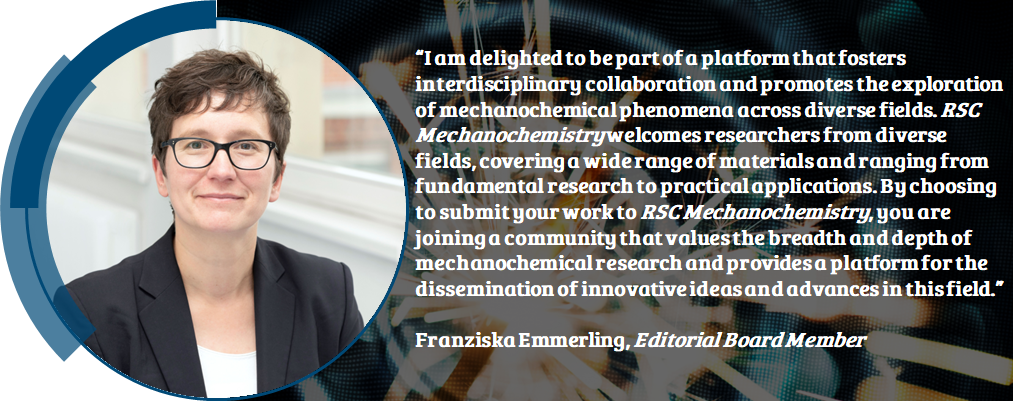
“I am delighted to be part of a platform that fosters interdisciplinary collaboration and promotes the exploration of mechanochemical phenomena across diverse fields. RSC Mechanochemistry welcomes researchers from diverse fields, covering a wide range of materials and ranging from fundamental research to practical applications. By choosing to submit your work to RSC Mechanochemistry, you are joining a community that values the breadth and depth of mechanochemical research and provides a platform for the dissemination of innovative ideas and advances in this exciting field.” – Franziska Emmerling


Hajime Ito, Associate Editor

Hokkaido University, Japan

Interested in papers on:

  • Organic and materials synthesis
  • Pharmaceutical synthesis
  • Experimental methods
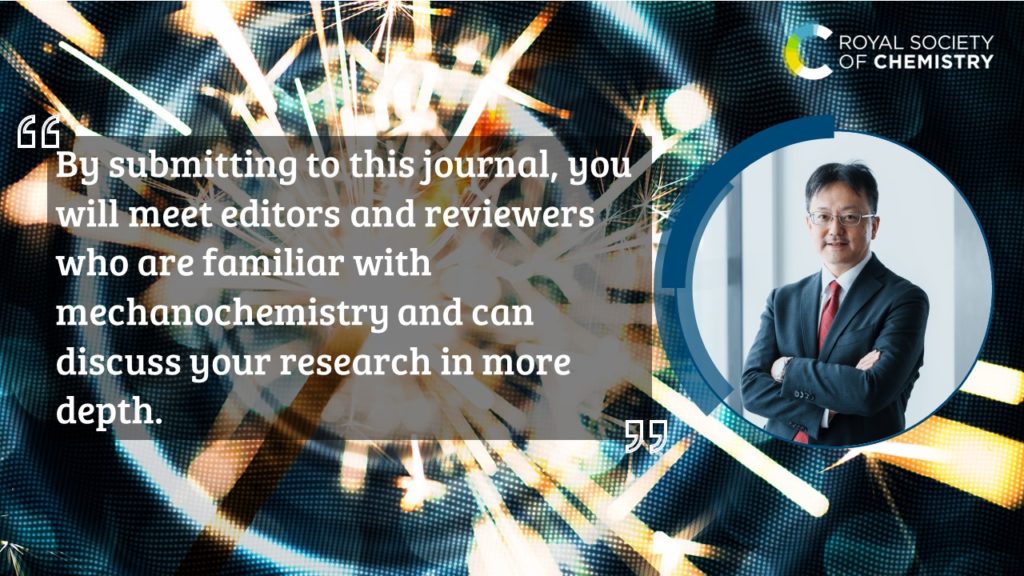
“Mechanochemistry is now in a period of great development after the accumulated research of pioneers. I joined the editorial team because I wanted to serve the mechanochemistry research community in any way I could. Publishing in this journal allows you to effectively promote your research to readers interested in mechanochemistry. By submitting to this journal, you will meet editors and reviewers who are familiar with mechanochemistry and can discuss your research in more depth.” – Hajime Ito

Are you feeling inspired to make an impact with your mechanochemistry research? We look forward to your contributions!


RSC Mechanochemistry offers you an inclusive and dedicated home for the ideas, scientific language and approaches that cut across the many disciplines mechanochemistry touches. Here we are seeking to build knowledge, as well as foster innovation and discovery at this forefront of chemistry. Whether you are seeking to understand the fundamentals of mechanochemistry, or you are excited by its applications and potential, this journal is for you.


Find out more about the journal

Submit your manuscript today

Sign up for email alerts

Follow us on social media

Evelina Colacino joins RSC Mechanochemistry as Associate Editor

We are delighted to introduce to you Professor Evelina Colacino, University of Montpellier, France, as one of our inaugural Associate Editors for RSC Mechanochemistry.


Learn more about Evelina Colacino

Evelina Colacino received her double Ph.D. (with European Label) in 2002 at the University of Montpellier II (France), and at the University of Calabria (Italy). Associate Professor of Organic Chemistry at the University of Montpellier (France), she is a member of the International Mechanochemical Association (IMA) and on the Advisory Board of the Green Chemistry Commitment. She promotes sustainability in higher education by integrating green chemistry at undergraduate level in organic chemistry courses, teaching laboratories and across the sub-disciplines of chemistry, with a special focus on the fundamentals and the practice of mechanochemistry. Her main research activities concern the development of eco-friendly mechanochemical processes for the preparation of value-added compounds for the industry, with a main focus on active pharmaceutical ingredients.

 

Read some of her recent publications:


Mechanochemistry: New Tools to Navigate the Uncharted Territory of “Impossible” Reactions

Federico Cuccu, Lidia De Luca, Francesco Delogu, Evelina Colacino, Niclas Solin, Rita Mocci and Andrea Porcheddu

ChemSusChem, 2022, 15, e202200362


Assessing the Greenness of Mechanochemical Processes with the DOZN 2.0 Tool

Pankaj Sharma, Caleb Vetter, Ettigounder Ponnusamy and Evelina Colacino

ACS Sustainable Chem. Eng., 2022, 10, 5110-5116


Mechanochemical synthesis of mononuclear gold(I) halide complexes of diphosphine ligand with tuneable luminescent properties

Andrea Deák, Csaba Jobbágy, Attila Demeter, Ladislav Čelko, Jaroslav Cihlář, Pál T. Szabó, Péter Ábrányi-Balogh, Deborah E. Crawford, David Virieux and Evelina Colacino

Dalton Trans., 2021, 50, 13337-13344


RSC Mechanochemistry offers you an inclusive and dedicated home for the ideas, scientific language and approaches that cut across the many disciplines mechanochemistry touches. Here we are seeking to build knowledge, as well as foster innovation and discovery at this forefront of chemistry. Whether you are seeking to understand the fundamentals of mechanochemistry, or you are excited by its applications and potential, this journal is for you.


Franziska Emmerling joins RSC Mechanochemistry as Associate Editor

We are delighted to welcome Dr Franziska Emmerling, Federal Institute for Materials Research and Testing, Germany, as Associate Editor for RSC Mechanochemistry. Dr Emmerling initially joined the journal as Editorial Board member and has now been promoted to an Associate Editor.


Learn more about Franziska Emmerling

Dr Franziska Emmerling is Head of the Department of Materials Chemistry at the Federal Institute for Materials Research and Testing in Berlin, Germany, and a privat dozent (lecturer) at the Department of Chemistry, Humboldt University, Berlin. She received her M.Sc. in Chemistry from the Albert-Ludwigs University of Freiburg in 2001, her Ph.D. in Chemistry from the same university in 2004, and completed her Habilitation at the Humboldt University in 2018. Emmerling’s research focuses on the design, synthesis, and characterisation of novel materials, with particular emphasis on their applications in green energy and catalysis. Dr Emmerling has made significant contributions to the development of mechanochemical synthesis methods for a wide range of materials. Her expertise extends to the development and use of synchrotron-based X-ray techniques, including diffraction and spectroscopy, to characterise materials and observe structural changes in situ. Dr Emmerling is a recognised expert in materials chemistry and mechanochemistry and serves as a reviewer for prestigious journals such as Science, Nature Communications and Angewandte Chemie. With a strong record of mentorship, Dr Emmerling has guided the research of numerous Postdoctoral Researchers, and PhD, Masters and Bachelor students, leaving a lasting impact on the field of chemistry.


Read some of her recent publications:


Exploring the role of solvent polarity in mechanochemical Knoevenagel condensation: in situ investigation and isolation of reaction intermediates

Kerstin Scheurrell, Inês C. B. Martins, Claire Murray and Franziska Emmerling

Phys. Chem. Chem. Phys., 2023, 25, 23637


Unintended Rate Enhancement in Mechanochemical Kinetics by Using Poly(methyl methacrylate) Jars

Kevin Linberg, Franziska Emmerling and Adam A.L. Michalchuk

Cryst. Growth Des. 2023, 23, 19-23


In situ time-resolved monitoring of mixed-ligand metal-organic framework mechanosynthesis

Max Rautenberg, Biswajit Bhattacharya, Julia Witt, Mohit Jain, Franziska Emmerling

CrystEngComm, 2022, 24, 6747-6750


  RSC Mechanochemistry offers you an inclusive and dedicated home for the ideas, scientific language and approaches that cut across the many disciplines mechanochemistry touches. Here we are seeking to build knowledge, as well as foster innovation and discovery at this forefront of chemistry. Whether you are seeking to understand the fundamentals of mechanochemistry, or you are excited by its applications and potential, this journal is for you.