MedChemComm article by William Troger picked up in media outlets

The concise article by Robert F. Mattrey, Andrew C. Kummel, William Troger and colleagues at University of California, San Diego, on gas filled hollow porous silica microshells for ultrasound image contrast has had a tremendous impact in media outlets worldwide. This article is now included in MedChemComm Issue 4 and as all the MedChemComm content, it is free to access.

These are some of the web pages in which the article has been highlighted:

Congratulations to the authors! It is a truly interesting piece of research.

You can read it for free here:

Hard shell gas-filled contrast enhancement particles for colour Doppler ultrasound imaging of tumors
H. Paul Martinez, Yuko Kono, Sarah L. Blair, Sergio Sandoval, Jessica Wang-Rodriguez, Robert F. Mattrey, Andrew C. Kummel and William C. Trogler
Med. Chem. Commun., 2010, 1, 266-270
DOI: 10.1039/C0MD00139B , Concise Article

Digg This
Reddit This
Stumble Now!
Share on Facebook
Bookmark this on Delicious
Share on LinkedIn
Bookmark this on Technorati
Post on Twitter
Google Buzz (aka. Google Reader)

Top ten most accessed articles in August

This month sees the following articles in MedChemComm that are in the top ten most accessed:-

Discovery of the highly potent PI3K/mTOR dual inhibitor PF-04691502 through structure based drug design
Hengmiao Cheng, Shubha Bagrodia, Simon Bailey, Martin Edwards, Jacqui Hoffman, Qiyue Hu, Robert Kania, Daniel R. Knighton, Matthew A. Marx, Sacha Ninkovic, Shaoxian Sun and Eric Zhang
Med. Chem. Commun., 2010, 1, 139 – 144, DOI: 10.1039/c0md00072h, Concise Article

Silver nanoparticles-the real “silver bullet” in clinical medicine?
Kenneth K. Y. Wong and Xuelai Liu
Med. Chem. Commun., 2010, 1, 125 – 131, DOI: 10.1039/c0md00069h, Review article

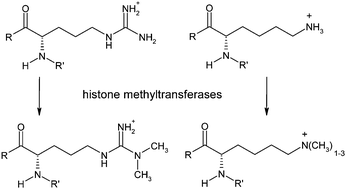
Targeting epigenetic modifiers: Inhibitors of histone methyltransferases
Elisabeth-Maria Bissinger, Ralf Heinke, Wolfgang Sippl and Manfred Jung
Med. Chem. Commun., 2010, 1, 114 – 124, DOI: 10.1039/c0md00062k, Review article

Small molecule modulation of stem cells in regenerative medicine: recent applications and future direction
Timothy E. Allsopp, Mark E. Bunnage and Paul V. Fish
Med. Chem. Commun., 2010, 1, 16 – 29, DOI: 10.1039/c0md00055h, Review article

Syntheses and biological evaluation of new cephalosporin-oxazolidinone conjugates
Shanshan Yan, Marvin J. Miller, Timothy A. Wencewicz and Ute Mollmann
Med. Chem. Commun., 2010, 1, 145 – 148, DOI: 10.1039/c0md00015a, Concise article

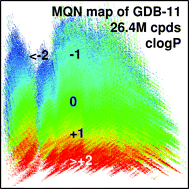
Chemical space as a source for new drugs
Jean-Louis Reymond, Ruud van Deursen, Lorenz C. Blum and Lars Ruddigkeit
Med. Chem. Commun., 2010, 1, 30 – 38, DOI: 10.1039/c0md00020e, Review article

Cytotoxic sugar analogues of an optimized novobiocin scaffold
Alison C. Donnelly, Huiping Zhao, Bhaskar Reddy Kusuma and Brian S. J. Blagg
Med. Chem. Commun., 2010, 1, 165 – 170, DOI: 10.1039/c0md00063a, Concise article

Photografted poly(methyl methacrylate)-based high performance protein microarray for hepatitis B virus biomarker detection in human serum
Yingshuai Liu, Weihua Hu, Zhisong Lu and Chang Ming Li Med. Chem. Commun., 2010, 1, 132 – 135, DOI: 10.1039/c0md00032a, Concise article

Synthesis and biological evaluation of substituted alpha- and beta-2,3-dihydrofuran naphthoquinones as potent anticandidal agents
Cristina Pessoa Veloso Freire, Sabrina Baptista Ferreira, Nivea Suely Melo de Oliveira, Ani Beatriz Jackisch Matsuura, Ivson Lelis Gama, Fernando de C. da Silva, Maria Cecília B. V. de Souza, Emerson Silva Lima and Vitor Francisco Ferreira
Med. Chem. Commun., 2010, 1, 229 – 232, DOI: 10.1039/c0md00074d, Concise article

Synthesis, modeling, and crystallographic study of 3,4-disubstituted-1,2,5-oxadiazoles and evaluation of their ability to decrease STAT3 activity
Dae-Seop Shin, Daniela Masciocchi, Arianna Gelain, Stefania Villa, Daniela Barlocco, Fiorella Meneghetti, Alessandro Pedretti, Young-Min Han, Dong Cho Han, Byoung-Mog Kwon, Laura Legnani and Lucio Toma
Med. Chem. Commun., 2010, 1, 156 – 164, DOI: 10.1039/c0md00057d, Concise article

Why not take a look at the articles today and blog your thoughts and comments below.

Fancy submitting an article to MedChemComm? Then why not submit to us today or alternatively email us your suggestions.

Digg This
Reddit This
Stumble Now!
Share on Facebook
Bookmark this on Delicious
Share on LinkedIn
Bookmark this on Technorati
Post on Twitter
Google Buzz (aka. Google Reader)

MedChemComm poster prize winner

Congratulations go to Dr Oliver Schwardt from the University of Basel, Switzerland, who won the MedChemComm poster prize at the recent EFMC-ISMC meeting in Brussels, Belgium. Dr Schwardt wins an RSC book and a year’s subscription to the journal.

Digg This
Reddit This
Stumble Now!
Share on Facebook
Bookmark this on Delicious
Share on LinkedIn
Bookmark this on Technorati
Post on Twitter
Google Buzz (aka. Google Reader)

Interview with Mark Bunnage: Medically speaking

Mark Bunnage talks to Leanne Marle about pharmaceuticals, chemologics and economics

Mark Bunnage is executive director of worldwide medicinal chemistry at Pfizer in Sandwich, UK. His areas of responsibility include chemistry leadership for regenerative medicine. He is also a member of the Executive Committee of the European Federation for Medicinal Chemistry (EFMC) and an editorial board member for MedChemComm. 
What led you into a career in medicinal chemistry?
I did a doctorate in organic chemistry at the University of Oxford, UK, followed by a post doc in total synthesis in the US. I guess I wanted to apply my skills as an organic chemist to help come up with new medicines – it seemed a really exciting way to put my training and skills to good use. This attracted me to the pharmaceutical industry and to join Pfizer.

What do you find most exciting about medicinal chemistry?
It feels a great privilege to be able to design and synthesise molecules that have never existed before. It is a genuine invention and very exciting to discover new molecules that can modulate human biology to potentially treat disease. This is a great way to apply chemistry and one of the best things about my job is that every day I’m learning new science. The field of medicinal chemistry is evolving quite significantly – so it’s a constant learning environment which is great fun. But the ultimate success is new medicines which can help people so it’s motivating from both the science and the application.

What projects are you working on at the moment?
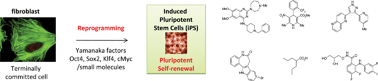
One of the things we’re working on at the moment is regenerative medicine and the potential of stem cells as therapies. There’s a great opportunity for chemistry to influence this area of research by identifying small molecules that can modulate how stem cells behave. This could be to help generate viable cell therapy products or to find small molecule oral drugs that can influence stem cells to become new cell types and cause regeneration. It’s a cutting edge area in which chemistry is playing an important role.

One project the regenerative medicine group is working on is the treatment of blindness caused by age related degeneration of the cells in the eye. Basically if you could get a cell therapy to replace the retinal pigmented epithelial cells you could potentially restore sight.

What are the current challenges facing drug discovery?
Everyone recognises that the pharmaceutical industry has significant productivity challenges in terms of the number of new drug approvals each year relative to the R&D investment. One of the big reasons that we’ve not been as successful as we might is that we don’t always select the right target, so you can put a lot of investment in and take a quality molecule all the way to a Phase II clinical study but it doesn’t work. As an industry we’ve got to get much better at selecting molecular targets that can really influence disease. We really need to embrace chemical biology because the tools of chemical biology can help make the link between target and disease, and there are some cracking breakthroughs in this area of science that can now be applied in that sense.

This is why we’ve established a dedicated chemical biology group at Pfizer in Sandwich to really apply chemical biology with that aim. Selecting the target to work on is probably the most important decision we make and chemical biology can help with that. In addition, we are also applying the synthetic approaches of chemical biology to generate novel ‘chemologic’ therapeutics that are at the interface between small molecules and large.

What achievement are you most proud of?
One project that I’ve been involved in and that I’m excited about is a new treatment for respiratory disease that is in Phase II trials and is looking promising. There is still a major medical need to treat diseases such as asthma and chronic obstructive pulmonary disease and we’ve hopefully got quite an interesting inhaled product that will make a good addition to treatment options for patients.

You’re on the Editorial Board for the new RSC Journal MedChemComm, how did you get involved?
I’m also involved with the EFMC and the RSC approached us when they were thinking about a medicinal chemistry journal, so we partnered with the RSC to bring forward MedChemComm. We recognised it as a real opportunity for a quality new journal in the field of medicinal chemistry, and particularly one that perhaps helps to drive the scientific agenda within our discipline by covering traditional medicinal chemistry but also going beyond this to illustrate some of the ways that medicinal chemistry is evolving. I was very excited about the opportunity and that’s why I agreed to join the Editorial Board.

As a child, what did you want to be when you grew up?
Well sadly, what I wanted to be when I was a teenager was an economist, which I now look back in horror at the thought of this! But thankfully I saw the light when I studied A-Level Chemistry and saw that there was much more fun to be had in chemistry than in economics. Especially with recent events I’m really glad I didn’t end up in economics!

Download his first (but not last) MedChemComm paper

Small molecule modulation of stem cells in regenerative medicine: recent applications and future direction
Timothy E. Allsopp, Mark E. Bunnage and Paul V. Fish, Med. Chem. Commun., 2010, 1, 16
DOI: 10.1039/c0md00055h

See here the original interview

Digg This
Reddit This
Stumble Now!
Share on Facebook
Bookmark this on Delicious
Share on LinkedIn
Bookmark this on Technorati
Post on Twitter
Google Buzz (aka. Google Reader)

HIV-1 fusion inhibitors

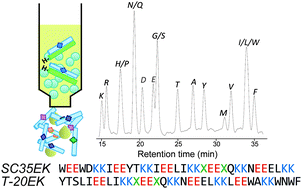
Oishi, Fujii and co-workers report on the affinity-based screening technology and sequence-activity relationships for aminoacid optimization in HIV-1 fusion inhibitors directed against enfuvirtide-resistant HIV strains.

Find out more about this affinity selection-mass spectrometry method to explore novel HIV-1 fusion inhibitors.  Do you have anything to say? Comment on it!

Affinity selection and sequence-activity relationships of HIV-1 membrane fusion inhibitors directed at the drug-resistant variants
Shinya Oishi, Kentaro Watanabe, Saori Ito, Michinori Tanaka, Hiroki Nishikawa, Hiroaki Ohno, Kazuki Shimane, Kazuki Izumi, Yasuko Sakagami, Eiichi N. Kodama, Masao Matsuoka, Akira Asai and Nobutaka Fujii
Med. Chem. Commun., 2010, Advance Article
DOI: 10.1039/C0MD00091D , Concise Article

Digg This
Reddit This
Stumble Now!
Share on Facebook
Bookmark this on Delicious
Share on LinkedIn
Bookmark this on Technorati
Post on Twitter
Google Buzz (aka. Google Reader)

MedChemComm at the 21st EFMC-ISMC Symposium

MedChemComm was at the 21st International Symposium on Medicinal Chemistry in Brussels last week. The meeting, organised by the journal’s official partner the European Federation for Medicinal Chemistry, was a great success, especially the MedChemComm reception on the Tuesday afternoon. We’d like to thank everyone who attended the reception and hope that you had a great time.

The MedChemComm reception at the 21st EFMC-ISMC meeting

Digg This
Reddit This
Stumble Now!
Share on Facebook
Bookmark this on Delicious
Share on LinkedIn
Bookmark this on Technorati
Post on Twitter
Google Buzz (aka. Google Reader)

Top ten most accessed articles in July

This month sees the following articles in MedChemComm that are in the top ten most accessed:-

Chemical space as a source for new drugs
Jean-Louis Reymond, Ruud van Deursen, Lorenz C. Blum and Lars Ruddigkeit
Med. Chem. Commun., 2010, 1, 30-38, DOI: 10.1039/C0MD00020E

Small molecule modulation of stem cells in regenerative medicine: recent applications and future direction
Timothy E. Allsopp, Mark E. Bunnage and Paul V. Fish
Med. Chem. Commun., 2010, 1, 16-29, DOI: 10.1039/C0MD00055H

Design, synthesis, and structure–activity relationships of indole-3-carboxamides as novel water soluble cannabinoid CB1 receptor agonists
Julia M. Adam, Jim Cairns, Wilson Caulfield, Phillip Cowley, Iain Cumming, Morag Easson, Darren Edwards, Morag Ferguson, Richard Goodwin, Fiona Jeremiah, Takao Kiyoi, Ashvin Mistry, Elizabeth Moir, Richard Morphy, Jason Tierney, Mark York, James Baker, Jean E. Cottney, Andrea K. Houghton, Paul J. Westwood and Glenn Walker
Med. Chem. Commun., 2010, 1, 54-60, DOI: 10.1039/C0MD00022A

Silver nanoparticles—the real “silver bullet” in clinical medicine?
Kenneth K. Y. Wong and Xuelai Liu
Med. Chem. Commun., 2010, 1, 125-131, DOI: 10.1039/C0MD00069H

An absolute structure template for a unique voltage-gated sodium channel binding site
Rex A. Palmer, Brian S. Potter, Michael J. Leach, Terence C. Jenkins and Babur Z. Chowdhry
Med. Chem. Commun., 2010, 1, 45-49, DOI: 10.1039/C0MD00043D

Synthesis and biological activity of new pyridonediaryl ether non-nucleoside inhibitorsof HIV-1 reverse transcriptase
Joshua J. Kennedy-Smith, Nidhi Arora, J. Roland Billedeau, Jennifer Fretland, Julie Q. Hang, Gabrielle M. Heilek, Seth F. Harris, Donald Hirschfeld, Hassan Javanbakht, Yu Li, Weiling Liang, Ralf Roetz, Mark Smith, Guoping Su, Judy M. Suh, Armando G. Villaseñor, Jeffrey Wu, Dennis Yasuda, Klaus Klumpp and Zachary K. Sweeney
Med. Chem. Commun., 2010, 1, 79-83, DOI: 10.1039/C0MD00009D

Histamine H3receptor ligands with a 3-cyclobutoxy motif: a novel and versatile constraint of the classical 3-propoxy linker
Maikel Wijtmans, Frédéric Denonne, Sylvain Célanire, Michel Gillard, Saskia Hulscher, Christel Delaunoy, Nathalie Van houtvin, Remko A. Bakker, Sabine Defays, Julien Gérard, Luc Grooters, Delphine Hubert, Henk Timmerman, Rob Leurs, Patrice Talaga, Iwan J. P. de Esch and Laurent Provins
Med. Chem. Commun., 2010, 1, 39-44, DOI: 10.1039/C0MD00056F

Effect of particle shape on phagocytosisof CdTe quantum dot–cystinecomposites
Zhisong Lu, Yan Qiao, Xin Ting Zheng, Mary B. Chan-Park and Chang Ming Li
Med. Chem. Commun., 2010, 1, 84-86, DOI: 10.1039/C0MD00008F

Synthesis and NMDAreceptor affinity of dexoxadrolanalogues with modifications in position 4 of the piperidine ring
Ashutosh Banerjee, Roland Fröhlich, Dirk Schepmann and Bernhard Wünsch
Med. Chem. Commun., 2010, 1, 87-102, DOI: 10.1039/C0MD00017E

Synthesis and selective inhibition of human monoamine oxidasesof a large scaffold of (4,5-substituted-thiazol-2-yl)hydrazones Franco Chimenti, Daniela Secci, Adriana Bolasco, Paola Chimenti, Arianna Granese, Simone Carradori, Melissa D’Ascenzio, Matilde Yáñez and Francisco Orallo
Med. Chem. Commun., 2010, 1, 61-72, DOI: 10.1039/C0MD00014K

Why not take a look at the articles today and blog your thoughts and comments below.

Fancy submitting an article to MedChemComm? Then why not submit to us today or alternatively email us your suggestions.

Digg This
Reddit This
Stumble Now!
Share on Facebook
Bookmark this on Delicious
Share on LinkedIn
Bookmark this on Technorati
Post on Twitter
Google Buzz (aka. Google Reader)

Discovery of a promising anticancer compound

Hengmiao Cheng and colleagues have synthesised a compound through integration of structure based drug design (SBDD) and physical properties based optimization (PPBO) with in vivo and in vitro great efficacy.

Currently, this compound is being evaluated in human clinical trilas for the treatment of cancer.

Read more and comment on it here:

Hengmiao Cheng, Shubha Bagrodia, Simon Bailey, Martin Edwards, Jacqui Hoffman, Qiyue Hu, Robert Kania, Daniel R. Knighton, Matthew A. Marx, Sacha Ninkovic, Shaoxian Sun and Eric Zhang
Med. Chem. Commun., 2010, 1, 139-144
DOI: 10.1039/C0MD00072H
Digg This
Reddit This
Stumble Now!
Share on Facebook
Bookmark this on Delicious
Share on LinkedIn
Bookmark this on Technorati
Post on Twitter
Google Buzz (aka. Google Reader)

RSC Spinks Symposium: Novel Therapeutics and Diagnostics in Alzheimer’s Disease

September 27th 2010 at the Chemistry Centre, Burlington House, London UK

Join in this discussion of the critical issues that underpin the future of both diagnostics and therapeutics for the treatment of Alzheimer’s Disease.

Register now

Digg This
Reddit This
Stumble Now!
Share on Facebook
Bookmark this on Delicious
Share on LinkedIn
Bookmark this on Technorati
Post on Twitter
Google Buzz (aka. Google Reader)

MedChemComm UK-China Symposium

We are delighted to announce the MedChemComm UK-China Symposium, which will take place on Monday 22nd November 2010 at The Chemistry Centre, London, UK.

This 1-day symposium will feature invited lectures by researchers working in academia and industry in the UK and China. Researchers and students with an interest in medicinal chemistry are welcome to attend. Speaking at the symposium will be:

Dr Jason Wong
Roche R&D Centre, China

Professor Chris Abell
University of Cambridge, UK

Dr Richard M Soll
WuXi AppTec, China

Dr Mark Bunnage
Pfizer, UK

Professor Fa-Jun Nan
Shanghai Institute of Materia Medica, CAS, China

Professor Paul Wyatt
University of Dundee, UK

Professor Zhenjun Yang
Peking University, China

More details, including details of how to register your attendance, are available on the symposium website at http://www.rsc.org/MCCSymp2010.

Student bursaries, provided by the RSC’s Organic Division and Biological & Medicinal Chemistry Sector are available.

Digg This
Reddit This
Stumble Now!
Share on Facebook
Bookmark this on Delicious
Share on LinkedIn
Bookmark this on Technorati
Post on Twitter
Google Buzz (aka. Google Reader)