Archive for October, 2010

Analysis of public datasets of antimalarial “hits” and drugs

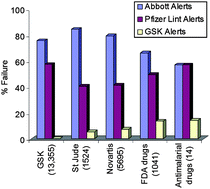
Sean Ekins and Tony Williams examine molecular properties across datasets of antimalarial screening hit compounds and compare them with compounds screened against Mycobacterim tuberculosis to identify patterns, trends or relationships.

The antimalarial hits were also filtered with computational rules to identify potentially undesirable substructures. They were surprised that approximately 75–85% of these compounds failed one of the sets of filters that they applied during this work.

To find out more about their findings I invite you to read this article. If you have something to say,  you can comment on this blog.

Meta-analysis of molecular property patterns and filtering of public datasets of antimalarial “hits” and drugs
Sean Ekins and Antony J. Williams
Med. Chem. Commun., 2010, Advance Article
DOI: 10.1039/C0MD00129E, Concise Article

Digg This
Reddit This
Stumble Now!
Share on Facebook
Bookmark this on Delicious
Share on LinkedIn
Bookmark this on Technorati
Post on Twitter
Google Buzz (aka. Google Reader)

Novel approach to high-throughput screening of molecules

Jason Kettle and colleagues at AstraZeneca in UK outline a simple and direct strategy for extraction of potentially high value reagents from patent and other medicinal literature.

This approach is based on fragmentation and analysis of molecules described in patent and medicinal chemistry literature. They also highlight an example of key secondary amines with potential for broad applicability across medicinal chemistry.

Read it free to access.

Data-mining patent literature for novel chemical reagents for use in medicinal chemistry design
Jason G. Kettle, Richard A. Ward and Ed Griffen
Med. Chem. Commun., 2010, Advance Article
DOI: 10.1039/C0MD00148A, Concise Article

Digg This
Reddit This
Stumble Now!
Share on Facebook
Bookmark this on Delicious
Share on LinkedIn
Bookmark this on Technorati
Post on Twitter
Google Buzz (aka. Google Reader)

Extending the life of peptides

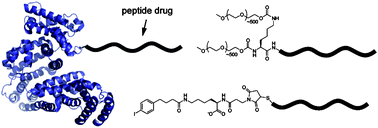
Christian Heinis and Lisa Pollaro talk about different strategies to prolong the in vivo plasma residence time of peptides.

Several strategies that extend the elimination half-life of peptides from minutes to several hours or even days are described in this interesting review.

You can read it for free here

Strategies to prolong the plasma residence time of peptide drugs
Lisa Pollaro and Christian Heinis
Med. Chem. Commun., 2010, Advance Article
DOI: 10.1039/C0MD00111B, Review

Digg This
Reddit This
Stumble Now!
Share on Facebook
Bookmark this on Delicious
Share on LinkedIn
Bookmark this on Technorati
Post on Twitter
Google Buzz (aka. Google Reader)

Tumour detection takes an ultrasonic leap

By Philippa Ross

Hollow silica nanoparticles filled with gas behave as efficient contrast agents for use in ultrasound imaging. This could improve detection of tumours in breast cancer patients, claim US scientists.

Ultrasound imaging is a safe, fast and non-invasive technique used for medical diagnosis. However, one shortcoming is the inferior image contrast compared to more sophisticated magnetic resonance imaging (MRI). To improve this, radiologists use microbubble contrast agents to enhance the reflection of ultrasonic waves and therefore improve the quality of the ultrasound image, or radioactive seeds that are injected into the patient before surgery to visualise the entire tumour.
However, the contrast particles – normally comprised of a soft protein outer shell and a gas core – can be unstable due to their high sensitivity to changes in pressure, while the radioactive seeds have to be painfully injected into the patient and only last a few hours.

Now, a team led by William Trogler at the Univeristy of Califonia, San Diego have developed a stable, hard shell, hollow particle which, when filled with gas, produces a ultrasound signal and can be safely and painlessly injected into breast tissue to locate tumours. The gas-filled microbubbles adhere to human breast tissue for days and have a longer imaging lifetime than their soft counterparts, explains Trogler. So if used in early stage breast cancer patients, they could help surgeons better visualise the tumours and remove it all in one procedure.

Elizabeth Shaughnessy, a specialist in breast diseases at the University of Cincinnati in the US agrees. ‘The injection of these silica hollow spheres with gas-filled contrast provides a less toxic alternative, [to radioactive seeds] that won’t degrade within a short time period.’ She adds that the work is ‘highly innovative and will have great appeal to surgeons, radiologists and patients, as well as operating staff.

It is still early days but next Trogler and his team hope to move to animal models, toxicology studies and eventually clinical trials. Methods are also being developed to make biodegradable gas filled silica micro and nanoshells that would broaden the possible imaging applications.

This story has been published on the  Highlights in Chemical Biology website.

Read the paper free to access

Hard shell gas-filled contrast enhancement particles for colour Doppler ultrasound imaging of tumors
H. Paul Martinez, Yuko Kono, Sarah L. Blair, Sergio Sandoval, Jessica Wang-Rodriguez, Robert F. Mattrey, Andrew C. Kummel and William C. Trogler, Med. Chem. Commun., 2010, 1, 266
DOI: 10.1039/c0md00139b

Digg This
Reddit This
Stumble Now!
Share on Facebook
Bookmark this on Delicious
Share on LinkedIn
Bookmark this on Technorati
Post on Twitter
Google Buzz (aka. Google Reader)

Reviews in MedChemComm in 2010

MedChemComm publishes Review articles on key topics across the breadth of medicinal chemistry. Take a look below at those published so far in 2010, or contact the Editor, Richard Kelly, if you have an idea for a Review of your own!

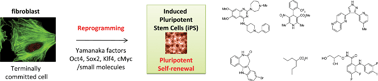
Small molecule modulation of stem cells in regenerative medicine: recent applications and future direction
Timothy E. Allsopp, Mark E. Bunnage and Paul V. Fish
Med. Chem. Commun., 2010, 1, 16-29

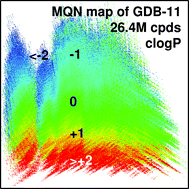
Chemical space as a source for new drugs

Jean-Louis Reymond, Ruud van Deursen, Lorenz C. Blum and Lars Ruddigkeit
Med. Chem. Commun., 2010, 1, 30-38

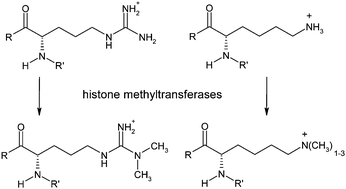
Targeting epigenetic modifiers: Inhibitors of histone methyltransferases

Elisabeth-Maria Bissinger, Ralf Heinke, Wolfgang Sippl and Manfred Jung
Med. Chem. Commun., 2010, 1, 114-124

Silver nanoparticles—the real “silver bullet” in clinical medicine?

Kenneth K. Y. Wong and Xuelai Liu
Med. Chem. Commun., 2010, 1, 125-131

Boronic acids in medicinal chemistry: anticancer, antibacterial and antiviral applications

Paul C. Trippier and Christopher McGuigan
Med. Chem. Commun., 2010, 1, 183-198

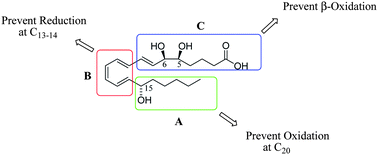
Recent advances in the chemistry and biology of stable synthetic Lipoxin analogues

Colm D. Duffy and Patrick J. Guiry
Med. Chem. Commun., 2010, 1, 249-265

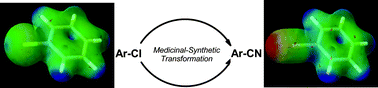
Aromatic chloride to nitrile transformation: medicinal and synthetic chemistry

Lyn H. Jones, Nicholas W. Summerhill, Nigel A. Swain and James E. Mills
Med. Chem. Commun., 2010, Advance Article


Digg This
Reddit This
Stumble Now!
Share on Facebook
Bookmark this on Delicious
Share on LinkedIn
Bookmark this on Technorati
Post on Twitter
Google Buzz (aka. Google Reader)

MedChemComm article by William Troger picked up in media outlets

The concise article by Robert F. Mattrey, Andrew C. Kummel, William Troger and colleagues at University of California, San Diego, on gas filled hollow porous silica microshells for ultrasound image contrast has had a tremendous impact in media outlets worldwide. This article is now included in MedChemComm Issue 4 and as all the MedChemComm content, it is free to access.

These are some of the web pages in which the article has been highlighted:

Congratulations to the authors! It is a truly interesting piece of research.

You can read it for free here:

Hard shell gas-filled contrast enhancement particles for colour Doppler ultrasound imaging of tumors
H. Paul Martinez, Yuko Kono, Sarah L. Blair, Sergio Sandoval, Jessica Wang-Rodriguez, Robert F. Mattrey, Andrew C. Kummel and William C. Trogler
Med. Chem. Commun., 2010, 1, 266-270
DOI: 10.1039/C0MD00139B , Concise Article

Digg This
Reddit This
Stumble Now!
Share on Facebook
Bookmark this on Delicious
Share on LinkedIn
Bookmark this on Technorati
Post on Twitter
Google Buzz (aka. Google Reader)