Must read: Organic semiconductors

We are delighted to share a selection of “must read” articles published in RSC Applied Interfaces in the field of organic semiconductors. The articles explore the application of organic semiconductor materials in photovoltaics, transistors, neuromorphic computing, and sensing. 

Organic photovoltaics 

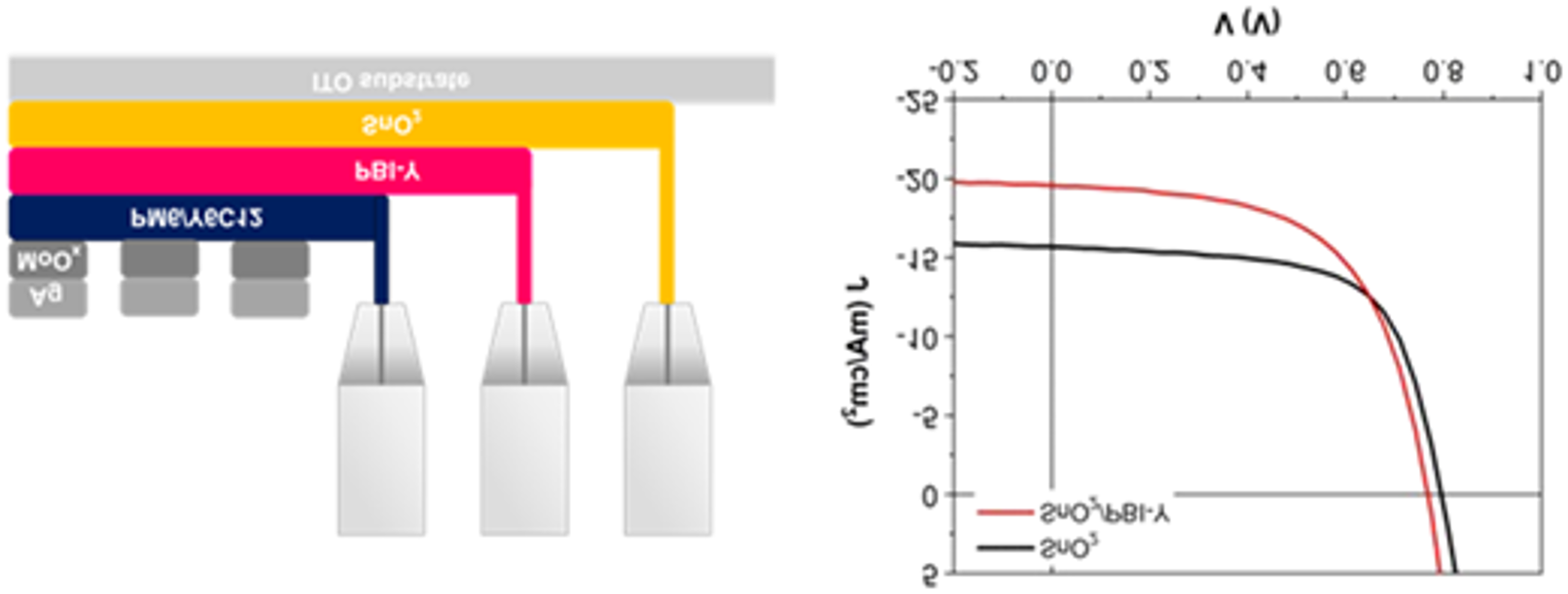
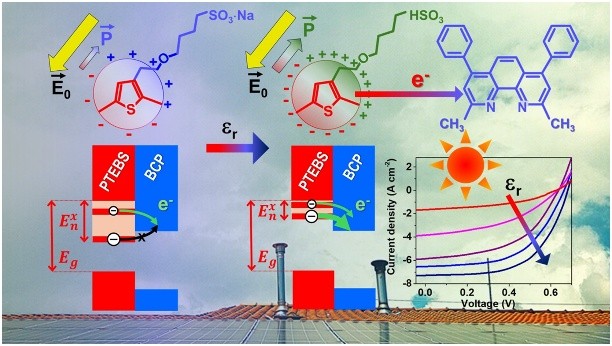
There are different strategies to improve organic photovoltaic performance through interface engineering. The papers below show how the charge-state formation at interfaces affect charge-transfer properties and ultimately device performance, as well as more sustainable processing methods. 
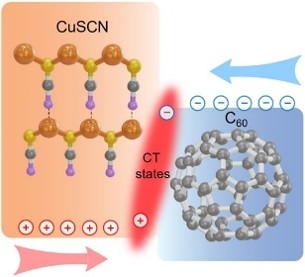
            Solution treatment controls charge-transfer states and energy-level alignment at hybrid CuSCN-organic interfaces 

Yingying Li, Zhewei Chen, Wenjie Zhou, Qi Wang, Yuan Zhang, Tao Song, Baoquan Sun, Steffen Duhm 

  All slot-die coated organic solar cells using an amine processed cathode interlayer based upon an amino acid functionalised perylene bisimide 

Rebecca E. Ginesi, Muhammad R. Niazi, Gregory C. Welch, Emily R. Draper 

  Dielectric-constant effects on the exciton dissociation and photovoltaic conversion efficiency of water-soluble green conducting polymers 

Xin Wei, Daniel Williams, Giovanni Fanchini 


Organic transistors for neuromorphic computing  

These studies explore organic transistor devices that reproduce aspects of neural and synaptic behaviour. They examine how operating voltage and material properties such as polymer molecular weight and film thickness affect the speed and dynamics of neuromorphic devices. 
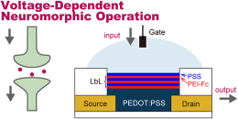
  Voltage-dependent time constants for neuromorphic organic electrochemical transistor applications 

Shunsuke Yamamoto, Nanako Kanazumi, Masaya Mitsuishi 

  Exploring response time and synaptic plasticity in P3HT ion-gated transistors for neuromorphic computing: impact of P3HT molecular weight and film thickness 

Ramin Karimi Azari, Zhaojing Gao, Alexandre Carrière, Clara Santato 


Organic semiconductors as sensors 

These papers focus on functional sensing devices made using flexible or scalable electronic materials, highlighting practical device functionality and manufacturing scalability. 
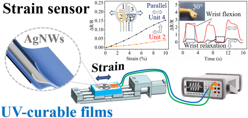
  Flexible strain sensors based on silver nanowires and UV-curable acrylate elastomers for wrist movement monitoring 

Shuhao Li, Wenjin Wu, Yu Chang, Weiquan Chen, Yijie Liu, Zifeng He, Yan Pu, Ivan S. Babichuk, Terry Tao Ye, Zhaoli Gao, Jian Yang 

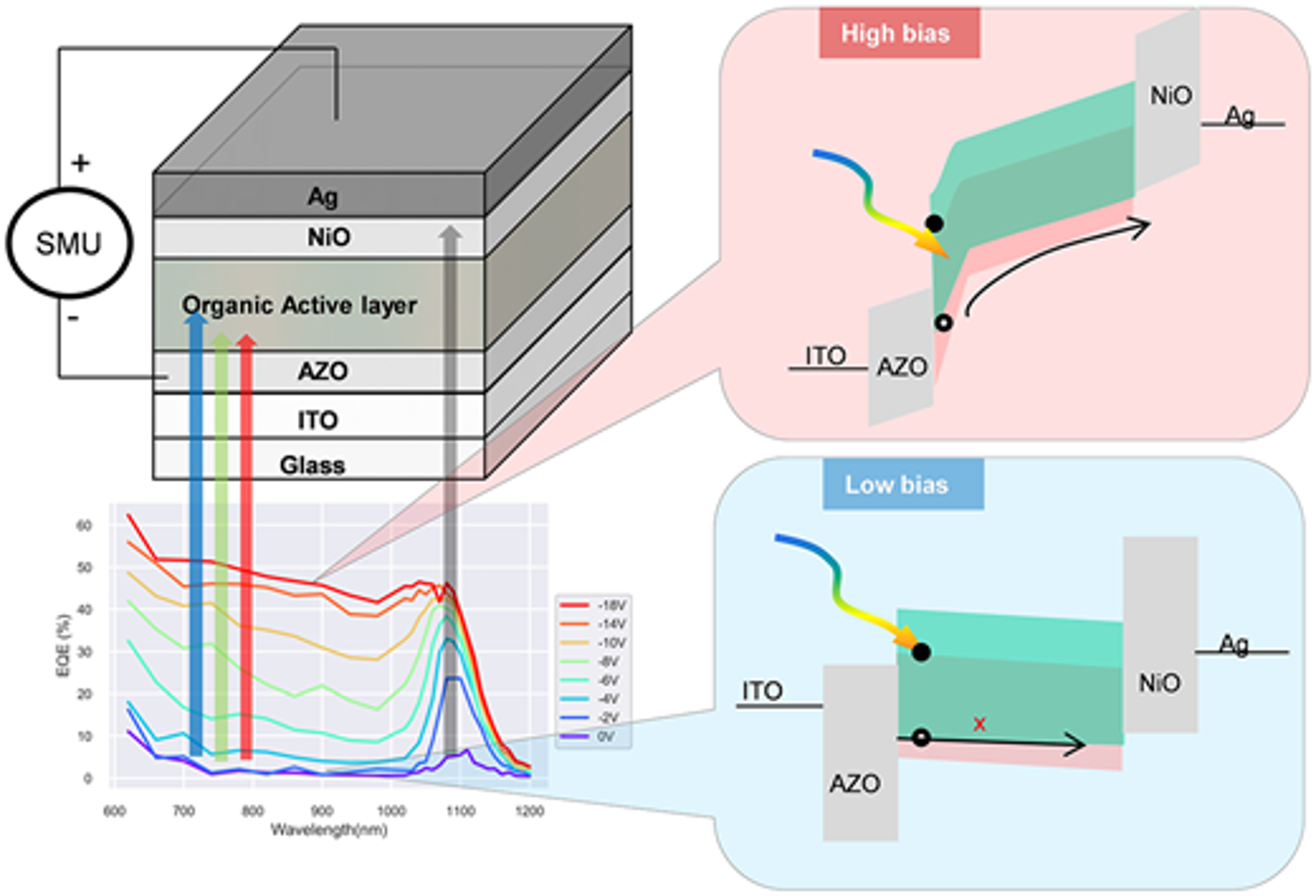
  Bias switchable narrowband/broadband NIR organic photodetector fabricated with a scalable technique 

Lai-Hung Lai, Wei-Hsiang Lin, Chin-Chuan Hsieh, Maria Antonietta Loi 


Thin film optimisation  

The articles below explore how important it is to optimise the molecule structure of organic semiconductor materials to enhance their performance. Molecular design, polymer structure and thin-film organisation all influence application-relevant properties like charge mobility. These studies highlight the need to balance electrical performance and other desirable properties like stretchability or stability. 
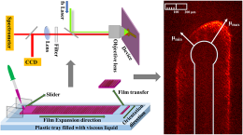
  Anisotropic charge transport study of highly oriented P4T2F-HD thin film fabricated at air–liquid interface through second harmonic generation (SHG) analysis 

Radhe Shyam, Takaaki Manaka, Rajiv Prakash 

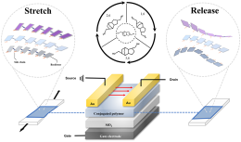
  N-type semiconducting polymers with an improved isotropic mobility–stretchability stability by using structural isomers as conjugation break spacers 

Ming-Han Chen, Yu-Chun Huang, Fu-En Szu, Jung-Yao Chen, Man-kit Leung, Yan-Cheng Lin 


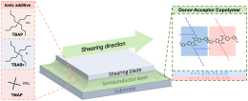
  Enhancing charge transport in isoindigo-based donor–acceptor copolymers by combining ionic doping with polar alkoxy side chains 

Sheng Chuo, Yun-Ching Peng, Thanapon Puangniyom, Qun-Gao Chen, Chu-Chen Chueh,Wen-Ya Lee 

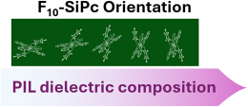
  Polymerized ionic liquid dielectrics tune molecular orientation and operating voltage in silicon phthalocyanine OTFTs 

Bahar Ronnasi, Nicolas Ledos, Benjamin King, Benoît H. Lessard 


Stay up to date with all the latest from RSC Applied Interfaces 

To keep up to date with all the latest news and research, sign up for our e-alerts and keep an eye on our journal webpage and social media for more exciting research.  Thank you for your ongoing support of RSC Applied Interfaces. 
Hear from our authors: Kanaparedu P. C. Sekhar and Jiwei Cui

RSC Applied Interfaces publishes interdisciplinary work with an applied focus, which can be read for free here. To celebrate the excellent articles that have been published so far in our journal, we asked some of our authors to discuss their work in more detail.

In this post, we hear from Kanaparedu P. C. Sekhar and Jiwei Cui as they discuss their recently published article, ‘Double emulsions of full-active sunscreen ingredients for enhanced broad-spectrum UV protection‘.


Read more »

Discover recent research published in RSC Applied Interfaces in the field of electrochemistry

Explore some of the exciting chemistry enabling the clean-energy transition through better hydrogen technologies, safer and more powerful batteries, and more sustainable recycling processes. 

Electrochemistry is playing a central role in solving some of the world’s biggest sustainability and technology challenges because it provides ways to convert, store, and recycle energy using green electricity sources rather than fossil-fuel-based processes. This makes it one of the key technologies for achieving net-zero emissions and a more sustainable energy future. 

To showcase some of the exciting research published in RSC Applied Interfaces in the field of sustainable electrochemistry, we have curated a small section of articles that highlight exciting new research in this area.  

Explore the collection below and discover how researchers are developing practical solutions to real-world challenges.  


Advances in Li-ion batteries 

This section explores advances in Li-ion battery technology. The articles report a mixture of experimental and computational studies that explore the introduction of safer solvents, Li diffusion at interfaces and surface functionalisation for improved performance. 


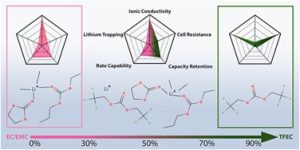
Influence of bis(2,2,2-trifluoroethyl) carbonate flame retarding co-solvent on interfacial chemistry in carbonate ester lithium-ion battery electrolytes 

 M. B. Shemirani, F. Gebert and A. J. Naylor 

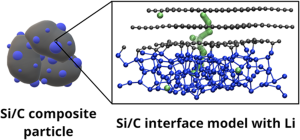
Ab initio study of lithium diffusion at a layered carbon/amorphous silicon interface 

 C. Kirsch and D. Sebastiani 

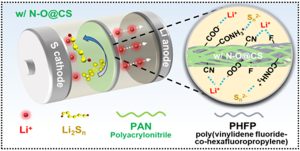
Functional separator with a nitrogen/oxygen-rich interlayer for enhancing performance of Li–S batteries 

 Y. Guo, J. Zhong, J. Liu and W.-H. Zhong 


Green Hydrogen Production  

The articles below explore novel energy solutions through green hydrogen production, reporting advances in both the hydrogen and oxygen evolution reactions.  


Reaction-passivation-driven delamination of spent LiFePO4 cathodes and their upgrading to highly efficient catalysts for hydrogen evolution 

 J. Yi, J. Hu, C. Gong, Q. Liu and W. Bi 

Hydrogen evolution reaction by Gd-doped transition metal dichalcogenide VSe2 nanoflowers  

 A. Parida, B. Dandasena and R. Naik 

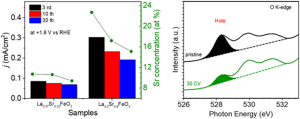
Evaluating the electronic structure and stability of epitaxially grown Sr-doped LaFeO3 perovskite alkaline O2 evolution model electrocatalysts 

 C. Tian, C. Maheu, X. Huang, F. E. Oropeza, M. Major, J. Brötz, M. Einert, W. Donner, K. H. Zhang and J. P. Hoffmann 


Electrochemical applications of graphene oxide materials  

The articles in this section explore the use of graphene oxide in sustainable electrochemical applications, including the oxygen evolution reaction, proton conductivity and Li-ion battery storage. 


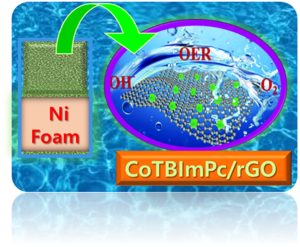
Cobalt–benzimidazole swapped metal–organic macrocycle with reduced graphene oxide as a hybrid electrocatalyst for highly efficient oxygen evolution reaction 

 C. P. K. Prabhu, K. R. Naveen and J. Hur 

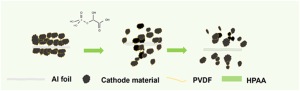
Enhanced proton conductivity from phytic acid-intercalated three-dimensional graphene oxide 

 S. Salehpour, L. I. Ardhayanti, Y. Hidaka, X. Liu, T. Tsugawa, K. Hatakeyama, M. S. Islam, Y. Sekine, S. Ida and S. Hayami 

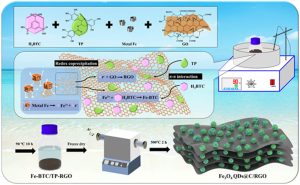
Synthesis of a MOF-derived magnetite quantum dots on surface modulated reduced graphene oxide composite for high-rate lithium-ion storage 

 R. Jia, L. Yu, Z. Han, S. Liu, P. Shang, S. Deng, X. Liu and B. Xu 


With an Impact Factor of 4.6 and time to first decision of 30.5 days, RSC Applied Interfaces is a dedicated, interdisciplinary reference journal for cutting-edge research on the applications of surfaces and interfaces. In addition to the applied focus, work considered for publication in RSC Applied Interfaces is expected to be highly original and of top quality. The journal seeks to report major scientific advances beyond the state of the art, at the cutting edge of this interdisciplinary field. 


Hear from our authors: Prasanna Kumar S. Mural

RSC Applied Interfaces publishes interdisciplinary work with an applied focus, which can be read for free here. To celebrate the excellent articles that have been published so far in our journal, we asked some of our authors to discuss their work in more detail.

In this post, we hear from Prasanna Kumar S. Mural from the Indian Institute of Technology Bombay as they discuss their recently published article entitled ‘Taguchi optimised next-generation electric field assisted patterned poly-(vinylidene difluoride)-based hybrid nanogenerators and OmniGait-sensor‘.


RSC Applied Interfaces – hear from our authors: Prasanna Kumar S. Mural


Read more »

Hear from our authors: Dannielle M. Cox-Pridmore, Eleanor Mishra, Mark Webber and Sheng Qi

RSC Applied Interfaces publishes interdisciplinary work with an applied focus, which can be read for free here. To celebrate the excellent articles that have been published so far in our journal, we asked some of our authors to discuss their work in more detail.

In this post, we hear from Dannielle M. Cox-Pridmore, Eleanor Mishra, Mark Webber and Sheng Qi as they discuss their recently published review, ‘Antibacterial surface engineering: bioinspiration from leaves to medical devices‘.


Read more »

Hear from our authors: Alp Ozgun and Fabio Variola

RSC Applied Interfaces publishes interdisciplinary work with an applied focus, which can be read for free here. To celebrate the excellent articles that have been published so far in our journal, we asked some of our authors to discuss their work in more detail.

In this post, we hear from Alp Ozgun and Fabio Variola as they discuss their recently published article entitled ‘Precision surface engineering of metallic biomaterials: translating cell-instructive nanoscale topographies from bench to bone-interfacing implants‘.


Read more »

Hear from our authors: Maryam Bonyani, Ronak Ansaripour and Sitaraman Krishnan

RSC Applied Interfaces publishes interdisciplinary work with an applied focus, which can be read for free here. To celebrate the excellent articles that have been published so far in our journal, we asked some of our authors to discuss their work in more detail.

In this post, we hear from Maryam Bonyani, Ronak Ansaripour and Sitaraman Krishnan as they discuss their recently published article entitled ‘Nanoclay-enhanced self-healing of polyurethane–urea coatings enabled by disulfide exchange‘.


Read more »

Celebrating the first RSC Applied Symposium!

RSC Applied Polymers and RSC Applied Interfaces were delighted to host the inaugural RSC Applied Symposium at Burlington House, London on Thursday 23rd July 2026, welcoming more than 70 attendees, 10 speakers, and 30 poster presenters. It was a fantastic day of networking filled with fascinating talks linked to sustainability in materials and polymer science. 

We would like to extend our thanks to all our speakers for sharing their exciting research with us and to our session chairs for facilitating the question and answer sessions. You can explore their recent research below! 

🔸Claire Carmalt  🔸Serena Margadonna 
🔸Pengfei Cao  🔸Jenny Nelson 
🔸Matthew Davies  🔸Emily Pentzer 
🔸Andrew Dove  🔸Ryan Richards 
🔸Rachel Evans  🔸Federico Rosei 
🔸Marina Freitag  🔸Magdalena Titirici 
🔸Matthew Gibson  🔸Peter Wich 


Congratulations to our poster prize winners! 

We would like to congratulate our poster prize winner Meiyi Chen, University of Edinburgh and runner-ups Megan Gutman, Queen Mary University of London and Francesca Patel Burrows, University of Manchester. Well done on this excellent achievement and thank you to all that attended and took part in the flash presentations and poster session. The standard of work was incredibly high which was great to see at our first symposium! 


Congratulations to our winner Meiyi Chen (left) and runner-ups Francesca Patel Burrows (right) and Megan Gutman (bottom).


RSC Applied Interfaces is a dedicated, interdisciplinary reference journal for cutting-edge research on the applications of surfaces and interfaces. In addition to the applied focus, work considered for publication in RSC Applied Interfaces is expected to be highly original and of top quality. The journal seeks to report major scientific advances beyond the state of the art, at the cutting edge of this interdisciplinary field.


RSC Applied Polymers is a leading international journal for the application of polymers, including experimental and computational studies on both natural and synthetic systems. In this journal, you can discover cross-disciplinary scientific research that leverages polymeric materials in a range of applications. This includes high impact advances made possible with polymers across materials, biology, energy applications and beyond.

Hear from our authors: Alicja Bachmatiuk, Xiaoqin Yang, Maria Zdończyk, Szymon Abrahamczyk, Gražyna Simha Martynková and Mark H. Rümmeli

RSC Applied Interfaces publishes interdisciplinary work with an applied focus, which can be read for free here. To celebrate the excellent articles that have been published so far in our journal, we asked some of our authors to discuss their work in more detail.

In this post, we hear from Alicja Bachmatiuk, Xiaoqin Yang, Maria Zdończyk, Szymon Abrahamczyk, Gražyna Simha Martynková and Mark H. Rümmeli as they discuss their recently published review entitled ‘No substrate required: electron-beam-enabled, single-atom-thick 2D metals and metal oxides‘.


Read more »

Hear from our authors: Taame Abraha Berhe

RSC Applied Interfaces publishes interdisciplinary work with an applied focus, which can be read for free here. To celebrate the excellent articles that have been published so far in our journal, we asked some of our authors to discuss their work in more detail.

In this post, we hear from Taame Abraha Berhe as they discuss their recently published article entitled ‘Strategic engineering of perovskite solar cells: revolutionary developments from interfacial stabilization to copper-based semiconductor innovations‘.


Read more »