


RSC Applied Interfaces publishes interdisciplinary work with an applied focus, which can be read for free here. To celebrate the excellent articles that have been published so far in our journal, we asked some of our authors to discuss their work in more detail.
In this post, we hear from Taame Abraha Berhe as they discuss their recently published article entitled ‘Strategic engineering of perovskite solar cells: revolutionary developments from interfacial stabilization to copper-based semiconductor innovations‘.
An introduction from Taame Abraha Berhe
Our review in RSC Applied Interfaces highlights strategies to improve perovskite solar cell (PSCs) stability and scalability through advanced surface engineering and interface passivation, including SAMs and copper-based alternatives to reduce toxic lead. The article outlines methods to bridge the efficiency gap for large-area modules while enhancing stability under ambient conditions.
Recent breakthroughs in perovskite solar cells have focused on advanced interface engineering to significantly mitigate energy loss and halt defect-induced degradation at the borders between layers. This connects material interfaces to macro-scale solar performance and facilitates the development of efficient, durable clean energy technologies. Utilizing surface passivation and aligning energy bands strategically enables researchers to drastically reduce charge recombination and improve the long-term resilience to moisture and heat, ensuring a longer operational lifespan for these devices.
This review article addresses the bottlenecks to the commercialization of PSCs by providing a strategic roadmap centred on enhancing operational stability and scalability. It outlines advanced interfacial stabilization techniques to passivate defects, as well as the use of cost-effective, robust, copper-based semiconductor alternatives, to facilitate the transition from laboratory devices to industrial-grade solar modules. The integration of copper-based semiconductors not only represents a major shift in replacing traditional, expensive hole-transport materials, but also perovskite materials. These copper compounds are cost-effective and highly conductive, boosting overall PCE by facilitating faster hole extraction. Together, these two strategic approaches — interfacial stabilization and novel material adoption — are paving the way for commercially viable, ultra-high-efficiency photovoltaic.
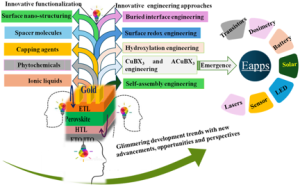
Strategic engineering of perovskite solar cells: revolutionary developments from interfacial stabilization to copper-based semiconductor innovations
Taame Abraha Berhe, ; Chu-Chen Chueh, Amare Aregahegn Dubale, Wei-Nien Su, Bing-Joe Hwang
RSC Appl. Interfaces 2026; https://doi.org/10.1039/d6lf00084c
 |
RSC Applied Interfaces is a dedicated, interdisciplinary reference journal for cutting-edge research on the applications of surfaces and interfaces. In addition to the applied focus, work considered for publication in RSC Applied Interfaces is expected to be highly original and of top quality. The journal seeks to report major scientific advances beyond the state of the art, at the cutting edge of this interdisciplinary field. |