Frank Vanhaecke: Analytical rock star

Frank Vanhaecke

Frank Vanhaecke

Frank Vanhaecke is a professor of analytical chemistry at Ghent University in Belgium. His research encompasses the determination, speciation and isotopic analysis of trace elements using inductively coupled plasma-mass spectrometry (ICP-MS). He took some time out from the 2013 Goldschmidt conference to talk to Rebecca Brodie.

What inspired you to become a chemist in the first place?

That’s an easy question. When I was in secondary school I knew that I wanted to do something in science. At first I had my mind set on biology. Questions like ‘how do animals and plants defend themselves?’ and ‘why do trees lose their leaves in autumn?’ intrigued me. But I quickly gave up on this idea when I had to do my first dissection – that was the end of biology for me.

To read the full article, please read Chemistry World.

Digg This
Reddit This
Stumble Now!
Share on Facebook
Bookmark this on Delicious
Share on LinkedIn
Bookmark this on Technorati
Post on Twitter
Google Buzz (aka. Google Reader)

Isotope signature identifies yellowcake origin

A new way to determine the source of nuclear materials has been developed by nuclear forensic scientists in Germany and South Korea. The sulfur isotope ratio in uranium ore concentrate gives an identifiable signature that depends on the origin of the ore and how it was processed.

Yellowcake is a key intermediate in the manufacture of nuclear fuel © Science Photo Library

Nuclear forensics is the analysis of nuclear materials, with a view to determining their heritage. This information can be used in conjunction with law enforcement and intelligence information to find individuals and organisations responsible for the illicit proliferation of nuclear material, or those planning nuclear terrorism.

To read the full article please visit Chemistry World.

Measurement of the sulphur isotope ratio (34S/32S) in uranium ore concentrates (yellow cakes) for origin assessment
Sun-Ho Han, Zsolt Varga, Judit Krajkó, Maria Wallenius, Kyuseok Song and Klaus Mayer  
J. Anal. At. Spectrom., 2013, Advance Article
DOI: 10.1039/C3JA50231G

Digg This
Reddit This
Stumble Now!
Share on Facebook
Bookmark this on Delicious
Share on LinkedIn
Bookmark this on Technorati
Post on Twitter
Google Buzz (aka. Google Reader)

European Symposium on Atomic Spectrometry ESAS 2014 & 15th Czech-Slovak Spectroscopic Conference

Conference websiteEuropean  Symposium  on  Atomic  Spectrometry

ESAS is  the  international  meeting  of  scientists  to  share recent  developments,  exchange  ideas,  explore  new directions and initiate a possible collaboration in the atomic spectrometry area. Leading scientists and researchers will be invited to present their most up-to-date results at this conference, to exchange exciting ideas and experiences as well as look into future development.

Czech – Slovak   Spectroscopy  Conference

CSSC brings together experts from Czech and Slovak universities, academia, official centers, various laboratories, and  industry  on  a  world-wide  scale,  to  summarize  the current progress in different areas of spectroscopy and the trends in the applications such as chemical, environmental, geological, biological, food, pharmaceutical and industrial materials and to stimulate contacts and mutual exchange of experiences and ideas.

Key dates

Registration and payment deadline             November 30, 2013

Submission of conference papers                 May 15, 2014

Venue

Prague – historical pearl of Europe – is one of the most beautiful cities in the world. Since 1992 the historical core of the  city  covering  866  hectares  has  been  listed  in  the UNESCO World Cultural and Natural Heritage.

Usually Prague is called “golden” and “a hundred towers”, but it is sure, that it belongs amongst the most beautiful cities in the world. The charming river Vltava, which enhances the city´s beauty, forms wreathes resembled to silver string. Many of the city´s dominants are reflected in the river, towers, the cathedral dome, the palace and many houses,greeness of the gardens and islands. www.praguecityline.cz

Organizers

  • Ioannes Marcus Marci Spectroscopic Society
  • Slovak Spectroscopic Society

With special support by

  • Atomic and Molecular Spectroscopy Working Group of the Committee of Analytical Chemistry of Polish Academy of Sciences
  • DASp, German Working Group for Applied Spectroscopy
  • Committee on Analytical and Environmental Chemistry of Hungarian Academy of Sciences
  • under the auspices of the Czech Commission for UNESCO

Contacts

Markéta Koželouhová
Ioannes Marcus Marci Spectroscopy Society
Faculty of Science, Masaryk University
Kotlářská 2, CZ – 611 37 BRNO, Czech Republic phone: +420 549 491 436, fax: +420 549 492 494

email : immss@spektroskopie.cz

For more information please visit: http://esas-cssc2014.spektroskopie.cz

Digg This
Reddit This
Stumble Now!
Share on Facebook
Bookmark this on Delicious
Share on LinkedIn
Bookmark this on Technorati
Post on Twitter
Google Buzz (aka. Google Reader)

Measuring Osmium in Small Biological Samples

Written by Marina Chanidou, Guest Web Writer for JAAS and PhD student at the University of York.

Determination of osmium in small biological samples

The high concentrations of osmium (Os) in sediments and the highly toxic nature of OsO4(a gaseous osmium oxide) have been the main interest of a number of studies. Isotope abundance ratio measurements of  187Os/188Os can provide valuable information about the source of Os, and concentration measurements can help define future toxicity effects. However, studies of biological samples are impeded by low accuracy and long measurement time of the available methods.

Nicola Pallavicini and colleagues at the Lulea University of Technology, Sweden, developed a methodology for the analysis of biological samples using double-focusing, sector field inductively coupled plasma mass spectrometry to measure the concentration of Os and also Os isotope ratio. The samples were prepared with microwave assisted acid digestion and spiked with Os of known isotope ratio. The method proved to be reproducible, relatively rapid and allowed high through-put of samples. The samples included different tissues from herbivore rodents and reference materials of biological and plant origin, allowing the method to provide information about Os metabolism and toxicity and also potential use of the Os isotope system in applications such as food authentication.

To read more about this article, please access the link below. This paper will be free to read October 18th.

A high-throughput method for the determination of Os concentrations and isotope ratio measurements in small-size biological samples
Nicola Pallavicini, Frauke Ecke, Emma Engström, Douglas C. Baxter and   Ilia Rodushkin
J. Anal. At. Spectrom., 2013,28, 1591-1599
DOI: 10.1039/C3JA50201E

Digg This
Reddit This
Stumble Now!
Share on Facebook
Bookmark this on Delicious
Share on LinkedIn
Bookmark this on Technorati
Post on Twitter
Google Buzz (aka. Google Reader)

HOT Articles in JAAS

Take a look at these new HOT articles just published in JAAS. These papers will be free to read for the next 4 weeks. Enjoy!

Determination of ultra-low 236U/238U isotope ratios by tandem quadrupole ICP-MS/MS
Masaharu Tanimizu, Naoki Sugiyama, Emmanuel Ponzevera and Germain Bayon  
J. Anal. At. Spectrom., 2013,28, 1372-1376
DOI: 10.1039/C3JA50145K

First inductively coupled plasma-distance-of-flight mass spectrometer: instrument performance with a microchannel plate/phosphor imaging detector
Alexander Gundlach-Graham, Elise A. Dennis, Steven J. Ray, Christie G. Enke, Charles J. Barinaga, David W. Koppenaal  and Gary M. Hieftje  
J. Anal. At. Spectrom., 2013,28, 1385-1395
DOI: 10.1039/C3JA50122A

A high-throughput method for the determination of Os concentrations and isotope ratio measurements in small-size biological samples
Nicola Pallavicini, Frauke Ecke, Emma Engström, Douglas C. Baxter and Ilia Rodushkin  
J. Anal. At. Spectrom., 2013,28, 1591-1599
DOI: 10.1039/C3JA50201E

Influence of chemical environment on the analysis of X-ray spectra of thick pellet samples containing 3d transition metal compounds
Stjepko Fazinić, Iva Božičević Mihalić and Luka Mandić 
J. Anal. At. Spectrom., 2013, Advance Article
DOI: 10.1039/C3JA50230A

The key role of atomic spectrometry in radiation protection
Jian Zheng, Keiko Tagami, Shino Homma-Takeda and Wenting Bua  
J. Anal. At. Spectrom., 2013, Advance Article
DOI: 10.1039/C3JA50217A

Selenium isotope analysis of organic-rich shales: advances in sample preparation and isobaric interference correction
E. E. Stüeken, J. Foriel, B. K. Nelson, R. Buick and D. C. Catling  
J. Anal. At. Spectrom., 2013, Advance Article
DOI: 10.1039/C3JA50186H

Digg This
Reddit This
Stumble Now!
Share on Facebook
Bookmark this on Delicious
Share on LinkedIn
Bookmark this on Technorati
Post on Twitter
Google Buzz (aka. Google Reader)

Geochemistry in JAAS- new themed issue open for submissions

Gunther et al, JAAS, 2013, 28, 831

Inspired by the recent Goldschmidt conference in Florence, we are pleased to announce a themed issue on “Geological applications of laser ablation” in JAAS. This themed issue is to cover a mixture of both fundamental advances and exciting new applications.

Submission deadline: 10th January 2014

Articles published in print Summer 2014

To celebrate this new themed issue, and the wonderful talks we saw in Florence, we’ve gathered together some of the articles published in JAAS from the areas of geochemistry and geology. If you work in this area, why not submit your next paper to JAAS. These papers will be free to read until October 15th.

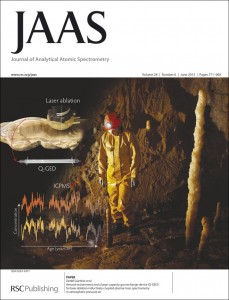
Aerosol entrainment and a large-capacity gas exchange device (Q-GED) for laser ablation inductively coupled plasma mass spectrometry in atmospheric pressure air
Daniel Tabersky, Kohei Nishiguchi, Keisuke Utani, Masaki Ohata, Rolf Dietiker, Mattias B. Fricker, Ivo M. de Maddalena, Joachim Koch and Detlef Günther
J. Anal. At. Spectrom., 2013, 28, 831-842
DOI: 10.1039/C3JA50044F

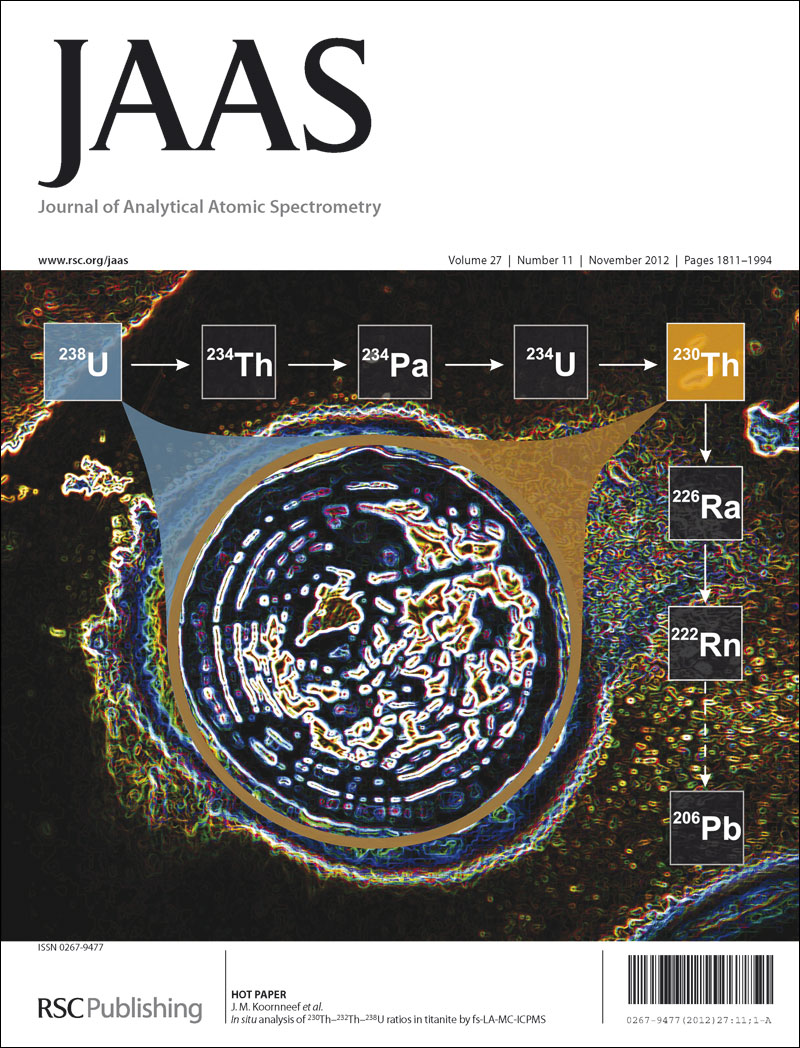
In situ analysis of 230Th–232Th–238U ratios in titanite by fs-LA-MC-ICPMS

Koorneef et al, JAAS, 2012, 27, 1863

Application of laser ablation-ICP-mass spectrometry for 2-dimensional mapping of element distributions in a Late Archean impact spherule layer
Andrei Izmer, Steven Goderis, Bruce M. Simonson, Iain McDonald, Scott W. Hassler, Philippe Claeys and Frank Vanhaecke
J. Anal. At. Spectrom., 2013, 28, 1031-1038
DOI: 10.1039/C3JA50045D

Standardless determination of Nd isotope ratios in glasses and minerals using laser-ablation multiple-collector inductively coupled plasma mass spectrometry with a low-oxide molecular yield interface setup
Jun-Ichi Kimura, Qing Chang and Hiroshi Kawabata
J. Anal. At. Spectrom., 2013, 28, 1522-1529
DOI: 10.1039/C3JA50109D

LA-ICPMS elemental imaging of complex discontinuous carbonates: An example using large benthic foraminifera
David Evans and Wolfgang Müller
J. Anal. At. Spectrom., 2013, 28, 1039-1044
DOI: 10.1039/C3JA50053E

Precise determination of the lithium isotope ratio in geological samples using MC-ICP-MS with cool plasma
Min Seok Choi, Jong-Sik Ryu, Ha Yan Park, Kwang-Sik Lee, Youngwoo Kil and Hyung Seon Shin
J. Anal. At. Spectrom., 2013, 28, 505-509
DOI: 10.1039/C2JA30293D

Solution and laser ablation MC-ICP-MS lead isotope analysis of gold
Christopher Standish, Bruno Dhuime, Robert Chapman, Christopher Coath, Chris Hawkesworth and Alistair Pike
J. Anal. At. Spectrom., 2013, 28, 217-225
DOI: 10.1039/C2JA30277B

In situ analysis of 230Th–232Th–238U ratios in titanite by fs-LA-MC-ICPMS
J. M. Koornneef, L. Dorta, B. Hattendorf, G. H. Fontaine, B. Bourdon, A. Stracke, P. Ulmer and D. Günther
J. Anal. At. Spectrom., 2012, 27, 1863-1874
DOI: 10.1039/C2JA30162H

Digg This
Reddit This
Stumble Now!
Share on Facebook
Bookmark this on Delicious
Share on LinkedIn
Bookmark this on Technorati
Post on Twitter
Google Buzz (aka. Google Reader)

Free to access Cancer Nanotechnology collection 2013

We are pleased to present a new Web Collection of articles from publications across the RSC journal portfolio demonstrating the use of (nano)technology in the diagnosis, imaging and treatment of cancer.

This web collection will be free to access until July 28th, so register for an RSC Publishing personal account and read this cutting edge research for free this week!

Here are just a few of the cancer nanotechnology articles:

Magnetic quantitative immunoanalysis of carcinoembryonic antigen by ICP-MS with mercury labels
Hanyong Peng, Beibei Chen, Man He, Yuan Zhang and   Bin Hu
J. Anal. At. Spectrom., 2011,26, 1217-1223
DOI: 10.1039/C1JA00007A

A microfluidic system for introduction of nanolitre sample in inductively coupled plasma mass spectrometry using electrokinetic flow combined with hydrodynamic flow
Heyong Cheng, Zigang Xu, Jinhua Liu, Xiuzhong Wanga and   Xuefeng Yin
J. Anal. At. Spectrom., 2012,27, 346-353
DOI: 10.1039/C1JA10273G 

Quantification of ovarian cancer markers with integrated microfluidic concentration gradient and imaging nanohole surface plasmon resonance
Carlos Escobedo, Yu-Wei Chou, Mohammad Rahman, Xiaobo Duan, Reuven Gordon, David Sinton, Alexandre G. Brolo and   Jacqueline Ferreira
Analyst, 2013,138, 1450-1458
DOI: 10.1039/C3AN36616B

Visualising gold inside tumour cells following treatment with an antitumour gold(I) complex
Louise E. Wedlock, Matt R. Kilburn, John B. Cliff, Luis Filgueira, Martin Saunders and   Susan J. Berners-Price
Metallomics, 2011,3, 917-925
DOI: 10.1039/C1MT00053E

Digg This
Reddit This
Stumble Now!
Share on Facebook
Bookmark this on Delicious
Share on LinkedIn
Bookmark this on Technorati
Post on Twitter
Google Buzz (aka. Google Reader)

Top ten most accessed articles from April – June 2013

During the months April – June, the following articles are in the Top Ten most accessed:-

Silver nanoparticle characterization using single particle ICP-MS (SP-ICP-MS) and asymmetrical flow field flow fractionation ICP-MS (AF4-ICP-MS) 
Denise M. Mitrano, Angela Barber, Anthony Bednar, Paul Westerhoff, Christopher P. Higgins and James F. Ranville  
J. Anal. At. Spectrom., 2012,27, 1131-1142 
DOI: 10.1039/C2JA30021D     

Reproducibility of CIGS thin film analysis by laser-induced breakdown spectroscopy 
Jung-Hwan In, Chan-Kyu Kim, Seok-Hee Lee and Sungho Jeong  
J. Anal. At. Spectrom., 2013,28, 473-481 
DOI: 10.1039/C3JA30298A     

Atomic spectrometry update. Environmental analysis 
Owen T. Butler, Warren R. L. Cairns, Jennifer M. Cook and Christine M. Davidson  
J. Anal. At. Spectrom., 2013,28, 177-216 
DOI: 10.1039/C2JA90077G     

The first years of laser-induced breakdown spectroscopy 
Matthieu Baudelet and Benjamin W. Smith 
J. Anal. At. Spectrom., 2013,28, 624-629 
DOI: 10.1039/C3JA50027F    

Atomic spectrometry update. Industrial analysis: metals, chemicals and advanced materials 
Simon Carter, Andy S. Fisher, Michael W. Hinds and Steve Lancaster   
J. Anal. At. Spectrom., 2012,27, 2003-2053 
DOI: 10.1039/C2JA90058K     

Simultaneous determination of Co, Fe, Ni and Pb in carbon nanotubes by means of solid sampling high-resolution continuum source graphite furnace atomic absorption spectrometry 
Martín Resano, Eduardo Bolea-Fernández, Engracia Mozas, María R. Flórez, Patricia Grinberg and Ralph E. Sturgeon  
J. Anal. At. Spectrom., 2013,28, 657-665 
DOI: 10.1039/C3JA30377B     

UV fs–ns double-pulse laser induced breakdown spectroscopy for high spatial resolution chemical analysis 
Yuan Lu, Vassilia Zorb, Xianglei Mao, Ronger Zheng and Richard E. Russo  
J. Anal. At. Spectrom., 2013,28, 743-748 
DOI: 10.1039/C3JA30315B     

235U–231Pa age dating of uranium materials for nuclear forensic investigations 
Gary R. Eppich, Ross W. Williams,  Amy M. Gaffney and Kerri C. Schorzman   
J. Anal. At. Spectrom., 2013,28, 666-674 
DOI: 10.1039/C3JA50041A     

Resolution of inter-laboratory discrepancies in Mo isotope data: an intercalibration 
Tatiana Goldberg, Gwyneth Gordon, Gareth Izon, Corey Archer, Christopher R. Pearce, James McManus, Ariel D. Anbarbh and Mark Rehkämper  
J. Anal. At. Spectrom., 2013,28, 724-735 
DOI: 10.1039/C3JA30375F     

Atomic spectrometry update. Clinical and biological materials, foods and beverages  
Andrew Taylor, Martin P. Day, Sarah Hill, John Marshall, Marina Patriarca and Mark White  
J. Anal. At. Spectrom., 2013,28, 425-459 
DOI: 10.1039/C3JA90005C     

Why not take a look at the articles today and blog your thoughts and comments below.

Fancy submitting an article to JAAS? Then why not submit to us today or alternatively email us your suggestions.

Digg This
Reddit This
Stumble Now!
Share on Facebook
Bookmark this on Delicious
Share on LinkedIn
Bookmark this on Technorati
Post on Twitter
Google Buzz (aka. Google Reader)

International Glow Discharge Spectroscopy Seminar (IGDSS 2014)

The European Working group for Glow Discharge Spectroscopy (EW-GDS)  is pleased to announce the

 International Glow Discharge Spectroscopy Seminar 

(IGDSS 2014) 

 7-9th April 2014 in Prague, Czech Republic

IGDSS 2014 features a rich technical programme that spans both research and applied aspects of Glow Discharge Spectroscopy.
The symposium will concentrate on the analysis of solids by  optical emission or  mass spectrometry with Glow Discharge sources.

Topics will include:
•Fundamentals (GD Processes)
•Instrumentation
•Analytical Methodology
•Depth Profiling , Thin Films
•Other applications and related fields.

Enjoy both oral and poster presentations from international experts and early stage researchers! For more information, please contact Peter Robinson at pete@masscare.co.uk

Digg This
Reddit This
Stumble Now!
Share on Facebook
Bookmark this on Delicious
Share on LinkedIn
Bookmark this on Technorati
Post on Twitter
Google Buzz (aka. Google Reader)

XXXVIII Colloquium Spectroscopicum Internationale and CSI Award for Ramon Barnes

As you already know if you are following us on twitter, the  XXXVIII Colloquium Spectroscopicum Internationale was held on June 17 – 21, 2012 in Tromso, Norway. The conference was chaired by Yngvar Thomassen, and counted with more than 200 participants who travel to the Far North to enjoy the land of the midnight sun. Several members of the JAAS Boards attended the conference and presented their latest works, including Martín Resano, Steven Ray, María Montes-Bayón, José Broekaert and Detlef Günther.

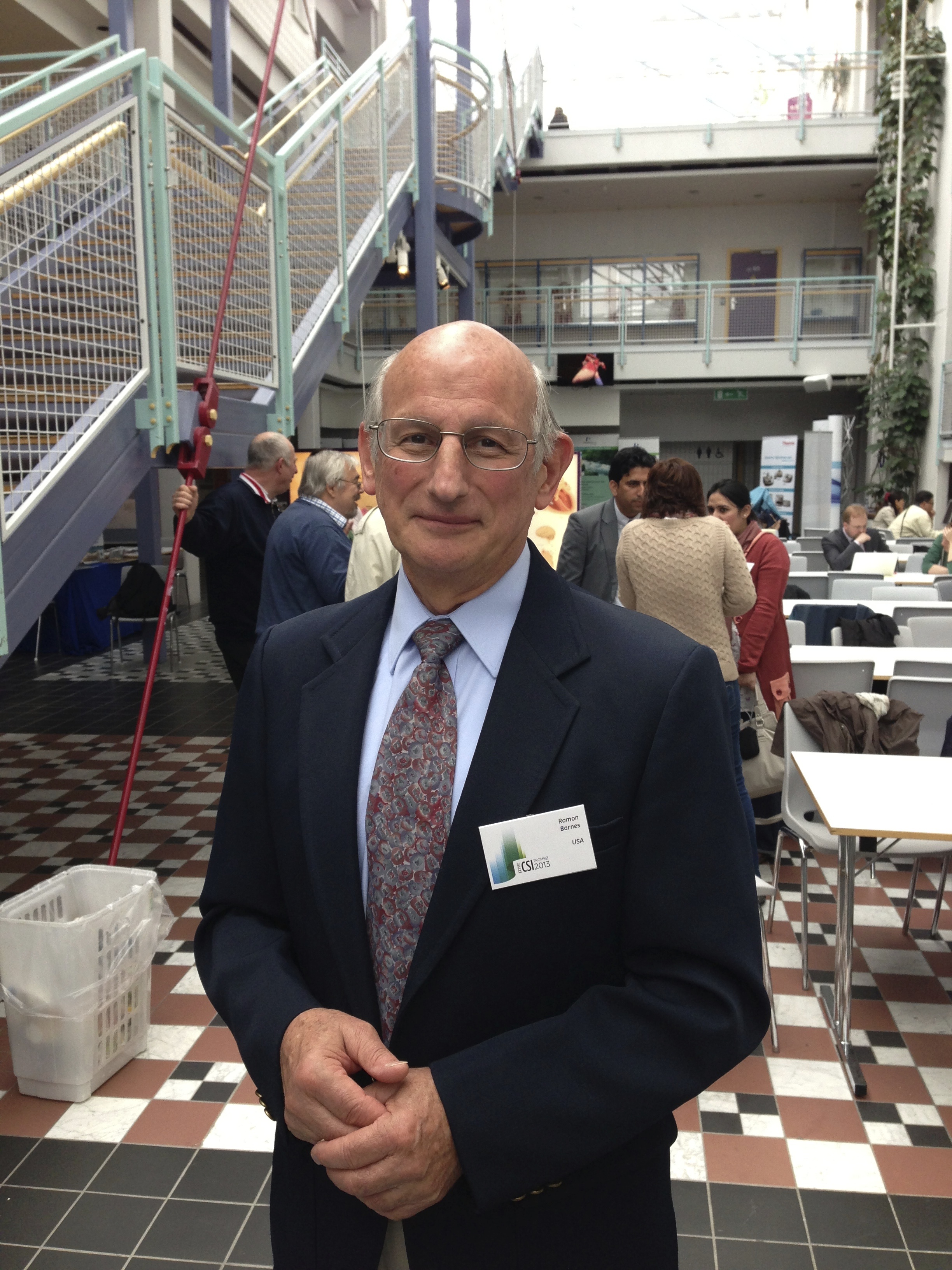
In addition, during the conference, the CSI Award for life achievement in Spectrochemistry was presented and the winner was JAAS Advisory Board Member Ramon Barnes. The Award was presented by Gary Hieftje. Congratulations, Ramon!

If you attended the conference and want to submit a paper, keep in mind that several RSC Journals (Analytical Methods/Environmental Science: Processes & Impacts/RSC Advances) will draw together a Themed Issue in electronic form. For more information see: http://site.uit.no/csi2013/official-publisher/

Prof. Dr. Ramon Barnes after receiving the CSI Award in Tromso. We’ll have an excellent opportunity

to congratulate him in person in Florida, in the upcoming 2014 Winter Conference

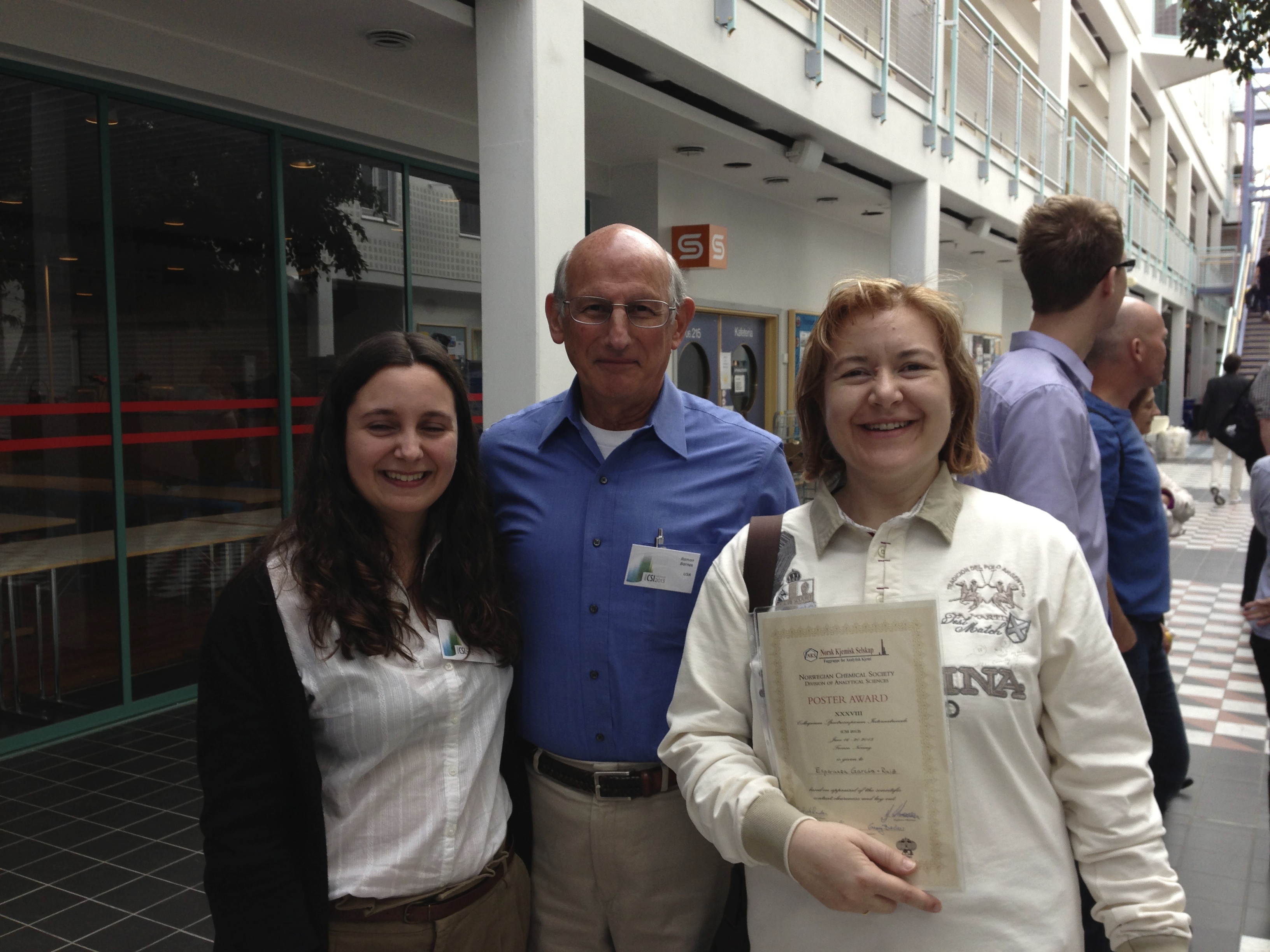
CSI Awardee Ramon Barnes together with the winners of the poster Awards, sponsored by the Norwegian Chemical Society,

Laura Trapiella (left, University of Oviedo) and Esperanza García-Ruiz (right, University of Zaragoza)

Digg This
Reddit This
Stumble Now!
Share on Facebook
Bookmark this on Delicious
Share on LinkedIn
Bookmark this on Technorati
Post on Twitter
Google Buzz (aka. Google Reader)