

Archive for the ‘Themed Collections’ Category

HOT article: triclosan distribution down under

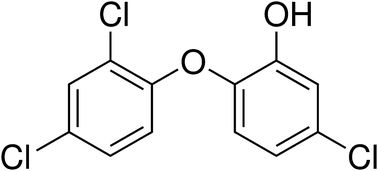
The anti-microbial agent triclosan has been used extensively in the last four decades, however concerns regarding its environmental impact on marine systems are relatively recent.

Milena Fernandes (South Australian Water Corporation) and co-workers investigated the distribution of wastewater-borne triclosan and its methylated derivative in surface sediments of a coastal inlet to determine the factors affecting transport and benthic preservation. The location studied is of interest as it is an important nursery habitat and provides sanctuary to a resident population of bottlenose dolphins.

Fernandes demonstrates that the pathways leading to dispersal are different for triclosan and methyl-triclosan discharged with wastewater, with triclosan having a larger area of impact. Triclosan accumulated in deeper sites containing finer sediment fractions, where in situ biological methylation was enhanced. Methyl-triclosan was absent from shallower sediments, potentially as a result of photodegradation of the parent compound.
This HOT article is part of our forthcoming SETAC themed issue focussing on Asia/Pacific environmental science and is free to access for 4 weeks.

The distribution of triclosan and methyl-triclosan in marine sediments of Barker Inlet, South Australia
Milena Fernandes, Ali Shareef, Rai Kookana, Sam Gaylard, Sonja Hoare and Tim Kildea
J. Environ. Monit.
, 2011, Advance Article
DOI: 10.1039/C0EM00612B

Digg This
Reddit This
Stumble Now!
Share on Facebook
Bookmark this on Delicious
Share on LinkedIn
Bookmark this on Technorati
Post on Twitter
Google Buzz (aka. Google Reader)

HOT: review of persistent organic pollutants in Antarctica

HOT off the press – a review article by Susan Nash at Griffith University, one of JEM’s 2010 Emerging Investigators.

In this review Nash describes the challenges faced by the research community in obtaining accurate information on the impact of persistent organic pollutants in Antarctica.

It is increasingly recognised that the role of the Antarctic system in climate change processes cannot be ignored. POPs are considered a substantial risk to human and environmental health; it is therefore of great importance to understand their distribution across the globe, including areas that are hard to reach.

Nash gives a thorough overview of the research carried out in this field to date.  She outlines shortcomings in previous research efforts, glaring gaps in existing knowledge and gives a number of specific research recommendations which will hopefully help advance the field.

Read her recommendations online here:

Persistent organic pollutants in Antarctica: current and future research priorities
Susan Bengtson Nash
J. Environ. Monit., 2011, Advance Article
DOI: 10.1039/C0EM00230E

Digg This
Reddit This
Stumble Now!
Share on Facebook
Bookmark this on Delicious
Share on LinkedIn
Bookmark this on Technorati
Post on Twitter
Google Buzz (aka. Google Reader)

Announcing the themed issue on Environmental Nanotechnology

The Journal of Environmental Monitoring (JEM) is commissioning a special issue reporting significant recent advances in Environmental Nanotechnology for publication in May 2011. Professor Omowunmi Sadik, Director of the Center for Advanced Sensors & Environmental Systems (CASE) at the State University of New York at Binghamton, will be the Guest Editor of this issue.

Through this issue on Environmental Nanotechnology, JEM aims to give wide-spread exposure to current advances from leading investigators and to stimulate further progress in the field based on these new developments. JEM places special emphasis on environmental processes and impacts and contributions are sought (critical and tutorial reviews, full papers, and communications are all welcome) covering these areas.

The journal will begin accepting submissions immediately with an absolute, final submission deadline of January 10th 2011 to meet the May publication date.  Manuscripts can be submitted using our online submission service. Please state in your covering letter that your article was submitted in response to the Call for Papers for the themed issue on Environmental Nanotechnology.

Digg This
Reddit This
Stumble Now!
Share on Facebook
Bookmark this on Delicious
Share on LinkedIn
Bookmark this on Technorati
Post on Twitter
Google Buzz (aka. Google Reader)