

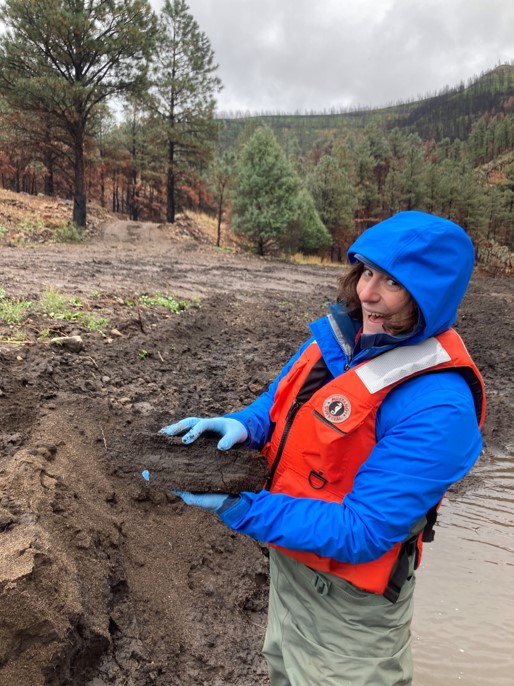
 Elizabeth Tomaszewski is a Research Chemist with the United States Geological Survey (USGS), located at the Geology, Energy & Minerals (GEM) Science Center in Reston, VA. Tomaszewski researches the coupling of carbon and metal cycles in the context of anthropogenic perturbations. She holds a B.Sc. in Chemistry from Georgia Institute of Technology and a Ph.D. in Environmental Chemistry from the University of Wisconsin, Madison. Tomaszewski pursued postdoctoral studies at the University of Tübingen in geomicrobiology, followed by the University of Delaware in soil and environmental chemistry before joining the USGS in 2020.
Your recent Emerging Investigator Series paper focuses the geochemical analysis of sediment post-wildfire in which you discovered mobilized manganese. This is your first independent publication in our RSC journal but hopefully not the last! How has your research evolved from your earliest work to this most recent article at the start of your research career?
Chemistry is what first sparked my interest in science, which is not always the case for people in the environmental sciences. Most people can point to experiences of being outside or loving rocks as children as sparking their love of science, but for me it really started in 10th grade chemistry. I eventually earned a B.Sc. in chemistry, and my Ph.D. was in the environmental chemistry and technology program at UW Madison. Being in a more chemistry focused program shaped my early work to be laboratory based, and fundamental in nature. Rather than spending time in the field, I spent a lot of time at synchrotrons doing X-ray adsorption spectroscopy. My earliest research was focused on how fast reactions with iron minerals happen and the mechanisms behind them.
My first postdoc was in the geomicrobiology group at the University of Tübingen with Andreas Kappler where I had the opportunity to learn so much about microbial iron metabolism, microbial cultivation and collaborate with a ton of awesome researchers. This wildfire paper actually is my second paper in Environmental Science: Processes and Impacts. I published a paper from my first postdoc in this journal investigating how cadmium speciation affected metal mobility during microbial metabolism by Geobacter sulfurreducens. This work is mechanistic but also brings together chemistry and microbiology in a way that is applicable to environmental systems.
My second postdoc was at the University of Delaware with Don Sparks where I worked on a project investigating the effects of saltwater intrusion on nutrient and carbon cycling. I was able to do some solo pandemic field work in Rehoboth, DE and learned how to work in high salinity systems as well as a lot about organic carbon cycling and analysis. This work was a bridge into some of the more applied field-based work I lead at USGS now.
Beginning my career focused on fundamentals has allowed me to be able to think critically about the complex environmental systems I study now in a unique way. I study water quality post-wildfire, but I also investigate coal mine drainages as potential critical mineral resources, methanogenesis in shale and ecosystem health post-mining restoration. Having deep knowledge of iron mineralogy, trace metal and carbon cycling as well as geomicrobiology experience allows me to work across scales and across systems and makes me a flexible researcher.
Globally, the incidents of wildfires are on the rise and your study interrogates the degradation of water quality as a consequence of wildfires. Your study site was Gallinas Creek in New Mexico, an area that was 87% burned during the 2022 Hermits Peak-Calf Canyon fire complex. Is there anything you’d like to share about the experience of studying such a devastated area?
Working in the Gallinas Creek watershed was the first time I had seen a burned watershed, and it was striking to say the least. One of the first things we had the opportunity to do was see where drinking water came down through the watershed to the city of Las Vegas and just how close the reservoir was to the burn scar. Sedimentation was a huge issue for water treatment post-wildfire, so much so that the city almost ran out of drinking water not only the year of the wildfire but also in the following years. The erosion that happened post-wildfire was massive and led not only to the sediment deposits we studied but also this very serious drinking water crisis. We also encountered locals who lost homes and knew others who had as well. It was a stark reminder that these events deeply impact and shape people’s lives and well-being.
What aspect of your work are you most excited about at the moment?
There are a couple of projects I’ve been working on for the past few years that are taking shape as interesting stories. We have some long-term field sites that we had the opportunity to sample at again this fall, and I am really excited to see how much water and sediment and geochemistry has changed post-restoration. I also have some work in the pipeline that brings together my chemistry/fundamental background and field-based work I’ve been doing at USGS, and it is rewarding to see that come together. I’m also excited about some of the new ideas that have been born out of some of this work. I’ve started up some new collaborations that have sparked different directions and I’m curious to see how those projects evolve.
In your opinion, what are the most important questions to be asked/answered in your field of research?
I think it is important that we face our resource scarcity issues including water, energy and critical minerals. Research that investigates water quality in a changing landscape, like this wildfire work, is essential to protecting the resources we have and ensuring they endure for future generations. Exploring new potential sources of critical minerals and energy also helps us advance as a society while preserving environmental resources like water.
What do you find most challenging about your research?
With field-based work, sometimes you go in with specific questions, but the data leads you in a completely different direction. That’s not unlike other kinds of research but it is challenging having systems that are so multi-faceted with several factors that are completely out of your control. This is also why collaboration is so essential in these kinds of studies because people with different backgrounds and expertise can look at the same data and think about totally different processes. It’s a challenge to untangle the web and find a clear through line but when you do it is so satisfying.
In which upcoming conferences or events may our readers meet you?
I have been attending Goldschmidt for the past couple of years and tend to a chair session at that conference. I plan to attend in 2027 as well.
How do you spend your spare time?
I like to run, swim, and hike as well as read and craft. Being in the DC area means I have access to a lot of amazing live music and professional sports. My favorite is going to see our women’s soccer team, the Washington Spirit play. I also have two cats that I dote on endlessly.
Which profession would you choose if you were not a scientist?
I didn’t start off as a scientist in undergrad, despite my love of 10th grade chemistry. I wanted to be a writer. Sometimes I like to think I would have been a science reporter and other times I think I may have been a novelist. Who knows, there’s still time.
Can you share one piece of career-related advice or wisdom with other early career scientists?
It may feel at times that you study and work on a niche topic but it’s important to remember that you aren’t pigeonholed into one type of research or profession. Just because you become really knowledgeable in one subject area doesn’t mean it doesn’t have other applications and the skills you pick up are likely applicable to several areas of science. Be open minded and flexible in the kinds of work you pursue and to new connections and contacts. You never know what may end up being interesting or what you truly want to do.


