Archive for October, 2013

Semipermeable membrane devises (SPMDs) as models in dissolved hydrocarbon exposure studies

Crude oil spillages are a major ecological threat, exposing aquatic wildlife to high concentrations of toxic organic pollutants. This study by Van Scoy et al. demonstrates the potential usefulness of semi-permeable membrane devises (SPMDs) in monitoring the exposure of aquatic organisms to dissolved hydrocarbons from crude oil, and in assessing the toxic effects that these compounds may exert.

Oil spills and their environmental impacts are frequently in the public and media spotlight. In order to adequately address this issue it is essential to establish the most effective way to limit exposure to the toxic compounds released. It is common for chemical dispersants to be used following spillages. These accelerate the natural dispersion of oil by reducing the interfacial surface tension. While these are considered to be an effective treatment method, the ecological impact of dispersed oil needs to be considered.

In this study SPMDs were used to extract the bioavailable fraction of dissolved hydrocarbons present in both ‘undispersed’ and ‘chemically dispersed’ crude oil. SPMDs mimic the action of biological membranes by allowing passive diffusion of aqueous compounds through the lipid membrane. Here, this technique was used to monitor levels of key polycyclic aromatic hydrocarbons (PAHs), a class of pollutants shown to display toxic and bioaccumulative properties in aquatic organisms.

The use of SPMDs is favourable compared to living models in bioavailability studies, providing a relatively quick, economical and efficient method and also avoids biotransformation of compounds during the experiment. In this study, ultra high purity triolein (C57H104O6) was used to extract 7 PAHs, monitoring accumulation over a 24hr exposure time to simulate the initial period after a spillage. Concentrations of 7 PAHs were measured using gas chromatography with mass spectrometry (GC-MS).

It was shown that, while the initial crude oil loading was 8 times higher for the undispersed oil (2 g L-1) compared to the dispersed oil (0.25 g L-1), accumulation of PAHs was greater for the dispersed oil. This was attributed to the micelles, formed upon dispersant application, weathering over time. This would suggest the use of chemical dispersants as a remediation measure may increase the risk of exposure of aquatic organisms to toxic hydrocarbons.

The study demonstrates the usefulness of SPMDs in measuring concentrations of dissolved organic pollutants present in crude oil. Data from this technique, in combination with metabolomic data, could be a valuable tool in better understanding the bioavailability of dissolved hydrocarbons in crude oil and the possible toxic effects this can have on aquatic wildlife. The paper would therefore be of interest to ecotoxicologists investigating aquatic organisms in both saltwater and freshwater environments.

Use of semipermeable membrane devices (SPMDs) to characterize dissolved hydrocarbon fractions of both dispersed and undispersed oil by April R. Van Scoy, Jennifer Voorhees, Brian S. Anderson, Bryn M. Philips and Ronald S. Tjeerdema.

DOI: 10.1039/C3EM00275F

This paper is part of the Environmental Science: Processes & Impacts HOT articles series and is free to download* for the next 2 weeks  – grab it while it’s HOT!

*Free access to individuals is provided through an RSC Publishing personal account. It’s quick, easy and more importantly – free – to register!

Digg This
Reddit This
Stumble Now!
Share on Facebook
Bookmark this on Delicious
Share on LinkedIn
Bookmark this on Technorati
Post on Twitter
Google Buzz (aka. Google Reader)

Top ten most accessed Environmental Science: Processes & Impacts articles in Q2 2013

This month sees the following articles in Environmental Science: Processes & Impacts that are in the top ten most accessed April – June:-

Heavy metals and organic compounds contamination in soil from an e-waste region in South China
Ming Liu, Bo Huang, Xinhui Bi, Zhaofang Ren, Guoying Sheng and Jiamo Fu
Environ. Sci.: Processes Impacts, 2013,15, 919-929
DOI: 10.1039/C3EM00043E

Quantifying temporal and spatial variations in sediment, nitrogen and phosphorus transport in stream inflows to a large eutrophic lake
Ming Liu, Bo Huang, Xinhui Bi, Zhaofang Ren, Guoying Sheng and Jiamo Fu
Environ. Sci.: Processes Impacts, 2013,15, 1137-1152
DOI: 10.1039/C3EM00083D

Application of fluorescence and PARAFAC to assess vertical distribution of subsurface hydrocarbons and dispersant during the Deepwater Horizon oil spill
Wilson G. Mendoza, Daniel D. Riemer and Rod G. Zika
Environ. Sci.: Processes Impacts, 2013,15, 1017-1030
DOI: 10.1039/C3EM30816B

Molecular toxicology of polybrominated diphenyl ethers: nuclear hormone receptor mediated pathways
Xiao-Min Ren and Liang-Hong Guo
Environ. Sci.: Processes Impacts, 2013,15, 702-708
DOI: 10.1039/C3EM00023K

Sources, transport and fate of PAHs in sediments and superficial water of a chronically polluted semi-enclosed body of seawater: linking of compartments
Elisa Rojo-Nieto, Diego Sales and José Antonio Perales
Environ. Sci.: Processes Impacts, 2013,15, 986-995
DOI: 10.1039/C3EM00050H

PAHs in the Chinese environment: levels, inventory mass, source and toxic potency assessment
Ji-Zhong Wang, Cheng-Zhu Zhu and Tian-Hu Chen
Environ. Sci.: Processes Impacts, 2013,15, 1104-1112
DOI: 10.1039/C3EM00070B

Polyaromatic hydrocarbons (PAHs) sorption behavior unaffected by the presence of multi-walled carbon nanotubes (MWNTs) in a natural soil system
Shibin Li, Todd A. Anderson, Micah J. Green, Jonathan D. Maul and Jaclyn E. Cañas-Carrell
Environ. Sci.: Processes Impacts, 2013,15, 1130-1136
DOI: 10.1039/C3EM00099K

Size distribution effects of cadmium tellurium quantum dots (CdS/CdTe) immunotoxicity on aquatic organisms
A. Bruneau, M. Fortier, F. Gagne, C. Gagnon, P. Turcotte, A. Tayabali, T. L. Davis, M. Auffret and M. Fournier
Environ. Sci.: Processes Impacts, 2013,15, 596-607
DOI: 10.1039/C2EM30896G

Statistical analysis and estimation of annual suspended sediments of major rivers in Japan
Pingping Luo, Bin He, Pedro Luiz Borges Chaffe, Daniel Nover, Kaoru Takara and M. A. Z. Mohd Remy Rozainy
Environ. Sci.: Processes Impacts, 2013,15, 1052-1061
DOI: 10.1039/C3EM30777H

Fecal pathogen pollution: sources and patterns in water and sediment samples from the upper Cook Inlet, Alaska ecosystem
Stephanie A. Norman, Roderick C. Hobbs, Stefan Wuertz, Ann Melli, Laurel A. Beckett, Nadira Chouicha, Arti Kundu and Woutrina A. Miller
Environ. Sci.: Processes Impacts, 2013,15, 1041-1051
DOI: 10.1039/C3EM30930D

Why not take a look at the articles today and blog your thoughts and comments below.

Fancy submitting an article to Environmental Science: Processes & Impacts? Then why not submit to us today or alternatively email us your suggestions.

Digg This
Reddit This
Stumble Now!
Share on Facebook
Bookmark this on Delicious
Share on LinkedIn
Bookmark this on Technorati
Post on Twitter
Google Buzz (aka. Google Reader)

Free to access HOT articles!

These HOT articles were recommended by our referees and are free to access for 4 weeks*

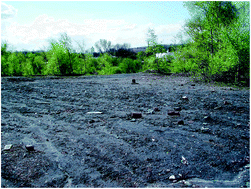
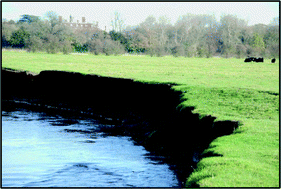
Contaminated land: can acute exposure be a significant health risk? Two case studies and associated risk assessment methods George Kowalczyk, Mark Brown, Rebecca Twigg, William Welfare and Yolande Macklin  
DOI: 10.1039/C3EM00278K

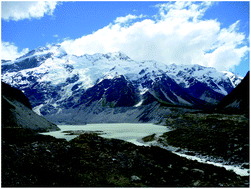
The influence of glacial meltwater on alpine aquatic ecosystems: a review
Krista E. H. Slemmons, Jasmine E. Sarosa and Kevin Simon  
DOI: 10.1039/C3EM00243H

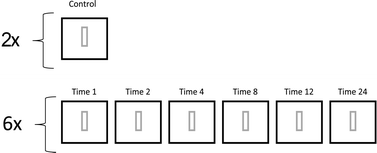
Use of semipermeable membrane devices (SPMDs) to characterize dissolved hydrocarbon fractions of both dispersed and undispersed oil
April R. Van Scoy, Jennifer Voorhees, Brian S. Anderson, Bryn M. Philips and Ronald S. Tjeerdema  
DOI: 10.1039/C3EM00275F

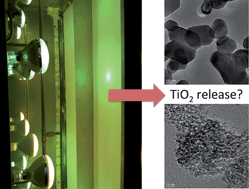
Release of TiO2 from paints containing pigment-TiO2 or nano-TiO2 by weathering
Ahmed Al-Kattan, Adrian Wichser, Roger Vonbank, Samuel Brunner, Andrea Ulrich, Stefano Zuin and Bernd Nowack  
DOI: 10.1039/C3EM00331K

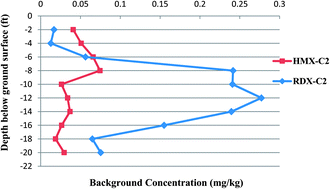
Pilot-scale in situ bioremediation of HMX and RDX in soil pore water in Hawaii
Zachary M. Payne, Krishna M. Lamichhane, Roger W. Babcock and Stephen J. Turnbull  
DOI: 10.1039/C3EM00320E

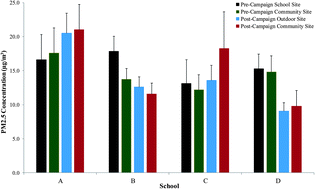
The impact of an anti-idling campaign on outdoor air quality at four urban schools
Patrick H. Ryan, Tiina Reponen, Mark Simmons, Michael Yermakov, Ken Sharkey, Denisha Garland-Porter, Cynthia Eghbalniad and Sergey A. Grinshpun  
DOI: 10.1039/C3EM00377A

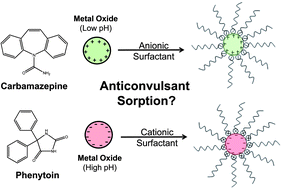
Influence of organic surface coatings on the sorption of anticonvulsants on mineral surfaces
Shen Qua and David M. Cwiertny  
DOI: 10.1039/C3EM00288H

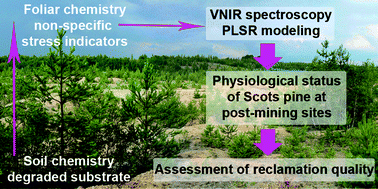
Detection of multiple stresses in Scots pine growing at post-mining sites using visible to near-infrared spectroscopy Lhotáková Zuzana,  Brodský Lukáš, Kupková Lucie, Kopačková Veronika, Potůčková Markéta, Mišurec Jan, Klement Aleš,   Kovářová Monika and Albrechtová Jana  
DOI: 10.1039/C3EM00388D

 
Human exposure to aluminium
Christopher Exleya  
DOI: 10.1039/C3EM00374D

 
Lability, solubility and speciation of Cd, Pb and Zn in alluvial soils of the River Trent catchment UK
Maria Izquierdo, Andrew M. Tye and Simon R. Chenery  
DOI: 10.1039/C3EM00370A

*Free access to individuals is provided through an RSC Publishing personal account. It’s quick, easy and more importantly – free – to register!

Digg This
Reddit This
Stumble Now!
Share on Facebook
Bookmark this on Delicious
Share on LinkedIn
Bookmark this on Technorati
Post on Twitter
Google Buzz (aka. Google Reader)

It’s an aluminium age: exploring human exposure

Aluminium is the most abundant metal in the Earth’s crust. Its range of desirable chemical and physical properties (e.g. low density, thermal conductivity, corrosion resistance etc) has made it the most widely used metal of the 21st century, utilised in a huge variety of products and applications, from kitchen utensils to aircraft parts, from food packaging to window frames. However, while the extracting and casting of this abundant resource yields many benefits, the disruption of natural geochemical and biochemical systems may expose organisms including humans to potential harm. It is of paramount importance that we fully understand the ways in which humans are exposed to aluminium and its behaviour within the body. This will allow the nature and extent of potential toxic effects to be assessed and enable people to live safely with these possible dangers.

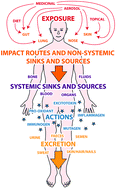
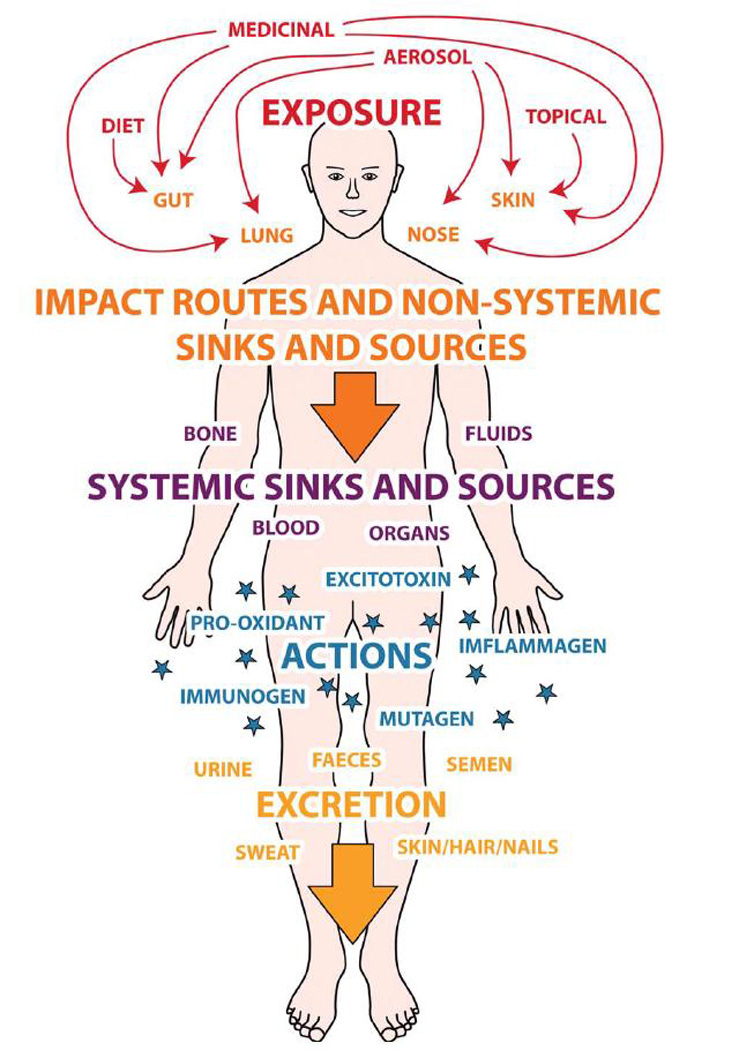
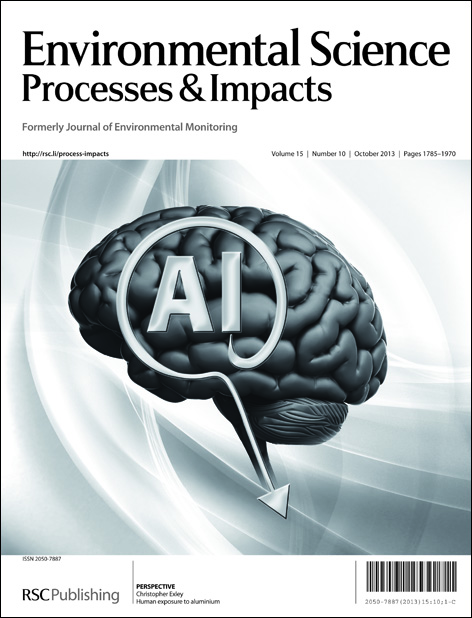
In this article, which featured on the cover of Environmental Science: Processes & Impacts Issue 10, Christopher Exley provides a detailed and comprehensive critical review, addressing these issues. A broad range of specific aspects within the field of aluminium exposure are covered. The myriad ways in which humans are exposed to aluminium (including inhalation, diet and cosmetics) are discussed as well as the key impact routes (e.g. skin. nose, lung and gut), distribution networks within the body (e.g. blood) and excretion routes. The mechanisms through which aluminium can exert biochemical effects in humans (e.g. pro-oxidant activity, immunopotency and mutagenicity) are also described. Additionally, the article provides a complete and clear description of the aluminium ‘body burden’ (the balance between exposure and excretion).

This article challenges the current perception that aluminium is completely ‘safe’ and demonstrates the need to change our thinking regarding human exposure to metals like aluminium. Furthermore, several key knowledge gaps in this field are identified. Specific areas for future research, required to improve our understanding of aluminium exposure and toxicology, are outlined. In particular, the need to identify specific ‘targets’ within biological systems that may be more vulnerable to aluminium ‘attack’ than others is emphasised. Also, a need to establish an acceptable level of ‘safe’ exposure in humans is highlighted.

Exley suggests that gaining a full understanding of aluminium exposure and body burden in humans will require further data to be gathered from both laboratory and computer modelling approaches. This article will therefore be a valuable resource for researchers within these fields as well as for policy-makers at local and national levels.

Read the full article here:
Human exposure to aluminium, Christopher Exley, DOI : 10.1039/c3em00374d

Digg This
Reddit This
Stumble Now!
Share on Facebook
Bookmark this on Delicious
Share on LinkedIn
Bookmark this on Technorati
Post on Twitter
Google Buzz (aka. Google Reader)