New RSC Book Series: Metallobiology

The RSC have just announced an exciting new book series on metallobiology, to provide an insightful perspective on the role of metals in biology.   As Editor-in-Chief, Professor David Garner (University of Nottingham, UK) will lead the Editorial Board of this Book Series, working with Professor Hongzhe Sun (University of Hong Kong, China), Professor Ann Walker (University of Arizona, USA) and Professor Anthony Wedd (University of Melbourne, Australia).

The Series will include the following topics:

  • Binding, transport and storage of metal ions
  • Interactions of metal ions with biomolecules, including proteins, DNA, RNA and nucleotides
  • Metal-based pharmaceuticals, including delivery and function
  • Bioorganometallic chemistry
  • Metalloporphyrins
  • Biominerals, biomineralization, biomaterials and bionanomaterials
  • Metal-based disease states, infection and immunology
  • Metal toxicology
  • Environmental bioinorganic chemistry
  • Metalloproteins
  • Metalloenzymes, including DNAzymes and ribozymes
  • Metallomes of biological systems
  • Metallothioneins
  • Bioimaging and biosensing of metals
  • Speciation of metals in biological systems
  • Spectroscopic investigations of metals in biological systems
  • Structural studies of metalloenzymes, metalloproteins and other metal-containing biomolecules 

More information can be found on the RSC Books website  here.

Digg This
Reddit This
Stumble Now!
Share on Facebook
Bookmark this on Delicious
Share on LinkedIn
Bookmark this on Technorati
Post on Twitter
Google Buzz (aka. Google Reader)

Hot Article: Platinum anti-cancer complexes

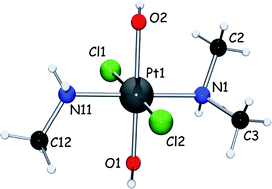
Pt(IV) complexes are accepted as a class of potential anticancer compounds with better oral activity than their Pt(II) analogues.  Adoración G. Quiroga and colleagues have synthesised two novel Pt(IV) complexes based on Pt(II) analogues previously shown by them to have potential as anticancer compounds. The team from Spain, Australia and Germany describe in this paper the synthesis, characterization, and unusually high cytotoxicity against three human cancer cell lines of these novel Pt(IV) complexes.

The preparation and characterization of trans-platinum(iv) complexes with unusually high cytotoxicityThe preparation and characterization of trans-platinum(IV) complexes with unusually high cytotoxicity
Leticia Cubo, Trevor W. Hambley, Pablo J. Sanz Miguel, Amancio Carnero, Carmen Navarro-Ranninger and Adoración G. Quiroga
Dalton Trans., 2011, Advance Article
DOI: 10.1039/C0DT00565G, Paper

 READ FOR FREE! Until the 12th November.

Digg This
Reddit This
Stumble Now!
Share on Facebook
Bookmark this on Delicious
Share on LinkedIn
Bookmark this on Technorati
Post on Twitter
Google Buzz (aka. Google Reader)

Hot Article: Novel cyclodiphosphazane-derived phosphine ligands

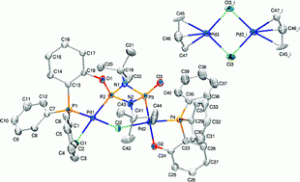
In this paper Maravanji S. Balakrishna and colleagues from India and the USA report the first examples of cyclodiphosphazane-derived phosphine ligands and their transition metal chemistry. The chemistry of cyclodiphosphazanes has received considerable interest recently due to their utility as ligands towards both main group and transition elements, building blocks in macrocyclic chemistry, mechanistic probes for organic reactions, and catalytic and biological applications.  Find out more in this Dalton Transactions ‘Hot Article’.

Transition metal chemistry of cyclodiphosphanes containing phosphine and amide-phosphine functionalities: Formation of a stable dipalladium(II) complex containing a Pd–P σ-bond.Transition metal chemistry of cyclodiphosphanes containing phosphine and amide-phosphine functionalities: Formation of a stable dipalladium(II) complex containing a Pd–P σ-bond.
Maravanji S. Balakrishna, Ramalingam Venkateswaran and Joel T. Mague
Dalton Trans., 2010, Advance Article
DOI: 10.1039/C0DT00614A, Paper

READ FOR FREE! Until the 11th November.

Digg This
Reddit This
Stumble Now!
Share on Facebook
Bookmark this on Delicious
Share on LinkedIn
Bookmark this on Technorati
Post on Twitter
Google Buzz (aka. Google Reader)

Hot Article: Computational study of ethene hydroarylation at a model catalyst

Computational studies have made an important contribution to understanding the mechanisms of C-H bond activation by transition metal systems.  In this Hot Article David Davies and Stuart A. Macgregor from the University of Leicester and Amalia Poblador-Bahamonde from Heriot-Watt University have used density functional theory calculations to define the energetics of ethene hydroarylation with a [Ir(κ2-OAc)(PMe3)Cp]+ catalyst and to assess possible competing side reactions.

Computational study of ethene hydroarylation at [Ir(κ2-OAc)(PMe3)Cp]+Computational study of ethene hydroarylation at [Ir(κ2-OAc)(PMe3)Cp]+
David L. Davies, Stuart A. Macgregor and Amalia I. Poblador-Bahamonde
Dalton Trans., 2010, Advance Article
DOI: 10.1039/C0DT00409J, Paper 

READ FOR FREE! Until the 9th November.

Digg This
Reddit This
Stumble Now!
Share on Facebook
Bookmark this on Delicious
Share on LinkedIn
Bookmark this on Technorati
Post on Twitter
Google Buzz (aka. Google Reader)

Hot Article: Making cerium cubes!

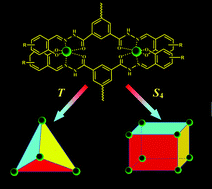
Chinese scientists use clever self-assembly techniques and symmetry to make Cerium cubes and molecular tetrahedrons. Read more in their Dalton Transactions Hot communication:

A symmetry-controlled and face-driven approach for the assembly of cerium-based molecular polyhedra 
Yang Liu, Zhihua Lin, Cheng He, Liang Zhao and Chunying Duan
Dalton Trans., 2010, DOI: 10.1039/C0DT01086C

READ FOR FREE! Until the 2nd of November.

Digg This
Reddit This
Stumble Now!
Share on Facebook
Bookmark this on Delicious
Share on LinkedIn
Bookmark this on Technorati
Post on Twitter
Google Buzz (aka. Google Reader)

Nobel Congratulations to Richard Heck, Ei-ichi Negishi and Akira Suzuki

The 2010 Nobel prize for chemistry has been awarded to Professors Richard Heck (University of Delaware, USA), Ei-ichi Negishi (Purdue University, USA) and Akira Suzuki (Hokkaido University, Japan), ‘ for palladium-catalyzed cross couplings in organic synthesis’.

Palladium-catalyzed cross coupling has had, and continues to have, a significant and wide reaching impact on research around the world, as well as in the commercial production of, e.g. pharmaceuticals and molecules for the electronics industry.

On behalf of the Dalton Transactions Editorial Board and Editorial Office, hearty congratulations, Richard, Ei-ichi and Akira!

Read Ei-ichi Negishi’s recent Dalton Transactions Perspective article, A quarter of a century of explorations in organozirconium chemistry, Dalton Trans., 2005, 827-848.

Digg This
Reddit This
Stumble Now!
Share on Facebook
Bookmark this on Delicious
Share on LinkedIn
Bookmark this on Technorati
Post on Twitter
Google Buzz (aka. Google Reader)

Hot Article: Taking TiF4 complexes to extremes

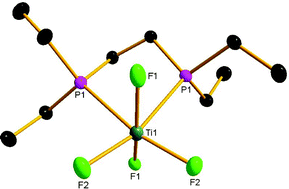
Phosphine, arsine and thioether complexes with metal fluorides are especially rare. In this Hot Article, Bill Levason and colleagues report the first examples of soft-donor alkyl phosphine complexes of TiF4.

Taking TiF4 complexes to extremes – the first examples with phosphine co-ligands 
Marek Jura, William Levason, Edmund Petts, Gillian Reid, Michael Webster and Wenjian Zhang
Dalton Trans., 2010, DOI: 10.1039/C0DT00747A

READ FOR FREE! Until the 2nd of November.

Digg This
Reddit This
Stumble Now!
Share on Facebook
Bookmark this on Delicious
Share on LinkedIn
Bookmark this on Technorati
Post on Twitter
Google Buzz (aka. Google Reader)

Hot Article: Solving the puzzle of Cu-catalyzed crosscoupling

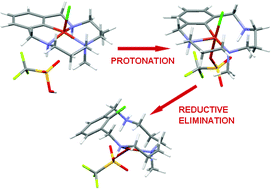
In their Hot Article, Solà, Stahl, Ribas and co-workers shed mechanistic light on the pharmaceutically important Cu-catalyzed Ullmann–Goldberg-type crosscoupling chemistry. Until now, fundamental knowledge of the mechanism of these reactions was still lacking. Find out more in this Dalton Transactions paper.

Molecular mechanism of acid-triggered aryl–halide reductive elimination in well-defined aryl–CuIII–halide species 
Alicia Casitas, Albert Poater, Miquel Solà, Shannon S. Stahl, Miquel Costas and Xavi Ribas
Dalton Trans., 2010, DOI: 10.1039/C0DT00284D 

READ FOR FREE until the 2nd of November.


Digg This
Reddit This
Stumble Now!
Share on Facebook
Bookmark this on Delicious
Share on LinkedIn
Bookmark this on Technorati
Post on Twitter
Google Buzz (aka. Google Reader)

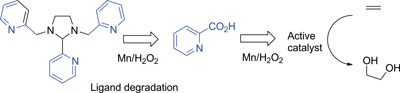
Hot Article: Degradation powering oxidation catalysts

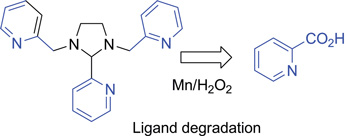
In their exciting Dalton Transactions Hot Article, Wesley Browne, Ben Feringa and colleagues show that pyridine-2-carboxylic acid plays an unexpected role in manganese based oxidation catalysis. The group show that, though catalyst degradation is typically considered as a cause of catalyst deactivation, in this case in situ ligand degradation actually results in a highly active oxidation system.  

The unexpected role of pyridine-2-carboxylic acid in manganese based oxidation catalysis with pyridin-2-yl based ligands 
Dirk Pijper, Pattama Saisaha, Johannes W. de Boer, Rob Hoen, Christian Smit, Auke Meetsma, Ronald Hage, Ruben P. van Summeren, Paul L. Alsters, Ben L. Feringa and Wesley R. Browne
Dalton Trans., 2010, DOI: 10.1039/C0DT00452A , Paper

READ FOR FREE! Until the 2nd of November.

Digg This
Reddit This
Stumble Now!
Share on Facebook
Bookmark this on Delicious
Share on LinkedIn
Bookmark this on Technorati
Post on Twitter
Google Buzz (aka. Google Reader)

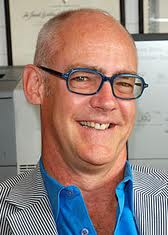
Chris Orvig elected Fellow of Royal Society of Canada

Professor Chris Orvig, Chair of the Dalton Transactions Editorial Board, has been elected Fellow of the Royal Society of Canada.

The citation for Chris’ election reads:

Chris Orvig, amongst the world’s foremost medicinal inorganic chemists, is also one of Canada’s best-known inorganic chemists. He studies metal ions in the etiology, diagnosis, and therapy of disease, making seminal contributions, both fundamental and applied, to the understanding of metal ions in biological processes.

Professor Chris Orvig, FRSC

Professor Chris Orvig, FRSC

Chris has been the Chair of the Dalton Transactions Editorial Board since 2008 and, working together with the Editorial Board and Editorial Office, has overseen some significant developments for the journal, culminating this year with the journal’s impressive rise in impact factor to 4.1!

We are delighted with this well-deserved election to Canada’s foremost learned society. Well done Chris!

Read Chris Orvig’s most recent Dalton Transactions article here.

Digg This
Reddit This
Stumble Now!
Share on Facebook
Bookmark this on Delicious
Share on LinkedIn
Bookmark this on Technorati
Post on Twitter
Google Buzz (aka. Google Reader)