Archive for the ‘News’ Category

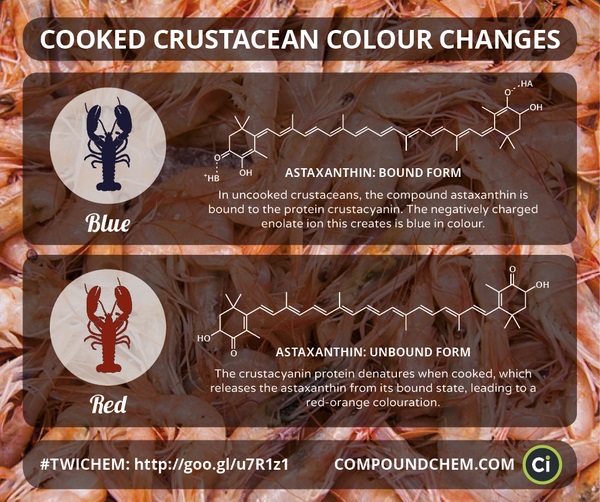
Why does a lobster change colour when you cook it?

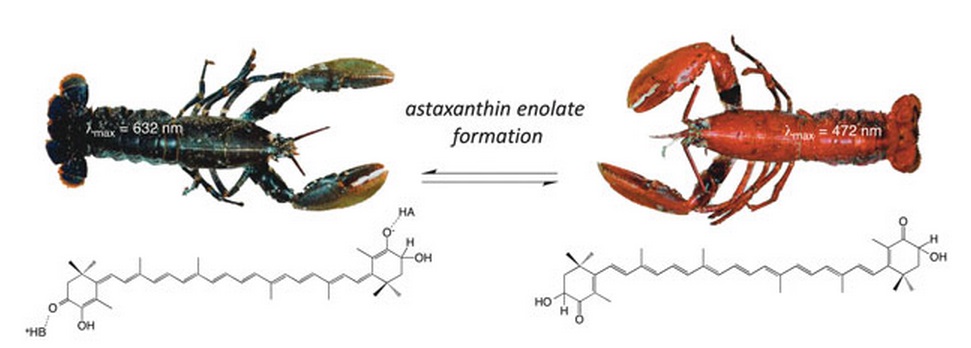
When you cook a lobster you will see a striking colour transformation from dark blue to orange-pink and until now, the cause for this has been subject to debate.  Although the presence of astaxanthin, a carotenoid, is known to be responsible for the change, a recent PCCP article has shed light on exactly how.

In an international collaboration, Dr. John Halliwell at the University of Manchester and his group, have found that astaxanthin is present as a negatively charged enolate ion in the uncooked blue lobster. On heating, the enolate bonds break down and release orange-pink astaxanthin causing the colour change. This discovery has been made as a result of the combined interdisciplinary expertise in physical organic, biological and theoretical chemistry as well as spectroscopy.

Interested to know more?

Read the full article in Chemistry World by William Bergius.

Or, take a look at the original Open Access research article:

On the origin and variation of colours in lobster carapace, Shamima Begum, Michele Cianci, Bo Durbeej, Olle Falklöf, Alfons Hädener, John R. Helliwell, Madeleine Helliwell, Andrew C. Regan and   C. Ian F. Watt, Phys. Chem. Chem. Phys., 2015, DOI: 10.1039/C4CP06124A


Digg This
Reddit This
Stumble Now!
Share on Facebook
Bookmark this on Delicious
Share on LinkedIn
Bookmark this on Technorati
Post on Twitter
Google Buzz (aka. Google Reader)

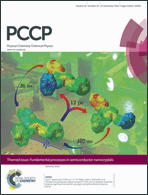
Fundamental processes in semiconductor nanocrystals – PCCP themed issue online now

PCCP is delighted to present a themed collection which includes a number of great articles on Fundamental Processes in Semiconductor Nanocrystals. The issue was guest edited by Efrat Lifshitz (Technion, Israel) and Laurens Siebbeles (TU Delft, The Netherlands) and brings together a collection of contributed papers that cover current interest in a wide variety of topics associated with semiconductor crystals. You can read the Guest Editor’s full introduction to the issue in their Editorial.

There are a number of great contributions in this issue, including:

Influence of nanoparticle shape on charge transport and recombination in polymer/nanocrystal solar cells
Zhe Li, Weiyuan Wang, Neil C. Greenham and Christopher R. McNeill
Phys. Chem. Chem. Phys., 2014,16, 25684-25693

Multiple exciton generation in cluster-free alloy CdxHg1−xTe colloidal quantum dots synthesized in water
Stephen V. Kershaw, Sergii Kalytchuk, Olga Zhovtiuk, Qing Shen, Takuya Oshima, Witoon Yindeesuk, Taro Toyoda and Andrey L. Rogach
Phys. Chem. Chem. Phys., 2014,16, 25710-25722

Take a look at the themed collection online now to see all of the great contributions!


Digg This
Reddit This
Stumble Now!
Share on Facebook
Bookmark this on Delicious
Share on LinkedIn
Bookmark this on Technorati
Post on Twitter
Google Buzz (aka. Google Reader)

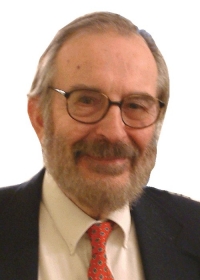
Paul von Ragué Schleyer, 1930–2014

Credit: U of Georgia

Paul von Ragué Schleyer, a leading figure in physical organic chemistry, died on November 21st at his home in Georgia, USA. Schleyer pioneered the use of computational chemistry in characterizing new and widely used concepts and made vast contributions to a broad range of physical organic, organometallic, inorganic, and theoretical chemistry topics.

‘Paul Schleyer was one of the greatest chemists of the 20th century’, says Herbert Mayr, from Ludwig Maximilian University of Munich, Germany. ‘Paul’s impact on Organic Chemistry is only inadequately reflected by the impressive numbers of articles he had published. Of even greater importance was his influence on the thinking of a countless number of scientists who discussed with him their projects, collaborated with him, or just attended his lectures.’

Schleyer attended Princeton University gaining an A.B. degree in Chemistry in 1951, followed by Harvard University where he received a Ph.D. in physical organic chemistry under Paul Bartlett in 1957. In 1976 Schleyer moved to the University of Erlangen-Nuremberg, in Germany and became a frequent speaker at international meetings, forming close relationships with many chemists with whom he would continue to maintain an active correspondence. Schleyer extended his career well past the mandatory retirement age in Germany and continued to contribute to the field as Graham Perdue Professor at the University of Georgia.

PCCP would like to send our deepest condolences to Paul Schleyer’s family and colleagues.

Is C60 buckminsterfullerene aromatic?
Zhongfang Chen,  Judy I. Wu,   Clémence Corminboeuf,  Jonathan Bohmann,  Xin Lu,  Andreas Hirsch and  Paul von Ragué Schleyer
Phys. Chem. Chem. Phys., 2012,14, 14886-14891

D 3h CN3Be3+ and CO3Li3+: viable planar hexacoordinate carbon prototypes
Yan-Bo Wu, Yan Duan, Gang Lu, Hai-Gang Lu, Pin Yang, Paul von Ragué Schleyer, Gabriel Merino, Rafael Islas and Zhi-Xiang Wang
Phys. Chem. Chem. Phys., 2012,14, 14760-14763

Digg This
Reddit This
Stumble Now!
Share on Facebook
Bookmark this on Delicious
Share on LinkedIn
Bookmark this on Technorati
Post on Twitter
Google Buzz (aka. Google Reader)

PCCP Impact Factor rises to 4.19

We are delighted to announce that PCCP’s Impact Factor* has increased to 4.19.pccp cover

PCCP has a large and truly international readership, which spans many communities in the broad fields of physical chemistry, chemical physics and biophysical chemistry.

With fast publication times and great author service, PCCP remains the ideal home for high-quality research.

We thank all of our authors, referees and Board members for their continued support of the journal.

We invite you to submit your next high-quality paper to PCCP.

Read more about the 2013 Impact Factors from across RSC Publishing on the RSC Publishing Blog.

*The Impact Factor provides an indication of the average number of citations per paper. Produced annually, Impact Factors are calculated by dividing the number of citations in a year by the number of citeable articles published in the preceding two years. Data based on 2013 Journal Citation Reports®, (Thomson Reuters, 2014).

Digg This
Reddit This
Stumble Now!
Share on Facebook
Bookmark this on Delicious
Share on LinkedIn
Bookmark this on Technorati
Post on Twitter
Google Buzz (aka. Google Reader)

Diamonds are an explosive’s best friend – PCCP article in Chemistry World

Scientists from China have coated the high energy explosive RDX (hexahydro-1,3,5-trinitro-1,3,5-triazine) with nanodiamonds in an attempt to make safer explosives.

The group, led by Yi Tong, from the Beijing Institute of Technology, prepared detonation nanodiamonds by detonating a mixture of TNT and RDX in a closed metallic chamber. Detonation nanodiamonds are known to have excellent Diamonds are an explosive’s best friend - © Shutterstockmechanical properties, including high thermal conductivity and electrical resistivity, whilst being chemically reactive but also environmentally benign. RDX was coated with different proportions of nanodiamonds to try to stabilise the explosive. This is important as you don’t want explosives to detonate if they are accidently heated when in storage.
By studying the thermodynamics of the resulting composites, the group found that nanodiamond coatings of between 1/7 and 1/5 of the mass of the RDX led to composites that were more stable than RDX alone, but that were more reactive than composites with thinner coatings. They also found that increasing the nanodiamond ratio to more than 1/3 of the mass of the RDX hindered the decomposition of the material.

Interested to know more?

Read the full article by Rachel Wood in Chemistry World here…

Read the article in PCCP:

The effect of a detonation nanodiamond coating on the thermal decomposition properties of RDX explosives
Yi Tong, Rui Liu and Tonglai Zhang
Phys. Chem. Chem. Phys., 2014, Advance Article
DOI: 10.1039/C4CP02237H

Digg This
Reddit This
Stumble Now!
Share on Facebook
Bookmark this on Delicious
Share on LinkedIn
Bookmark this on Technorati
Post on Twitter
Google Buzz (aka. Google Reader)

Applications open for the 2015 Gordon F. Kirkbright Bursary Award

The Gordon F. Kirkbright bursary award is a prestigious annual award that enables a promising student/non-tenured young scientist of any nation to attend a recognised scientific meeting or visit a place of learning.

The fund for this bursary was established in 1985 as a memorial to Professor Gordon Kirkbright in recognition of his contributions to analytical spectroscopy and to science in general. Although the fund is administered by the Association of British Spectroscopists (ABS) Trust, the award is not restricted to spectroscopists.

Applications are invited for the 2015 Gordon Kirkbright Bursary.

For further information contact John Chalmers by email: vibspecconsult@aol.com

The closing date for entries is 31 December 2014.

Digg This
Reddit This
Stumble Now!
Share on Facebook
Bookmark this on Delicious
Share on LinkedIn
Bookmark this on Technorati
Post on Twitter
Google Buzz (aka. Google Reader)

Out of the frying pan and into the atmosphere: PCCP article in Chemistry World

Researchers at the University of Reading have come closer to understanding why fatty acids, emitted in significant quantities by fast food outlets cooking meat, persist for so long in the atmosphere.

Out of the fying pan and into the atmosphere

Christian Pfrang and colleagues, studied the ozone oxidation kinetics of methyl oleate monolayers at the air–water interface using experiments designed to mimic the atmospheric degradation of aerosols formed from fatty acid surfactants and moisture droplets. The experiments were carried out by skimming a fine beam of neutrons off a free air–water interface while the oxidation reaction took place. They found that the methyl ester monolayers broke down much faster than expected based on reported lifetimes in the atmosphere, suggesting that the long-chain organics are taken up into the droplet itself, where they are protected from further ozonolysis.

The presence of particulate matter in the atmosphere is a major health concern and may ultimately have significant climate change implications. Reports suggest that around a third of directly emitted aerosols above central London come from cooking, the majority of which are rich in oleic acid derivatives produced by cooking meat. These types of emissions are on the rise as vehicles move towards biofuels, another source of fatty acid methyl esters.

Interested to know more?

Read the full article by Richard Massey in Chemistry World here…

Read the article in PCCP:

Ozonolysis of methyl oleate monolayers at the air–water interface: oxidation kinetics, reaction products and atmospheric implications
Christian Pfrang, Federica Sebastiani, Claire O. M. Lucas, Martin D. King, Ioan D. Hoare, Debby Chang and Richard A. Campbell  
Phys. Chem. Chem. Phys., 2014, Advance Article
DOI: 10.1039/C4CP00775A

Digg This
Reddit This
Stumble Now!
Share on Facebook
Bookmark this on Delicious
Share on LinkedIn
Bookmark this on Technorati
Post on Twitter
Google Buzz (aka. Google Reader)

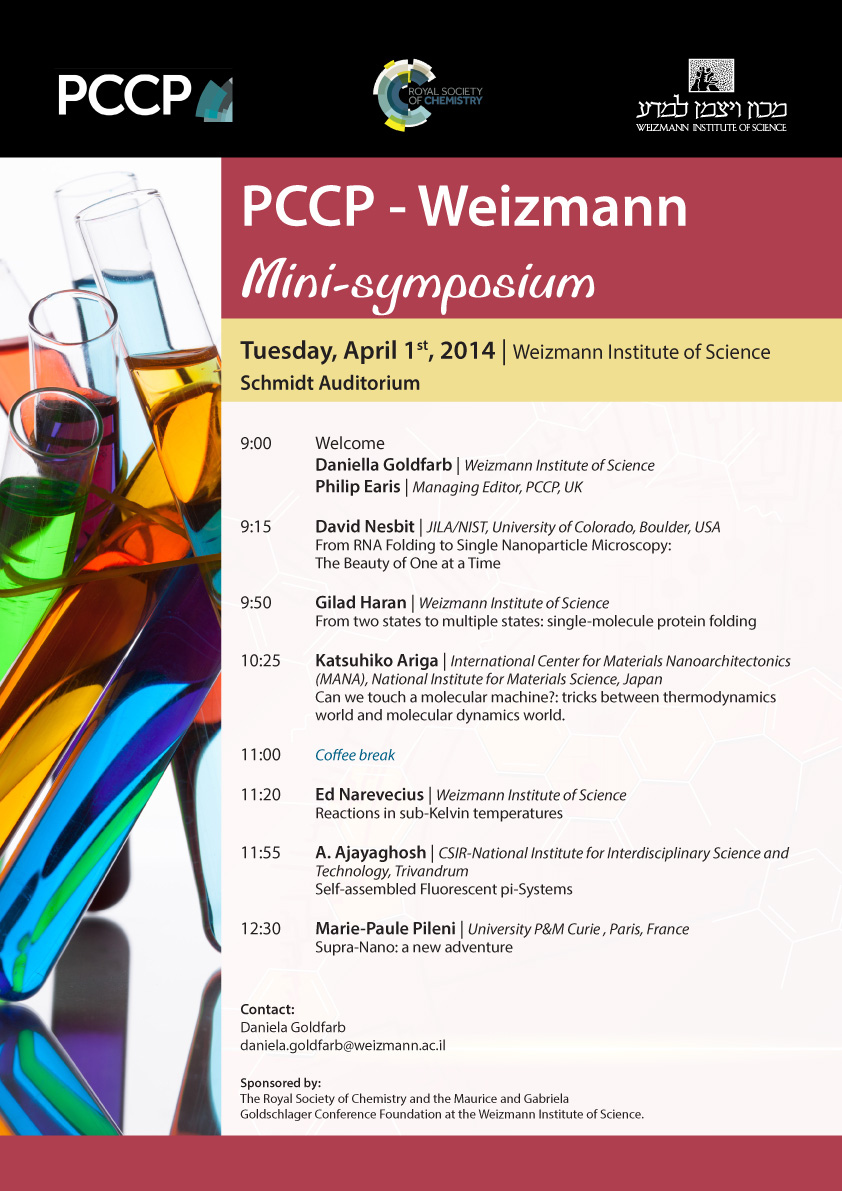
PCCP – Weizmann mini symposium: 1st April 2014

Join us for the upcoming joint Physical Chemistry Chemical Physics (PCCP) – Weizmann Institute of Science mini-symposium on Tuesday 1st April 2014.

The event is free to attend for all delegates and no registration is necessary.

More details of the exciting programme can be found below.

PCCP Weizmann Mini Symposium advert

Digg This
Reddit This
Stumble Now!
Share on Facebook
Bookmark this on Delicious
Share on LinkedIn
Bookmark this on Technorati
Post on Twitter
Google Buzz (aka. Google Reader)

Centrifuge spectroscopy probes extreme rotational states: PCCP article in Chemistry World

A new spectroscopic technique for studying electronically excited molecules at very high angular momentum has been developed and tested by scientists in Canada.

The team, from the University of British Columbia, headed by Valery Milner, have used an optical centrifuge to excite oxygen to rotational states that otherwise can’t be reached. An optical centrifuge combines two laser pulses to create an intense electric field which undergoes angular acceleration to drive molecules into the remarkable angular momentum states. The super rotation state reached for oxygen in the study is equivalent to heating the molecule to 50,000K, a temperature that is too hot for the molecule to survive. A spectroscopic technique called resonance-enhanced multi-photon ionisation was combined with the centrifuge and by carefully controlling and calibrating the rotational speed of the centrifuge a spectrum can be viewed as a two-dimensional function of photon energy and angular momentum.

‘It greatly simplifies the spectra,’ says Aleksey Korobenko, the lead scientist on this study. ‘Even when the photon energy branches are overlapping, you can track one by one the rotational peaks which you can’t otherwise separate out.’

Interested to know more?

Read the full article by Rachel Wood in Chemistry World here…

Read the article in PCCP:

Rotational spectroscopy with an optical centrifuge
Aleksey Korobenko, Alexander A. Milner, John W. Hepburn and Valery Milner
Phys. Chem. Chem. Phys., 2014, Advance Article
DOI: 10.1039/C3CP54598A, Paper

Digg This
Reddit This
Stumble Now!
Share on Facebook
Bookmark this on Delicious
Share on LinkedIn
Bookmark this on Technorati
Post on Twitter
Google Buzz (aka. Google Reader)

Insights into “carbon bonds” highlighted

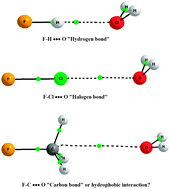
Schematic of proposed "carbon bond"The work of PCCP Advisory Board member Professor Elangannan Arunan on noncovalent bonding interactions has been highlighted in the latest Edition of Chemical & Engineering News. The so-called “carbon bonds” have been suggested as the force behind the hydrophobic effect.
You can find the full details of this fascinating research here:

The X–CY (X = O/F, Y = O/S/F/Cl/Br/N/P) ‘carbon bond’ and hydrophobic interactions
Devendra Mani and E. Arunan
DOI: 10.1039/C3CP51658J

The C&EN article also discusses the important work of Professor T. N. Guru Row’s group which very recently appeared in Chemical Communications on X-ray data which provides experimental evidence of the effect:

Experimental evidence for ‘carbon bonding’ in the solid state from charge density analysis
Sajesh P. Thomas, Mysore S. Pavan and T. N. Guru Row
DOI: 10.1039/C3CC47226D

And while you are at it, check out the PCCP Perspective by Peter Politzer et al. which provides an overview of this area:

Halogen bonding and other σ-hole interactions: a perspective
Peter Politzer, Jane S. Murray and Timothy Clark
DOI: 10.1039/C3CP00054K

Digg This
Reddit This
Stumble Now!
Share on Facebook
Bookmark this on Delicious
Share on LinkedIn
Bookmark this on Technorati
Post on Twitter
Google Buzz (aka. Google Reader)