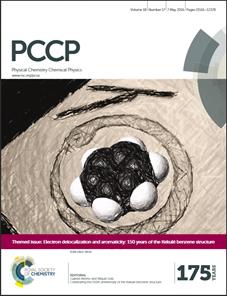

London – May 16: We are delighted to announce a new partnership between Overleaf and the Royal Society of Chemistry. Through this partnership, authors submitting to Physical Chemistry Chemical Physics (PCCP) will have access to the award-winning Overleaf collaborative cloud-based writing and reviewing tool with 1-click submission into the PCCP ScholarOne submission system.
A PCCP journal template is available within the Overleaf platform to help authors write, collaborate and publish their work in the correct journal format. Once authors are finished writing, they can quickly and easily submit to PCCP using the 1-click submission link within Overleaf. All files and necessary information will be seamlessly transferred to the PCCP submission system – greatly simplifying the author’s submission experience.
Caroline Burley, Journals Operations Manager, Publishing Services & Production at the Royal Society of Chemistry, says:
“Our authors want the submission process to be quick and simple, so we’re very pleased to be partnering with Overleaf to offer this benefit to PCCP’s authors. This development makes the process of submitting a paper to PCCP from the Overleaf platform as easy as the click of a button.”
John Hammersley, Founder & CEO of Overleaf says:
“I’m hugely excited for Overleaf to be able to support the Royal Society of Chemistry, the PCCP journal and their authors through this new partnership. Simplifying and streamlining an author’s writing and submission experience is a major goal for Overleaf and this partnership addresses that perfectly.”
Links to the template and Overleaf platform are available at the PCCP journal website.
I
About The Royal Society of Chemistry
We are the oldest chemical society in the world and in 2016 we’re celebrating 175 years of progress and people in the chemical sciences. Throughout the year, we’re sharing the stories of how our members past and present have helped to change the world with chemistry.
With over 50,000 members and a knowledge business that spans the globe, we are the UK’s professional body for chemical scientists; a not-for-profit organisation with 175 years of history and an international vision of the future.
We promote, support and celebrate chemistry. We work to shape the future of the chemical sciences – for the benefit of science and humanity.
I
About Overleaf
Founded in 2012 and with over 400,000 registered users, Overleaf is an academic authorship tool that allows seamless collaboration and effortless manuscript submission, all underpinned by cloud-technology. By providing an intuitive online collaborative writing and publishing platform, Overleaf is making the process of writing, editing and publishing scientific documents quicker and easier. Researchers and academics can now write, collaborate, and publish with a single click, directly from the Overleaf web-app. Publishers and Institutions are partnering with Overleaf to provide customized writing templates, simple reference tool linking, and one-click publishing submission links.
Supported by Digital Science, Overleaf aims to make science and research faster, more open and more transparent by bringing the whole scientific writing process into one place in the cloud – from idea, to writing, to review, to publication.
Follow @overleaf and @PCCP on Twitter.