Archive for the ‘Hot Article’ Category

Hot Article: 2D self-assembly of a hexapod


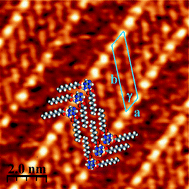
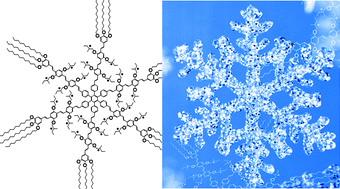
In this CrystEngComm Hot Article, Steven De Feyter, Albertus Schenning and colleagues investigate how molecular chirality can be expressed at the supramolecular level during 2D self-assembly.

They studied the formation of a chiral monolayer of a substituted hexaarylbenzene with 24 stereogenic centres at the interface between a liquid and highly oriented pyrolytic graphite. When both enantiomers are co-adsorbed on the surface, a racemic conglomerate is formed.

Read more for FREE:

A multivalent hexapod having 24 stereogenic centers: chirality and conformational dynamics in homochiral and heterochiral systems
Hong Xu, Martin Wolffs, Željko Tomović, E. W. Meijer, Albertus P. H. J. Schenning and Steven De Feyter
CrystEngComm, 2011, Advance Article
DOI: 10.1039/C1CE05433C, Paper

Digg This
Reddit This
Stumble Now!
Share on Facebook
Bookmark this on Delicious
Share on LinkedIn
Bookmark this on Technorati
Post on Twitter
Google Buzz (aka. Google Reader)

Hot Article: Aminoazines and their affinity for graphite

James D. Wuest and co-workers from the University of Montréal, Canada, look at crystalline amino-substituted azines in this CrystEngComm Hot article.

They look at how 2D and 3D structures of crystalline materials can be designed, using aminoazines and alkanecarboxylic acids absorbed on graphite as the test case, and as the authors say ‘Our results may therefore help identify other families of compounds that dependably favor analogous crystallization in 3D and 2D, possibly even when multiple surfaces are used and when significant epitaxy is not present’

Read the full article for FREE to find out more about these 2D and 3D structures…

Engineering homologous molecular organization in 2D and 3D. Cocrystallization of aminoazines and alkanecarboxylic acids
Adam Duong, Thierry Maris and James D. Wuest
CrystEngComm, 2011, DOI: 10.1039/C1CE05445G

Digg This
Reddit This
Stumble Now!
Share on Facebook
Bookmark this on Delicious
Share on LinkedIn
Bookmark this on Technorati
Post on Twitter
Google Buzz (aka. Google Reader)

Hot Article: Metal oxide nanoheterostructures

This CrystEngComm Hot article describes the fabrication of SnO2/α-Fe2O3 nanoheterostructures by a hydrothermal process.

The structures are made of iron oxide nanoprisms with tin dioxide nanorods on the inner and outer surfaces, which gives them superior visible light photocatalytic properties. The authors believe this is due to ‘the effective electron-hole separation at the SnO2/α-Fe2O3 interfaces’.

Read the full article for FREE to find out more about these nanostructures…

SnO2/α-Fe2O3 nanoheterostructure with novel architecture: structural characteristics and photocatalytic properties
Ju Xu, Feng Huang, Yunlong Yu, Anping Yang and Yuansheng Wang
CrystEngComm, 2011, DOI: 10.1039/C1CE05270E

Digg This
Reddit This
Stumble Now!
Share on Facebook
Bookmark this on Delicious
Share on LinkedIn
Bookmark this on Technorati
Post on Twitter
Google Buzz (aka. Google Reader)

HOT article: Crystalline perfection

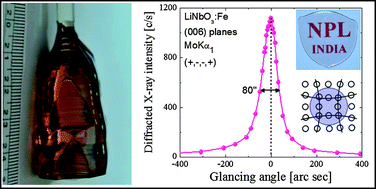
Lithium niobate (LN), a nonlinear optical  material in its single crystal form, is well proven as a potential and unique material for its use in advanced photonic device applications like second-harmonic generation, optical switching, optical modulators, holographic data storage, acousto-optic and ferroelectric. The transition and rare earth metal ions (Fe, Mn, Cuand Ce) improve the data storage capabilities of LN by improving its photorefraction efficiency. However, when the concentration of dopants in the crystal increase, high geometric strains develop in the lattice resulting in the agglomeration of point defects, the formation of dislocations finally leading to structural boundaries. These defects mask or partially/completely deteriorate some of the anisotropic physical properties of the single crystals and reduce the efficiency of the devices made out of these crystals.
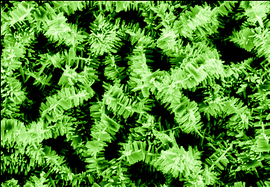
In this HOT article, a very detailed account of a novel technique for producing optical quality single crystals of doped lithium niobate is presented. The authors have grown Fe doped LiNbO3 single crystals using an indigenously developed Czochralski growth setup. In order to achieve good quality crystals (free from structural defects, voids and grain boundaries) from the Czochralski method they have used a post growth cooling technique. Additionally they have evaluated the potential of the material for use in optical devices and shown it to be “fit for purpose”.

Read more for FREE at:

Crystalline perfection, EPR, prism coupler and UV-VIS-NIR studies on Cz-grown Fe-doped LiNbO3: A photorefractive nonlinear optical crystal
Satya Kumar Kushwaha, Kamlesh Kumar Maurya, Narayanasamy Vijayan and Godavarthi Bhagavannarayana
CrystEngComm, 2011, Advance Article
DOI: 10.1039/C0CE00892C

Digg This
Reddit This
Stumble Now!
Share on Facebook
Bookmark this on Delicious
Share on LinkedIn
Bookmark this on Technorati
Post on Twitter
Google Buzz (aka. Google Reader)

HOT article: Nanorods make a stand

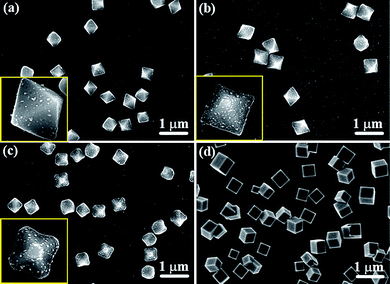
In this HOT article, ZnO nanorods were helped to “stand” vertically on microsubstrates by an interesting seed-mediated approach. Taking ZnO nanosheets as the microsubstrates, ZnO nanorods can grow vertically, not lying horizontally, on the facets with the aid of a seed layer precoating to form hierarchical ZnO nanorod-nanosheet architectures. The diameter as well as the length of the standing nanorods can be controlled effectively by adjusting the growth time and the amount of ammonia in the growth solution. The precoated seed layer has been found to be the key factor in determining the resultant morphology.
Read more for FREE at:

Help nanorods “stand” on microsubstrate to form hierarchical ZnO nanorod-nanosheet architectures
Jun Jiang, Feng Gu, Wei Shao, Lili Gai, Chunzhong Li and Guangjian Huang
CrystEngComm, 2011, Advance Article
DOI: 10.1039/C1CE05180F

Digg This
Reddit This
Stumble Now!
Share on Facebook
Bookmark this on Delicious
Share on LinkedIn
Bookmark this on Technorati
Post on Twitter
Google Buzz (aka. Google Reader)

Hot Article: Cocrystals by halogen bonding

.

This CrystEngComm Hot article investigates the formation of co-crystals from an isoindoline nitroxide and an iodoperfluorocarbon, and looks at the halogen bonding in the resulting crystals.

This is particularly interesting as organic spin systems such as this are of importance in the fields of spintronics and spin-based quantum computing. This method is fast and reliable, so the making of organic molecular magnetic materials is much easier.

.

Read the full article for FREE to discover more about the way they prepared their x-bonding co-crystals…

Vapour phase assembly of a halogen bonded complex of an isoindoline nitroxide and 1,2-diiodotetrafluorobenzene
Karl J. P. Davy, John McMurtrie, Llew Rintoul, Paul V. Bernhardt and Aaron S. Micallef
CrystEngComm, 2011, DOI: 10.1039/C1CE05344B

Digg This
Reddit This
Stumble Now!
Share on Facebook
Bookmark this on Delicious
Share on LinkedIn
Bookmark this on Technorati
Post on Twitter
Google Buzz (aka. Google Reader)

Hot Article: Green synthesis of PbS nanocrystals

In this CrystEngComm Hot Article, Hongzheng Chen and colleagues synthesized uniform PbS nanocrystals using a surfactant-free electrodeposition method.

They investigated the effect of the concentration of Cl ions, deposition time and applied deposition current in tuning the morphology of the crystals.

The authors believe the method could be extended to the shape-controlled synthesis of other semiconductor crystals, especially metal sulfides.

Read more for FREE:

Morphology evolution route of PbS crystals via environment-friendly electrochemical deposition
Weiming Qiu, Mingsheng Xu, Fei Chen, Xi Yang, Yaxiong Nan and Hongzheng Chen
CrystEngComm, 2011, Advance Article
DOI: 10.1039/C1CE05225J, Paper

Digg This
Reddit This
Stumble Now!
Share on Facebook
Bookmark this on Delicious
Share on LinkedIn
Bookmark this on Technorati
Post on Twitter
Google Buzz (aka. Google Reader)

Hot Article: ZnS nanocrystals with a cone-shaped head

Masato Uehara and Hideaki Maeda look at unusually shaped zinc sulphide nanocrystals in this CrystEngComm Hot article.

The scientists from Japan, made ZnS nanocrystals with a conical head, rather than the expected truncated pyramid.

Read the full article for FREE to find our more about these interesting nanocrystals…

Structural characterization of ZnS nanocrystals with a conic head using HR–TEM and HAADF tomography
Masato Uehara, Yusuke Nakamura, Satoshi Sasaki, Hiroyuki Nakamura and Hideaki Maeda
CrystEngComm, 2011, DOI: 10.1039/C1CE05168G

This paper is building on the team’s earlier work, published in CrystEngComm earlier in the year:

Controlled synthesis and structural evolutions of ZnS nanodots and nanorods using identical raw material solution, M. Uehara, S. Sasaki, Y. Nakamura, C. G. Lee, K. Watanabe, H. Nakamura and H. Maeda
CrystEngComm, 2011, 13, 2973–2983

Digg This
Reddit This
Stumble Now!
Share on Facebook
Bookmark this on Delicious
Share on LinkedIn
Bookmark this on Technorati
Post on Twitter
Google Buzz (aka. Google Reader)

Hot Article: Writing on fresnoite thin films

In this CrystEngComm Hot article, Michael Lorenz and colleagues from Universitat Leipzig have made fresnoite thin films, fused on various materials by pulsed laser deposition, for use in photonic applications.
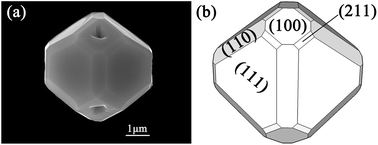
The mineral fresnoite (Ba2TiSi2O8)was discovered in California in 1965, and has become increasingly interesting to chemists because of its luminescence, non-linear optic and ferroelectic properties. In this work the authors examine the understudied films of these minerals, focussing on their growth using pulsed laser deposition, which hasn’t been done before.

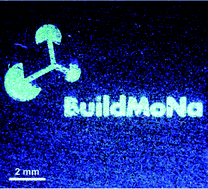
Lorenz and coworkers found that the fresnoite films had high photoluminescence intensity, and were able to use a laser to ‘write’ on the films, which induced local crystallisation. They think this will open the door for many applications of their films, including potentially ‘security features against product piracy or individualized branding of products’.

Read the full article for FREE to find out more about writing on the amorphous fresnoite films…

Fresnoite thin films grown by pulsed laser deposition: photoluminescence and laser crystallization
Alexander Müller, Michael Lorenz, Kerstin Brachwitz, Jörg Lenzner, Kai Mittwoch, Wolfgang Skorupa, Marius Grundmann and Thomas Höche
CrystEngComm, 2011, DOI: 10.1039/C1CE05265A

Digg This
Reddit This
Stumble Now!
Share on Facebook
Bookmark this on Delicious
Share on LinkedIn
Bookmark this on Technorati
Post on Twitter
Google Buzz (aka. Google Reader)

Hot Article: Polyhedral 50-facet cuprous oxide crystals

In this CrystEngComm Hot Article, Shaodong Sun et al. prepared polyhedral 50-facet cuprous oxide crystals with high-index planes using a seed-mediated solution phase route.

Cuprous oxide is a p-type semiconductor with potential applications including solar energy conversion, catalysis, gas sensors and lithium-ion batteries.

The authors studied the growth mechanism of the crystals, which will aid the design and synthesis of new polyhedral cuprous oxide architectures.

They also studied the photocatalytic activity of the crystals in the degradation of Methyl Orange dye. The crystals with high-index facets exhibited higher catalytic activity than crystals with low-index facets.

Find out more for FREE until 15th June 2011:

Seed-mediated synthesis of polyhedral 50-facet Cu2O architectures
Shaodong Sun, Dongchu Deng, Chuncai Kong, Yang Gao, Shengchun Yang, Xiaoping Song, Bingjun Ding and Zhimao Yang
CrystEngComm, 2011, Advance Article
DOI: 10.1039/C1CE05243H, Communication

Digg This
Reddit This
Stumble Now!
Share on Facebook
Bookmark this on Delicious
Share on LinkedIn
Bookmark this on Technorati
Post on Twitter
Google Buzz (aka. Google Reader)