

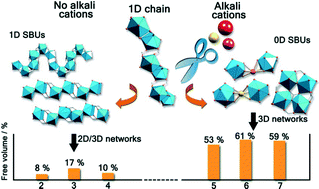
Many potential applications of metal-organic frameworks (MOFs) rely on the size and nature of the available free volume or pores within the framework structure. These include use for gas storage or capture and catalysis. Tuning of the pores is typically achieved by variation of the metal ions or organic ligands. Lengthening the organic chains can lead to increased pore size but is often limited by a decrease in stability of the framework. A new paper by Yan-Zhen Zheng and colleagues at Xi’an Jiaotong University and the University of Arizona reports a new method of structurally modifying MOFs by insertion of alkali metal ions.
In a series of experiments, a heterometallic MOF with O-containing ligands was modified by the insertion of alkali metal ions into the coordination environment formed by two bridged lanthanide centres. Initially, 2D or 3D Cu-Pr MOFs were formed with bridging isonicotinate ligands, by reacting isonicotinic acid, CuI and Pr(NO3)3 in a range of organic solvents. The reaction producing one of these MOFs, {[Pr3(Cu4I4)3(ina)9(DMF)4](DMF)}n (where ina is isonicotinato and DMF is N,N-dimethylformamide), was then repeated with the addition of NaCl, KCl, RbCl or CsCl.
In the NaCl and KCl reactions, new MOFs were produced incorporating Na+ or K+ ions, with void volumes of 53% and 61%, respectively (compared with 10% for the alkali metal ion free MOF).
Reaction involving the next largest ion, Rb+, produced an unstable MOF which could not be studied further. However, reaction with the larger Cs+ ion produced a new MOF which didn’t contain this ion, but with a void volume of 59%.
The authors suggest that their method of inducing structural variation using appropriately-sized alkali metal ions should be extendable to other ligand systems for the production of a variety of MOFs with novel structures and functions.
For more information, read the full paper at:
An alkali-ion insertion approach to structurally transform metal–organic frameworks
Yue-Qiao Hu, Mu-Qing Li, Teng Li, Yan-Yan Wang, Zhiping Zheng and Yan-Zhen Zheng
CrystEngComm, 2016, Advance Article
DOI: 10.1039/C6CE00540C
__________________________________________________________________________________________________
 Gwenda Kyd has a PhD in metallocarborane chemistry from the University of Edinburgh. Other research work includes the spectroscopic study of the structure of glasses and organometallic electron-transfer reactions and the preparation of new inorganic phosphors. She published a book, ‘Molecules, Medicines and Mischief’, in 2014, on some of the chemicals found in plants and is currently working on a follow-up.