Archive for the ‘Hot Article’ Category

HOT article: Nanoparticles within liposomes

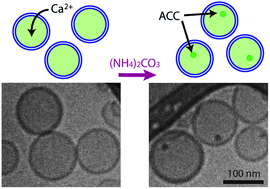
In this HOT article, the Joester group, show for the first time the synthesis and stabilization of amorphous calcium carbonate (ACC) nanoparticles in phosphatidylcholine liposomes (vesicles).  There is exactly one nanoparticle per liposome, and the ACC is stable over time (it does not crystallize for at lease 20 h).

The authors have also observed ACC nanoparticles of up to
200 nm in liposomes extruded through a 1 mm pore size membrane.  Showing no sign of faceting or crystallization, these are the largest ACC nanoparticles stabilized by confinement thus far.

The liposomal encapsulation strategies in combination with in situ imaging, scattering, and spectroscopy will aid in characterizing subsequent phase transformations and polymorph selection in the
nucleation and growth not only of calcium carbonate, but also other (bio)-minerals, pharmaceuticals, and proteins.

Read more for FREE at:
In vitro synthesis and stabilization of amorphous calcium carbonate (ACC) nanoparticles within liposomes
Chantel C. Tester, Ryan E. Brock, Ching-Hsuan Wu, Minna R. Krejci, Steven Weigand and Derk Joester
CrystEngComm, 2011, Advance Article
DOI: 10.1039/C1CE05153A

Digg This
Reddit This
Stumble Now!
Share on Facebook
Bookmark this on Delicious
Share on LinkedIn
Bookmark this on Technorati
Post on Twitter
Google Buzz (aka. Google Reader)

HOT article: “Beaded rings” for small molecule absorption

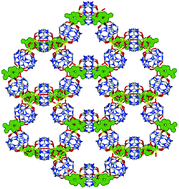
MOF structures as ‘beaded’ rings built on a p-hydroxybenzoic acid templateMOF have been much studied due to their potential applications from their excellent physical and chemical properties, however, many are unlikely to realize their potential due to the expense of the starting materials and/or complexity of the synthesis involved.  In this HOT article, Day and co-workers have formed stable cucurbit[5]uril MOF structures as ‘beaded’ rings built on a p-hydroxybenzoic acid template prepared readily by self-assembly as a supramolecular structure that remarkably can be recrystallised from water to form the same stoichiometry and structure as occurs under the initial crystallisation conditions.  Accessible channels have clearly been demonstrated for a group of polar volatile organic molecules with significant absorption selectivity for at least three examples.
Read more about these interesting porous structures for FREE at:

Stable cucurbit[5]uril MOF structures as ‘beaded’ rings built on a p-hydroxybenzoic acid template—a small molecule absorption material
Xing Feng, Kai Chen, Yun-Qian Zhang, Sai-Feng Xue, Qiang-Jiang Zhu, Zhu Tao and Anthony I. Day
CrystEngComm, 2011, Advance Article
DOI: 10.1039/C1CE05051F

Digg This
Reddit This
Stumble Now!
Share on Facebook
Bookmark this on Delicious
Share on LinkedIn
Bookmark this on Technorati
Post on Twitter
Google Buzz (aka. Google Reader)

Hot Article: Assembling isoniazid

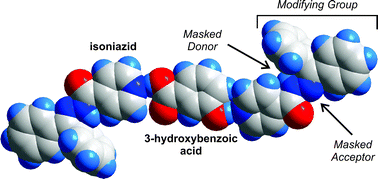
How does one control and modify the self-assembly process of organic molecules towards a desired solid state? Andreas Lemmerer, Joel Bernstein and Volker Kahlenberg ask themselves this very question in their recent CrystEngComm Hot Article. In their paper the group tell us how they modify the hydrogen bonding in isonicotinic acid hydrazide (isoniazid) in order to control the self-assembly process.

Isoniazid is an active pharmaceutical ingredient that helped cure tuberculosis as part of a triple therapy cocktail. It co-crystallizes with carboxylic acids to form pharmaceutical co-crystals and is also a versatile supramolecular reagent as it has multiple donor and accepting groups to interact with different functional groups. Find out more about this study and Isoniazid in the article – FREE to read until 31 May 2011.

Covalent assistance in supramolecular synthesis: in situ modification and masking of the hydrogen bonding functionality of the supramolecular reagent isoniazid in co-crystals
Andreas Lemmerer, Joel Bernstein and Volker Kahlenberg
CrystEngComm, 2011, Advance Article   DOI: 10.1039/C1CE05152K, Paper

Digg This
Reddit This
Stumble Now!
Share on Facebook
Bookmark this on Delicious
Share on LinkedIn
Bookmark this on Technorati
Post on Twitter
Google Buzz (aka. Google Reader)

Hot Article: Bridge to chiral recognition

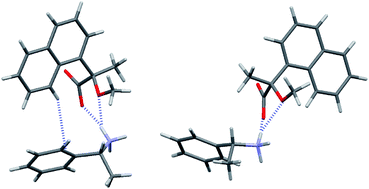
In this CrystEngComm Hot Article, Akio Ichikawa and colleagues from Tsukuba and Nara, Japan, report that a methoxy-assisted salt bridge is important for chiral recognition in the crystalline diastereomeric salts prepared from (R)- and (S)-2-methoxy-2-(1-naphthyl)propanoic acid with (R)-1-phenylethylamine.

The authors predict that the findings will be useful in the crystal engineering of 2-aryl-2-methoxypropanoic acid derivatives for the development of single-enantiomer biofunctional molecules, agrochemicals and pharmaceuticals.

Read more for FREE:

Crystal structures and chiral recognition of the diastereomeric salts prepared from 2-methoxy-2-(1-naphthyl)propanoic acid
Akio Ichikawa, Hiroshi Ono, Takuya Echigo and Yuji Mikata
CrystEngComm, 2011, Advance Article
DOI: 10.1039/C1CE05155E, Paper

Digg This
Reddit This
Stumble Now!
Share on Facebook
Bookmark this on Delicious
Share on LinkedIn
Bookmark this on Technorati
Post on Twitter
Google Buzz (aka. Google Reader)

HOT Article: Crystal engineering lead molecules in drug design

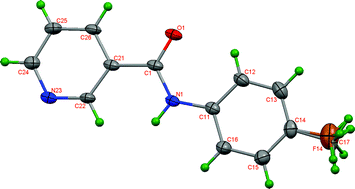
In this HOT article, scientists from Dublin, Ireland have directed their research towards integrating crystal structure analyses with computational (ab initio) modelling methods and exploring the influence and positional influence of different functional groups e.g. N/F/Cl/Br/I atoms, Me/OMe in semi-rigid drug-like molecules on inter- and intramolecular interactions, conformations and solid-state packing.
Read more for FREE at:

Structural systematics and conformational analyses of a 3 × 3 isomer grid of nine N-(tolyl)pyridinecarboxamides and three chlorinated relatives
Pavle Mocilac and John F. Gallagher
CrystEngComm, 2011, Advance Article
DOI: 10.1039/C1CE05169E

Digg This
Reddit This
Stumble Now!
Share on Facebook
Bookmark this on Delicious
Share on LinkedIn
Bookmark this on Technorati
Post on Twitter
Google Buzz (aka. Google Reader)

HOT Article: High quality thin films at low temperatures

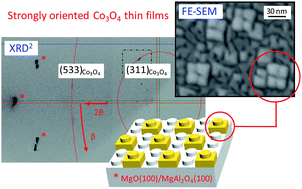
In this CrystEngComm Hot article, Co3O4 thin films are synthesised on MgO and MgAl2O4 single crystal substrates.

The authors manage to keep the growth temperature quite low while still obtaining high quality films, which will be particularly useful for device fabrication.
Read the full article to find out more about the low temperature deposition technique they used…

Strongly oriented Co3O4 thin films on MgO(100) and MgAl2O4(100) substrates by PE-CVD
Davide Barreca, Anjana Devi, Roland A. Fischer, Daniela Bekermann, Alberto Gasparotto, Marco Gavagnin, Chiara Maccato, Eugenio Tondello, Elza Bontempi, Laura E. Depero and Cinzia Sada
CrystEngComm, 2011, Advance Article
DOI: 10.1039/C1CE05280B, Communication

Digg This
Reddit This
Stumble Now!
Share on Facebook
Bookmark this on Delicious
Share on LinkedIn
Bookmark this on Technorati
Post on Twitter
Google Buzz (aka. Google Reader)

Top Ten most-read CrystEngComm articles in March

Read the most-read CrystEngComm articles of March 2011, listed below:

Andrew D. Burrows, CrystEngComm, 2011, Advance Article
DOI: 10.1039/C0CE00568A

Pei-Xiu Yin, Jian Zhang, Ye-Yan Qin, Jian-Kai Cheng, Zhao-Ji Li and Yuan-Gen Yao, CrystEngComm, Role of 2011, 13, 3536-3544
DOI: 10.1039/C0CE00762E
 
John Meurig Thomas, CrystEngComm, 2011, Advance Article
DOI: 10.1039/C1CE90016A
 
Ke-Hui Cui, Shi-Yan Yao, Hai-Qin Li, Yan-Tao Li, Hai-Ping Zhao, Chun-Jie Jiang and Yun-Qi Tian, CrystEngComm, 2011, 13, 3432-3437
DOI: 10.1039/C0CE00789G
 
Jian-Qiang Liu, Yao-Yu Wang and Yun-Sheng Huang, CrystEngComm, 2011, Advance Article
DOI: 10.1039/C0CE00871K
 
J. Thomas-Gipson, G. Beobide, O. Castillo, J. Cepeda, A. Luque, S. Pérez-Yáñez, A. T. Aguayo and P. Román, CrystEngComm, 2011, 13, 3301-3305
DOI: 10.1039/C1CE05195D
 
Ji-Cheng Ma, Ying-Ying Liu, Jin Yang, Yun-Yu Liu and Jian-Fang Ma, CrystEngComm, 2011, 13, 3498-3505
DOI: 10.1039/C0CE00724B
 
Mingyan Ma, Annika Gross, Denise Zacher, Antonio Pinto, Heshmat Noei, Yuemin Wang, Roland A. Fischer and Nils Metzler-Nolte, CrystEngComm, 2011, 13, 2828-2832
DOI: 10.1039/C0CE00416B
 
Guang-Zhen Liu, Ling-Yun Xin and Li-Ya Wang, CrystEngComm, 2011, 13, 3013-3020
DOI: 10.1039/C0CE00873G
 
Zu-Jin Lin, Tian-Fu Liu, Bo Xu, Li-Wei Han, Yuan-Biao Huang and Rong Cao, CrystEngComm, 2011, 13, 3321-3324
DOI: 10.1039/C1CE05099K
 
To keep up-to-date with all the best crystal engineering research articles, sign up for the journal’s e-alerts here
Digg This
Reddit This
Stumble Now!
Share on Facebook
Bookmark this on Delicious
Share on LinkedIn
Bookmark this on Technorati
Post on Twitter
Google Buzz (aka. Google Reader)

Lanthanide MOFs: Amazing Structures say ‘Hello!’ to Outstanding Properties

Ángeles Monge and co-workers delve into the world of Y and Sc MOFs in their recently published CrystEngComm Highlight article. You can read their HOT article for FREE until the 20th May 2011 by clicking on the following link:

Lanthanide, Y and Sc MOFs: where amazing crystal structures meet outstanding material properties
Ángeles Monge, Felipe Gándara, Enrique Gutiérrez-Puebla and Natalia Snejko
CrystEngComm, 2011, DOI: 10.1039/C0CE00891E

Digg This
Reddit This
Stumble Now!
Share on Facebook
Bookmark this on Delicious
Share on LinkedIn
Bookmark this on Technorati
Post on Twitter
Google Buzz (aka. Google Reader)

HOT Article: Nickel-platinum alloy nanocubes

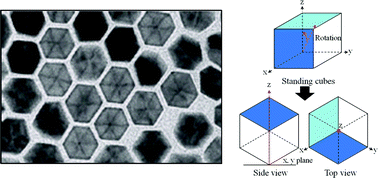
In this CrystEngComm Hot article, Balachandran Jeyadevan and co-workers from the University of Shiga Prefecture, Japan make cubic-shaped standing Ni–Pt alloy nanoparticles via an alcohol reduction process.

These nanoparticles are particularly interesting because, rather unusually, they stand on their corners, instead of on a face. Jeyadevan believes this due to ‘the magnetic interaction between particles whose easy axis is in the [111] direction’.

Novel standing Ni–Pt alloy nanocubes
Jhon L. Cuya Huaman, Shunya Fukao, Kozo Shinoda and Balachandran Jeyadevan
CrystEngComm, 2011, Advance Article
DOI: 10.1039/C1CE05241A, Communication

FREE TO READ until 13th May

Digg This
Reddit This
Stumble Now!
Share on Facebook
Bookmark this on Delicious
Share on LinkedIn
Bookmark this on Technorati
Post on Twitter
Google Buzz (aka. Google Reader)

HOT Article: Perfect single crystals of magnesium diboride

Chinping Chen, Rongming Wang and colleagues have made perfect single crystals of MgBr2, as part of their collaboration between Peking University and Beijing University of Aeronautics and Astronautics.

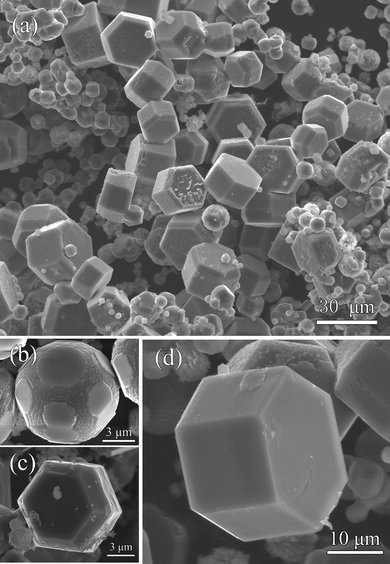
Magnesium diboride is known for its good superconducting properties, and many forms of MgB2 have been made previously, but large single crystals are still extremely difficult to obtain. In this CrystEngComm Hot article, Chen and Wang use a hybrid physical-chemical vapor deposition technique to obtain perfect crystals.

Read the full article to find out more about magnesium diboride single crystals…

Single-crystal MgB2 hexagonal microprisms via hybrid physical-chemical vapor deposition
Weimeng Chen, Wei Liu, Chinping Chen, Rongming Wang and Qingrong Feng
CrystEngComm, 2011, Advance Article
DOI: 10.1039/C1CE05272A, Communication

FREE TO READ until 13th May

Digg This
Reddit This
Stumble Now!
Share on Facebook
Bookmark this on Delicious
Share on LinkedIn
Bookmark this on Technorati
Post on Twitter
Google Buzz (aka. Google Reader)