

Archive for the ‘Hot Article’ Category

Hot Article: Correlating supramolecular structures and melting points

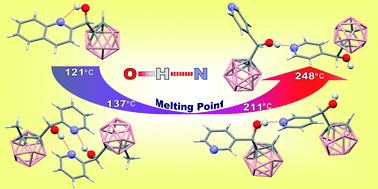
José Giner Planas and colleagues from the Institut de Ciència de Materials de Barcelona (ICMAB-CSIC), and Mark E. Light and Michael B. Hursthouse from the University of Southampton look at methyl-o-carboranyl and o-carboranyl alcohols bearing N-aromatic rings in this CrystEngComm Hot article.

Giner-Planas relates the presence of infinite O–H···N hydrogen bonding networks with melting points using decomposed Fingerprint plots, which looks to be a really interesting finding for crystal engineers.

Read the full article for FREE until 30th August…

Supramolecular architectures in o-carboranyl alcohols bearing N-aromatic rings: syntheses, crystal structures and melting points correlation
Florencia Di Salvo, Beatriz Camargo, Yolanda García, Francesc Teixidor, Clara Viñas, José Giner Planas, Mark E. Light and Michael B. Hursthouse
CrystEngComm, 2011, DOI: 10.1039/C1CE05449J

Digg This
Reddit This
Stumble Now!
Share on Facebook
Bookmark this on Delicious
Share on LinkedIn
Bookmark this on Technorati
Post on Twitter
Google Buzz (aka. Google Reader)

Hot Article: ‘Shish-kebab’ porphyrin nanorods

In this CrystEngComm Hot article, Roberto Otero and colleagues from Spain self assemble zinc meso-tetramesitylporphyrin on copper and gold into one-dimensional nanorods.
Otero explains they are ‘shish-kebab type coordination polymers’, and that they can extend for hundreds of nanometres.

Read the full article for FREE to find out more about these porphyrin nanorods…

Surface assembly of porphyrin nanorods with one-dimensional zinc–oxygen spinal cords
Marta Trelka, Christian Urban, Celia Rogero, Paula de Mendoza, Eva Mateo-Marti, Yang Wang, Iñaki Silanes, David Écija, Manuel Alcamí, Felix Yndurain, Andrés Arnau, Fernando Martín, Antonio M. Echavarren, José Ángel Martín-Gago, José María Gallego, Roberto Otero and Rodolfo Miranda
CrystEngComm, 2011, DOI: 10.1039/C1CE05494E

Keep up to date with the latest news and research in solid-state and crystalline materials: sign up to the CrystEngComm e-alert, follow us on Twitter, and get the RSS feed.

Digg This
Reddit This
Stumble Now!
Share on Facebook
Bookmark this on Delicious
Share on LinkedIn
Bookmark this on Technorati
Post on Twitter
Google Buzz (aka. Google Reader)

Hot Article: Using the Kirkendall effect to make BiOI nests

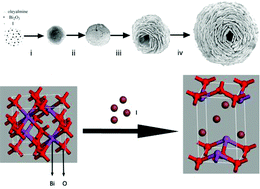
Read this CrystEngComm Hot article to discover how the Kirkendall effect can be used to make BiOI nests.
Zhi Zheng and co-workers from Central China Normal University made δ-Bi2O3 spheres, which became the reactive template to make the hierarchical ternary BiOI nest-shaped structures.

Read the full article for FREE to find out more…

Low temperature synthesis of δ-Bi2O3 solid spheres and their conversion to hierarchical BiOI nests via the Kirkendall effect
Manying Liu, Lizhi Zhang, Kewei Wang and Zhi Zheng
CrystEngComm, 2011, DOI: 10.1039/C1CE05101F

Digg This
Reddit This
Stumble Now!
Share on Facebook
Bookmark this on Delicious
Share on LinkedIn
Bookmark this on Technorati
Post on Twitter
Google Buzz (aka. Google Reader)

Examining breathing MOFs

A unique feature, which distinguishes some MOFs from conventional porous materials, is the ability to ‘breathe’ i.e. to expand or contract in response to external stimuli such as variation in temperature. Such flexible networks are also called ‘breathing’ MOFs. In their recent Hot Article Roland Fischer and his colleagues have  investigated the structural transformations of such breathing frameworks yielding valuable insights in the underlying mechanisms.

Read for free until the 20th August 2011

Multiple phase-transitions upon selective CO2 adsorption in an alkyl ether functionalized metal–organic framework—an in situ X-ray diffraction study
Sebastian Henke, D. C. Florian Wieland, Mikhail Meilikhov, Michael Paulus, Christian Sternemann, Kirill Yusenko and Roland A. Fischer
CrystEngComm, 2011, Advance Article DOI: 10.1039/C1CE05446E

Digg This
Reddit This
Stumble Now!
Share on Facebook
Bookmark this on Delicious
Share on LinkedIn
Bookmark this on Technorati
Post on Twitter
Google Buzz (aka. Google Reader)

HOT Article: Novel nickel complexes

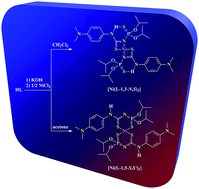
In this HOT article, Babashkina and co-workers have synthesized the first examples of NiII complexes containing the same asymmetric NTT [(N-(thio)phosphorylated thioamides and thioureas RC(S)NHP(X)(OR0)2 (X ¼ O, S)] ligand featuring an aryl-NH substituent at the thiocarbonyl group and coordinating to the metal both in the 1,3-N,S- and 1,5-S,S’-fashion in the solid state depending on the crystallization conditions.

Find out more about these interesting complexes by reading the full HOT article for FREE at:

Solvent-induced 1,3-N,Svs. 1,5-S,S‘-coordination in the NiII complex [Ni{p-Me2NC6H4NHC(S)NP(S)(OiPr)2}2]
Maria G. Babashkina, Damir A. Safin, Monika Srebro, Piotr Kubisiak, Mariusz P. Mitoraj, Michael Bolte and Yann Garcia
CrystEngComm, 2011, Advance Article
DOI: 10.1039/C1CE05387F

Digg This
Reddit This
Stumble Now!
Share on Facebook
Bookmark this on Delicious
Share on LinkedIn
Bookmark this on Technorati
Post on Twitter
Google Buzz (aka. Google Reader)

Hot Article: Chiral crystals of erbium–formate frameworks

Song Gao and colleagues from Peking University investigate a way of improving the chances of obtaining chiral crystalline solids, in this CrystEngComm Hot article.
Control of chirality is important in the making of drugs, and in materials that are used for things like second-order nonlinear optics and ferroelectrics. Here Gao uses more acentric centers in the crystal lattice, to try and obtain chiral solids from achiral starting materials.

Read the full article for FREE to find out more about making chiral crystals…

Chiral crystalline solids of ammonium-templated ErIII–formate frameworks assembled from three achiral acentric components
Bin Liu, Hai-Bin Zheng, Zhe-Ming Wang and Song Gao
CrystEngComm, 2011, DOI: 10.1039/C1CE05250K

Digg This
Reddit This
Stumble Now!
Share on Facebook
Bookmark this on Delicious
Share on LinkedIn
Bookmark this on Technorati
Post on Twitter
Google Buzz (aka. Google Reader)

Hot Article: Fluorine misbehaving….

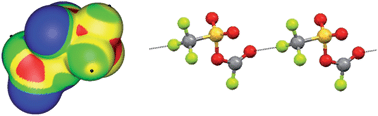
In their recent CrystEngComm article Pierangelo Metrangolo, Giuseppe Resnati and co-workers discuss how fluorine can display a region of positive electrostatic potential when bound to residues which work as particularly strong electron withdrawing groups. Fluorine can thus function as a halogen bond donor and form complexes with lone-pair-containing neutral atoms and anions. Read more about the impact of this newly revealed aspect of fluorine behaviour in the communication below.

The fluorine atom as a halogen bond donor, viz. a positive site
Pierangelo Metrangolo, Jane S. Murray, Tullio Pilati, Peter Politzer, Giuseppe Resnati and Giancarlo Terraneo
CrystEngComm, 2011, Advance Article, DOI: 10.1039/C1CE05554B

Digg This
Reddit This
Stumble Now!
Share on Facebook
Bookmark this on Delicious
Share on LinkedIn
Bookmark this on Technorati
Post on Twitter
Google Buzz (aka. Google Reader)

HOT article: Mixed crystals for SC-OFETs

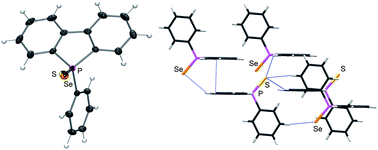
In this HOT article, the solid-state interactions of dibenzophosphole chalcogenides and their potential application as electron transporting materials were investigated. The crystallographic properties of 9-phenyl-9-dibenzophosphole chalcogenides were compared with the mixed crystal structure and optical properties of 9-phenyl-9-dibenzophosphole sulphideselenide. The mixed crystal displayed desirable properties, i.e. carrier transport and emission properties, and this approach may be useful in the future for optoelectronic applications such as light-emitting SC-OFETs
More information on this topic is available FREE at:

Enhanced phosphorescence in dibenzophosphole chalcogenide mixed crystal
Ryota Kabe, Vincent M. Lynch and Pavel Anzenbacher Jr.
CrystEngComm, 2011, Advance Article
DOI: 10.1039/C1CE05388D

Digg This
Reddit This
Stumble Now!
Share on Facebook
Bookmark this on Delicious
Share on LinkedIn
Bookmark this on Technorati
Post on Twitter
Google Buzz (aka. Google Reader)

Hot Article: Bisazomethine dyes

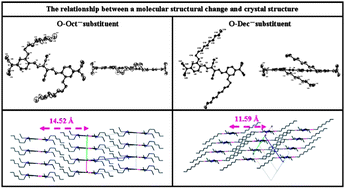
Scientists from Japan and China have investigated the crystal structures of bisazomethine dyes in this CrystEngComm Hot article.
The researchers looked at the 2D molecular stacking of the structures, to try and work out the best way of engineering a quasi-low-D electronic state. These materials could then be used in opto-electronics, especially in flexible devices.

Read the full article for FREE to find out more about the structures of these organic dyes…

Effects of alkoxy substitution on the crystal structure of 2,3-bis[(E)-4-(diethylamino)-2-alkoxybenzylideneamino]fumaronitrile derivatives
Byung-Soon Kim, Takumi Jindo, Ryohei Eto, Yohei Shinohara, Young-A Son, Sung-Hoon Kim and Shinya Matsumoto
CrystEngComm, 2011, DOI: 10.1039/C1CE05198A

Digg This
Reddit This
Stumble Now!
Share on Facebook
Bookmark this on Delicious
Share on LinkedIn
Bookmark this on Technorati
Post on Twitter
Google Buzz (aka. Google Reader)

Hot Article: Self-assembly of melem on silver

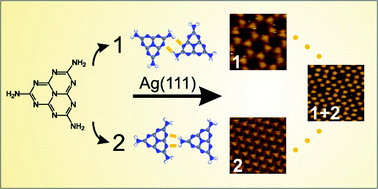
In this CrystEngComm Hot Article, Johanna Eichhorn and colleagues from Munich, Germany study the self-assembly of melem on Ag(111) surface using scanning tunnelling microscopy.

They observe seven different monolayer polymorphs stabilized by intermolecular hydrogen bonds. Porous surface-supported supramolecular monolayers have potential applications as host networks for the inclusion of guests or even as organic templates for the growth of size-selected metal nanoparticles.

Read more for FREE:

Self-assembly of melem on Ag(111)—emergence of porous structures based on amino-heptazine hydrogen bonds
Johanna Eichhorn, Stefan Schlögl, Bettina V. Lotsch, Wolfgang Schnick, Wolfgang M. Heckl and Markus Lackinger
CrystEngComm, 2011, Advance Article
DOI: 10.1039/C1CE05342F, Paper

Digg This
Reddit This
Stumble Now!
Share on Facebook
Bookmark this on Delicious
Share on LinkedIn
Bookmark this on Technorati
Post on Twitter
Google Buzz (aka. Google Reader)