Themed collection for Michael Sefton’s 65th birthday
Stem cell-materials interactions themed issue now online
We hope you enjoy reading our latest themed issue on stem cell—materials interactions, Guest Edited by Matthias Lutolf (EPFL) and Jason Burdick (University of Pennsylvania).
Stem cells have an enormous potential in regenerative medicine and drug discovery but the development of stem cell based therapies and models in these fields has been slow. This is largely due to the difficulty of maintaining functional stem cells in a culture dish or controlling their directed differentiation. Naturally, stem cells reside in highly complex microenvironments (termed ‘niches’) that regulate their behavior.
This themed issue focuses on emerging efforts to engineer these niches to better control and probe stem cell fate in culture and in vivo, including the development of new biomaterials, the better understanding of stem cell and biomaterial interfaces, and the implementation of biomaterials and bioreactors together.
Take a look at these themed issue highlights:
Nanotopography – potential relevance in the stem cell niche Lesley-Anne Turner and Matthew J. Dalby
Biophysical regulation of hematopoietic stem cells C. Lee-Thedieck and J. P. Spatz
Stem cell culture using cell-derived substrates Binata Joddar, Takashi Hoshiba, Guoping Chen and Yoshihiro Ito
Chemically diverse polymer microarrays and high throughput surface characterisation: a method for discovery of materials for stem cell culture A. D. Celiz, J. G. W. Smith, A. K. Patel, R. Langer, D. G. Anderson, D. A. Barrett, L. E. Young, M. C. Davies, C. Denning and M. R. Alexander
Dual-stage growth factor release within 3D protein-engineered hydrogel niches promotes adipogenesis Midori Greenwood-Goodwin, Eric S. Teasley and Sarah C. Heilshorn
Artificial microniches for probing mesenchymal stem cell fate in 3DYujie Ma, Martin P. Neubauer, Julian Thiele, Andreas Fery and W. T. S. Huck
Self assembling substrates probe impact of ligands on stem cell fate
By precisely controlling the number of various adhesive ligands in integrin-sized nanodomains, this study provides important insights about the impact of local ligand redundancy on mesenchymal stem cell adhesion and phenotype.
In regenerative medicine, one of the limiting factors has been the number, complex isolation and limited lifespan of patients’ differentiated cell types for seeding scaffolds and subsequent cultivation of a functional tissue. The use of patient-specific stem cell populations, which have a prolonged life-span and can potentially be differentiated into any cell type desired, has emerged as the prevailing tissue engineering paradigm in the past decade. Despite its tremendous potential, steering stem cell differentiation towards a specific phenotypical outcome has been challenging. Polymer surfaces have been used extensively to elucidate the permissive cues required to drive selective differentiation, such as surface functionalities and adhesive molecules. Especially the impact of surface distribution and concentration of adhesive ligands remains a question mark. Yet, it is challenging to tether multiple distinct functionalities in a controllable manner and assess their respective effects on stem cell adhesion and differentiation.
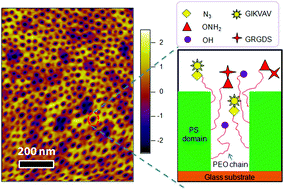
Based at the University of Queensland, Justin Cooper-White and Haiqing Li sought to increase the understanding of surface ligand-dependent stem cell fate by precisely controlling the concentration and spatial organization of various ligands. To this end, they analyzed the effects of two well-known cell adhesion ligands, IKVAV and RGD, on mesenchymal stem cell adhesion and morphology.
Polystyrene-polyethyleneoxide (PS-PEO) block copolymers were shown to self-assemble into polymer films with a uniform distribution of cylindrical nanodomains of PEO, approximately the size of adhesion-controlling cell integrin pairs. By adding varying percentages of azide- or aminooxy-terminated PEO, orthogonal click chemistry was used to sequentially functionalize those cylindrical nanodomains with a controllable local density of grafted adhesion sequences IKVAV and RGD. Then, the researchers assessed the effects of varying local IKVAV and RGD densities in the nanodomains on human mesenchymal stem cell adhesion, spreading morphology and focal adhesion complex formation. They found that with increasing IKVAV or RGD ligand density, leading to ligand ‘redundancy’ for integrin pairs, stem cells showed increased attachment, spreading and stress fiber formation. Moreover, an increase in ratio between RGD and IKVAV densities increased stem cell adhesion.
Together, the researchers found that PS-PEO block co-polymers with functional end-groups, permitting orthogonal chemistry, allowed tight control of ligand decoration within cylindrical nanodomains. Furthermore, using IKVAV and RGD as exemplars, they showed the effect of varying ligand redundancy within nanodomains on stem cell fate. The reported self-assembling substrates offer a highly flexible platform technology to investigate and elucidate the impact of various ligands and their density on integrin binding, which also determines cell phenotype.
Changing ligand number and type within nanocylindrical domains through kinetically constrained self-assembly – impacts of ligand ‘redundancy’ on human mesenchymal stem cell adhesion and morphology
H. Li and J. J. Cooper-White
Biomater. Sci., 2014, Advance Article DOI: 10.1039/C4BM00109E
Robert van Lith is currently a Ph.D. Candidate in the Biomedical Engineering department at Northwestern University, working on novel biomaterials to modulate oxidative stress in tissues. He received an American Heart Association Fellowship and Society for Biomaterials award for his work. He holds B.S. and M.S. degrees in Biomedical Engineering from Eindhoven University of Technology, the Netherlands. Read more about Robert’s research publications here.
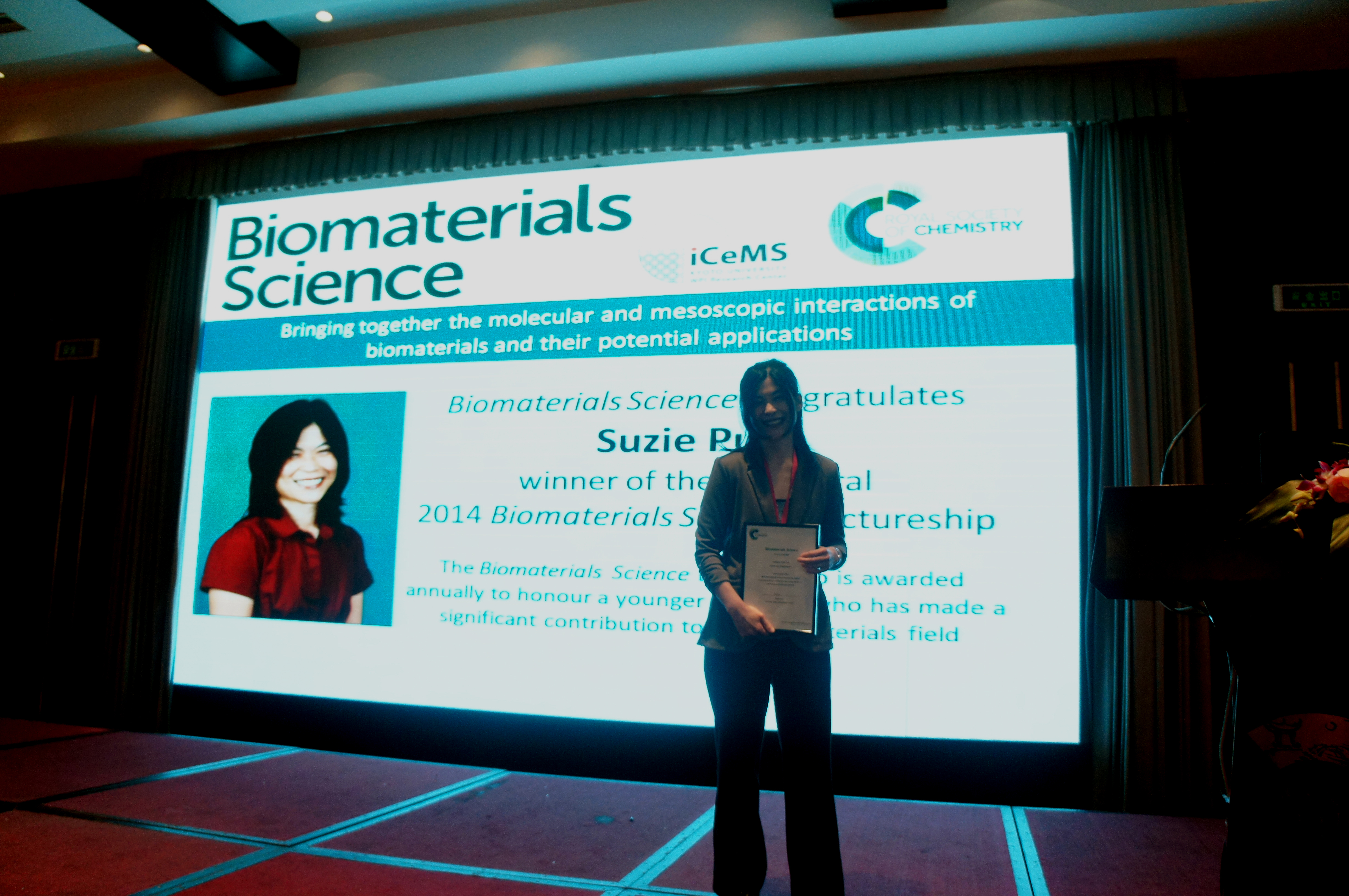
Suzie Pun accepts Biomaterials Science Lectureship Award at SIPCD 2014
Suzie Pun, recipient of the inaugural Biomaterials Science lectureship, accepted her award at the 3rd Symposium on Innovative Polymers for Controlled Delivery (SIPCD 2014), which took place in Suzhou, China on 16-19th September and is where Suzie delivered her first Award Lecture. The award was presented by Biomaterials Science Editorial Board member Jun Wang.
As part of the Lectureship, Suzie, a Professor in the bioengineering department at University of Washington, will also be presenting her Award Lecture at the 1st International Symposium on Immunobiomaterials in Tianjin, China, and NanoDDS 2014 in North Carolina, US.
Read Suzie Pun’s latest Biomaterials Science article
Top 10 Most-accessed Biomaterials Science articles – Q2 2014
This month sees the following articles in Biomaterials Science that are in the top ten most accessed from April – June:
Electrospinning and Additive Manufacturing: Converging Technologies
Paul D. Dalton, Cédryck Vaquette, Brooke L. Farrugia, Tim R. Dargaville, Toby D. Brown and Dietmar W. Hutmacher
Biomater. Sci., 2013,1, 171-185
DOI: 10.1039/C2BM00039C
Smart Hydrogels as Functional Biomimetic Systems
Han L. Lim, Yongsung Hwang, Mrityunjoy Kar and Shyni Varghese
Biomater. Sci., 2014,2, 603-618
DOI: 10.1039/C3BM60288E
Stimuli-Responsive Functionalized Mesoporous Silica Nanoparticles for Drug Release in Response to Various Biological Stimuli
Xin Chen, Xiaoyu Cheng, Alexander H. Soeriyadi, Sharon M. Sagnella, Xun Lu, Jason A. Scott, Stuart B. Lowe, Maria Kavallaris and J. Justin Gooding
Biomater. Sci., 2014,2, 121-130
DOI: 10.1039/C3BM60148J
Personalized Protein Corona: “Key” Factor at the NanoBio Interface
Mohammad J. Hajipour, Sophie Laurent, Afsaneh Aghaie, Farhad Rezaee and Morteza Mahmoudi
Biomater. Sci., 2014,2, 1210-1221
DOI: 10.1039/C4BM00131A
Magnetic Iron Oxide-Fluorescent Carbon Dots Integrated Nanoparticles for Dual-modal Imaging, Near-infrared Light-responsive Drug Carrier and Photothermal Therapy
Hui Wang, Jing Shen, Yingyu Li, Zengyan Wei, Guixin Cao, Zheng Gai, Kunlun Hong, Probal Banerjee and Shuiqin Zhou
Biomater. Sci., 2014,2, 915-923
DOI: 10.1039/C3BM60297D
Hyaluronic acid hydrogel stiffness and oxygen tension affect cancer cell fate and endothelial sprouting
Yu-I Shen, Hasan E. Abaci, Yoni Krupski, Lien-Chun Weng, Jason A. Burdick and Sharon Gerecht
Biomater. Sci., 2014,2, 655-665
DOI: 10.1039/C3BM60274E
Enzyme responsive materials: Design strategies and future developments
Mischa Zelzer, Simon J. Todd, Andrew R. Hirst, Tom O. McDonald and Rein V. Ulijn
Biomater. Sci., 2013,1, 11-39
DOI: 10.1039/C2BM00041E
Mesoporous silica nanoparticles for the design of smart delivery nanodevices
Montserrat Colilla, Blanca González and María Vallet-Regí
Biomater. Sci., 2013,1, 114-134
DOI: 10.1039/C2BM00085G
A peptide functionalized poly(ethylene glycol) (PEG) hydrogel for investigating the influence of biochemical and biophysical matrix properties on tumor cell migration
Samir P. Singh, Michael P. Schwartz, Justin Y. Lee, Benjamin D. Fairbanks and Kristi S. Anseth
Biomater. Sci., 2014,2, 1024-1034
DOI: 10.1039/C4BM00022F
Gelatin hydrogels formed by orthogonal thiol-norbornene photochemistry for cell encapsulation
Zachary Mũnoz, Han Shih and Chien-Chi Lin
Biomater. Sci., 2014,2, 1063-1072
DOI: 10.1039/C4BM00070F
Why not take a look at the articles today and blog your thoughts and comments below.
Fancy submitting an article to Biomaterials Science? Then why not submit to us today!
Creating a blood substitute with polymers
Biomaterials Science web writer, Debanti Sengupta, highlights a HOT article from the journal
Blood transfusions are crucial for the successful treatment of many diseases and injuries. However, as we all know, donated blood can often be in short supply. Further, donated blood must always be screened for carrier diseases. In this study, the researchers aim to develop an encapsulation system for hemoglobin (a key component of blood transfusions) which can one day be used as a substitute for donated blood in the clinic.
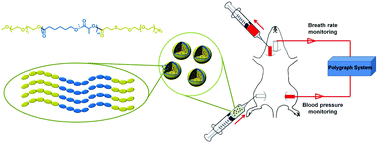
The researchers used PEG (polyethylene-glycol) and PCL (poly caprolactone) as starting materials to build what they term ‘polymersomes’, or triblock copolymers consisting of a water-insoluble PCL segment and two water-soluble PEG chains. The hemoglobin-polymer aggregates were mixed into blood plasma substitute solutions. Once encapsulated, the hemoglobin-containing particles were studied to determine that the hemoglobin continued to be reactive. Most importantly, the researchers demonstrated that the encapsulated hemoglobin could continue to bind oxygen. Ascorbic acid was added to prevent hemoglobin from being oxidized to methemoglobin, an unreactive form of hemoglobin.
The researchers then demonstrated that hemoglobin could be contained in these polymersomes for up to 1 week with only 7% leakage of hemoglobin. The hemoglobin-polymersome particles were almost completely nontoxic to cells outside of the body, and did not interfere with regular blood components. Finally, animal studies were conducted where rats were first subjected to severe blood loss, followed by the introduction of hemoglobin-containing polymersomes. When hemoglobin-containing polymersomes were introduced, the animals recovered in a manner that was comparable to recovery after a blood transfusion. Further, the animals suffered only minimal inflammation after the polymersome treatment as compared to the introduction of non-encapsulated hemoglobin. This work is therefore an important step in demonstrating the feasibility of using similar ‘blood substitutes’ in clinical therapy in the future.
Asymmetric copolymer vesicles to serve as a hemoglobin vector for ischemia therapy
Bin Li, Yanxin Qi, ShaSha He, Yupeng Wang, Zhigang Xie, Xiabin Jing and Yubin Huang
Biomater. Sci., 2014, 2, 1254-1261 DOI: 10.1039/C4BM00123K
Debanti Sengupta recently completed her PhD in Chemistry from Stanford University. She is currently a Siebel postdoctoral scholar at the University of California, Berkeley.
Follow the latest journal news on Twitter @BioMaterSci or go to our Facebook page.
Biomaterials Science 2013 Immediacy Index is 0.89
We are pleased to announce that Biomaterials Science‘s first official Immediacy Index is 0.890– fifth highest for all the journals in the Materials Science, Biomaterials category, according to the 2013 Journal Citation Reports®.
Immediacy Index is a measure of how quickly articles in a journal are cited, and is calculated as the average number of citations articles receive in the year they are published. Our high number and ranking indicate that, even as a new journal, Biomaterials Science is making a splash in the community. We would like to thank all our readers, authors and board members for their contribution to the early success of the journal.
Biomaterials Science will receive its first (partial) Impact Factor next year in the 2014 Journal Citation Reports®. For the latest Impact Factors of other Royal Society of Chemistry journals, take a look at this blog post.
We recommend these highly cited Biomaterials Science articles
Nanovehicles for targeted bone metastasis chemotherapy
The cover story for the July 2014 issue of Biomaterials Science highlights the use of nanovehicle particles for the targeted delivery of chemotherapy drugs to tumor cells in bone.
Bone metastasis, or the spreading of tumor cells from the initial tumor site to bone tissue, marks the stage of cancer progression where the diseased is deemed incurable. Currently, the main method to treat bone metastasis is to utilize aggressive chemotherapy drugs and destroy metastatic tumor cells. Unfortunately, untargeted chemotherapy treatments result in death of both cancerous and healthy tissue. Treatments could be significantly improved with the technology to specifically target the destruction of tumor cells without affecting the surrounding bone tissue.
Researchers at the University of Utah, University of Iowa, and Wuhan University in China are making this desired technology a reality. Wang et al. have developed a nanovehicle capable of targeting tumor cells within bone tissue. Nanovehicles (NVs) are essentially nano-sized cargo containers capable of delivering drugs to a desired destination. The cleverly designed NVs are designed to target diseased bone tissue to deliver chemotherapy drugs at a specific site.
The NVs developed in this study have three design features:
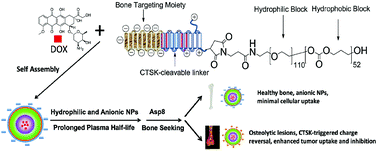
(1) The NVs core is made of hydrophilic and hydrophobic block co-polymers able to form a shell-like structure known as a micelle. The micelle serves as the cargo vessel that contains the chemotherapy drug doxorubicin.
(2) The outermost segments of the NVs are negatively charged bone-targeting peptides. The peptide is responsible for the accumulation of NVs in skeletal tissue, and the negative charge prevents cellular uptake of the NVs into healthy tissue.
(3) For uptake into cancer cells, the particle must be positively charged. Therefore, a positively charged peptide linker was added in between the micelle core and the negatively charged bone-targeting region. The peptide linker is cleavable by cathepsin K enzyme (CTSK), which is overexpressed in bone metastatic lesions. When the NV enters a metastatic lesion, the CTSK cleaves off the negatively charged peptides and exposes the positively charged peptides. This charge reversal allows for tumor cells present in the metastatic lesion to uptake the NV.
After extensively characterizing the nanoparticles with NMR and zeta potential measurements, the NVs were used to observe decreased tumor cell viability under CTSK-rich conditions in vitro. More strikingly, in vivo tests of the NVs in a mouse model of bone metastasis showed significant increases in mouse survival and decreases in overall tumor burden.
Collectively, these ingeniously designed nanovehicles show great promise in providing an effective targeted therapy for bone metastasis.
Peptide decoration of nanovehicles to achieve active targeting and pathology-responsive cellular uptake for bone metastasis chemotherapy
X. Wang, Y. Yang, H. Jia, W. Jia, S. Miller, B. Bowman, J. Feng, and F. Zhan
Biomater. Sci., 2014, Advance Article DOI: 10.1039/C4BM00020J
Brian Aguado is currently a Ph.D. Candidate and NSF Fellow in the Biomedical Engineering department at Northwestern University. He holds a B.S. degree in Biomechanical Engineering from Stanford University and a M.S. degree in Biomedical Engineering from Northwestern University. Read more about Brian’s research publications here.
Follow the latest journal news on Twitter @BioMaterSci or go to our Facebook page.
Protein corona key to safe, personalized nanomedicine
Biomaterials Science web writer, Robert van Lith, highlights a HOT article from the journal
The concept of personalized medicine has become increasingly relevant in healthcare over the past decade. Ever since the human genome was unraveled, the idea of tailoring therapies specific to the individual patient has been at the forefront of medicine. Diagnosis, prognosis and most importantly treatment are thought to eventually be adapted to each individual’s genetic and pathophysiological makeup. Nonetheless, biomaterials for invasive use (e.g. implantation or injection) are still largely being designed for general use. This study argues for a much more specific approach of biomaterials design, looking at the nanoparticles (NPs) in particular.
A collaborative effort headed by Dr. Mahmoudi from Stanford University, US, and the University of Medical Sciences in Tehran, Iran, Hajipour et al. evaluated effects of the altered protein composition of human plasma in different disease states on NP corona formation. Two NP materials were chosen for their analysis, hydrophobic polystyrene and hydrophilic silica, which are widely investigated for biomedical material approaches and currently evaluated for safety purposes.
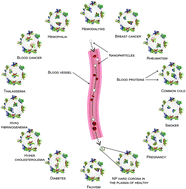
NPs were exposed to plasma solutions of different patient populations to form hard protein coronas, after which the composition of NP protein coronas was analyzed using SDS-page, densitometry and zeta-potential measurements. Interestingly, the authors found that changes in plasma protein composition due to underlying conditions alter the protein decoration on NPs, resulting in an unpredictable biologic identity of the NPs and thus their biological fate. The severity of the condition was also found to impact protein deposition. Intriguingly, even among healthy subjects there was considerable variation in corona composition, creating even more of an impetus for personalized NP design.
Collectively, the researchers found that NP protein corona distinctly depends on particular condition, severity of condition and combination of conditions, with relatively low variation between subjects with similar health profiles. Moving forward, identifying the personalized protein corona for individual patients or at least the expected protein corona in specific patient populations may become an integral aspect of nanoparticle-based biomaterial therapies.
Personalized protein coronas: a “key” factor at the nanobiointerface
M. J. Hajipour, S. Laurent, A. Aghaie, F. Rezaee and M. Mahmoudi
Biomater. Sci., 2014, Advance Article DOI: 10.1039/c4bm00131a
Robert van Lith is currently a Ph.D. Candidate in the Biomedical Engineering department at Northwestern University, working on novel biomaterials to modulate oxidative stress in tissues. He received an American Heart Association Fellowship and Society for Biomaterials award for his work. He holds B.S. and M.S. degrees in Biomedical Engineering from Eindhoven University of Technology, the Netherlands. Read more about Robert’s research publications here.
NanoBio Australia 2014 Biomaterials Science Poster Prize Winners