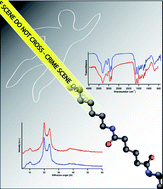
In this month’s Top Ten: prototyping chip devices, polymers on crime scenes, trace metals in water, nanomaterials in biomedical applications and more.
See what made the Top Ten and access all the articles in full
In this month’s Top Ten: prototyping chip devices, polymers on crime scenes, trace metals in water, nanomaterials in biomedical applications and more.
See what made the Top Ten and access all the articles in full
Submission are now welcome for an upcoming themed issue on Analysis in Sport. We’re very excited about the London 2012 Olympics, which take place later this year, and are looking to highlight the importance of analytical science in sporting success.
We’d like to cover the whole spectrum of sport analysis: anti-doping tests, drug monitoring, athlete health, issues with equipment and animals, safety concerns and regulations.
The deadline for submissions is 18 May 2012. The first articles will go online as the Olympics start, with the full issue to be published once the games have been completed.
You can submit your paper online, or contact us if you have any queries. Of course, all submissions will undergo peer-review in the usual manner.
We look forward to publishing an exciting collection of papers!
The latest issue of Analytical Methods includes some new papers from our continuing web theme on Future Electroanalytical Developments. This collection of articles highlights important developments and novel applications in this exciting area of research, and features papers from Analyst, Analytical Methods and other RSC journals.
Monitoring of bovine serum albumin using ultrasensitive electrochemiluminescence biosensors based on multilayer CdTe quantum dots modified indium tin oxide electrodes
Meng Zhang, Mei Yan, Jinghua Yu, Shenguang Ge, Fuwei Wan and Lei Ge
Anal. Methods, 2012, 4, 460-466
DOI: 10.1039/C1AY05481C
A novel electrochemical sensor based on boronic acid-functionalized multi-walled carbon nanotubes for astragaloside IV determination using ARS as the current indicator
Li Gu, Ying Liang, Tianshu Zhou, Xiaoshan Tang and Guoyue Shi
Anal. Methods, 2012, 4, 492-495
DOI: 10.1039/C1AY05553D
If you work in the area of electrochemical sensors and detection, submit your next paper and it could be selected for inclusion in this web theme.
Featured in the latest issue: a Critical Review on magnetic resonance techniques and a number of HOT articles, which will be free to access until the end of February. Don’t forget to take a look at the issue in full via the journal homepage.
Critical Review: Low field magnetic resonance techniques in the development of nanomaterials for biomedical applications
Carla J. Meledandri and Dermot F. Brougham
Anal. Methods, 2012, 4, 331-341
DOI: 10.1039/C2AY05420E
Communication: Engineering a unimolecular multifunctional DNA probe for analysis of Hg2+ and Ag+
Xiaoxiao He, Zhihe Qing, Kemin Wang, Zhen Zou, Hui Shi and Jin Huang
Anal. Methods, 2012, 4, 345-347
DOI: 10.1039/C2AY05823E
Communication: Simultaneous determination of two important dopamine metabolites at physiological pH by voltammetry
S. Brillians Revin and S. Abraham John
Anal. Methods, 2012, 4, 348-352
DOI: 10.1039/C2AY05664J
Communication: A new labelling reagent for glycans analysis by capillary electrophoresis-mass spectrometry
Cai Tie and Xin-Xiang Zhang
Anal. Methods, 2012, 4, 357-359
DOI: 10.1039/C2AY05741G
Communication: A graphene oxide–rhodamine 6G nanocomposite as turn-on fluorescence probe for selective detection of DNA
Xue Wang, Shuhua Zhong, Yu He and Gongwu Song
Anal. Methods, 2012, 4, 360-362
DOI: 10.1039/C2AY05827H
Arsenic species and selected metals in human urine: validation of HPLC/ICPMS and ICPMS procedures for a long-term population-based epidemiological study
Jürgen Scheer, Silvia Findenig, Walter Goessler, Kevin A. Francesconi, Barbara Howard, Jason G. Umans, Jonathan Pollak, Maria Tellez-Plaza, Ellen K. Silbergeld, Eliseo Guallar and Ana Navas-Acien
Anal. Methods, 2012, 4, 406-413
DOI: 10.1039/C2AY05638K
Monitoring intracellular nitric oxide production using microchip electrophoresis and laser-induced fluorescence detection
Emilie R. Mainz, Dulan B. Gunasekara, Giuseppe Caruso, Derek T. Jensen, Matthew K. Hulvey, Jose Alberto Fracassi da Silva, Eve C. Metto, Anne H. Culbertson, Christopher T. Culbertson and Susan M. Lunte
Anal. Methods, 2012, 4, 414-420
DOI: 10.1039/C2AY05542B
Multivariate calibration of near-infrared spectra by using influential variables
Xueguang Shao, Min Zhang and Wensheng Cai
Anal. Methods, 2012, 4, 467-473
DOI: 10.1039/C2AY05609G
Mass spectrometric imaging as a high-spatial resolution tool for functional genomics: Tissue-specific gene expression of TT7 inferred from heterogeneous distribution of metabolites in Arabidopsis flowers
Andrew R. Korte, Zhihong Song, Basil J. Nikolau and Young Jin Lee
Anal. Methods, 2012, 4, 474-481
DOI: 10.1039/C2AY05618F
A simple and sensitive colorimetric method for detection of mercury ions based on anti-aggregation of gold nanoparticles
Tingting Lou, Ling Chen, Chunrong Zhang, Qi Kang, Huiyan You, Dazhong Shen and Lingxin Chen
Anal. Methods, 2012, 4, 488-491
DOI: 10.1039/C2AY05764F
Take a look at the latest issue of Analytical Methods, now available online.
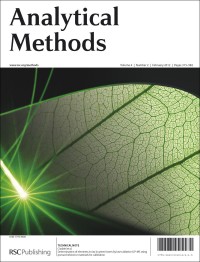
The stunning front cover highlights work from James Cizdziel of the University of Mississippi, and colleagues.
They evaluate the use of multiple botanical reference materials as LA-ICP-MS standards for quantifying the spatial distribution of elements in desert leaves.
Determination of elements in situ in green leaves by laser ablation ICP-MS using pressed reference materials for calibration
James Cizdziel, Kaixuan Bu and Piotr Nowinski
Anal. Methods, 2012, 4, 564-569
DOI: 10.1039/C1AY05577A
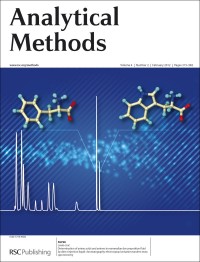
The inside front cover features a sensitive and selective analytical method utilising LC-ESI-MS/MS for the semi-quantitative determination of biogenic amines and amino acids in porcine decomposition fluid.
This paper is from Simon Lewis and colleagues from Curtin University, Perth, Australia, and was highlighted as a HOT article when it first appeared online.
Determination of amino acids and amines in mammalian decomposition fluid by direct injection liquid chromatography-electrospray ionisation-tandem mass spectrometry
Lisa M. Swann, Francesco Busetti and Simon W. Lewis
Anal. Methods, 2012, 4, 363-370
DOI: 10.1039/C1AY05447C
Both articles will be free to access for 6 weeks.
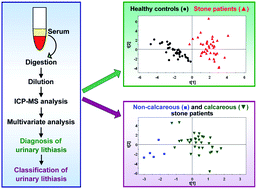
A method to diagnose urinary lithiasis at an early stage has been devised by Wei Hang and colleagues in Xiamen, China. The method can also distinguish between the different types of stone, which is important when considering treatment options.
Currently, distinguishing between types can only be done after the stones have been removed from a patient, making it difficult to prescribe a treatment.
Urinary lithiasis, stones in the lower urinary tract, has become more common, with about 100,000 new cases each year. It causes substantial pain and leads to renal failure. The stones are caused by a build up of organic materials and inorganic crystals.
The team’s diagnostic method uses elemental analysis on blood serum samples to detect the levels of barium, gallium, antimony and sodium; variations from the norm are linked to the appearance of stones. The test subjects could then be subdivided into calcareous and non-calcareous stone patients by metallomic profiling, and the team found that selenium levels play a major role in this classification.
Compared with urine samples, blood serum samples show smaller variability under normal physiological conditions so are a better choice for elemental screening, say the researchers.
Early diagnosis of urinary lithiasis via elementary profile of serum samples
Yao Gao, Ning Yang, Xiaomei Yan, Wei Hang, Jinchun Xing, Jiaxin Zheng, Eryi Zhu and Benli Huang
Anal. Methods, 2012, Advance Article
DOI: 10.1039/C2AY05705K
You may also be interested in:
Direct infusion mass spectrometry or liquid chromatography mass spectrometry for human metabonomics? A serum metabonomic study of kidney cancer
Lin Lin, Quan Yu, Xiaomei Yan, Wei Hang, Jiaxin Zheng, Jinchun Xing and Benli Huang
Analyst, 2010, 135, 2970-2978
DOI: 10.1039/C0AN00265H
Critical Review: Combination of PAGE and LA-ICP-MS as an analytical workflow in metallomics: state of the art, new quantification strategies, advantages and limitations
Alessandra Sussulini and Johanna Sabine Becker
Metallomics, 2011, 3, 1271-1279
DOI: 10.1039/C1MT00116G
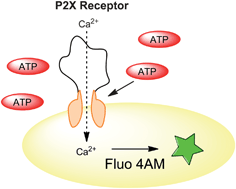
Dana Spence and colleagues at Michigan State University have developed a way to study the P2X1 receptor on platelets, providing new possibilities for the research of these important cells.
The primary function of platelets in the bloodstream involves maintaining hemostasis and preventing blood loss through the clotting process.
Platelets are found in the bloodstream and function to maintain hemostasis and prevent blood loss via clotting. Adenine receptors on the surface of the platelet are important in this process, most notably the ADP-sensitive receptors P2Y1/P2Y12, and the ATP-sensitive P2X1 receptor.
Roles for P2Y-type receptors in platelet activation are well established, but the role of the P2X1 receptor is less clear as it has proven difficult to study. P2X1 is rapidly desensitised during in vitro experiments, particularly when the platelets have been separated from plasma and washed.
Here, Professor Spence – who is on the Advisory Board of Analytical Methods‘ sister journal, Analyst – and his team use the reported P2X1 inhibitor NF449 to sensitise washed platelets, enabling them to be properly studied.
In a press release from MSU, Professor Spence says, “This receptor, P2X1, has long been viewed as not important in platelets; our studies show that is not necessarily true. The receptor is very active; you just need to be careful in working with it.”
He hopes that this now opens up investigation of the P2X1 receptor as a potential drug target for the treatment of conditions such as diabetes and hypertension.
Read the paper in full:
Measuring P2X1 receptor activity in washed platelets in the absence of exogenous apyrase
Kari B. Anderson , Welivitiya Karunarathne and Dana M. Spence
Anal. Methods, 2012, 4, 101-105
DOI: 10.1039/C1AY05530E
This month sees the following articles in Analytical Methods that are in the top ten most accessed:-
Let there be chip—towards rapid prototyping of microfluidic devices: one-step manufacturing processes
Ansgar Waldbaur, Holger Rapp, Kerstin Länge and Bastian E. Rapp
Anal. Methods, 2011, 3, 2681-2716 DOI: 10.1039/C1AY05253E
Scope and limitations of principal component analysis of high resolution LC-TOF-MS data: the analysis of the chlorogenic acid fraction in green coffee beans as a case study
Nikolai Kuhnert, Rakesh Jaiswal, Pinkie Eravuchira, Rasha M. El-Abassy, Bernd von der Kammer and Arnulf Materny
Anal. Methods, 2011, 3, 144-155 DOI: 10.1039/C0AY00512F
Surface micropatterning technique for surface-enhanced Raman scattering analysis
Weidong Ruan, Zhicheng Lu, Tieli Zhou, Bing Zhao and Li Niu
Anal. Methods, 2010, 2, 684-687 DOI: 10.1039/C0AY00068J
Expedient methodology for total methotrexate polyglutamation pool determination in human erythrocytes
Leon van Haandel, Anthonius A. M. Heemskerk, Mara L. Becker, J. Steven Leeder and John F. Stobaugh
Anal. Methods, 2010, 2, 831-836 DOI: 10.1039/C0AY00164C
Determination of bisphenol A, bisphenol F and their diglycidyl ethers in environmental water by solid phase extraction using magnetic multiwalled carbon nanotubes followed by GC-MS/MS
Yanna Jiao, Li Ding, Shanliang Fu, Shaohua Zhu, Hui Li and Libing Wang
Anal. Methods, 2012, 4, 291-298 DOI: 10.1039/C1AY05433C
Quantification of four tobacco-specific nitrosamines in cigarette filter tips using liquid chromatography-tandem mass spectrometry
P. M. Clayton, A. Cunningham and J. D. H. van Heemst
Anal. Methods, 2010, 2, 1085-1094 DOI: 10.1039/B9AY00306A
Polyaniline/polyacrylic acid/multi-walled carbon nanotube modified electrodes for sensing ascorbic acid
Ida Tiwari, Karan Pratap Singh, Manorama Singh and Craig E. Banks
Anal. Methods, 2012, 4, 118-124 DOI: 10.1039/C1AY05415E
Electrochemiluminescence based on quantum dots and their analytical application
Haiping Huang, Jingjing Li and Jun-Jie Zhu
Anal. Methods, 2011, 3, 33-42 DOI: 10.1039/C0AY00608D
Carbon nanofiber based electrochemical biosensors: A review
Jianshe Huang, Yang Liu and Tianyan You
Anal. Methods, 2010, 2, 202-211 DOI: 10.1039/B9AY00312F
Detection of apoptosis: A review of conventional and novel techniques
Michelle M. Martinez, Randall D. Reif and Dimitri Pappas
Anal. Methods, 2010, 2, 996-1004 DOI: 10.1039/C0AY00247J
Why not take a look at the articles today and blog your thoughts and comments below.
Fancy submitting an article to Analytical Methods? Then why not submit to us today or alternatively email us your suggestions.
Electrophoresis is a very useful separation method employed in a great variety of applications, including the separation and analysis of biological samples (e.g. DNA and proteins) and environmental samples (e.g. pesticide or pollutant analysis). Electrophoresis comes in various different forms (capillary or gel electrophoresis for example) making it a very versatile and adaptable technique.
Analytical Methods presents an excellent forum for advances and applications of this technique, and below is a sample of the high-quality work we have published in this area. These articles are free to access until the 13th February 2012 so make the most of this and take a look!
And don’t forget to stay informed of all our latest content by signing up to our e-alert or following us on Twitter: @methodsrsc and @analystrsc.
EndoV/DNA ligase mutation scanning assay using microchip capillary electrophoresis and dual-color laser-induced fluorescence detection, Akira Kotani, Małgorzata A. Witek, John K. Osiri, Hong Wang, Rondedrick Sinville, Hanna Pincas, Francis Barany and Steven A. Soper, Anal. Methods, 2012, 4, 58-64
Thermally responsive polymer as a sieving matrix of proteins in capillary gel electrophoresis, Chun Yang, Chunyan Chang, Jun Wang, Qishu Qu, Xiaoya Hu and Yang Wang, Anal. Methods, 2011, 3, 2717-2720
Assay design considerations for use of affinity aptamer amplification in ultra-sensitive protein assays using capillary electrophoresis, Kris P. F. Janssen, Karel Knez, Jeroen Pollet, Scott J. Roberts, Jan Schrooten and Jeroen Lammertyn, Anal. Methods, 2011, 3, 2156-2159
Recent advances of enantioseparations in capillary electrophoresis and capillary electrochromatography, Huang Lu and Guonan Chen, Anal. Methods, 2011, 3, 488-508
Rapid speciation analysis of mercury by short column capillary electrophoresis on-line coupled with inductively coupled plasma mass spectrometry, Bao-Hui Li, Anal. Methods, 2011, 3, 116-121
Rapid prototyping of polymeric electrophoresis microchips with integrated copper electrodes for contactless conductivity detection, Wendell Karlos Tomazelli Coltro, José Alberto Fracassi da Silva and Emanuel Carrilho, Anal. Methods, 2011, 3, 168-172
Speciation of organotin compounds in environmental samples with semi-permanent coated capillaries by capillary electrophoresis coupled with inductively coupled plasma mass spectrometry, Jing Sun, Bin He, Yongguang Yin, Lu Li and Guibin Jiang, Anal. Methods, 2010, 2, 2025-2031
Determination of paraquat and diquat preconcentrated with N doped TiO2nanotubes solid phase extraction cartridge prior to capillary electrophoresis, Qingxiang Zhou, Jinli Mao, Junping Xiao and Guohong Xie, Anal. Methods, 2010, 2, 1063-1068
Ionic liquids in the assay of proteins, Xuwei Chen, Jiawei Liu and Jianhua Wang, Anal. Methods, 2010, 2, 1222-1226
Ionic mobility of the solvated proton and acid–base titration in a four-compartment capillary electrophoresis system, Renata Mayumi Saito, José Geraldo Alves Brito-Neto, Fernando Silva Lopes, Lucas Blanes, Eric Tavares da Costa, Denis Tadeu Rajh Vidal, Guilherme Minoru Hotta and Claudimir Lucio do Lago, Anal. Methods, 2010, 2, 164-170
Application of dispersive liquid–liquid microextraction combined with sweeping micellar electrokinetic chromatography for trace analysis of six carbamate pesticides in apples, Shuaihua Zhang, Chao Li, Shuangju Song, Tao Feng, Chun Wang and Zhi Wang, Anal. Methods, 2010, 2, 54-62
This month sees the following articles in Analytical Methods that are in the top ten most accessed:-
Carbon nanofiber based electrochemical biosensors: A review
Jianshe Huang, Yang Liu and Tianyan You
Anal. Methods, 2010, 2, 202-211 DOI:10.1039/b9ay00312f
Electrochemiluminescence based on quantum dots and their analytical application
Haiping Huang, Jingjing Li and Jun-Jie Zhu
Anal. Methods, 2011, 3, 33-42 DOI:10.1039/c0ay00608d
Quantification of four tobacco-specific nitrosamines in cigarette filter tips using liquid chromatography-tandem mass spectrometry
P. M. Clayton, A. Cunningham and J. D. H. van Heemst
Anal. Methods, 2010, 2, 1085-1094 DOI:10.1039/b9ay00306a
Synthesis of MgFe2O4 nanoparticles and MgFe2O4 nanoparticles/CPE for electrochemical investigation of dopamine
Sathish Reddy, B. E. Kumara Swamy, Umesh Chandra, K. R. Mahathesha, T. V. Sathisha and H. Jayadevappa
Anal. Methods, 2011, 3, 2792-2796 DOI:10.1039/c1ay05483j
Graphene oxide?Ru complex for label-free assay of DNA sequence and potassium ions via fluorescence resonance energy transfer
Wenliang Sun, Shuo Shi and Tianming Yao
Anal. Methods, 2011, 3, 2472-2474 DOI:10.1039/c1ay05521f
Surface micropatterning technique for surface-enhanced Raman scattering analysis
Weidong Ruan, Zhicheng Lu, Tieli Zhou, Bing Zhao and Li Niu
Anal. Methods, 2010, 2, 684-687 DOI:10.1039/c0ay00068j
Trends in process analytical technology
Wee Chew and Paul Sharratt
Anal. Methods, 2010, 2, 1412-1438 DOI:10.1039/c0ay00257g
Ionic liquids in the assay of proteins
Xuwei Chen, Jiawei Liu and Jianhua Wang
Anal. Methods, 2010, 2, 1222-1226 DOI:10.1039/c0ay00342e
Dual functional electrochemical sensor based on Au?polydopamine?Fe3O4 nanocomposites
Guangfeng Wang, Hao Huang, Ge Zhang, Xiaojun Zhang and Lun Wang
Anal. Methods, 2011, 3, 2475-2477 DOI:10.1039/c1ay05404j
Gold nanoparticles/l-cysteine/graphene composite based immobilization strategy for an electrochemical immunosensor
Guangfeng Wang, Hao Huang, Ge Zhang, Xiaojun Zhang, Bin Fang and Lun Wang
Anal. Methods, 2010, 2, 1692-1697 DOI:10.1039/c0ay00389a
Why not take a look at the articles today and blog your thoughts and comments below.
Fancy submitting an article to Analytical Methods? Then why not submit to us today or alternatively email us your suggestions.