HOT Article: Colorimetric detection of lysine using gold nanoparticles

Xu et al, Anal. Methods, 2012, Advance Article

By Laura Ruvuna, Web Writer

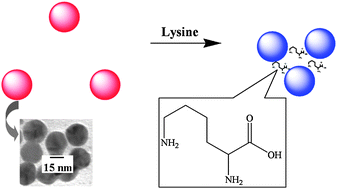
Sensors don’t always require expensive equipment or complex attachment chemistries, and when possible a visual color change is enough. In this HOT article, Maotian Xu and colleagues from Shangqiu Normal University, China, have detected lysine effectively and cheaply using the colorimetric properties of gold nanoparticles during aggregation. The lysine content in food is important for growth and development, and using this assay it was detected in three different commercial food sources. In addition to the visual change, the UV-Vis spectra scaled linearly with lysine concentration. See more about this simple but sensitivity system below, it will be free to read for 2 weeks.

Colorimetric detection of lysine using gold nanoparticles aggregation
Yanli Zhou,  Zhichong Yang and Maotian Xu
Anal. Methods, 2012, Advance Article
DOI: 10.1039/C2AY25475A

Digg This
Reddit This
Stumble Now!
Share on Facebook
Bookmark this on Delicious
Share on LinkedIn
Bookmark this on Technorati
Post on Twitter
Google Buzz (aka. Google Reader)

HOT articles in Analytical Methods

FitzGerald et al., Anal. Methods, 2012, Advance ArticleTake a look at some of the HOT articles we’ve published recently in Analytical Methods! These papers cover a wide variety of topics such as analysis of food, water pollution, zeolite columns and quantum dots. These papers will be free to access for 2 weeks.

Sensitive and rapid monitoring of water pollution level based on the signal enhancement of an activated glassy carbon electrode
Can Wu, Shijin Yu, Bin Lin, Qin Cheng and Kangbing Wu
Anal. Methods, 2012, Advance Article
DOI: 10.1039/C2AY25523E

Determination of trace leaching phthalate esters in water by magnetic solid phase extraction based on magnetic multi-walled carbon nanotubes followed by GC-MS/MS
Yanna Jiao, Shanliang Fu, Li Ding, Qiang Gong, Shaohua Zhu, Libing Wang and Hui Li
Anal. Methods, 2012, Advance Article
DOI: 10.1039/C2AY25386K

Mollica & Charles et al, Anal. Methods, 2012, Advance Article

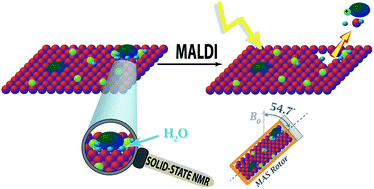
Towards the rationalization of the MALDI process: a combined mass spectrometry/solid-state NMR approach
Yannis Major, Hélène Pizzala, Fabio Ziarelli, Trang N. T. Phan, Giulia Mollica and Laurence Charles
Anal. Methods, 2012, Advance Article
DOI: 10.1039/C2AY25708D

Preparative size-exclusion chromatography for separation and purification of water-stable Cd-based quantum dots
Luis Alamo-Nole, Sonia Bailon-Ruiz, Oscar Perales-Perez and Felix R. Roman
Anal. Methods, 2012, Advance Article
DOI: 10.1039/C2AY25629K

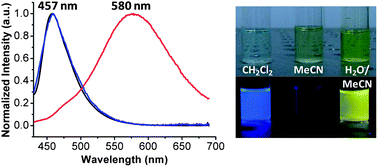
Hydrochromic fluorescence of organo-boronium-avobenzone complexes
Xuepeng Zhang and Guoqing Zhang
Anal. Methods, 2012, Advance Article
DOI: 10.1039/C2AY25424G

Multi-branch chemiluminescence–molecular imprinting sensor for sequential determination of carbofuran and omethoate in foodstuff
Shenguang Ge, Peini Zhao, Mei Yan, Dejin Zang and Jinghua Yu
Anal. Methods, 2012, Advance Article
DOI: 10.1039/C2AY25410G

Zhang & Zhang, Anal. Methods, 2012, Advance Article

Surface chemistry and linker effects on lectin–carbohydrate recognition for glycan microarrays
Michelle Kilcoyne, Jared Q. Gerlach, Marian Kane and Lokesh Joshi
Anal. Methods, 2012, Advance Article
DOI: 10.1039/C2AY25532D

Determination of anionic impurities in hexafluorosilicic acid by capillary zone electrophoresis
Nerea Ayarza, Juan M. G. Góngora, Rosa María Alonso and Rosa María Jiménez
Anal. Methods, 2012, Advance Article
DOI: 10.1039/C2AY25553G

Hierarchical Fe-ZSM-5 zeolite monolithic column for enhanced phosphorylated protein immobilization and identification
Wenzhong Zhang, Deju Wang, Huai Sun, Jun Yao, Fang Xu and Pengyuan Yang
Anal. Methods, 2012, Advance Article
DOI: 10.1039/C2AY25454A

Digg This
Reddit This
Stumble Now!
Share on Facebook
Bookmark this on Delicious
Share on LinkedIn
Bookmark this on Technorati
Post on Twitter
Google Buzz (aka. Google Reader)

Eye spy cyanide

The colour of cyanide poisoning is purple, according to researchers in Switzerland who have developed a method that enables them to quickly detect blood cyanide levels through a simple colour change.

The two-step method to detect cyanide. (A) Adding a chemosensor to a blood sample, followed by extracting the purple chemosensor–cyano complex from the sample. (B) Washing the column with water

The two-step method to detect cyanide. (A) Adding a chemosensor to a blood sample, followed by extracting the purple chemosensor–cyano complex from the sample. (B) Washing the column with water

Cyanide poisoning as a result of smoke inhalation can have serious or fatal consequences unless an antidote is rapidly administered. Current methods for determining cyanide poisoning, including microdiffusion, microdistillation and liquid chromatography-mass spectrometry detection, can take up to an hour to give results and are not suitable for point-of-care settings.

Read the full article in Chemistry World online.

Rapid visual detection of blood cyanide
Christine Männel-Croisé and Felix Zelder
Anal. Methods, 2012, Advance Article
DOI: 10.1039/C2AY25595B

Digg This
Reddit This
Stumble Now!
Share on Facebook
Bookmark this on Delicious
Share on LinkedIn
Bookmark this on Technorati
Post on Twitter
Google Buzz (aka. Google Reader)

HOT Article: A fresh approach using strontium isotopic analysis for forensic identification of human remains

By Pui Sai Lau, Web Writer

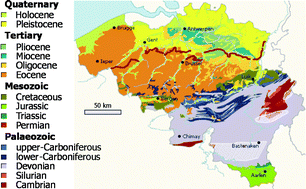
For many decades, natural radioactive elements have been used to date the age of minerals and rocks, and also trace the geological origins of archaeological, organic and inorganic materials. Various methods have been explored to measure radioisotopes in often complex samples and retrieve information that may otherwise be lost from possibly eons ago. Patrick Degryse, Frank Vanhaecke, the new Chair for JAAS and others from Belgium have recently demonstrated a modern-day application of strontium isotopic analysis. The team has forensically identified human remains by determining the 87Sr/86Sr ratio of bone and tooth enamel using multi-collector ICP-mass spectrometry. Read more about their exciting discovery below!

Strontium isotopic analysis as an experimental auxiliary technique in forensic identification of human remains
Patrick Degryse, David De Muynck, Steve Delporte, Sara Boyen, Laure Jadoul, Joan De Winne, Tatiana Ivaneanu and Frank Vanhaecke
Anal. Methods, 2012, Advance Article
DOI: 10.1039/C2AY25035G

Digg This
Reddit This
Stumble Now!
Share on Facebook
Bookmark this on Delicious
Share on LinkedIn
Bookmark this on Technorati
Post on Twitter
Google Buzz (aka. Google Reader)

Phenomenal legacy for London 2012

Professor Jeremy Nicholson

Professor Jeremy Nicholson of Imperial College, London, will be Director of the MRC-NIHR Phenome Centre

A pioneering new research centre set to emerge from the London 2012 anti-doping facilities could help revolutionise healthcare. The London 2012 anti-doping facilities will be developed after the Olympic and Paralympic Games into a world-class resource that could help revolutionise healthcare. The MRC-NIHR Phenome Centre will use the cutting edge facilities developed for London 2012 to help develop better and more targeted treatment for patients.
A phenome describes a person’s chemistry – all the molecules in their blood, urine or tissues – that are the result of their genetics and their lifestyle. Researchers at the Centre will investigate the phenome patterns of patients and volunteers by analysing samples very rapidly and on an unprecedented scale.

Professor Jeremy Nicholson of Imperial College, London, will be the Centre’s research director and principal investigator. He said: “We are delighted to receive this major award from the MRC and NIHR to create the world’s first comprehensive metabolic phenotyping centre. Generous contributions from the Waters Corporation and Bruker will also allow us to develop the next generation analytical screening technologies – which will be good news for analytical science in the UK as well as for basic medical research.”

Read the full press release from the RSC here, including comments from our Director of Science and Education, Professor Jim Iley, and Alan Handley, from the RSC’s Analytical Division. Also take a look at the official statement from the Medical Research Council (MRC), and a news story in Chemistry World.

We’re certainly very excited to see the new developments that will come from this new venture, and will be watching closely. For the time being, here’s some of Jeremy Nicholson’s recent work in the area of metabolite analysis:

Quantitative UPLC-MS/MS analysis of the gut microbial co-metabolites phenylacetylglutamine, 4-cresyl sulphate and hippurate in human urine: INTERMAP Study
Anisha Wijeyesekera, Philip A. Clarke, Magda Bictash, Ian J. Brown, Mark Fidock, Thomas Ryckmans, Ivan K. S. Yap, Queenie Chan, Jeremiah Stamler, Paul Elliott, Elaine Holmes and Jeremy K. Nicholson
Anal. Methods, 2012,4, 65-72
DOI: 10.1039/C1AY05427A

A metabolic system-wide characterisation of the pig: a model for human physiology
Claire A. Merrifield, Marie Lewis, Sandrine P. Claus, Olaf P. Beckonert, Marc-Emmanuel Dumas, Swantje Duncker, Sunil Kochhar, Serge Rezzi, John C. Lindon, Mick Bailey, Elaine Holmes and Jeremy K. Nicholson
Mol. BioSyst., 2011,7, 2577-2588
DOI: 10.1039/C1MB05023K

Digg This
Reddit This
Stumble Now!
Share on Facebook
Bookmark this on Delicious
Share on LinkedIn
Bookmark this on Technorati
Post on Twitter
Google Buzz (aka. Google Reader)

Anion detection method to help police fight crime


Molotov cocktail

Chemical ignition Molotov cocktails consist of a flammable liquid and sulfuric acid and potassium chlorate in a glass bottle. The mixture is set alight by the reactants’ reaction on smashing the bottle

Researchers in Spain have developed a fast, non-hazardous method of identifying the anions present in improvised incendiary devices (a type of petrol bomb). This information will be important to police officers, as knowing the components of the original device could potentially help lead to the suspects involved.

Carmen García-Ruiz of the University of Alcalá, Madrid, and her co-workers studied a particular type of device – so-called chemical ignition Molotov cocktails (CIMCs), which consist of a flammable liquid (typically petrol) along with sulfuric acid and potassium chlorate in a glass bottle. Rather than needing to be lit by the thrower, the exothermic reaction of these ingredients on contact sets the mixture alight.

Read the full article in Chemistry World.

Qualitative Determination of inorganic anions in incendiary device residues by capillary electrophoresis
Carlos Martín-Alberca, Jorge Sáiz, José Luis Ferrando and Carmen Garcia Ruiz
Anal. Methods, 2012, Accepted Manuscript

Digg This
Reddit This
Stumble Now!
Share on Facebook
Bookmark this on Delicious
Share on LinkedIn
Bookmark this on Technorati
Post on Twitter
Google Buzz (aka. Google Reader)

HOT articles in Analytical Methods Issue 8

To match our current weather, this month’s issue of Analytical Methods is hot, hot, HOT! We have 11 HOT papers for you to read and digest. So take a look below at some of this month’s hot science. These papers will be free to read for 2 weeks.

Making light work: a miniaturised, real-time optical sensor network for the detection of CWA simulant methyl salicylate
Karl D. Pavey, Nicholas J. FitzGerald and David J. Nielsen
Anal. Methods, 2012, 4, 2224
DOI: 10.1039/C2AY25099C

Silver paste nanocomposite electrode as a new metallic electrode for amperometric determination of hydrazine
Afsaneh Safavi and Maryam Tohidi
Anal. Methods, 2012, 4, 2233
DOI: 10.1039/C2AY05851K

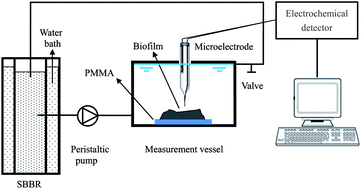
Development of an in situ dissolved oxygen measurement system and calculation of its effective diffusion coefficient in a biofilm
Yun-Fang Ning, You-Peng Chen, Shan Li, Jin-Song Guo, Xu Gao, Fang Fang, Yu Shen and Kun Zhang
Anal. Methods, 2012, 4, 2242
DOI: 10.1039/C2AY25132A

Matrixes in UV-MALDI mass spectrometry – crystals of organic salts versus co-crystals of neutral polyfunctional carboxylic acids
Bojidarka B. Ivanova and Michael Spiteller
Anal. Methods, 2012, 4, 2247
DOI: 10.1039/C2AY25090J

Thiophene anchored naphthalene derivative: Cr3+ selective turn-on fluorescent probe for living cell imaging
Sudipta Das, Animesh Sahana, Arnab Banerjee, Sisir Lohar, Subarna Guha, Jesús Sanmartín Matalobos and Debasis Das
Anal. Methods, 2012, 4, 2254
DOI: 10.1039/C2AY25384D

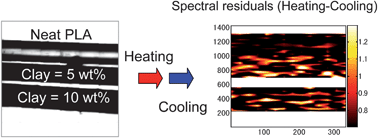
Thermal behavior of drawn poly(lactic acid)-nanocomposite fiber probed by near-infrared hyperspectral imaging based on roundtrip temperature scan
Hideyuki Shinzawa, Masakazu Nishida, Toshiyuki Tanaka and Wataru Kanematsu
Anal. Methods, 2012, 4, 2259
DOI: 10.1039/C2AY25204J

A highly sensitive resonance scattering based sensor using unmodified gold nanoparticles for danunomycin detection in aqueous solution
Lan He, Wenting Zhi, Yuangen Wu, Shenshan zhan, Faze Wang, Haibo Xing and Pei zhou
Anal. Methods, 2012, 4, 2266
DOI: 10.1039/C2AY25596K

Trace determination of linear alkylbenzene sulfonates using ionic liquid based ultrasound-assisted dispersive liquid–liquid microextraction and response surface methodology
Majid Arvand, Elahe Bozorgzadeh, Shahab Shariati and Mohammad A. Zanjanchi
Anal. Methods, 2012, 4, 2272
DOI: 10.1039/C2AY25302J

A capillary electrophoresis method for the simultaneous analysis of ammonium and metals in animal wastes used in biogas production
Mari Jaakkola, Maija Lipponen, Johanna Kallio and Vesa Virtanen
Anal. Methods, 2012, 4, 2278
DOI: 10.1039/C2AY25307K

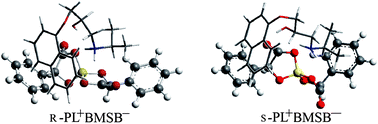
Determination of enantiomer compositions of propranolol enantiomers by chiral ionic liquid as a chiral selector and the UV-assisted spectrophotometric method
Ghodratollah Absalan, Yousef Alipour, Zahra Rezaei and Morteza Akhond
Anal. Methods, 2012, 4, 2283
DOI: 10.1039/C2AY25161B

Determination of uric acid in biological samples on the pretreated pencil graphite electrode
Esmaeel Alipou, Mir Reza Majidi, Afsaneh Saadatirad and Sayed Mahdi Golabi
Anal. Methods, 2012, 4, 2288
DOI: 10.1039/C2AY25463H

Digg This
Reddit This
Stumble Now!
Share on Facebook
Bookmark this on Delicious
Share on LinkedIn
Bookmark this on Technorati
Post on Twitter
Google Buzz (aka. Google Reader)

Analytical Methods Issue 8 online

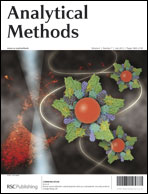
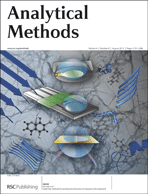
The latest issue of Analytical Methods has now gone online. This month we have two covers for you to enjoy.

FitzGerald et al., Anal. Methods, 2012, 4, 2224

On the outside front cover is a striking image from Nicholas J. FitzGerald and colleagues from the Defence Science and Technology Organisation, Australia. They have developed a miniature, real-time optical sensor that can detect the absorption levels of the chemical warfare agent methyl salicylate in a soldier’s clothing.

Making light work: a miniaturised, real-time optical sensor network for the detection of CWA simulant methyl salicylate
Karl D. Pavey, Nicholas J. FitzGerald and David J. Nielsen
Anal. Methods, 2012, 4, 2224
DOI: 10.1039/C2AY25099C

Minunni & Kerman et al., Anal. Methods, 2012, 4, 2228

On the inside front cover is a colourful image from a team from Canada and Italy. Maria Minunni and Kagan Kerman, from the Università degli Studi di Firenze and the University of Toronto Scarborough, respectively, have with their team been studying Alzheimer’s disease and looking at label free probing methods used in its research.

Label-free methods for probing the interaction of clioquinol with amyloid-β
Xin Ran Cheng, Vinci Wing Sze Hung, Simona Scarano, Marco Mascini, Maria Minunni and Kagan Kerman
Anal. Methods, 2012, 4, 2228
DOI: 10.1039/C2AY25123J

These articles will be free to read for 6 weeks, so take a look today!

Digg This
Reddit This
Stumble Now!
Share on Facebook
Bookmark this on Delicious
Share on LinkedIn
Bookmark this on Technorati
Post on Twitter
Google Buzz (aka. Google Reader)

HOT articles in Analytical Methods this July!

It’s been a busy month with so many great papers, so here are some HOT articles from Analytical Methods that you might have missed this July!

Why not take a look, they will be free to read for 2 weeks.

Rapid characterisation and classification of automotive clear coats by attenuated total reflectance infrared spectroscopy
Mark Maric, Wilhelm van Bronswijk, Simon W. Lewis and Kari Pitts
Anal. Methods, 2012, Advance Article
DOI: 10.1039/C2AY25419K

A fast-responding fluorescent turn-on sensor for sensitive and selective detection of sulfite anions
Changmin Yu, Ming Luo, Fang Zeng and Shuizhu Wu
Anal. Methods, 2012, Advance Article
DOI: 10.1039/C2AY25496D

Fused core particles as an alternative to fully porous sub-2 μm particles in pharmaceutical analysis using coupled columns at elevated temperature
Heba Shaaban and Tadeusz Górecki
Anal. Methods, 2012, Advance Article
DOI: 10.1039/C2AY25202C

Critical evaluation of methods for end-point determination in pharmaceutical blending processes
Marcelo Blanco, Ruben Cueva-Mestanza and Jordi Cruz
Anal. Methods, 2012, Advance Article
DOI: 10.1039/C2AY25379H

Matrixes in UV-MALDI mass spectrometry – crystals of organic salts versus co-crystals of neutral polyfunctional carboxylic acids
Bojidarka B. Ivanova and Michael Spiteller
Anal. Methods, 2012, Advance Article
DOI: 10.1039/C2AY25090J

Determination of enantiomer compositions of propranolol enantiomers by chiral ionic liquid as a chiral selector and the UV-assisted spectrophotometric method
Ghodratollah Absalan, Yousef Alipour, Zahra Rezaei and Morteza Akhond
Anal. Methods, 2012, Advance Article
DOI: 10.1039/C2AY25161B

A highly sensitive resonance scattering based sensor using unmodified gold nanoparticles for danunomycin detection in aqueous solution
Lan He, Wenting Zhi, Yuangen Wu, Shenshan zhan, Faze Wang, Haibo Xing and Pei zhou
Anal. Methods, 2012, Advance Article
DOI: 10.1039/C2AY25596K

Determination of uric acid in biological samples on the pretreated pencil graphite electrode
Esmaeel Alipou, Mir Reza Majidi, Afsaneh Saadatirad and Sayed Mahdi Golabi
Anal. Methods, 2012, Advance Article
DOI: 10.1039/C2AY25463H

Thiophene anchored naphthalene derivative: Cr3+ selective turn-on fluorescent probe for living cell imaging
Sudipta Das, Animesh Sahana, Arnab Banerjee, Sisir Lohar, Subarna Guha, Jesús Sanmartín Matalobos and Debasis Das
Anal. Methods, 2012, Advance Article
DOI: 10.1039/C2AY25384D

Digg This
Reddit This
Stumble Now!
Share on Facebook
Bookmark this on Delicious
Share on LinkedIn
Bookmark this on Technorati
Post on Twitter
Google Buzz (aka. Google Reader)

HOT articles in Analytical Methods

Take a look at some of the HOT articles we’ve published recently in Analytical Methods! These papers cover a wide variety of topics such as analysis of animal wastes and biogas, biofilms, and colorimetric detection. They will be free to access for 2 weeks.

Development of a cataluminescence-based method for rapid screening of de-NOx catalysts
Liyan Wu, Yantu Zhang, Sichun Zhang and Xinrong Zhang
Anal. Methods, 2012, Advance Article
DOI: 10.1039/C2AY25323B

A simple and effective colorimetric technique for the detection of boronic acids and their derivatives
Katherine Lawrence, Stephen E. Flower, Gabriele Kociok-Kohn, Christopher G. Frost and Tony D. James
Anal. Methods, 2012, Advance Article
DOI: 10.1039/C2AY25346A

Development of an in situ dissolved oxygen measurement system and calculation of its effective diffusion coefficient in a biofilm
Yun-Fang Ning, You-Peng Chen, Shan Li, Jin-Song Guo, Xu Gao, Fang Fang, Yu Shen and Kun Zhang
Anal. Methods, 2012, Advance Article
DOI: 10.1039/C2AY25132A

Thermal behavior of drawn poly(lactic acid)-nanocomposite fiber probed by near-infrared hyperspectral imaging based on roundtrip temperature scan
Hideyuki Shinzawa, Masakazu Nishida, Toshiyuki Tanaka and Wataru Kanematsu
Anal. Methods, 2012, Advance Article
DOI: 10.1039/C2AY25204J

Layered double hydroxide supported Prussian blue nanocomposites for electrocatalytic reduction of H2O2
Rongrong Jin, Lifang Li, Yinghui Lian, Xuefeng Xu and Fan Zhao
Anal. Methods, 2012, Advance Article
DOI: 10.1039/C2AY25306B

A capillary electrophoresis method for the simultaneous analysis of ammonium and metals in animal wastes used in biogas production
Mari Jaakkola, Maija Lipponen, Johanna Kallio and Vesa Virtanen
Anal. Methods, 2012, Advance Article
DOI: 10.1039/C2AY25307K

Digg This
Reddit This
Stumble Now!
Share on Facebook
Bookmark this on Delicious
Share on LinkedIn
Bookmark this on Technorati
Post on Twitter
Google Buzz (aka. Google Reader)