Improving Drug Detection in Blood

Polly-Anna Ashford is a guest web writer for Analytical Methods. She is currently a PhD student at the University of East Anglia, UK.

Mass spectral analysis of blood samples

Mass spectral analysis of blood samples

Analysing blood samples for the presence of legal and illegal drugs can present a challenge to forensic scientists; blood is a complex matrix which requires cleaning up before analysis, and the standard tests tend to be specific to a single drug or drug class.

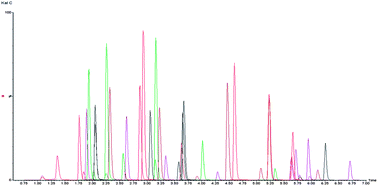
Lambert Sørensen and Jørgen Hasselstrøm from the Department of Forensic Medicine at Aarhus University, Denmark, have developed a rapid method for quantification of around 50 drugs and metabolites in whole blood samples. The process uses ultra-high-performance liquid chromatography tandem mass spectrometry (UPLC-ESI-MS/MS) and shows low limits of detection even with post-mortem blood samples, which are more difficult to analyse due to varying degrees of putrefaction.

The simple sample preparation procedure involves deproteinisation by methanol/acetonitrile and ultrafiltration of the extract, and the researchers used a 96-well format to obtain high sample throughput.

To know more, access the link below. This paper will be free to read for the next 10 days.

A high-throughput multi-class liquid chromatography tandem mass spectrometry method for quantitative determination of licit and illicit drugs in whole blood
Lambert K. Sørensen* and   Jørgen B. Hasselstrøm
Anal. Methods, 2013,5, 3185-3193
DOI: 10.1039/C3AY40443A

Digg This
Reddit This
Stumble Now!
Share on Facebook
Bookmark this on Delicious
Share on LinkedIn
Bookmark this on Technorati
Post on Twitter
Google Buzz (aka. Google Reader)

HOT Articles in Analytical Methods!

Take a look at our selected HOT Articles just published in Analytical Methods! They are all free for you to read until July 15th. Have a read now!

Time domain nuclear magnetic resonance: a key complementary technique for the forensic differentiation of foam traces
Michele Mauri, Murali Krishna Dibbanti, Matteo Calzavara, Lucio Mauri, Roberto Simonutti and Valerio Causin  
Anal. Methods, 2013, Advance Article
DOI: 10.1039/C3AY40330K 

Discrimination of oral submucous fibrosis (OSF) affected oral tissues from healthy oral tissues using multivariate analysis of in vivo fluorescence spectroscopic data: A simple and fast procedure for OSF diagnosis
Keshav Kumar, S. Sivabalan, S. Ganesan and Ashok Kumar Mishra  
Anal. Methods, 2013, Advance Article
DOI: 10.1039/C3AY40352A 
 
Rapid electrochemical detection of ferulic acid based on a graphene modified glass carbon electrode
Yanli Zhang, Yanpei Liu, Zhongming Yang, Yingcai Yang, Pengfei Pang, Yuntao Gao and Qiufen Hu  
Anal. Methods, 2013, Advance Article
DOI: 10.1039/C3AY40084K 

Evaluation of a new passive sampler using hydrophobic zeolites as adsorbents for exposure measurement of indoor BTX
Zhengjian Du, Jinhan Mo, Yinping Zhang, Xinxiao Li and Qiujian Xu 
Anal. Methods, 2013, Advance Article
DOI: 10.1039/C3AY40600H 

Electrochemical biosensing platform based on a hemocyanin–Au@QC NP–carbon black hybrid nano-composite film
Peng Yang, Jun You, Fangping Li, Junjie Fei, Bo Feng, Xiulan He and Jinping Zhou  
Anal. Methods, 2013,5, 3168-3171
DOI: 10.1039/C3AY40654G

Digg This
Reddit This
Stumble Now!
Share on Facebook
Bookmark this on Delicious
Share on LinkedIn
Bookmark this on Technorati
Post on Twitter
Google Buzz (aka. Google Reader)

Analytical Methods Impact Factor rises to 1.9

We are delighted to announce that our Impact Factor* has risen to 1.9!

Analytical Methods continues to grow, and remains the the place to publish exciting research on early applied demonstrations of new analytical methods with clear societal impact. The journal focuses on the advancement of analytical technologies for wider application by the international scientific community. Areas covered include developments within the fields of healthcare, pharmaceuticals and biomedical diagnostics, environmental and forensic analysis, heritage science, agricultural science and food products, industrial process development and product validation.

The Editorial Office thanks all of our Board members, authors and readers for their continued support.

We invite you to submit your latest piece of research here.

*The Impact Factor provides an indication of the average number of citations per paper. Produced annually, Impact Factors are calculated by dividing the number of citations in a year by the number of citeable articles published in the preceding two years. Data based on 2012 Journal Citation Reports®, (Thomson Reuters, 2013).

Digg This
Reddit This
Stumble Now!
Share on Facebook
Bookmark this on Delicious
Share on LinkedIn
Bookmark this on Technorati
Post on Twitter
Google Buzz (aka. Google Reader)

Diabetes breath test overcomes humidity

Sonja Hampel writes on a HOT Analytical Methods article in Chemistry World

A cheaper and safer to produce breath test for diabetes has been developed by scientists in Canada. The titanium nanoparticle-based sensor detects acetone, a biomarker of type 1 diabetes, even at 90% relative humidity.

Diabetes is a chronic condition which requires life-long treatment and monitoring. Untreated diabetes can lead to dangerous complications, such as ketoacidosis. Diagnosing diabetes quickly can be life-saving.

Commonly, diabetes is diagnosed and monitored through blood sample analysis. Acetone levels in breath can be measured by time-consuming and difficult-to-access gas chromatography and mass spectrometry. Other non-invasive breath sensors based on metal oxide semiconductors, whose conductivity changes upon acetone adsorption, are fabricated via unsafe and expensive flame pyrolysis. To be useful for diagnosis, breath sensors must be able to detect parts-per-billion levels of acetone from a complex mixture of breath components including water vapour.

To read the full article please visit Chemistry World.

Low cost acetone sensor with selectivity over water vapor based on screen printed TiO2 nanoparticles
Lucy Lulu Deng, Cindy Xinxin Zhao, Yiqun Ma, Sean Shangzhi Chen and Gu Xu  
Anal. Methods, 2013, Accepted Manuscript
DOI: 10.1039/C3AY40373D

Digg This
Reddit This
Stumble Now!
Share on Facebook
Bookmark this on Delicious
Share on LinkedIn
Bookmark this on Technorati
Post on Twitter
Google Buzz (aka. Google Reader)

Power-free nucleic acid extraction device

HIV RNA has been successfully extracted from human blood using a portable device that does not need electrical power to work. The system, developed by researchers in the US, is another link in the chain to enable the accurate monitoring of Aids treatment in countries with limited resources.

The availability of antiretroviral therapy has expanded rapidly in recent years, but the ability to monitor the progress of treatment has not kept up with the pace. Although cheap, qualitative assays are available for the initial detection of HIV infection, quantitative viral load measurements are needed to check if treatment is working. Effective, inexpensive sample preparation that works at ambient temperature and without the need for cold storage is one of the current stumbling blocks in achieving this goal.

To read the full article please visit Chemistry World.

A portable, pressure driven, room temperature nucleic acid extraction and storage system for point of care molecular diagnostics
Samantha Byrnes, Andy Fan, Jacob Trueb, Francis Jareczek, Mark Mazzochette, Andre Sharon, Alexis F. Sauer-Budge and Catherine M. Klapperich  
Anal. Methods, 2013, Advance Article
DOI: 10.1039/C3AY40162F

Digg This
Reddit This
Stumble Now!
Share on Facebook
Bookmark this on Delicious
Share on LinkedIn
Bookmark this on Technorati
Post on Twitter
Google Buzz (aka. Google Reader)

Take 1.. minute for chemistry in health

Do you know how chemical scientists can tackle global challenges in Human Health? If so, the RSC is running a one minute video competition this summer for young researchers such as PhD and Post-doc students; get involved and innovate the way scientists share their research. Your video should communicate your own personal research or an area of research that interests you, highlighting its significance and impact to Human Health.

Five videos will be shortlisted by our judging panel and the winner will be selected during the ‘How does chemistry keep us healthy?’ themed National Chemistry Week taking place 16-23 November.

A £500 prize and a fantastic opportunity to shadow the award winning video Journalist, Brady Harran, is up for grabs for the winner.

The judging panel will include the makers of The Periodic Tale of Videos, Martyn Poliakoff and Brady Harran, and RSC Division representatives.

Check out our webpage for further details of the competition and an example video.

The competition will open 02 April 2013 and the closing date for entries is 01 July 2013. Please submit your entries to rsc.li/take-1-video-competition.

Any questions please contact science@rsc.org.

Digg This
Reddit This
Stumble Now!
Share on Facebook
Bookmark this on Delicious
Share on LinkedIn
Bookmark this on Technorati
Post on Twitter
Google Buzz (aka. Google Reader)

Misdiagnosed manganism near Mount Etna?

Scientists in Italy have found that the surfaces of lava stones from from Mount Etna, in Sicily, may be leaching manganese into the environment. Almost 1.5 million people are supplied with water from Etna’s wells and these findings could help identify any health risks associated with using this water.

The origins of elevated occurrences of some health problems in the population around Europe’s tallest and most active volcano have been debated for many years. Reports have shown that levels of Parkinson’s disease in the area are well above average and doctors have been unable to rationalise these numbers.

Mount Etna

To read the full article please visit Chemistry World.

A photoelectron spectroscopy study of lava stones
Domenico Andrea Cristaldi, Cosimo G. Fortuna and Antonino Gulino  
Anal. Methods, 2013, Advance Article
DOI: 10.1039/C3AY40136G

Digg This
Reddit This
Stumble Now!
Share on Facebook
Bookmark this on Delicious
Share on LinkedIn
Bookmark this on Technorati
Post on Twitter
Google Buzz (aka. Google Reader)

Measuring indoor air pollution

Chinese scientists have developed a passive sampler that can be used for monitoring common indoor air pollutants. Air quality is currently an important topic in China, with air pollution rivalling food safety and clean drinking water as a key theme for Chinese lawmakers. The quality of indoor air can be just as compromised as the outside. Nowadays, people spend a large amount of their time indoors so it is important to be able to accurately measure indoor air quality.

Should indoor air pollution be as much of a concern as outdoor air pollution?

The Tsinghua Passive Diffusive Sampler (THPDS), made by Yinping Zhang and colleagues at Tsinghua University, China, is a low-cost, passive air sampler that can be used to monitor levels of the volatile organic compounds (VOC), benzene, toluene and xylene (BTX). ‘Rapid urbanisation in China has resulted in serious indoor BTX pollution in the past few decades. However, there is little quantitative information on indoor BTX exposure and corresponding health risks in China, primarily because there has been a lack of cheap and accurate passive samplers,’ says Zhang.

To read the full article please visit Chemistry World.

Evaluation of a New Passive Sampler Using Hydrophobic Zeolites as Adsorbents for Exposure Measurement of Indoor BTX
Zhengjian Du, Jinhan Mo, Yinping Zhang,  Xinxiao Li and Qiujian Xu  
Anal. Methods, 2013, Accepted Manuscript
DOI: 10.1039/C3AY40600H

Digg This
Reddit This
Stumble Now!
Share on Facebook
Bookmark this on Delicious
Share on LinkedIn
Bookmark this on Technorati
Post on Twitter
Google Buzz (aka. Google Reader)

Hot Articles in Analytical Methods

Take a look at our new selected HOT articles just published in Analytical Methods. They are all free for you to read until June 28th. Have a read now!

Supramolecular dispersive liquid–liquid microextraction based solidification of floating organic drops for speciation and spectrophotometric determination of chromium in real samples
Malihe Dehghani Mohammad Abadi, Mahmoud Chamsaz, Mohammad Hossein Arbab-Zavar and Farzaneh Shemirani  
Anal. Methods, 2013, Advance Article
DOI: 10.1039/C3AY00036B 
 
A ratiometric fluorescent sensor for Ag+ based on 8-hydroxyquinoline platform in aqueous media
Huajie Xu, Zhaodi Liu, Liangquan Sheng, Deqian Huang, Hong Zhang, Chongfu Song, Mingming Chena and  Wuyang Hua  
Anal. Methods, 2013, Advance Article
DOI: 10.1039/C3AY40277K 
 
Application of portable spectrometer for ultra trace metal analysis after ionic liquid based microextraction
Xiaodong Wen, Qingwen Deng, Jiwei Wang and Xia Zhao  
Anal. Methods, 2013, Advance Article
DOI: 10.1039/C3AY40229K 
 
Highly sensitive determination of Orange II based on the dual amplified electrochemical signal of graphene and mesoporous TiO2
Tian Gan, Junyong Sun, Zuomin Lin and Yuling Li  
Anal. Methods, 2013, Advance Article
DOI: 10.1039/C3AY40250A 
 
Elimination of interferences caused by simultaneous use of deuterated and carbon-13 standards in GC-MS analysis of polycyclic aromatic hydrocarbons (PAHs) in extracts from passive sampling devices
Matyas Ripszam, Roman Grabic and Peter Haglund  
Anal. Methods, 2013, Advance Article
DOI: 10.1039/C3AY40419F

Digg This
Reddit This
Stumble Now!
Share on Facebook
Bookmark this on Delicious
Share on LinkedIn
Bookmark this on Technorati
Post on Twitter
Google Buzz (aka. Google Reader)

Analytical Methods Issue 11 is out now!

The latest Issue of Analytical Methods is now available online.

Our outside front cover features the interesting work of Kazuto Sazawa and his team from the University of Toyama, Japan. In their paper, the rearchers evaluate the effect of forest fires on soil color using the CIE Lab system, the international standard system for color measurements in food, textiles and plastics. According to this study, the proposed method is useful to evaluate the effect of heat on Indonesian peat soil, forest soil, highmoor peat and peatmoss, and is especially indicated for the evaluation of soil that contains a high ratio of organic matter such as peat soil.

The evaluation of forest fire severity and effect on soil organic matter based on the L*, a*, b* color reading system
Kazuto Sazawa, Takatoshi Wakimoto, Noriko Hata, Shigeru Taguchi, Shunitz Tanaka, Masamoto Tafu and   Hideki Kuramitz 
Anal. Methods, 2013,5, 2660-2665
DOI: 10.1039/C3AY26251K

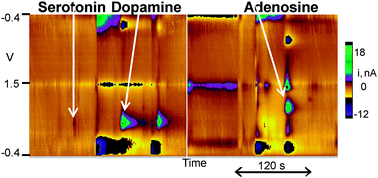
Also free for your is this paper from the Analyst Advisory Board Member Jill Venton on a new method to detect low concentrations of dopamine, serotonin and adenosine in tissues.

Capillary electrophoresis with fast-scan cyclic voltammetry detection to determine dopamin, serotonin and adenosine

Quantitation of dopamine, serotonin and adenosine content in a tissue punch from a brain slice using capillary electrophoresis with fast-scan cyclic voltammetry detection
Huaifang Fang, Megan L. Pajski, Ashley E. Ross and   B. Jill Venton
Anal. Methods, 2013,5, 2704-2711
DOI: 10.1039/C3AY40222C

In addition, take a look at the two HOT articles below. These papers will be free to read until June 10th.

Identification of bacteria in drinking water with Raman spectroscopy
Jack van de Vossenberg, Heli Tervahauta, Kees Maquelin, Carola H. W. Blokker-Koopmans, Marijan Uytewaal-Aarts, Dick van der Kooij, Annemarie P. van Wezel and   Bram van der Gaag   
Anal. Methods, 2013,5, 2679-2687
DOI: 10.1039/C3AY40289D

Protein–polyphenol interaction on silica beads for astringency tests based on eye, photography or reflectance detection modes
J. Rafaela L. Guerreiro, Duncan S. Sutherland, Victor De Freitas and   M. Goreti F. Sales
Anal. Methods, 2013,5, 2694-2703
DOI: 10.1039/C3AY26478E

Digg This
Reddit This
Stumble Now!
Share on Facebook
Bookmark this on Delicious
Share on LinkedIn
Bookmark this on Technorati
Post on Twitter
Google Buzz (aka. Google Reader)