HOT: Studying the scope of the 1,2-sulfone rearrangement

Adrien Quintard and Alexandre Alexakis from the University of Geneva report a systematic study on the application and scope of the 1,2-sulfone rearrangement and notably on its asymmetric variant. 

A wide variety of nucleophiles can be used to yield highly functionalised substrates, with some demonstrating excellent enantioselectivities of up to 94% ee.  This 1,2-sulfone rearrangement constitutes an alternative to the use of expensive 1,1-bis(phenylsulfonyl)ethene and leads to a formal alkylation of the nucleophile.

Both reviewers thought this HOT article would be of very wide interest in the organic community and it is now free to access until 8th February.

1,2-Sulfone rearrangement in organocatalytic reactions
Adrien Quintard and Alexandre Alexakis
Org. Biomol. Chem., 2011, Advance Article
DOI: 10.1039/C0OB00818D

Digg This
Reddit This
Stumble Now!
Share on Facebook
Bookmark this on Delicious
Share on LinkedIn
Bookmark this on Technorati
Post on Twitter
Google Buzz (aka. Google Reader)

HOT: Treasures from the Free Radical Renaissance Period

Carl Schiesser takes us through the evolution of Free Radical Chemistry in this very original and well written paper that highlights results from the Beckwith “golden era”.
Join us in this trip from the “Dark Ages” of Free Radical Chemistry to the Post-Renaissance period.  The paper will be free to access until 4th February.

In the paper, they determine the rate constant data and Arrhenius parameters for a series of substituted hexenyl radicals of differing electronic and steric demand.

This paper will be included in the special issue on ‘Free Radical Chemistry’ in memory of Athel Beckwith that will be published in Spring. Keep an eye on it.

Treasures from the Free Radical Renaissance Period – Miscellaneous hexenyl radical kinetic data
Athelstan L. J. Beckwith and Carl H. Schiesser
Org. Biomol. Chem., 2011, Advance Article
DOI: 10.1039/C0OB00708K, Paper

Digg This
Reddit This
Stumble Now!
Share on Facebook
Bookmark this on Delicious
Share on LinkedIn
Bookmark this on Technorati
Post on Twitter
Google Buzz (aka. Google Reader)

HOT: A potential antihypertensive drug

Inhibition of angiotensin converting enzyme (ACE) is generally used as one of the methods for the treatment of hypertension. ‘Oxidative stress’ is another disease state caused by an imbalance in the production of oxidants and antioxidants. Hypertension and oxidative stress may be interdependent. Therefore, ACE inhibitors having antioxidant properties are considered beneficial for the treatment of hypertension.

Bhaskar J. Bhuyan and Govindasamy Mugesh at the Indian Institute of Science in Bangalore, India, synthesise in this paper a number of selenium analogues of captopril, an ACE inhibitor used as an antihypertensive drug. These analogues not only inhibit ACE activity but also effectively scavenge peroxynitrite, a strong oxidant found in vivo.

Read this paper which is free to access until the 4th February. The referees strongly recommended it and the editorial office as well.

Synthesis, characterization and antioxidant activity of angiotensin converting enzyme inhibitors Bhaskar J. Bhuyan and Govindasamy Mugesh
 Org. Biomol. Chem
., 2011, Advance Article
DOI: 10.1039/C0OB00823K, Paper

Digg This
Reddit This
Stumble Now!
Share on Facebook
Bookmark this on Delicious
Share on LinkedIn
Bookmark this on Technorati
Post on Twitter
Google Buzz (aka. Google Reader)

HOT: Expanding the catalogue of emission colours

Bruce A. Armitage and his team at Carnegie Mellon University in Pittsburgh, USA, create a new family of blue fluoromodules with low nanomolar Kds and high quantum yields.
These fluoromodules provide a new technology for multicolour fluorescent labelling and cellular imaging.

This is a very interesting paper that has been rated as very significant by all the referees.

You don’t want to miss this one! Read it now – it is free to access until the 4th February.

Blue fluorescent dye-protein complexes based on fluorogenic cyanine dyes and single chain antibody fragments
Kimberly J. Zanotti, Gloria L. Silva, Yehuda Creeger, Kelly L. Robertson, Alan S. Waggoner, Peter B. Berget and Bruce A. Armitage
Org. Biomol. Chem., 2011
DOI: 10.1039/C0OB00444H

Digg This
Reddit This
Stumble Now!
Share on Facebook
Bookmark this on Delicious
Share on LinkedIn
Bookmark this on Technorati
Post on Twitter
Google Buzz (aka. Google Reader)

Unnatural aromatic amino acids – Cover Issue 2

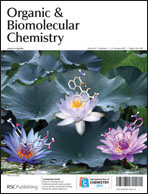
Gangadhar J. Sanjayan and his team at the National Chemical Laboratory in Pune, India, write about the development of conformationally constrained unnatural aromatic amino acids in this communication that is the cover of OBC Issue 2.

The strategy described within the paper will be useful for the construction of oligomers displaying novel molecular architectures with unique conformations, distinct from those classically observed.

Download this paper free to access for a limited period of time.

Congratulations to the authors for a beautiful cover and their interesting research.

Conformationally rigid aromatic amino acids as potential building blocks for abiotic foldamers
Veera V. E. Ramesh, Arup Roy, Kuruppanthara N. Vijayadas, Amol M. Kendhale, Panchami Prabhakaran, Rajesh Gonnade, Vedavati G. Puranik and Gangadhar J. Sanjayan
Org. Biomol. Chem., 2011, 9, 367-369
DOI: 10.1039/C0OB00593B, Communication

Digg This
Reddit This
Stumble Now!
Share on Facebook
Bookmark this on Delicious
Share on LinkedIn
Bookmark this on Technorati
Post on Twitter
Google Buzz (aka. Google Reader)

Meet the OBC team

The OBC team will be attending a number of conferences in 2011 and we would be delighted to meet you.

These are just some of the conferences where you can meet us in the coming months:

Please let us know if you are planning on attending any of these meetings as it would be lovely to meet you there.

Digg This
Reddit This
Stumble Now!
Share on Facebook
Bookmark this on Delicious
Share on LinkedIn
Bookmark this on Technorati
Post on Twitter
Google Buzz (aka. Google Reader)

Announcement: New Organic & Biomolecular Chemistry Editorial Board Chair

We are delighted to announce that Professor Jeff Bode (ETH Zurich, Switzerland) will take position as the Chair of the Organic & Biomolecular Chemistry Editorial Board in January 2011.  The editorial team would like to congratulate Jeff and wish him well in his new role.

Professor Jay Siegel, the current Chair, will retire from his post at the end of 2010. Jay joined the Editorial Board at the journal’s inception in 2003 and became Chair in 2007. In the past 4 years Jay has overseen significant growth in the high quality content published in the journal. The Editorial team would like to thank Jay for all his work on OBC over the past eight years.

Digg This
Reddit This
Stumble Now!
Share on Facebook
Bookmark this on Delicious
Share on LinkedIn
Bookmark this on Technorati
Post on Twitter
Google Buzz (aka. Google Reader)

HOT: Ferrocene-containing rotaxane: New chloride ion sensor

Nicholas H. Evans and Paul D. Beer at University of Oxford, describe in this paper the first example of a solution based redox-active interlocked host system capable of the electrochemical recognition of anions and most specifically chloride.

Read this HOT article, as rated by the referees, which will be free to access until 6th December.

A ferrocene functionalized rotaxane host system capable of the electrochemical recognition of chloride
Nicholas H. Evans and Paul D. Beer
Org. Biomol. Chem., 2011, 9, 92-100
DOI: 10.1039/C0OB00458H

Digg This
Reddit This
Stumble Now!
Share on Facebook
Bookmark this on Delicious
Share on LinkedIn
Bookmark this on Technorati
Post on Twitter
Google Buzz (aka. Google Reader)

HOT: Synthesis and biological evaluation of 4,5-disubstituted isoquinolin-1-ones

Michael D. Threadgill and coworkers at University of Bath report a very interesting synthesis of 4,5-disubstituted isoquinolin-1-ones and their biological evaluation against PARP-2.

This paper is specially relevant because of the difficulties of working with this class of compound such as insolubility and lack of reactivity. This is a HOT paper that will be free to access until 6th December.

A very neat synthesis relevant for the synthetic and medicinal chemistry communities.

Synthesis of 4-alkyl-, 4-aryl- and 4-arylamino-5-aminoisoquinolin-1-ones and identification of a new PARP-2 selective inhibitor
Peter T. Sunderland, Archana Dhami, Mary F. Mahon, Louise A. Jones, Sophie R. Tully, Matthew D. Lloyd, Andrew S. Thompson, Hashim Javaid, Niall M. B. Martin and Michael D. Threadgill
Org. Biomol. Chem., 2011, Advance Article
DOI: 10.1039/C0OB00665C,

Digg This
Reddit This
Stumble Now!
Share on Facebook
Bookmark this on Delicious
Share on LinkedIn
Bookmark this on Technorati
Post on Twitter
Google Buzz (aka. Google Reader)

A combined mechanistic and computational study of the gold(I)-catalyzed formation of substituted indenes

A collaboration between research groups in UK, Spain and Italy led by Steven Nolan reveals the mechanism of the Au (I) catalysed formation of substituted indenes.

Read the conclusions of this mechanistic and computational study in this free to access until mid-January paper that is the inside cover of OBC Issue 1 2011.

Enjoy it!

A combined mechanistic and computational study of the gold(I)-catalyzed formation of substituted indenes
Pierrick Nun, Sylvain Gaillard, Albert Poater, Luigi Cavallo and Steven P. Nolan
Org. Biomol. Chem., 2011, 9, 101-104
DOI: 10.1039/C0OB00758G

Digg This
Reddit This
Stumble Now!
Share on Facebook
Bookmark this on Delicious
Share on LinkedIn
Bookmark this on Technorati
Post on Twitter
Google Buzz (aka. Google Reader)