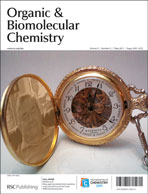
Ring-opening Radical Clock Reactions – OBC Issue 9 Cover

Why do certain DFT methods give good results for ring-opening reactions while others do not?

Gino DiLabio and Iain Mackie at University of Albaerta, in Canada, try to answer this question in this timely paper on radical clock reactions.

You can read it for free until the end of May.

This paper will be included in the special web themed issue on radical chemistry in memory of Athel Beckwith that will be published soon. Keep an eye on it!

Ring-opening radical clock reactions: many density functionals have difficulty keeping time
Iain D. Mackie and Gino A. DiLabio
Org. Biomol. Chem., 2011, 9, 3158-3164
DOI: 10.1039/C0OB01246G

Digg This
Reddit This
Stumble Now!
Share on Facebook
Bookmark this on Delicious
Share on LinkedIn
Bookmark this on Technorati
Post on Twitter
Google Buzz (aka. Google Reader)

HOT: Effect of substituents on the stabilities of radicals

The effect of substituents on the thermodynamic stabilities of trisubstituted carbon-centered radicals is an interesting topic that has received limited attention in literature until now.

Now, Leo Radom and collaborators in Australia and Switzerland present in this paper a thorough computational study, which correlates with experimental data, of the stability of a very large series of multiply-substituted carbon-centered radicals. They look at the stabilization and interaction energies and the deviations from additivity of RSEs.

If you want to learn about the 14 conclusions they reach in this HOT article, download it now. It is free to access until 5th May.

This article will be included in the OBC special issue in memory of Athel Beckwith: Free Radical Chemistry. Coming soon.

Effect of substituents on the stabilities of multiply-substituted carbon-centered radicals
Ambili S. Menon, David J. Henry, Thomas Bally and Leo Radom
Org. Biomol. Chem., 2011, Advance Article
DOI: 10.1039/C1OB05196B

Digg This
Reddit This
Stumble Now!
Share on Facebook
Bookmark this on Delicious
Share on LinkedIn
Bookmark this on Technorati
Post on Twitter
Google Buzz (aka. Google Reader)

Hot: Glycosidase inhibitors with potential

Glycosidases are involved in a broad range of biological and pathological processes. The development of inhibitors of these enzymes that could potentially help with diseases such as type II diabetes mellitus, viral infections, cancer or hereditary enzyme deficiency diseases is one of the aims of Jose M Garcia Fernandez, Carmen Ortiz Mellet and their research groups in Spain.

In this paper, they prepare a library of sp2-iminosugar-type glycomimetics and they evaluate their glycosidase inhibition properties against a panel of commercial glycosidases. They actually got very interesting results that show the potential of this molecular diversity-oriented approach to identify suitable hits for further in cell and in vivo studies.

Read this HOT article now that is free to access until the 5th May.

Bicyclic (galacto)nojirimycin analogues as glycosidase inhibitors: Effect of structural modifications in their pharmacological chaperone potential towards β-glucocerebrosidase
Matilde Aguilar-Moncayo, M. Isabel García-Moreno, Ana Trapero, Meritxell Egido-Gabás, Amadeu Llebaria, José M. García Fernández and Carmen Ortiz Mellet
Org. Biomol. Chem., 2011, Advance Article
DOI: 10.1039/C1OB05234A

Digg This
Reddit This
Stumble Now!
Share on Facebook
Bookmark this on Delicious
Share on LinkedIn
Bookmark this on Technorati
Post on Twitter
Google Buzz (aka. Google Reader)

HOT:Modeling oxidative damage to peptide radicals

Richard O’Hair and colleagues use mass spectrometry (MS) as an analytical tool to study the mechanism of protein oxidation.

They say in the paper that the aims of their work are:

  1. To establish whether these peptide radicals react with oxygen in the gas phase to form peroxyl radicals and if so to examine the gas-phase chemistry of these peroxyl radicals
  2. To determine if the radicals NO. and NO2. can act as ‘radical scavengers’ of these peptide radicals and if so to establish whether the resultant adducts provide structural information on any migrations of the original peptide radical sites

If you want to find out whether they achieved these goals, download this HOT article which is free to access until 5th May.

This paper is part of the OBC collection of free radical chemistry papers in memory of Athel Beckwith that will be published soon. Watch this space!

Gas-phase ion-molecule reactions using regioselectively generated radical cations to model oxidative damage and probe radical sites in peptides
Christopher K. Barlow, Adam Wright, Christopher J. Easton and Richard A. J. O’Hair
Org. Biomol. Chem., 2011, Advance Article
DOI: 10.1039/C0OB01245A

Digg This
Reddit This
Stumble Now!
Share on Facebook
Bookmark this on Delicious
Share on LinkedIn
Bookmark this on Technorati
Post on Twitter
Google Buzz (aka. Google Reader)

HOT article: success in a time of cholera

Researchers from the University of Alberta, Canada, have discovered an antagonist with impressive nanomolar inhibition of cholera toxin (CT) using a novel approach to design and synthesise a small, focused library of CT binding ligands.

David Bundle and co-workers aimed to design a ligand capable of binding to cholera toxin and that could be orally administered.  CT is the most important virulence factor in the disease and deactivating bacterial toxins may reduce the development of antibiotic resistance – a real problem in current cholera treatments.   Binding to CT occurs predominantly at GM1 receptor, and a multiple binding strategy through weak ligand interactions has been demonstrated to be very effective.

Here, the authors have created a compound library of heterobifunctional ligands, with an invariable ligand, galactose – which is very effective at binding to GM1 – conjugated to a polymer carrier.  The other, non-galactose ligand fragment was varied to probe a complimentary GM1 binding site. The polymer scaffold, polyacrylamide or dextran,  provided a framework for the synthesis, purification and assay of the compounds as well as being necessary for the multivalent presentation of the ligands.  The library allowed the authors to identify weak ligands that are capable of complimenting the binding affinity of galactose for the cholera toxin protein.

Read how the authors obtained the nanomolar inhibition activities here – the article is free to access for four weeks!

Multifunctional multivalency: a focused library of polymeric cholera toxin antagonists
Huu-Anh Tran, Pavel I. Kitov, Eugenia Paszkiewicz, Joanna M. Sadowska and David R. Bundle
Org. Biomol. Chem., 2011, Advance Article
DOI: 10.1039/C0OB01089H

Digg This
Reddit This
Stumble Now!
Share on Facebook
Bookmark this on Delicious
Share on LinkedIn
Bookmark this on Technorati
Post on Twitter
Google Buzz (aka. Google Reader)

HOT: How to deal with a problem like Brucella

Brucella spp. are the causative organisms for the zoonotic disease Brucellosis, which in humans may require months of treatment and can kill. As there is no human vaccine, new treatments are needed.

Stephan Köhler and Jean-Yves Winum from CNRS, and their colleagues, have created a new series of inhibitors that are highly active in vitro, and are shown to be active in vivo. Additionally, molecular modelling and competition experiment with NAD+ confirmed the positioning of the inhibitor inside the active site of HDH. As the target HDH has been directly linked to bacterial virulence, and with the results obtained on live extra- and intracellular brucellae, the development of these inhibitors can be considered as a promising step towards novel anti-virulence drugs.

The referees thought this article was very significant, and so do we – so read this HOT article today in OBC. It is free to download until 5th May.

Anti-virulence Strategy against Brucella suis: Synthesis, Biological Evaluation and Molecular Modeling of Selective Histidinol Dehydrogenase Inhibitors
Marie-Rose Abdo, Pascale Joseph, Jérémie Mortier, François Turtaut, Jean-Louis Montero, Bernard Masereel, Stephan Köhler and Jean-Yves Winum
Org. Biomol. Chem., 2011, Advance Article

DOI: 10.1039/C1OB05149K

Digg This
Reddit This
Stumble Now!
Share on Facebook
Bookmark this on Delicious
Share on LinkedIn
Bookmark this on Technorati
Post on Twitter
Google Buzz (aka. Google Reader)

HOT: Understanding oxidative damage to DNA

Cellular oxidative stress is thought to lie behind many disease and ageing processes, so an understanding of its effects is vital to designing strategies to counter such damage. Cynthia J. Burrows et al. from University of Utah have conducted a characterisation study of the nucleoside degradation products of copper-mediated Fenton reactions and determined the major product to be a recently discovered hydantoin, d2Ih. The products contrast with those produced in radiation-induced oxidation and the discovery of a new product, dGhred, in the double-stranded oligodeoxynucleotide studies points the way for future chemical and biological studies in this vital area.

The referees thought this was a very significant work so read this HOT article today in OBC – it is free to access until 28th April!

Characterization of 2′-deoxyguanosine oxidation products observed in the Fenton-like system Cu(II)/H2O2/reductant in nucleoside and oligodeoxynucleotide contexts
Aaron M. Fleming, James G. Muller, Insun Ji and Cynthia J. Burrows
Org. Biomol. Chem., 2011, Advance Article

DOI: 10.1039/C1OB05112A

Digg This
Reddit This
Stumble Now!
Share on Facebook
Bookmark this on Delicious
Share on LinkedIn
Bookmark this on Technorati
Post on Twitter
Google Buzz (aka. Google Reader)

Review: Organic reactions mediated by electrochemically generated ArS+

Jun-ichi Yoshida and colleagues at Kyoto University, describe in this excellent review some of the reactions mediated by electrochemically generated ArS+.

This Perspective focuses on three main points:

  1. The electrochemical generation of ArS+ ions by oxidation of ArSSAr
  2. The applications of the obtained ArS+ pools in organic synthesis
  3. Catalysis by ArS+

It is a very complete and informative perspective that has captivated both the referees and the editorial office. Would you feel the same? Download it now and let us know.

Organic reactions mediated by electrochemically generated ArS+
Kouichi Matsumoto, Seiji Suga and Jun-ichi Yoshida
Org. Biomol. Chem., 2011, 9, 2586-2596
DOI: 10.1039/C0OB01070G

Digg This
Reddit This
Stumble Now!
Share on Facebook
Bookmark this on Delicious
Share on LinkedIn
Bookmark this on Technorati
Post on Twitter
Google Buzz (aka. Google Reader)

Review: Recently developed novel cross-linking reactions

Fumi Nagatsugi and Shuhei Imoto talk about recently developed novel cross-linking reactions in this emerging area.

This short review focuses on the crosslinking reactions using modified ONs (synthetic oligonucleotides) to react natural bases in duplexes and describes their recent work on the development of selective cross-linking reactions.

To have a good overview of the latest developments in cross-linking reactions to target genes using modified oligonucleotides download this review.

Induced cross-linking reactions to target genes using modified oligonucleotides
Fumi Nagatsugi and Shuhei Imoto
Org. Biomol. Chem., 2011, 9, 2579-2585
DOI: 10.1039/C0OB00819B

Digg This
Reddit This
Stumble Now!
Share on Facebook
Bookmark this on Delicious
Share on LinkedIn
Bookmark this on Technorati
Post on Twitter
Google Buzz (aka. Google Reader)

Delivery of fullerenes into liposomes – OBC Cover Issue 8

Atsushi Ikeda and colleagues describe in this paper, which is the outside cover of OBC Issue 8, how the addition of small amounts of lipids bearing a π-moiety can help the migration of hydrophobic C70 into the hydrophilic liposome surface.
The delivery of fullerenes C70 into liposomes could have interesting applications in drug delivery. 

Read more about the mechanism of how fullerenes are incorporated into the lipid structures in this article which is free to access for 6 weeks!

Formation and regulation of fullerene-incorporation in liposomes under the phase transition temperature
Atsushi Ikeda, Yoshihiko Kawai, Jun-ichi Kikuchi, Motofusa Akiyama, Eiji Nakata, Yoshihiro Uto and Hitoshi Hori
Org. Biomol. Chem., 2011, 9, 2622-2627
DOI: 10.1039/C0OB01030H

Digg This
Reddit This
Stumble Now!
Share on Facebook
Bookmark this on Delicious
Share on LinkedIn
Bookmark this on Technorati
Post on Twitter
Google Buzz (aka. Google Reader)