OBC poster prizes at the 5th Chemical Protein Synthesis

Congratulations to Stijn Agten and Claudia Bello who both received OBC poster prizes at the 5th Chemical Protein Synthesis meeting in Vienna last month.

Stijn Agten, from the group of Professor Tilman Hackeng at Maastricht University, The Netherlands won for a poster entitled “Chemoselective reactions in proteins and peptides using an optimized oxime strategy: the demise of levulinic acid”, while Claudia Bello from the Institute of Biological Chemistry at University of Vienna presented a poster entitled “A Chemoenzymatic Approach for the Preparation of Site-Specifically O-Glycosylated MUC1 variants for Proteomic Studies”.

Both winners receive a year’s subscription to OBC.

Digg This
Reddit This
Stumble Now!
Share on Facebook
Bookmark this on Delicious
Share on LinkedIn
Bookmark this on Technorati
Post on Twitter
Google Buzz (aka. Google Reader)

HOT – Dyes with fluorinated ponytails

This paper is HOT as recommended by the referees, and is free to access for 4 weeks
Published on behalf of Steve Moore, Organic & Biomolecular Chemistry web science writer.

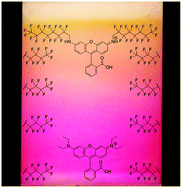
In this HOT article Bräse and co-workers report the synthesis of eight new rhodamine fluorophores with fluorous ‘ponytails’, dubbed rhodamine F dyes. Rhodamine derivatives are widely used as fluorescent labels for biomolecules and characteristically have high absorption coefficients and high absorption and emission maxima in the visible region combined with high chemical and photostability.

The ‘ponytails’ are fluorous alkyl residues that are deliberately not cleaved during synthesis. They facilitate fluorous solid-phase extraction, utilising the strong, specific nature of fluorine-fluorine interactions. During this purification process a fluorous solid phase is used to bind fluorous molecules and separate them from non-fluorous compounds.

The fluorine content of the rhodamine F dyes is below 50% of the total molecular weight, preserving solubility in organic solvents. Conjugation with a peptide mediates cellular uptake may have potential applications in live cell imaging; clear, bright images were obtained in human cervix carcinoma cells incubated with rhodamine F dyes at concentrations as low as 1 µM.

Rhodamine F-a novel class of fluorous ponytailed dyes for bioconjugation

Rhodamine F: a novel class of fluorous ponytailed dyes for bioconjugation
Dominik K. Kölmel, Birgit Rudat, Delia M. Braun, Christin Bednarek, Ute Schepers and Stefan Bräse
DOI: 10.1039/c3ob40267c

Free to access for 4 weeks

Published on behalf of Steve Moore, Organic & Biomolecular Chemistry web science writer.

Digg This
Reddit This
Stumble Now!
Share on Facebook
Bookmark this on Delicious
Share on LinkedIn
Bookmark this on Technorati
Post on Twitter
Google Buzz (aka. Google Reader)

PERSPECTIVE – A Brief History of Molecular Sensors

This paper is HOT as recommended by the referees, and is free to access for 4 weeks.
Annabella Newton is an organic chemist and trainee patent attorney with Phillips Ormonde Fitzpatrick, based in Melbourne, Australia.

In this HOT article, Julius Rebek Jr presents a fascinating insight into the design of molecules which can detect and destroy organophosphorus compounds.

Organophosphorus (OP) compounds are primarily used as pesticides, and can be a useful alternative to more traditional chlorinated hydrocarbon-based pesticides. However, due to OP compounds’ ability to inhibit acetylcholine esterase (AChE), they can be extremely toxic to humans and they have therefore found use as nerve agents and chemical weapons. For these reasons, their toxicity is an area of intense research focus and new methods for their detection and treatment are always welcome.

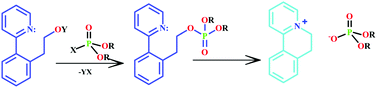
Rebek and his research group at The Scripps Research Institute have been looking into molecular sensors for OPs for several years, and this paper highlights some of the significant developments in the field. Their interest in the area was sparked by a carefully crafted pyridine structure discovered by Swager, which upon reaction with an OP undergoes a subsequent cyclisation reaction to create a fluorescent dye. This is a useful premise for the sensing of OPs. The Rebek group have expanded upon this premise and developed a series of molecular sensors that employ similar mechanisms. They have used their established expertise in cavitand chemistry to develop specially-tailored vase-shaped molecules, which are able to fold around OP-based nerve agents and isolate them from the surrounding medium. This paper provides a whistle-stop tour of an exciting and important area of organic chemistry.

Chemical approaches for detection and destruction

Chemical approaches for detection and destruction of nerve agents
Dariush Ajami and Julius Rebek, Jr.
DOI: 10.1039/c3ob40324f

Free to access for 4 weeks

Digg This
Reddit This
Stumble Now!
Share on Facebook
Bookmark this on Delicious
Share on LinkedIn
Bookmark this on Technorati
Post on Twitter
Google Buzz (aka. Google Reader)

Bursary opportunity for final year PhD students and postdocs to attend the Sao Paulo Advanced School Bioorganic Chemistry

The RSC is delighted to announce a fantastic bursary opportunity for PhD students/post docs to attend the Advanced School Bioorganic Chemistry taking place in Araraquara, Brazil, 30 June – 05 July 2013. The school includes talks and discussion sessions from highly qualified scientists (including Professor Steven V. Ley from the University of Cambridge) and leaders in the field covering bioorganic chemistry, involving aspects of natural products, medicinal chemistry, synthesis and spectroscopic methods.  The full programme can be viewed here: http://www.bioorgchemespca.iq.unesp.br/nodes/view/program

FAPESP (Sao Paulo Research Foundation) have invited the RSC to select 2 UK students to participate in the meeting. The bursary will cover international and domestic transportation, hotel accommodation, meals, registration fee and welcome reception. To apply please complete the form which is available download here and at the end of this post. Return to science@rsc.org by 19 April 2013 at 4pm.

Sao Paulo Advanced School in Bioorganic Chemistry

Closing date for application is 4pm on 19 April 2013
 
For any queries please contact science@rsc.org

Application Form for the Advanced School Bioorganic Chemistry

Digg This
Reddit This
Stumble Now!
Share on Facebook
Bookmark this on Delicious
Share on LinkedIn
Bookmark this on Technorati
Post on Twitter
Google Buzz (aka. Google Reader)

HOT – Self-assembled multivalent RGD-peptide arrays – morphological control and integrin binding

In this HOT article, Dave Smith, Sabrina Pricl and co-workers report the synthesis of 4 different RGD-peptide derivatives, which spontaneously self-assemble into nanoscale architectures. They used multiscale modelling to understand the self-assembly of these ligands and they demonstrated that by modifying the building blocks through organic synthesis on the molecular scale, they could control the morphology of the resulting self-assembled nanostructures. The multivalent binding of the assemblies to integrin proteins was shown to be highly dependent on the morphology of the assemblies. The paper elegantly showcases the importance of nanoscale morphology on binding events and highlights the advantages of employing a self-assembly approach. 

Self-assembled multivalent RGD-peptide arrays – morphological control and integrin binding

Self-assembled multivalent RGD-peptide arrays – morphological control and integrin binding
Daniel J. Welsh, Paola Posocco, Sabrina Pricl and David K. Smith
DOI: 10.1039/c3ob00034f

Free to access for 4 weeks

… and presently in the Top 10 most read articles in OBC –  check the full list here

Digg This
Reddit This
Stumble Now!
Share on Facebook
Bookmark this on Delicious
Share on LinkedIn
Bookmark this on Technorati
Post on Twitter
Google Buzz (aka. Google Reader)

OBC Top 10 most accessed articles published in 2012 (Volume 10)

Curious about which articles published in 2012 gathered most readership? Here are the Top 10 works your colleagues have been accessing in Organic & Biomolecular Chemistry:

A one-pot catalysis: the strategic classification with some recent examples
Nitin T. Patil, Valmik S. Shinde and Balakrishna Gajula
Org. Biomol. Chem., 2012, 10, 211-224
DOI: 10.1039/C1OB06432K

A convenient and mild chromatography-free method for the purification of the products of Wittig and Appel reactions
Peter A. Byrne, Kamalraj V. Rajendran, Jimmy Muldoon and Declan G. Gilheany
Org. Biomol. Chem., 2012, 10, 3531-3537
DOI: 10.1039/C2OB07074J

Imidazole derivatives: A comprehensive survey of their recognition properties
Pedro Molina, Alberto Tárraga and Francisco Otón
Org. Biomol. Chem., 2012, 10, 1711-1724
DOI: 10.1039/C2OB06808G

Enhanced reduction of C–N multiple bonds using sodium borohydride and an amorphous nickel catalyst
Shouxin Liu, Yihua Yang, Xiaoli Zhen, Junzhang Li, Huimin He, Juan Feng and Andrew Whiting
Org. Biomol. Chem., 2012, 10, 663-670
DOI: 10.1039/C1OB06471A

Strategies for the enantioselective synthesis of spirooxindoles
Nicolas R. Ball-Jones, Joseph J. Badillo and Annaliese K. Franz
Org. Biomol. Chem., 2012, 10, 5165-5181
DOI: 10.1039/C2OB25184A

Thiol–yne coupling: revisiting old concepts as a breakthrough for up-to-date applications
Alessandro Massi and Daniele Nanni
Org. Biomol. Chem., 2012, 10, 3791-3807
DOI: 10.1039/C2OB25217A

Small molecule control of bacterial biofilms
Roberta J. Worthington, Justin J. Richards and Christian Melander
Org. Biomol. Chem., 2012, 10, 7457-7474
DOI: 10.1039/C2OB25835H

Asymmetric organocatalytic formation of protected and unprotected tetroses under potentially prebiotic conditions
Laurence Burroughs, Paul A. Clarke, Henrietta Forintos, James A. R. Gilks, Christopher J. Hayes, Matthew E. Vale, William Wade and Myriam Zbytniewski
Org. Biomol. Chem., 2012, 10, 1565-1570
DOI: 10.1039/C1OB06798B

Olefin cross-metathesis for the synthesis of heteroaromatic compounds
Timothy J. Donohoe, John F. Bower and Louis K. M. Chan
Org. Biomol. Chem., 2012, 10, 1322-1328
DOI: 10.1039/C2OB06659A

Selective N-alkylation of amines using nitriles under hydrogenation conditions: facile synthesis of secondary and tertiary amines
Takashi Ikawa, Yuki Fujita, Tomoteru Mizusaki, Sae Betsuin, Haruki Takamatsu, Tomohiro Maegawa, Yasunari Monguchi and Hironao Sajiki
Org. Biomol. Chem., 2012, 10, 293-304
DOI: 10.1039/C1OB06303K

Interested in submitting your own work to OBC? Submit online today, or email us with your suggestions!

Digg This
Reddit This
Stumble Now!
Share on Facebook
Bookmark this on Delicious
Share on LinkedIn
Bookmark this on Technorati
Post on Twitter
Google Buzz (aka. Google Reader)

New diagnostic test lights up bacteria

Highlighting an OBC article being featured in Chemistry World

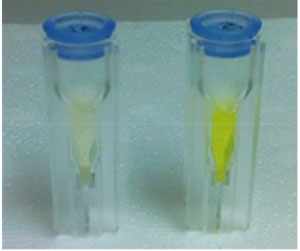
Fluorescent probe before (left) and after (right) addition of S. aureusUK researchers have developed a faster way to detect Staphylococcus aureus bacteria using a fluorescent probe. The method holds promise as the basis for a new rapid diagnosis kit to identify infections in hospital patients.

S. aureus infections, including both methicillin-resistant and methicillin-susceptible strains (named MRSA and MSSA, respectively), persist in hospital wards worldwide. In the UK, controlling outbreaks is a constant challenge for the NHS. Fast diagnosis is as important as thorough treatment in the early stages of an outbreak. However, current screening methods are slow and costly.

‘The problem with existing techniques is that they take time,’ explains Adam Le Gresley, of Kingston University, who lead the team that developed the probe. ‘You either have to amplify the bacteria in culture, or amplify the DNA with PCR. It’s not something that can be done at the point of care.’

To address this, Le Gresley and his colleagues have developed a test that is sensitive to very low levels of bacteria, eliminating the need for culture. The method utilises staphylothrombin, an enzyme complex unique to S. aureus. It employs a test solution comprising a tripeptide chain, which mimicks staphylothrombin’s natural target, that is bound to rhodamine, a fluorescent dye. When S. aureus is present, it releases staphylothrombin which frees the rhodamine from the tripeptide by cleaving an amide bond. This results in a strong colouration in the solution.

Read the full story in Chemistry World

Development of an in situ culture-free screening test for the rapid detection of Staphylococcus aureus within healthcare environments
Alex Sinclair, Lauren E. Mulcahy, Lynsey Geldeard, Samerah Malik, Mark D. Fielder and Adam Le Gresley
DOI: 10.1039/c3ob40150b

Digg This
Reddit This
Stumble Now!
Share on Facebook
Bookmark this on Delicious
Share on LinkedIn
Bookmark this on Technorati
Post on Twitter
Google Buzz (aka. Google Reader)

This week’s HOT papers featuring a copper-catalyzed aromatic C–H bond halogenation and more

These two articles are HOT as recommended by the referees. And we’ve made them free to access for 4 weeks.

Copper-catalyzed aromatic C–H bond halogenation with lithium halides under aerobic conditions
Song Mo, Yamin Zhu and Zengming Shen
DOI: 10.1039/c3ob40185e

Copper-catalyzed aromatic C–H bond halogenation with lithium halides under aerobic conditions

Free to access for 4 weeks


Direct acylation of N-benzyltriflamides from the alcohol oxidation level via palladium-catalyzed C–H bond activation
Jihye Park, Aejin Kim, Satyasheel Sharma, Minyoung Kim, Eonjeong Park, Yukyoung Jeon, Youngil Lee, Jong Hwan Kwak, Young Hoon Jung and In Su Kim
DOI: 10.1039/c3ob40140e

Direct acylation of N-benzyltriflamides from the alcohol oxidation level via palladium-catalyzed C–H bond activation

Free to access for 4 weeks 

Digg This
Reddit This
Stumble Now!
Share on Facebook
Bookmark this on Delicious
Share on LinkedIn
Bookmark this on Technorati
Post on Twitter
Google Buzz (aka. Google Reader)

A photo-triggerable drug carrier on the front cover of OBC Issue 16

A photo-triggerable drug carrier based on cleavage of PEG lipids by photosensitiser-generated reactive singlet oxygen

Welcome to OBC Issue 16, 2013!

This week’s front cover highlights the work of Atsushi Ikeda and co-workers at the Nara Institute of Science and Technology, Japan. They developed a photo-triggerable drug carrier based on cleavage of PEG lipids by photosensitiser fullerene derivatives. This interesting methodology has the potential to facilitate the development of novel liposomal drug carriers for use in biomedical research.

A photo-triggerable drug carrier based on cleavage of PEG lipids by photosensitiser-generated reactive singlet oxygen
Chikako Komeda, Atsushi Ikeda, Jun-ichi Kikuchi, Norihiro Ishida-Kitagawa, Hisashi Tatebe, Kazuhiro Shiozaki and Motofusa Akiyama
DOI: 10.1039/c2ob27199k

On the inside front cover is the work of Francisco Santoyo-Gonzalez and collegues at the University of Granada, Spain. They report an easy Vinyl sulfone-based ferrocenylation reagents: applications in conjugation and bioconjugationvinyl sulfone functionalisation of ferrocene derivatives which facilitates the preparation of a variety of versatile ferrocenylation reagents. Their methodology allows the facile preparation of a variety of conjugates and bioconjugates derivatives under mild conditions.

Vinyl sulfone-based ferrocenylation reagents: applications in conjugation and bioconjugation
Alicia Megia-Fernandez, Fernando Hernandez-Mateo and Francisco Santoyo-Gonzalez
DOI: 10.1039/c3ob27209e


Both articles can be read for free for the next 6 weeks!


Digg This
Reddit This
Stumble Now!
Share on Facebook
Bookmark this on Delicious
Share on LinkedIn
Bookmark this on Technorati
Post on Twitter
Google Buzz (aka. Google Reader)

This week’s HOT papers featuring recent advances in the synthesis of aromatic nitro compounds and more…

These articles are HOT as recommended by the referees. And we’ve made them free to access for 4 weeks.

Recent advances in the synthesis of aromatic nitro compounds
Guobing Yan and Minghua Yang
DOI: 10.1039/c3ob27354g  

recent advances in the synthesis of aromatic nitro compounds  

Free to access for 4 weeks


Facile dimethylarsenic exchange and pyramidal inversion in its cysteine and glutathione adducts
D. Scott Bohle and Yuxuan Gu
DOI: 10.1039/c3ob40268a 

Facile dimethylarsenic exchange and pyramidal inversion in its cysteine and glutathione adducts  

Free to access for 4 weeks  


PEGylation enables the specific tumor accumulation of a peptide identified by phage display
Walter Mier, Susanne Krämer, Sabine Zitzmann, Annette Altmann, Karin Leotta, Ursula Schierbaum, Martina Schnölzer, Michael Eisenhut and Uwe Haberkorn
DOI: 10.1039/c3ob27475f  


PEGylation enables the specific tumor accumulation of a peptide identified by phage display   

Free to access for 4 weeks  


Synthetic use of the primary kinetic isotope effect in hydrogen atom transfer 2: generation of captodatively stabilised radicals
Mark E. Wood, Sabine Bissiriou, Christopher Lowe and Kim M. Windeatt
DOI: 10.1039/c3ob40275d  

Synthetic use of the primary kinetic isotope effect in hydrogen atom transfer 2: generation of captodatively stabilised radicals   

Free to access for 4 weeks  


Digg This
Reddit This
Stumble Now!
Share on Facebook
Bookmark this on Delicious
Share on LinkedIn
Bookmark this on Technorati
Post on Twitter
Google Buzz (aka. Google Reader)