Tagetitoxin – real structure finally revealed?

Posted on behalf of Victoria Corless, guest web writer for Organic & Biomolecular Chemistry

For centuries, natural products have been linked to medicine through traditional remedies and since played an important role in drug discovery.

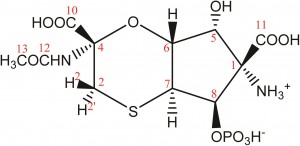
New structure of tagetitoxin

New tagetitoxin structure based on 2D NMR correlations

Despite competition from other drug discovery methods, natural products have provided their fair share of clinical candidates and commercial drugs. Furthermore, the isolation, synthesis and biological evaluation of natural products often lead to lasting impressions in science.

In a recent study lead by Dr Abil Aleiv of the University College London, the structure of the known natural product tagetitoxin has been revised based on a detailed analysis of newly acquired NMR and MS data. The group employed 2D 1H–13C HMBC correlations and long-range JCH couplings in conjunction with computational analysis to correlate JCH couplings with predicted values.

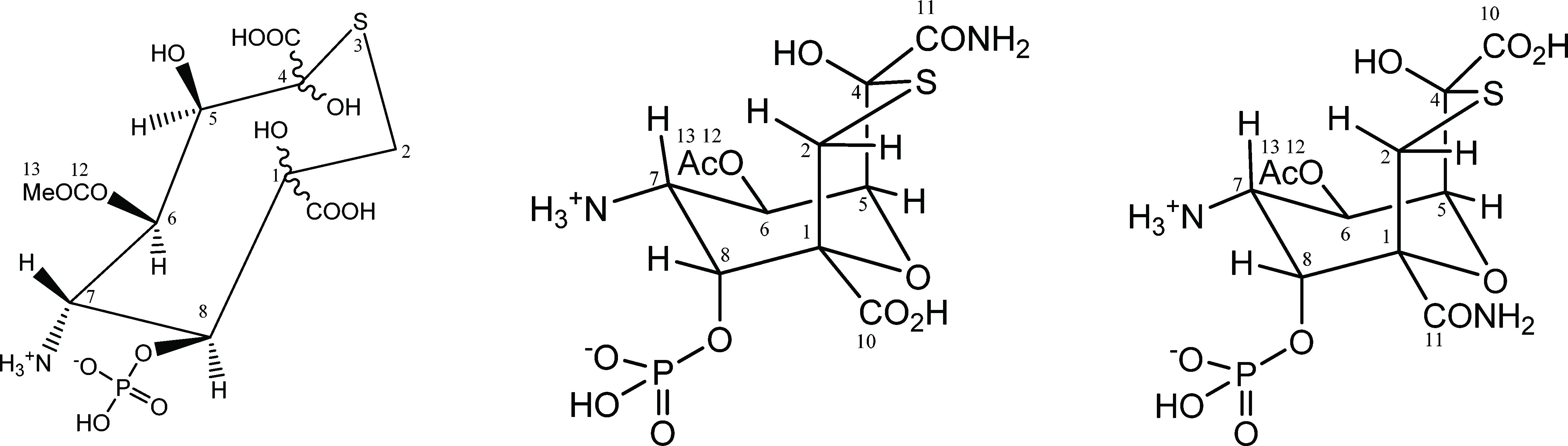
For several years, the structure of tagetitoxin remained a mystery. First identified in 1981 by Mitchell, the structure was only partially characterized by MS and was proposed to be an 8-membered heteroatomic ring.  Revised structures have since been published by Mitchel (1989), Vassylyev (2005) and Gronwald (2005). Despite all these efforts, conflicting results and incomplete analyses resulted in the absolute configuration remaining undetermined.

Structures of tagetitoxin previously published by Mitchel (1989), Vassylyev (2005) and Gronwald (2005)

Early analysis of complex structures was generally difficult as spectrometers were relatively insensitive and experiments were performed at low-fields strengths. Through the increasing prevalence and utility of modern 2D NMR experiments in the past decade, NMR has become a powerful and enabling tool for structure elucidation and confirmation.

In addition, the key to Dr Aliev’s findings lies in confirming the purity of the tagetitoxin sample the group had acquired. They noted that the compound gradually decomposed in aqueous solutions if left for prolonged periods of time, which they suspect led to additional peaks being observed in previously reported NMR spectra.

This exciting work showcases the importance of technical advances in determining the structure of biologically active natural products with greater ease and confidence. As a result, advances in lead development and the identification of important families of pharmacophores for drug discovery can be attained with greater efficiency, which may contribute to a revival of interest in natural products for drug discovery purposes.

To find out more see:

The structure of tagetitoxin
Abil E. Aliev, Kersti Karu, Robin E. Mitchell and Michael J. Porter
DOI: 10.1039/c5ob02076j


Victoria Corless is currently completing her Ph.D. in organic chemistry with Prof. Andrei Yudin at The University of Toronto. Her research is centred on the synthesis of kinetically amphoteric molecules, which offer a versatile platform for the development of chemoselective transformations with particular emphasis on creating novel biologically active molecules.

Digg This
Reddit This
Stumble Now!
Share on Facebook
Bookmark this on Delicious
Share on LinkedIn
Bookmark this on Technorati
Post on Twitter
Google Buzz (aka. Google Reader)

OBC Call for Papers – Selective Chemistry with Peptides and Proteins Themed Issue

Organic & Biomolecular Chemistry is delighted to announce a call for paper for its latest themed issue on: Selective Chemistry with Peptides and Proteins

Guest Editor: Philip Dawson (The Scripps Research Institute, San Diego, USA)

Deadline for Submission: 11 April 2016

OBC offers fast decisions and publication (average time from receipt to first decision for peer reviewed articles is 12 days for communications and 19 days for papers). Colour publication is free and all articles are indexed in MEDLINE. You can choose for your article to be handled by the Cambridge office or one of our Associate Editors: Christian Hackenberger, Lei Liu, Margaret Brimble or Jin-Quan Yu.

Scope

This issue will cover topics including native chemical ligation and other chemical reactions to prepare proteins and peptides, and selective protein modification. We would welcome either a primary research article or a review.

Research in OBC is published as communications (for urgent work – up to 5 pages in length) or full papers. There is also the opportunity to write a Perspective or Review article for the issue, and if you would be interested in this please let us know. All submissions will be subject to rigorous peer review to meet the usual high standards of OBC. Guidelines are available at rsc.li/1K0EgYx and rsc.li/1OoQWQh.

If you are interested in taking part in this issue, please email OBC: obc-rsc@rsc.org

Manuscripts can be submitted using the Royal Society of Chemistry’s online article submission service. Please clearly state that the manuscript is submitted for the themed issue on Selective Chemistry with Peptides and Proteins.

To view recent articles or find out more about OBC, please visit the journal’s homepage:

Organic & Biomolecular ChemistryRapid publication of high quality organic chemistry research


Please note that articles will be published online as soon as ready to ensure no delay in dissemination of your work. Articles for the web theme will be published in regular issues of the journal. The themed issue will then be published online once all articles have been published. Click here for an example of a previous web theme issue in OBC.

Digg This
Reddit This
Stumble Now!
Share on Facebook
Bookmark this on Delicious
Share on LinkedIn
Bookmark this on Technorati
Post on Twitter
Google Buzz (aka. Google Reader)

What are your colleagues reading in Organic & Biomolecular Chemistry?

The articles below are the most read Organic & Biomolecular Chemistry articles in July, August and September 2015.

Linear and star-shaped pyrazine-containing acene dicarboximides with high electron-affinity
Jinjun Shao, Jingjing Chang and Chunyan Chi
DOI: 10.1039/C2OB25680K, Paper

Recent synthetic additions to the visible light photoredox catalysis toolbox
Ricardo A. Angnes, Zhou Li, Carlos Roque D. Correia and Gerald B. Hammond
DOI: 10.1039/C5OB01349F, Review Article

Biomineralization-inspired synthesis of functional organic/inorganic hybrid materials: organic molecular control of self-organization of hybrids
Atsushi Arakaki, Katsuhiko Shimizu, Mayumi Oda, Takeshi Sakamoto, Tatsuya Nishimura and Takashi Kato
DOI: 10.1039/C4OB01796J, Review Article

Decarboxylative functionalization of cinnamic acids
Arun Jyoti Borah and Guobing Yan
DOI: 10.1039/C5OB00727E, Review Article

Design and synthesis of analogues of natural products
Martin E. Maier
DOI: 10.1039/C5OB00169B, Review Article

Anatomy of gold catalysts: facts and myths
Beatrice Ranieri, Imma Escofet and Antonio M. Echavarren
DOI: 10.1039/C5OB00736D, Review Article

Copper-catalyzed trifluoromethylation of alkenes: synthesis of trifluoromethylated benzoxazines
Sadhan Jana, Athira Ashokan, Shailesh Kumar, Ajay Verma and Sangit Kumar
DOI: 10.1039/C5OB01196E, Communication

Synthesis of substituted pyrenes by indirect methods
Juan M. Casas-Solvas, Joshua D. Howgego and Anthony P. Davis
DOI: 10.1039/C3OB41993B, Review Article

Enantioselective cooperative catalysis
Suleman M. Inamdar, Valmik S. Shinde and Nitin T. Patil
DOI: 10.1039/C5OB00986C, Review Article

Organic synthetic transformations using organic dyes as photoredox catalysts
Shunichi Fukuzumi and Kei Ohkubo
DOI: 10.1039/C4OB00843J, Review Article

Read more »

Digg This
Reddit This
Stumble Now!
Share on Facebook
Bookmark this on Delicious
Share on LinkedIn
Bookmark this on Technorati
Post on Twitter
Google Buzz (aka. Google Reader)

2016 RSC Prizes and Awards in Organic Chemistry & Chemical Biology now open for nomination

Nominate someone you know who is an exceptional talent in chemical sciences

The 2016 RSC Prizes and Awards are now open for nomination!

Nominations will close on 15 January 2016.


For more than 140 years, our Prizes and Awards programme has been acknowledging and celebrating exceptional talent in the chemical sciences, and with your support we are hoping that 2016 will even more successful!

Last year’s winners include Chemists such as Prof. Wilfred van der Donk (University of Illinois), Prof. Tim Donohoe (University of Oxford), Prof. Shuli You (Shanghai Institute of Organic Chemistry), Prof. Philip Gale (University of Southampton), Prof. Herman Overkleeft (Leiden University), Prof. Alison Ashcroft and Prof. Sheena Radford (University of Leeds).

This year we have 63 prizes and awards open for nominations of individuals, teams and organisations covering the breadth of the chemical sciences across academia, education and industry.

This year’s prizes in the field of Organic Chemistry & Chemical Biology include:

CBID (Chemistry Biology Interface Division) awards –

Organic Awards –

For 2016 our Longstaff Prize is also open – since 1881 we have awarded this prize once every three years to one of our members who has achieved the most to advance the science of chemistry.

Submit your suggestions now!

Digg This
Reddit This
Stumble Now!
Share on Facebook
Bookmark this on Delicious
Share on LinkedIn
Bookmark this on Technorati
Post on Twitter
Google Buzz (aka. Google Reader)

Shanti Swarup Bhatnagar Prize for Chemical Sciences awarded

Dr Srinivasa Reddy has received the 2015 Shanti Swarup Bhatnagar Prize for Chemical Sciences

Every year since 1958, the Council of Scientific and Industrial Research (CSIR) awards the Shanti Swarup Bahtnagar Prize for Chemical Sciences to up to two Indian scientists up to the age of 45 for exceptional and outstanding research.

Shanti Swarup Bhatnagar Prize Winner 2015One of this year’s winners, Srinivasa Reddy, received the prize for his notable work in the fields of organic synthesis and medicinal chemistry. The research group of Dr Reddy is situated at the CSIR-National Chemical Laboratory in Pune, India, and not only works on the design and synthesis of new agrochemicals for advanced crop protection,1 but also develops new concepts and drugs for the treatment of diseases such as diabetes and Alzheimer’s.2–4

The prize includes a citation, a plaque and a cash prize and will be distributed by the Prime Minister of India. As part of the award the awardee will also be giving a lecture later on the topic of the award.

In line with this, at the end of this month one of the biggest and most important Indian meetings will be held in Jaipur – the 17th NOST-Organic Chemistry Conference, at which our India representative Deeksha Gupta will be present and one of OBC’s Editorial Board members, Christian Hackenberger will be giving a talk on the ‘Synthesis and Cellular Delivery of Functional Proteins’.

References

1 Srinivasa et al., “Silicon Incorporated Morpholine Antifungals: Design, Synthesis, and Biological Evaluation”, ACS Med. Chem. Lett., 2015, DOI: 10.1021/acsmedchemlett.5b00245.

2 Srinivasa et al., “Identification of noreremophilane-based inhibitors of angiogenesis using zebrafish assays”, Org. Biomol. Chem., 2015, DOI: 10.1039/C5OB01594D.

3 Srinivasa et al., “Synthesis of palmyrolide A and its cis-isomer and mechanistic insight into trans–cis isomerisation of the enamide macrocycle”, Chem. Commun., 2013, DOI: 10.1039/C3CC40541A

4 Srinivasa et al., “Zinc mediated allylations of chlorosilanes promoted by ultrasound: Synthesis of novel constrained sila amino acids”, Org. Biomol. Chem., 2014, DOI: 10.1039/C4OB00294F

Digg This
Reddit This
Stumble Now!
Share on Facebook
Bookmark this on Delicious
Share on LinkedIn
Bookmark this on Technorati
Post on Twitter
Google Buzz (aka. Google Reader)

Contemporary Synthetic Chemistry in Drug Discovery Themed Issue Launched

Organic and Biomolecular Chemistry (OBC) is delighted to announce a high-profile web themed issue on Contemporary Synthetic Chemistry in Drug Discovery. The guest editors for this issue are Professor Angela Russell (University of Oxford, UK), Professor Douglas E. Frantz (The University of Texas at San Antonio, USA), Dr Matthew Duncton (Rigel, San Francisco, USA), Dr Graham Wynne (University of Oxford, UK) and Dr Shane Krska (Merck, Boston, USA).

Deadline for Submission: 30 April 2016

If you are interested in taking part in this issue, please email OBC: obc-rsc@rsc.org

Manuscripts can be submitted using the Royal Society of Chemistry’s online article submission service. Please clearly state that the manuscript is submitted for the themed issue on Contemporary Synthetic Chemistry in Drug Discovery.

The level of quality of this issue will be high, and all manuscripts will undergo the journal’s normal peer review process. Guidelines are available at rsc.li/1K0EgYx and rsc.li/1OoQWQh


Scope of the issue

This issue aims to demonstrate the importance of synthetic chemistry in drug discovery. Specifically it will highlight how synthetic methods can be used to address hurdles currently being faced in modern medicinal chemistry. Areas falling within the scope of the issue include:

•    CH-Functionalization, including late-stage CH-functionalization & CH-functionalization via biomimetic catalysis
•    Fluorination chemistry, including late-stage fluorination, CF3, SCF3 & SF5 chemistry
•    Asymmetric chemistry, including use of organocatalytic methods
•    Synthesis of compounds with enhanced 3-dimensional character (including cross-coupling & other metal-catalyzed reactions, particularly in relation to sp3-functionalization)
•    Modern heterocyclic chemistry including synthesis of novel heterocycles, highly-decorated heterocycles & synthesis/use of small heterocyclic groups (e.g. oxetanes, azetidines, etc.)
•    Modern synthetic techniques, including flow chemistry, automated synthesis, high-throughput synthesis, microwave-assisted chemistry, multi-component reactions & sustainable chemistry
•    Synthesis/modification of natural products, or natural-product-like compounds (diversity-orientated synthesis)
•    Synthesis utilizing enzymatic chemistry and its use in drug discovery
•    The use of novel reagents/reactions in drug discovery


All submissions should clearly show/explain what challenge within drug discovery is being addressed by the presented work. Articles covering general organic synthesis without this connection are not suitable for this issue.

Inclusion of biological data is not a requirement for submission but you are welcome to include any such data that you feel supports your article. Please note that the main focus of the manuscript should be on the organic synthesis and not the medicinal chemistry.

To view recent articles or find out more about OBC, please visit the journal’s homepage:

Organic & Biomolecular ChemistryRapid publication of high quality organic chemistry research

Digg This
Reddit This
Stumble Now!
Share on Facebook
Bookmark this on Delicious
Share on LinkedIn
Bookmark this on Technorati
Post on Twitter
Google Buzz (aka. Google Reader)

Poster Prize Winners at Biorelevant Chemistry Symposium

Congratulations to the Poster Prize winners at the 9th Symposium on Biorelevant Chemistry.

We were please to present the prize to these winners:

  • Ayaka Nakashima (Nagoya University)
  • Kotaro Nishiyama (University of Tokyo)
  • Hayato Kawai (Nagoya University)
  • Takeya Shou (Tokyo Institute of Technology)
  • Takayuki Miki(Kyoto University

Organized by the Chemical Society of Japan, the Biorelevant Chemistry Symposium took place from 10-12th Sept in Kumamoto, Japan.

From left to right: Professor Rie Wakabayashi (Poster award committee co-chair), Professor Hiroyuki Asanuma (Poster award committee chair), Ayaka Nakashima, Kotaro Nishiyama , Hayato Kawai , Takeya Shou , Takayuki Miki, Professor Masahiro Takagi (Chair of the Division of Biotechnology, Chemical Society of Japan), Professor Itaru Hamachi (Vice-Chair of the Division of Biofunctional Chemistry, Chemical Society of Japan).

Digg This
Reddit This
Stumble Now!
Share on Facebook
Bookmark this on Delicious
Share on LinkedIn
Bookmark this on Technorati
Post on Twitter
Google Buzz (aka. Google Reader)

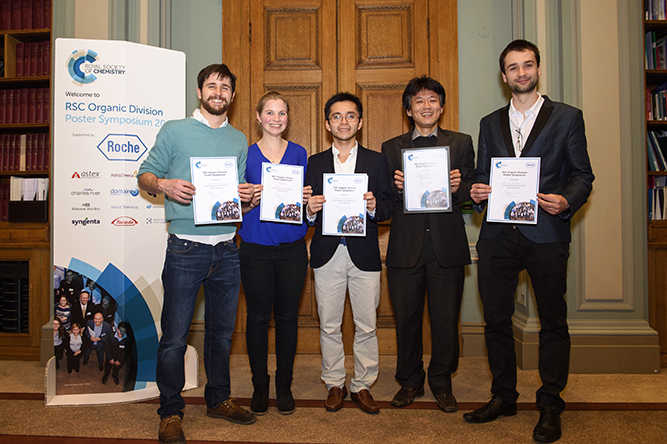
RSC Organic Division Poster Symposium 2015

RSC Organic Division Poster Symposium 2015, headline sponsored by F. Hoffmann-La Roche, Ltd.

Abstract submission is now open.

This poster symposium for final year organic chemistry PhD students will take place at The Royal Society of Chemistry at Burlington House, in London, Monday 30 November 2015.

The closing date for submissions is Wednesday 30 September 2015.
Get more information or submit an abstract now.


This symposium offers final year PhD students a chance to showcase their research to their peers, leading academics and industrial chemists. It is open to all branches of organic chemistry – in its broadest interpretation – and has a tradition of being the most competitive and highly-regarded organic chemistry symposium for PhD students in the UK and Ireland.

There will be a first prize of £500, two runner-up prizes of £250, and a ‘selected by Industry’ prize – also of £500. Industrial delegates will select this winner based on the potential for application in an industrial context.

We would like to thank F. Hoffmann-La Roche, Ltd. and our industry sponsors for their generous support of this event.

Digg This
Reddit This
Stumble Now!
Share on Facebook
Bookmark this on Delicious
Share on LinkedIn
Bookmark this on Technorati
Post on Twitter
Google Buzz (aka. Google Reader)

Entry into Mitochondria to reveal oxidative secrets

Amogh Kulkarni, a graduate student at IISER Pune, India, writes on a recent OBC article

Recently, researchers from The University of Sydney, under the leadership of Dr. Elizabeth New, have reported a novel redox probe that selectively localises in Mitochondria. This fluorescent probe, NpFR2, has been used to identify the variations in the oxidative capacity of the haematopoietic cells.

Targeting Mitochondria has become one of the most important research protocols due to its immense importance to organelle-specific drug delivery. Mitochondria, being the power house of a cell, are the focus of researchers working in the area. Similarly, reactive oxygen species (ROS) have a key role and their levels are important in maintaining the redox homeostasis of the cell. A number of biological processes have been linked to mitochondrial ROS levels. These include response to hypoxia, immune responses, cellular differentiation and maturation, autophagy and ageing.

Graphic 1Graphic 2

In this paper, Dr. Elizabeth New et al., presents this novel compound that can be used reversibly and has a reduction potential within the biologically relevant range. To target mitochondria, a triphenyl phosphonium (TPP) group is been incorporated into the molecule. Further, they test this molecule in haematopoietic cells and can identify the mitochondrial ROS levels of different types of cells such as bone marrow macrophages, thymus and spleen.

NpFR2 can further be combined with other fluorescent probes and antibodies for further understanding of mitochondrial ROS in different cell processes.

Find out more in their Communication:

Mitochondrially targeted redox probe reveals the variations in oxidative capacity of the haematopoietic cells
Amandeep Kaur, Kurt W. L. Brigden, Timothy F. Cashman, Stuart T. Fraser and Elizabeth J. New
DOI: 10.1039/C5OB00928F

Digg This
Reddit This
Stumble Now!
Share on Facebook
Bookmark this on Delicious
Share on LinkedIn
Bookmark this on Technorati
Post on Twitter
Google Buzz (aka. Google Reader)

Poster prize winners at ESOC

19th European Symposium of Organic Chemistry (ESOC2015)

Congratulations to the Poster Prize winners at ESOC 2015.

The winners are:

  • Michael E. Muratore (OBC Best Oral Comm Prize) – “The versatility of gold(I) catalysis applied to the total synthesis of (-)-nardoaristolone B and lundurine C”
  • Joanna Wencel-Delord (OBC Poster Prize) – “Asymmetric C-H activation and dynamic kinetic resolution: new tool for the synthesis of axially chiral biaryls”
  • Szilár Varga (ChemComm Poster Prize) – “Organocatalytic approach to indole terpenoids”
  • Ana M. Matos (MedChemComm Poster Prize) – “Genista tenera as a source of new innovative molecular leads against diabetes and related amyloid disorders: phytochemistry, synthesis and mechanism of action”

The European Symposium of Organic Chemistry is a biannual event which is held all over Europe.  The 19th European Symposium of Organic Chemistry was held from 12th – 16th of July in Lisbon, at the Universidade de Lisboa.   The conference is aimed at stimulating new emerging areas in Organic Chemistry.

Photos of the winners below (from left to right): Michael E. Muratore, Joanna Wencel-Delord, Ana M. Matos and Szilár Varga.

Michael E. Muratore (OBC Best Oral Comm Prize) Joanna Wencel-Delord (OBC Poster Prize)
Ana M. Matos (MedChemComm Poster Prize) Szilár Varga (ChemComm Poster Prize)
Digg This
Reddit This
Stumble Now!
Share on Facebook
Bookmark this on Delicious
Share on LinkedIn
Bookmark this on Technorati
Post on Twitter
Google Buzz (aka. Google Reader)