

© Shutterstock
A graphene inspired electrode material that could help batteries hold more power has been developed by Chinese scientists. The large surface area of these cobalt oxide nanosheets is key to their electrochemical performance.
Batteries are a cornerstone of modern life with most smartphones and laptops using rechargeable lithium ion batteries. As technology advances, the search is on for batteries that can pack more energy into the same space.
Graphitic electrodes are commonly used in lithium ion batteries but suffer from low theoretical capacity. A viable alternative is to use metal oxides which have significantly higher theoretical capacities but in practice are limited by their inability to hold more lithium ions. Recently nanostructures have been developed that can hold more lithium ions but the swelling and shrinking from charge–discharge cycles damages the electrode and greatly reduces its capacity, a problem known as pulverisation.
Read the full article in Chemistry World!
Topochemical Transformation Route to Atomically-thick Co3O4 Nanosheets Realizing Enhanced Lithium Storage Performance
Jinbao Zhu, Liangfei Bai, Yongfu Sun, Xiaodong Zhang, Qiuyang Li, Boxiao Cao, Wensheng Yan and Yi Xie
Nanoscale, 2013, Accepted Manuscript
DOI: 10.1039/C3NR01178J


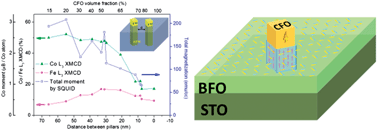 Scientists from Taiwan and Germany report a strong magnetic enhancement in self-assembled multiferroic-ferrimagnetic nanostructures in
 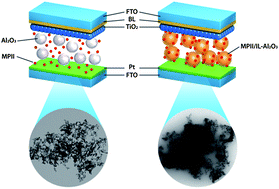 Jong Hak Kim and co-workers from Yonsei University report very impressive quasi-solid-state dye-sensitized solar cell (DSSC) efficiencies in
 Scientists from Tsinghua University in China have found a way to synthesis water soluble nanocrystals with sizes smaller than 10nm using a formamide solvent-system.

 The State Administration for Foreign Experts Affairs (SAFEA) is a division of the Chinese Government with which RSC has a cooperation agreement. Under this agreement the RSC and SAFEA will jointly fund researchers from the UK to visit Chinese Universities. The purpose of the visits is to stimulate collaboration between UK and Chinese institutions. They will allow the visitor to contribute their experience towards the development of excellent emerging science and build links with the Chinese Chemistry community.
 Collaborators in the US and China have demonstrated that by