Archive for November, 2015

HOT article: Responsive polymer brushes for controlled nanoparticle exposure

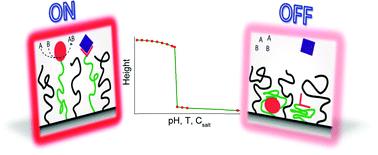
In this article, Scheutjens-Fleer self-consistent field (SF-SCF) theory simulations were used to accurately predict the position of a nanoparticle attached to the end-group of a responsive polymer chain surrounded by a majority of non-responsive polymer chains in a mixed brush system.

Certain stimuli such as pH or temperature can be used to create a defined ‘on-off’ switch between a protected ‘off’ state, where the responsive polymer chain is contracted thus burying the nanoparticles well within the non-responsive components, or an ‘on’ state where the nanoparticle is exposed to the medium through swelling of the responsive polymer chains.

The solvent quality was parameterised by the Flory-Huggins interaction parameter (χ) and for nearly all investigated systems there was a sharp transition at the so-called critical χ value between the on-off state.   Design variables for mixed polymer brushes such as grafting density, chain length and nanoparticle size were investigated and all had an effect on the critical χ value, with a larger particle size and grafting density leading to an increase in χ. Fixing the polymer chain length for both responsive and non-responsive polymer chains led to the most optimal switching.

The authors are planning to develop materials from these findings and use the mixed polymer brush-nanoparticle systems as rapidly responsive (bio)sensors with single molecule sensitivity.

Responsive polymer brushes for controlled nanoparticle exposure
Namik Akkilic, Frans A. M. Leermakers and Wiebe M. de Vos
Nanoscale, 2015,7, 17871-17878, DOI: 10.1039/C5NR05150A

Dr Mike Barrow is a guest web writer for the Nanoscale blog, he currently works as a Postdoctoral Researcher at the University of Liverpool. Twitter: @mikesyb

Digg This
Reddit This
Stumble Now!
Share on Facebook
Bookmark this on Delicious
Share on LinkedIn
Bookmark this on Technorati
Post on Twitter
Google Buzz (aka. Google Reader)

Highlights from ChinaNANO

The Nanoscale Editorial Office is delighted at the success of the Nanoscience Symposium which occurred at the ChinaNANO 2015 conference in Beijing from 3rd-5th September. This one-day symposium included talks from the Nanoscale Associate Editors about their latest research covering topics such as carbon nanomaterials, nanoelectronics, bionanomaterials, nanophotonics, nanoclusters and nanocrystals.

Some articles submitted to Nanoscale from delegates of the ChinaNANO 2015 conference can be found below.

Surface coating of siRNA-peptidomimetic nano-self-assemblies with anionic lipid bilayers: Enhanced gene silencing and reduced adverse effects in vitro
Xianghui Zeng, Anne Marit de Groot, Alice Sijts, Femke Broere, Erik Oude Blenke, Stefano Colombo, Willem van Eden, Henrik Franzyk, Hanne M Nielsen and Camilla Foged
Nanoscale, 2015, DOI: 10.1039/C5NR04807A

Strong metal-support interaction in novel core-shell Au-CeO2 nanostructures induced by different pretreatment atmospheres and its influence on CO oxidation
Zhihua Wang, Huifen Fu, Ziwei Tian, Dongmei Han and Fubo Gu
Nanoscale, 2015, DOI: 10.1039/C5NR06929G

Fabrication of ultra-thin silicon nanowire arrays using ion beam assisted chemical etching
Zhiyuan Tan, Wenjia Shi, Chungang Guo, Quan Zhang, Liang Yang, Xiaoling Wu, Guo-an Cheng and Ruiting Zheng
Nanoscale, 2015,7, 17268-17273, DOI: 10.1039/C5NR02876K

Ethanol-assisted gel chromatography for single-chirality separation of carbon nanotubes
Xiang Zeng, Jinwen Hu, Xiao Zhang, Naigen Zhou, Weiya Zhou, Huaping Liu and Sishen Xie
Nanoscale, 2015,7, 16273-16281, DOI: 10.1039/C5NR04116C

There was a great turn-out and we received a lot of useful feedback from the attendees.

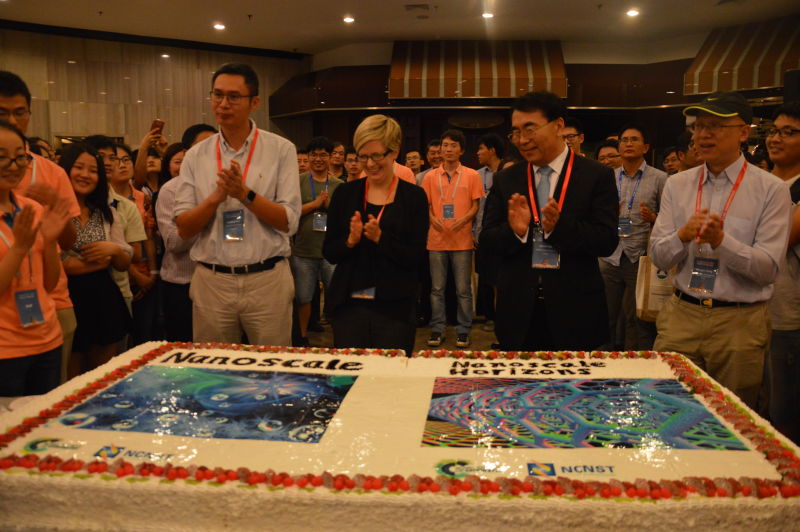
A prominent highlight of the event was the reception organised by the Royal Society of Chemistry to celebrate the launch of Nanoscale Horizons as well as the Nanoscale and Nanoscale Horizons partnership with the National Center for Nanoscience and Technology (NCNST) in Beijing which included cutting an enormous cake!

Left to right: Xiaodong Chen, Fiona McKenzie, Chunli Bai and Xingyu Jiang

Digg This
Reddit This
Stumble Now!
Share on Facebook
Bookmark this on Delicious
Share on LinkedIn
Bookmark this on Technorati
Post on Twitter
Google Buzz (aka. Google Reader)

Micro meets nano: Multicolour gold nanoprobes detect micoRNA biomarkers in serum

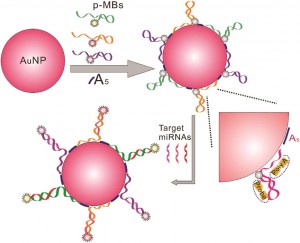
Researchers from Chinese Academy of Sciences have investigated the use of molecular beacons (MBs) for the simultaneous detection of multiple microRNA (miRNA) biomarkers.

The MBs were immobilized onto gold nanoparticles (AuNPs) via poly-adenine (poly-A) spacer. In addition, the authors used short oligonucleotides (oligos) consisting of 5 As in order to fill the gaps between MBs on the AuNP surface to ensure stability in salt solutions and obtain greater fluorescence signals.

MBs with 3 different fluorophores were employed in order to enable multiplexed detection of miRNAs in simulated serum samples. The authors reported that each MB specifically bound to its corresponding miRNA target in the presence of 10% fetal bovine serum (FBS), thereby demonstrating the applicability of this method for real biological sample detection.

In recent years, miRNA has emerged as a potential biomarker for many types of diseases, such as cancer, neurological disorders and cardiovascular disease. The need for rapid and sensitive assays for miRNA detection is therefore of great interest. Wang et al. have demonstrated a step in this direction with the research presented here.

Elaborately designed diblock nanoprobes for simultaneous multicolor detection of microRNAs
Chenguang Wang, Huan Zhang, Dongdong Zeng, Wenliang Sun, Honglu Zhang, Ali Aldalbahi, Yunsheng Wang, Lili San, Chunhai Fan, Xiaolei Zuo and Xianqiang Mi
Nanoscale, 2015,7, 15822-15829, DOI: 10.1039/C5NR04618A

Dr Lee Barrett is a guest web writer for the Nanoscale blog. Lee is currently a postdoctoral researcher in the Centre for Molecular Nanometrology at the University of Strathclyde. His research is currently focused on the development of nanoparticle-based sensors and surface enhanced Raman scattering (SERS). Follow him on twitter @L_Bargie

Digg This
Reddit This
Stumble Now!
Share on Facebook
Bookmark this on Delicious
Share on LinkedIn
Bookmark this on Technorati
Post on Twitter
Google Buzz (aka. Google Reader)