Archive for the ‘Article collections’ Category

Celebrating Nanoscience in Spain

New region spotlight in Nanoscale Advances

Over the year, Nanoscale Advances has published quality research across the breadth of nanoscience and our authors and readers in Spain remain a core part of the journal community.

To showcase some of the great research being carried out in these countries we have selected some of the most popular articles from authors across Spain. A small selection are highlighted in this blog post, but click the button below to read the full collection. All articles are gold open access so they are free to read.


Copper(i) as a reducing agent for the synthesis of bimetallic PtCu catalytic nanoparticles
Adrian Fernandez-Lodeiro, Javier Fernandez Lodeiro, Noelia Losada-Garcia, Silvia Nuti, Jose Luis Capelo-Martinez, Jose M. Palomo and Carlos Lodeiro
Nanoscale Adv., 2023, 5, 4415-4423

Antibacterial lignin-based nanoparticles and their use in composite materials
A. Gala Morena, Tzanko Tzanov
Nanoscale Adv., 2022, 4, 4447-4469

Magnetic order and magnetic anisotropy in two-dimensional ilmenenes
R. H. Aguilera-del-Toro, M. Arruabarrena, A. Leonardoac and A. Ayuela
Nanoscale Adv., 2023, 5, 2813-2819


Nanoscale Advances is pleased to have prominent members of the nanoscience community in Spain acting as Advisory Board Members and Guest Editors:

  • Lakshminarayana Polavarapu (University of Vigo)
  • Maurizio Prato (CIC biomaGUNE, San Sebastián, Spain)
  • Carlos A García-González (Universidade de Santiago de Compostela)


The Royal Society of Chemistry has arranged Read and Publish agreements with many institutes in Spain. As part of these agreements you may be entitled to publish your research gold open access at no cost or with a discount. Get in touch to find out more and find out if your institute is covered here.

Thank you for your support of the journal and we hope you will consider Nanoscale Advances for your next submission!

Digg This
Reddit This
Stumble Now!
Share on Facebook
Bookmark this on Delicious
Share on LinkedIn
Bookmark this on Technorati
Post on Twitter
Google Buzz (aka. Google Reader)

Celebrating Nanoscience in Japan and South Korea

New collection in Nanoscale Advances

Over the years, Nanoscale Advances has published quality research across the breadth of nanoscience and our Japanese and South Korean authors and readers remain a core part of the journal community.

To showcase some of the great research being carried out in these countries we have selected some of the most popular articles from authors across Japan and South Korea. A small selection are highlighted in this blog post, but click the button below to read the full collection. All articles are gold open access so they are free to read.


Lipid-based colloidal nanoparticles for applications in targeted vaccine delivery
Muhammad Saad Khan, Sila Appak Baskoy, Celina Yang, Joohye Hong, Jayoung Chae, Heejin Ha, Sungjun Lee, Masayoshi Tanaka, Yonghyun Choi and Jonghoon Choi
Nanoscale Adv., 2023, 5, 1853-1869

Bottom-up synthesis of 2D layered high-entropy transition metal hydroxides
Fei Li, Shi-Kuan Sun, Yinjuan Chen, Takashi Naka, Takeshi Hashishin, Jun and Hiroya Abe
Nanoscale Adv., 2022, 4, 2468-2478

Quantum dot photolithography using a quantum dot photoresist composed of an organic-inorganic hybrid coating layer
Seungmin Myeong, Bumsoo Chon, Samir Kumar, Ho-Jin Son, Sang Ook Kang and Sungkyu Seo
Nanoscale Adv., 2022, 4, 1080-1087


Nanoscale Advances is pleased to have some prominent members of the nanoscience community acting as Associate Editors and as Advisory Board Members:

  • Renzhi Ma (NIMS, Japan)
  • Dong Ha Kim (Ewha Womans University)
  • So-Jung Park (Ewha Womans University)
  • Hyeon Suk Shin (Ulsan National Institute of Science and Technology)

The Royal Society of Chemistry has arranged Read and Publish agreements with many institutes around the world. As part of these agreements you may be entitled to publish your research gold open access at no cost or with a discount. Get in touch to find out more and find out if your institute is covered here.

Thank you for your support of the journal and we hope you will consider Nanoscale Advances for your next submission!

Digg This
Reddit This
Stumble Now!
Share on Facebook
Bookmark this on Delicious
Share on LinkedIn
Bookmark this on Technorati
Post on Twitter
Google Buzz (aka. Google Reader)

Top articles from NCNST

Top articles from NCNST

Celebrating NCNST’s 20th anniversary by highlighting some of their best research and reviews

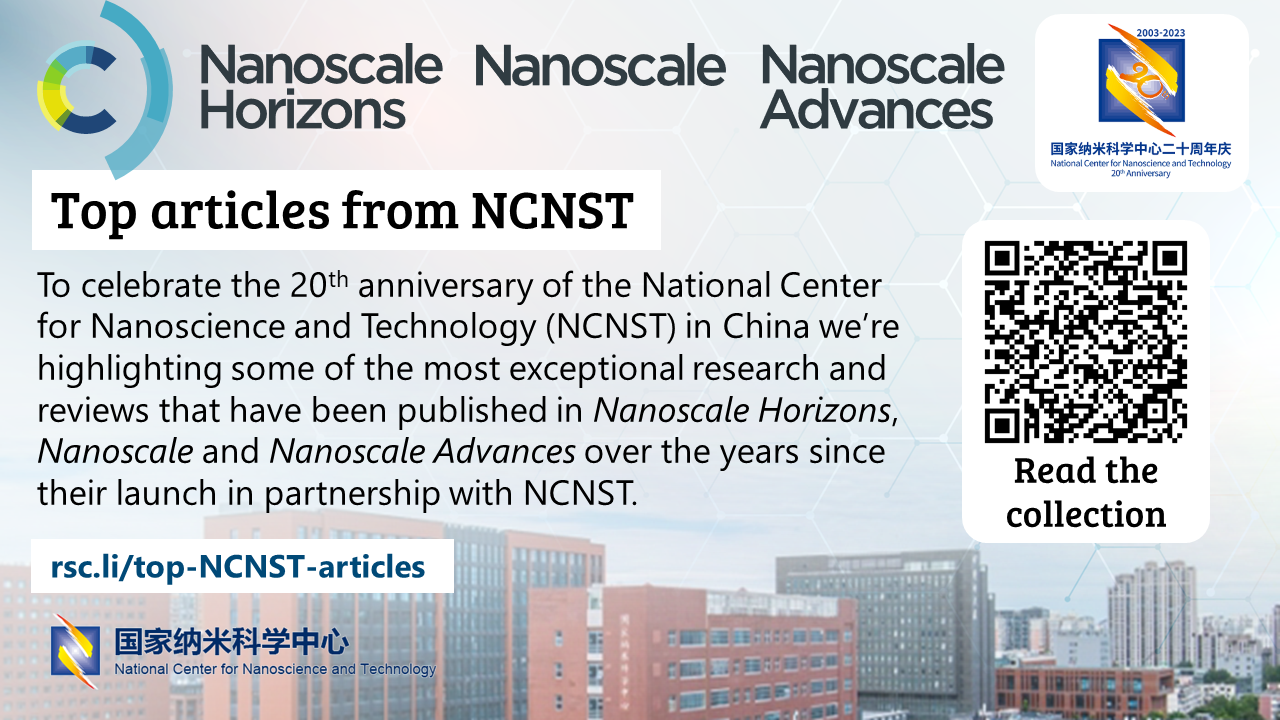
In celebration of the 20th anniversary of the National Center for Nanoscience and Technology (NCNST) in China and to highlight the strong connection between Nanoscale Horizons, Nanoscale, Nanoscale Advances and the institute we wanted to showcase some of the most exceptional research and reviews that have been published in the journals by NCNST researchers over the years since their launch in partnership with NCNST.

Top articles from NCNST promotional graphic.

The collection features some of the most cited articles from each year, some of the most popular articles and some of the most recent publications from NCNST in the nanoscale family of journals.

Read the collection

Read some of the featured articles below.

Gold nanoparticles for the colorimetric and fluorescent detection of ions and small organic molecules
Dingbin Liu, Zhuo Wang and Xingyu Jiang
Nanoscale, 2011, DOI: 10.1039/C0NR00887G

Visible light driven type II heterostructures and their enhanced photocatalysis properties: a review
Yajun Wang, Qisheng Wang, Xueying Zhan, Fengmei Wang, Muhammad Safdar and Jun He
Nanoscale, 2013, DOI: 10.1039/C3NR01577G

An 80.11% FF record achieved for perovskite solar cells by using the NH4Cl additive
Chuantian Zuo and Liming Ding
Nanoscale, 2014, DOI: 10.1039/C4NR02425G

Fe3O4–Pd Janus nanoparticles with amplified dual-mode hyperthermia and enhanced ROS generation for breast cancer treatment
Xiaowei Ma, Yanyun Wang, Xiao-Li Liu, Huijun Ma, Galong Li, Yao Li, Fei Gao, Mingli Peng, Hai Ming Fan and Xing-Jie Liang
Nanoscale Horiz., 2019, DOI: 10.1039/C9NH00233B

Single atomic Fe–N4 active sites and neighboring graphitic nitrogen for efficient and stable electrochemical CO2 reduction
Leta Takele Menisa, Ping Cheng, Xueying Qiu, Yonglong Zheng, Xuewei Huang, Yan Gao and Zhiyong Tang
Nanoscale Horiz., 2022, DOI: 10.1039/D2NH00143H

Versatile fabrication of metal sulfide supraparticles by an in situ decomposition–assembly strategy
Menglei Wang, Fulin Jia, Jianxiao Gong and Yunsheng Xia
Nanoscale Adv., 2023, DOI: 10.1039/D2NA00747A


We hope you enjoy reading this collection and look forward our continued partnership with NCNST and to sharing more work from the institute with you in the future.

Digg This
Reddit This
Stumble Now!
Share on Facebook
Bookmark this on Delicious
Share on LinkedIn
Bookmark this on Technorati
Post on Twitter
Google Buzz (aka. Google Reader)

Nanoscale 2023 Lunar New Year Collection

Lunar New Year collection

A collection of our most popular articles from Asia

To celebrate the Lunar New Year, we are delighted to highlight some of the most popular articles, determined by their citations and page views, published in Nanoscale last year by corresponding authors based in countries celebrating the Lunar New Year.

Read the collection now

Nanoscale Chinese New Year promotional graphic with a red background and an image of a gold rabbit surrounded by flowers. Text reads: "Nanoscale Wishes you a Happy Chinese New Year 2023, May you enjoy a very prosperous and productive year of the rabbit".

Professor Katharina Landfester (Nanoscale Horizons Editorial Board Chair) and Professor Dirk Guldi (Nanoscale and Nanoscale Advances Editor-in-Chief) have recorded messages to welcome us into the Year of the Rabbit!

Watch our Editors-in-Chief’s new year greeting

All of the articles in the collection are free to access until the end of February 2023. Read some of the featured articles below.

Halide perovskite single crystals: growth, characterization, and stability for optoelectronic applications
Yunae Cho, Hye Ri Jung and William Jo
Nanoscale, 2022, DOI: 10.1039/D2NR00513A

Ultrathin Ti-doped WO3 nanosheets realizing selective photoreduction of CO2 to CH3OH
Peiquan Ling, Juncheng Zhu, Zhiqiang Wang, Jun Hu, Junfa Zhu, Wensheng Yan, Yongfu Sun and Yi Xie
Nanoscale, 2022, DOI: 10.1039/D2NR02364D

Nanoparticle-induced chemoresistance: the emerging modulatory effects of engineered nanomaterials on human intestinal cancer cell redox metabolic adaptation
Zhuoran Wu, Magdiel Inggrid Setyawati, Hong Kit Lim, Kee Woei Ng and Chor Yong Tay
Nanoscale, 2022, DOI: 10.1039/D2NR03893E

Highly-efficient radiative thermal rectifiers based on near-field gap variations
Bei Yang and Qing Dai
Nanoscale, 2022, DOI: 10.1039/D2NR04350E

Improved zT in Nb5Ge3–GeTe thermoelectric nanocomposite
Jing Cao, Xian Yi Tan, Ning Jia, Da Lan, Samantha Faye Duran Solco, Kewei Chen, Sheau Wei Chien, Hongfei Liu, Chee Kiang Ivan Tan, Qiang Zhu, Jianwei Xu, Qingyu Yan and Ady Suwardi
Nanoscale, 2022, DOI: 10.1039/D1NR06962D

We hope you enjoy reading these popular articles and wish you a happy, healthy and prosperous year of the rabbit!

Digg This
Reddit This
Stumble Now!
Share on Facebook
Bookmark this on Delicious
Share on LinkedIn
Bookmark this on Technorati
Post on Twitter
Google Buzz (aka. Google Reader)

US Nanotechnology Day 2022

The US National Nanotechnology Day 2022 is an annual event of the National Nanotechnology Initiative of the U.S government “featuring community-led events and activities on or around October 9th to help raise awareness of nanotechnology.” Holding the event on October 9th pays homage to the nanometer scale (10-9 m).

We are delighted to share with you a new collection of recent articles published in Nanoscale Horizons, Nanoscale, Nanoscale Advances, Environmental Science: Nano and RSC Advances on this year’s theme of nanotechnology’s role in understanding and responding to climate change and improving the health of the Earth and its people.

Containing both reviews and original research, this collection includes work on nanoparticles used in sustainable agriculture, photonics and power generation as well as environmental remediation: rsc.li/USNanoDay2022

Below is a snapshot of some of the papers in the collection. We hope you enjoy reading these articles, which are all free to access till 30th November, 2022. Nanoscale Advances and RSC Advances are fully gold open access journals whose articles are free to read always.

Reviews

Doing nano-enabled water treatment right: sustainability considerations from design and research through development and implementation, M. Falinski, R. S. Turley, J. Kidd, A. W. Lounsbury, M. Lanzarini-Lopes,   A. Backhaus,  H. E. Rudel, M. K. M. Lane,   C. L. Fausey   A. C. Barrios,  J. E. Loyo-Rosales,  F. Perreault, W. S. Walker, L. B. Stadler,  M. Elimelech, J. L. Gardea-Torresdey, P. Westerhoff, J. B. Zimmerman, Environ. Sci.: Nano, 2020,7, 3255-3278, DOI:10.1039/D0EN00584C

Silicon nanoparticles (SiNPs) in sustainable agriculture: major emphasis on the practicality, efficacy and concerns , Javaid Akhter Bhat, Nitika Rajora, Gaurav Raturi, Shivani Sharma, Pallavi Dhiman, Sandhya Sanand,  S. M. Shivaraj, Humira Sonahand,  Rupesh Deshmukh, Nanoscale Adv., 2021,3, 4019-4028, DOI: 10.1039/D1NA00233C

Paper

Cellulose particles capture aldehyde VOC pollutants, Isaac Bravo, Freddy Figueroa, Maria I. Swasy, Mohamed F. Attia, Mohamed Ateia, Domenica Encalada, Karla Vizuete,  Salome Galeas,  Victor H. Guerrero, Alexis Debut, Daniel C. Whitehead, Frank Alexis, RSC Adv., 2020,10, 7967-7975, DOI: 10.1039/D0RA00414F

Here is what Professor Jesse Jokerst, University of California at San-Diego, Advisory Board member, Nanoscale had to say on this theme:

Nanotechnology can lead to better particulates and aerosols that reflect sunlight during geo-engineering. Nanotechnology and nanoengineering can also produce better containment systems for next-generation nuclear reactors.

We wish you all a Happy #NationalNanoDay!

Thank you for reading this collection of papers and for your support!

Digg This
Reddit This
Stumble Now!
Share on Facebook
Bookmark this on Delicious
Share on LinkedIn
Bookmark this on Technorati
Post on Twitter
Google Buzz (aka. Google Reader)

Editor’s Choice: Functional MOFs and COFs

Functional MOFs and COFs

A collection of articles selected by Paolo Samorì

Professor Paolo Samorì, University of Strasbourg, France, and Associate Editor for Nanoscale and Nanoscale Advances, presents his highlights of the latest research published in the journals on functional metal- and covalent-organic frameworks.

Professor Paolo Samori


“Metal–organic frameworks (MOFs) and covalent–organic frameworks (COFs) have established themselves during the last few years as chemically tuneable scaffolds displaying unique structures and ad hoc physical and chemical properties that can be tailored by design. Their assembly enables the generation of highly porous structures that can, for example, host chemical species for gas and liquid purification or sensing and can host ions for energy storage and catalysis.

This online collection from Nanoscale and Nanoscale Advances highlights some of the most enlightening recent results on MOF- and COF-based functional assemblies, by providing clear evidence for their outstanding potential to address today’s societal challenges in the field of energy as well as environmental sciences.”


Read the collection

We hope you enjoy reading these articles.

Best wishes,

Professor Paolo Samorì
University of Strasbourg, France


Digg This
Reddit This
Stumble Now!
Share on Facebook
Bookmark this on Delicious
Share on LinkedIn
Bookmark this on Technorati
Post on Twitter
Google Buzz (aka. Google Reader)

Most Popular 2021 Nanoscale Articles

Most popular articles in 2021


We wanted to share with you some of the most popular articles published in Nanoscale last year, determined by their citations and page views.

Read the most popular Nanoscale articles here

All of the articles in the collection are free to access until the end of March 2022. Read some of the featured articles below.

Revisiting anodic alumina templates: from fabrication to applications
Alejandra Ruiz-Clavijo, Olga Caballero-Calero and Marisol Martín-González
Nanoscale, 2021, DOI: 10.1039/D0NR07582E

2D metal–organic framework-based materials for electrocatalytic, photocatalytic and thermocatalytic applications
Yanpeng Xue, Gongchi Zhao, Ruiying Yang, Feng Chu, Juan Chen, Lei Wang and Xiubing Huang
Nanoscale, 2021, DOI: 10.1039/D0NR09064F

Inorganic nanohybrids combat antibiotic-resistant bacteria hiding within human macrophages
Martin T. Matter, Meagan Doppegieter, Alexander Gogos, Kerda Keevend, Qun Ren and Inge K. Herrmann
Nanoscale, 2021, DOI: 10.1039/D0NR08285F

Efficient single-photon pair generation by spontaneous parametric down-conversion in nonlinear plasmonic metasurfaces
Boyuan Jin, Dhananjay Mishra and Christos Argyropoulos
Nanoscale, 2021, DOI: 10.1039/D1NR05379E

Group-IV(A) Janus dichalcogenide monolayers and their interfaces straddle gigantic shear and in-plane piezoelectricity
Pradip Nandi, Ashima Rawat, Raihan Ahammed, Nityasagar Jena and Abir De Sarkar
Nanoscale, 2021, DOI: 10.1039/D0NR07027K


We hope you enjoy reading these popular articles.

With best wishes,

Dr Heather Montgomery
Managing Editor, Nanoscale

Digg This
Reddit This
Stumble Now!
Share on Facebook
Bookmark this on Delicious
Share on LinkedIn
Bookmark this on Technorati
Post on Twitter
Google Buzz (aka. Google Reader)

Nanoscale 2022 Lunar New Year Collection

Lunar New Year collection

A collection of our most popular articles from Asia

To celebrate the Lunar New Year, we are delighted to highlight some of the most popular articles, determined by their citations and page views, published in Nanoscale last year by corresponding authors based in Asia.

Read the collection

All of the articles in the collection are free to access until the end of March 2022. Read some of the featured articles below.

2D metal–organic framework-based materials for electrocatalytic, photocatalytic and thermocatalytic applications
Yanpeng Xue, Gongchi Zhao, Ruiying Yang, Feng Chu, Juan Chen, Lei Wang and Xiubing Huang
Nanoscale, 2021, DOI: 10.1039/D0NR09064F

Towards a point-of-care SERS sensor for biomedical and agri-food analysis applications: a review of recent advancements
Jayakumar Perumal, Yusong Wang, Amalina Binte Ebrahim Attia, U. S. Dinish and Malini Olivo
Nanoscale, 2021, DOI: 10.1039/D0NR06832B

The flexibility-based modulation of DNA nanostar phase separation
Taehyun Lee, Sungho Do, Jae Gyung Lee, Do-Nyun Kim and Yongdae Shin
Nanoscale, 2021, DOI: 10.1039/D1NR03495B

An asymmetric sandwich structural cellulose-based film with self-supported MXene and AgNW layers for flexible electromagnetic interference shielding and thermal management
Bing Zhou, Qingtao Li, Penghui Xu, Yuezhan Feng, Jianmin Ma, Chuntai Liu and Changyu Shen
Nanoscale, 2021, DOI: 10.1039/D0NR07840A

Incorporating highly basic polyoxometalate anions comprising Nb or Ta into nanoscale reaction fields of porous ionic crystals
Zhewei Weng, Naoki Ogiwara, Takashi Kitao, Yuji Kikukawa, Yu Gao, Likai Yan and Sayaka Uchida
Nanoscale, 2021, DOI: 10.1039/D1NR04762K


We hope you enjoy reading these popular articles and wish you a happy Lunar New Year!

With best wishes,

Dr Heather Montgomery

Managing Editor, Nanoscale


Digg This
Reddit This
Stumble Now!
Share on Facebook
Bookmark this on Delicious
Share on LinkedIn
Bookmark this on Technorati
Post on Twitter
Google Buzz (aka. Google Reader)

Editor’s Choice: Controlling anisotropy in nanomaterials

Controlling anisotropy in nanomaterials

A collection of articles selected by Shouheng Sun

Professor Shouheng Sun, Brown University, USA, and Associate Editor for Nanoscale and Nanoscale Advances, presents his highlights of the latest research published in the journals on anisotropic nanomaterials.

Professor Shouheng Sun


“Anisotropy is an important characteristic that offers desirable direction-dependent properties in materials. Recent advances in nanoscience research have led to extensive studies in controlling anisotropy in nanomaterials to provide unprecedented control over their properties and functionality.

This online collection from Nanoscale and Nanoscale Advances highlights work on controlling anisotropy in nanomaterials to achieve desired chemical and physical properties. These articles provide understanding of the growth of anisotropic nanostructures at the atomic and molecular level, and explore their use in optoelectronic, magnetic, catalytic, biomedical and molecular separation applications.”


Read the collection


We hope you enjoy reading these articles.

Best wishes,

Professor Shouheng Sun

Brown University, USA


Digg This
Reddit This
Stumble Now!
Share on Facebook
Bookmark this on Delicious
Share on LinkedIn
Bookmark this on Technorati
Post on Twitter
Google Buzz (aka. Google Reader)

Editor’s Choice: Computational studies of nanomaterials for energy, catalysis and electronics

Computational studies of nanomaterials for energy, catalysis and electronics

A collection of articles selected by Xiao Cheng Zeng

Professor Xiao Cheng Zeng, University of Nebraska-Lincoln, USA, and Associate Editor for Nanoscale and Nanoscale Advances, presents his highlights of the latest computational research published in the journals on nanomaterials for energy, catalysis and electronics.


Professor Xiao Cheng Zeng

“Computational nanomaterials research has been playing a growing role over the past decade in the design of new nanomaterials, bringing deeper insights into novel properties of nanomaterials, supporting and corroborating experimental research, and gathering new data for machine learning and model development.

This online collection from Nanoscale and Nanoscale Advances covers several active areas of computational nanomaterials research, including design and/or investigation of nanoscale and single-atom catalysts, low-dimensional ferromagnetic, ferroelectric and multiferroic materials, low-dimensional semiconductors, halide perovskites, protein-ligand binding affinity, plasmonic nanoparticles, and metal nanoclusters. We hope this themed collection will be informative to contemporary computational nanomaterials research.”


Read the collection


We hope you enjoy reading these articles.

Best wishes,

Professor Xiao Cheng Zeng

University of Nebraska-Lincoln, USA


Digg This
Reddit This
Stumble Now!
Share on Facebook
Bookmark this on Delicious
Share on LinkedIn
Bookmark this on Technorati
Post on Twitter
Google Buzz (aka. Google Reader)