

We are delighted to celebrate the 2026 Nanoscale Advances Paper Prize, highlighting the most significant articles published in the journal in the previous calendar year! Find out more about Ritu Ladhi, Arshminder Kaur Dhillon and Monika Singh, the authors of the 2026 Nanoscale Advances Paper Prize winning paper A metal–organic framework with chiral nanochannels for enantioselective fluorescence switching of amino alcohols.
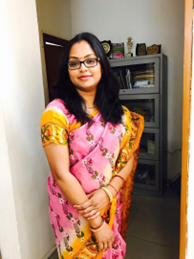 |
Dr. Monika Singh (corresponding author).
After her PhD (Materials Chemistry) from IIT Delhi, India, Dr. Monika Singh joined Institute of Nano Science and Technology (INST), Mohali as a Scientist in 2013 where she is continuing till now. Currently she is Scientist E (Associate Professor) at INST Mohali. INST Mohali is an autonomous Institute of Department of Science and Technology (DST), Government of India. Dr. Singh’s research interest lies in Developing nanoporous materials (e.g. MOFs, POMs, POMOFs) for various applications such as carbon dioxide sequestration, sensing, electrocatalysis and anti-cancer |
 |
Ritu Ladhi (First author).
Ritu Ladhi obtained her Bachelor’s and Master’s degrees in Chemistry with first-class honors from Panjab University, Chandigarh, in 2016 and 2018, respectively. In 2020, she joined Ph.D. at the Institute of Nano Science and Technology (INST), Mohali, while enrolled at the Indian Institute of Science Education and Research (IISER) Mohali, under the supervision of Dr. Monika Singh. Her doctoral research focuses on designing and engineering Metal-Organic Frameworks (MOFs) for the sensing of environmental pollutants. Her broader scientific interests include porous functional materials design, fluorometric sensing and photocatalytic applications. |
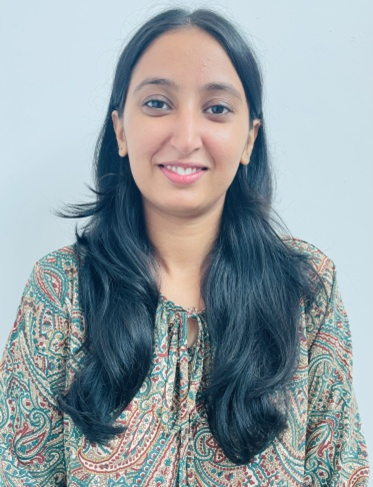 |
Arshminder Kaur Dhillon (Second author)
Arshminder kaur Dhillon obtained her Bachelor’s and Master’s degrees in Chemistry with first-class honors from Panjab University, Chandigarh. She joined Dr. Singh’s laboratory as a research scholar in August 2022 at the Institute of Nano Science and Technology (INST), Mohali, while enrolled at the Indian Institute of Science Education and Research (IISER) Mohali. Her doctoral research focuses on designing Metal-Organic Frameworks (MOFs) for various applications such as sensing of harmful chemicals, catalysis etc. |
What aspect of your work are you most excited about at the moment?
Monika Singh: The most exciting part of this work is understanding how a chiral environment can emerge from an achiral linker system and exhibit high enantiomeric selectivity. In our work, observing distinct turn-off and turn-off-on fluorescence responses for different amino alcohol enantiomers was particularly interesting because it gave us insight into how subtle host-guest interactions inside the chiral MOF channels influence sensing performance. This work is a small contribution to the field of chiral porous materials, where the symmetry-breaking process induces chirality in a MOF constructed from achiral linkers. Although this area is still relatively less explored, there is significant scope for further investigation into how such crystallisation processes can be tailored to induce and control chirality in MOFs.
How do you feel about Nanoscale Advances as a place to publish research on this topic?
Monika Singh: I feel that Nanoscale Advances is a very suitable platform for this kind of interdisciplinary research. The journal covers innovative and emerging concepts in materials chemistry and nanoscience, which aligns well with our study. The journal has a broad readership, which makes it a valuable platform for communicating research that connects MOFs, chirality, and sensing applications. I also appreciate the journal’s emphasis on high-quality and impactful studies in rapidly developing research fields.
Can you share one piece of career-related advice for early career scientists?
Monika Singh: I would say that in research, there is rarely completely “right” or “wrong” data, it is our keen observation and understanding that give meaning to the results. Sometimes the most unexpected observations lead to the most interesting discoveries, so young researchers should stay curious and pay attention even to results that initially seem unusual or unsuccessful.


