Archive for April, 2013

Parallelogram shaped nanowires control light in two dimensions

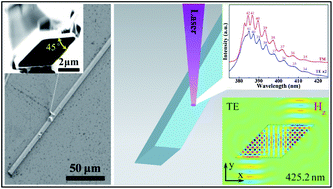
Table of contents imageA novel zinc oxide microwire optical resonator with parallelogram-shaped cross section has been made by chemists based in China and Taiwan. The material can effectively control light in two dimensions, and could play the part of a building block in the development of optoelectronic devices.

Read this HOT Nanoscale communication today:

Optical modulation of ZnO microwire optical resonators with a parallelogram cross-section
Yang Liu, Hongxing Dong, Shulin Sun, Wenhui Liu, Jinxin Zhan, Zhanghai Chen, Jun Wang and Long Zhang
DOI: 10.1039/C3NR00700F

Digg This
Reddit This
Stumble Now!
Share on Facebook
Bookmark this on Delicious
Share on LinkedIn
Bookmark this on Technorati
Post on Twitter
Google Buzz (aka. Google Reader)

New Nanoscale Associate Editor: Prof. Dirk Guldi

Dirk Guldi Nanoscale Associate Editor

We are delighted to welcome Professor Dirk Guldi as a new Associate Editor for Nanoscale. Professor Guldi is one of the world-leading scientists in the field of charge transfer/nanocarbons. In particular, he is well-known for his contributions to the areas of charge-separation in donor-acceptor materials and construction of nanostructured thin films for solar energy conversion.Nanoscale

His research at the Friedrich Alexander University of Erlangen-Nuremberg involves the application of an arsenal of spectroscopic and microscopic techniques to a variety of molecular systems designed specifically to explore the nature of the chemical, physical and photophysical properties of new molecular hybrids, quantum dots, quantum rods and nanoparticles. He is also interested in designing and synthesising novel nanometer scale structures in combination with electron donors as integrative components for electron-donor-acceptor ensembles.

Prof. Guldi is handling papers and so we encourage you to submit to his editorial office.

Digg This
Reddit This
Stumble Now!
Share on Facebook
Bookmark this on Delicious
Share on LinkedIn
Bookmark this on Technorati
Post on Twitter
Google Buzz (aka. Google Reader)

Get Funded To Visit Chinese Universities

If you wish to create new research collaborations with Chinese Universities, you can now apply for the RSC-SAFEA visiting researcher programme.

Call for applications are open until the 20th May 2013.

Please email: international@rsc.org to register your interest in participating in the programme. Read more from previous researchers who have participated in this programme in 2010-2012 http://my.rsc.org/blogs/74.

RSC Visiting Researcher Programme ChinaThe State Administration for Foreign Experts Affairs (SAFEA) is a division of the Chinese Government with which RSC has a cooperation agreement. Under this agreement the RSC and SAFEA will jointly fund researchers from the UK to visit Chinese Universities. The purpose of the visits is to stimulate collaboration between UK and Chinese institutions. They will allow the visitor to contribute their experience towards the development of excellent emerging science and build links with the Chinese Chemistry community.

In addition, the visitor will advise Chinese research groups on all aspects of presenting their research to an international audience. The programme will strengthen links between the UK and Chinese Science and between the RSC and our partners in China.

Digg This
Reddit This
Stumble Now!
Share on Facebook
Bookmark this on Delicious
Share on LinkedIn
Bookmark this on Technorati
Post on Twitter
Google Buzz (aka. Google Reader)

Nanoscale article in Chemistry World: Nanopaper light scattering under control

Transparent nanopaper with tailored optical propertiesCollaborators in the US and China have demonstrated that by changing the diameter of cellulose fibres in nanopaper they can tailor its optical properties for use in optoelectronics.

In this work, Zhichao Ruan from Zhejiang University and Liangbing Hu from the University of Maryland have looked at the effect of changing the fibre diameter and packing density in transparent nanopaper. ‘Specular transmittance measures light in the normal direction, whereas diffusive transmittance refers to the forward direction’ explains Hu. ‘As the fibre diameter decreases, the overall transmittance, including both specular and diffusive transmittance, increases. But the difference between the two, which is related to the haze of the nanopaper, starts to decrease.’

Read the full article in Chemistry World!

Read the article in Nanoscale:

Transparent nanopaper with tailored optical properties
Hongli Zhu, Sepideh Parvinian, Colin Preston, Oeyvind Vaaland, Zhichao Ruan and Liangbing Hu
DOI: 10.1039/C3NR00520H

Digg This
Reddit This
Stumble Now!
Share on Facebook
Bookmark this on Delicious
Share on LinkedIn
Bookmark this on Technorati
Post on Twitter
Google Buzz (aka. Google Reader)

Strong composite films from silk fibroin and graphene oxide

Strong composite films with layered structures prepared by casting silk fibroin–graphene oxide hydrogels

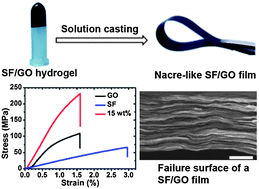
Gaoquan Shi and co-workers have made composite films comprising graphene oxide sheets and silk fibroin in a layered structure, which mimic natural nacre. They demonstrate a facile solution-casting method for incorporating the fibroin into graphene oxide.

The impressive mechanical properties of their material, surpassing those of natural nacre in some ways, make it potentially useful as a high-strength structural material. The biocompatibility of the material components also makes the composite promising for biological applications, such as tissue engineering.

Read this HOT article today:

Strong composite films with layered structures prepared by casting silk fibroin–graphene oxide hydrogels
Liang Huang, Chun Li, Wenjing Yuan and Gaoquan Shi
DOI: 10.1039/C3NR00196B

Digg This
Reddit This
Stumble Now!
Share on Facebook
Bookmark this on Delicious
Share on LinkedIn
Bookmark this on Technorati
Post on Twitter
Google Buzz (aka. Google Reader)

Full camouflage for stealth nanoparticles

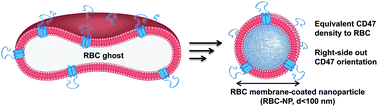
‘Marker-of-self’ functionalization of nanoscale particles through a top-down cellular membrane coating approachCamouflaging nanoparticles so that they are not attacked by the immune system is a major challenge in developing long-circulating, effective drug-delivery vehicles. Attaching CD47, a transmembrane protein that serves as a universal molecular ‘marker-of-self’, to the surface of nanoparticles is one way to enable active immune evasion. However, functionalising the particle surface evenly and with uniformly oriented protein is very difficult.

Liangfang Zhang et al. show that their membrane translocation approach is very effective for functionalizing nanoparticles with molecules of CD47 in their recent Nanoscale Communication. They were able to coat nanoparticles with immunomodulatory proteins at an equivalent density to those on red blood cells, and in the correct orientation.

Read this HOT article today:

‘Marker-of-self’ functionalization of nanoscale particles through a top-down cellular membrane coating approach
Che-Ming J. Hu, Ronnie H. Fang, Brian T. Luk, Kevin N. H. Chen, Cody Carpenter, Weiwei Gao, Kang Zhang and Liangfang Zhang
DOI: 10.1039/C3NR00015J


Digg This
Reddit This
Stumble Now!
Share on Facebook
Bookmark this on Delicious
Share on LinkedIn
Bookmark this on Technorati
Post on Twitter
Google Buzz (aka. Google Reader)