Archive for the ‘News’ Category

Building a nation of scientists

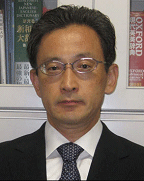
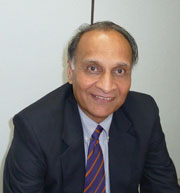
Goverdhan MehtaGoverdhan Mehta talks to Sheena Elliott and Elinor Richards about the progress of science in India and the challenges scientists face

Goverdhan Mehta is a researcher, specialising in organic synthesis. He has helped to build institutions in India – the Indian Institute of Technology, Kanpur, the University of Hyderabad, and the Indian Institute of Science, Bangalore. He was director of the Indian Institute of Science (1998-2005) and vice chancellor of the University of Hyderabad (1994-1998).

Your research is focused on organic chemistry. What attracted you to that field?

There is something intrinsically fascinating about organic chemistry. In my early high school years, when I was exposed to interesting chemical structures, I was attracted to them. I had a sense of appreciation for art and organic molecules to me provided a wonderful expression of art at a molecular level.

What are your main achievements in the field?

I have worked in many areas of organic chemistry, but it’s synthesis that’s given me the greatest pleasure. As organic chemistry advanced, different contemporary challenges came to my attention. The main driver for me to pursue those challenges was the intricacy of the target structure synthesis. There was also an element of expectation that perhaps our research might become useful to society. We continue to need new drugs for a variety of disorders, so we synthesised a large number of natural products; many of them are biologically active and it is quite possible that some of them can provide leads for new drug discovery.

Over the last few years, I have become interested in how to address a problem that the ageing population is facing – neurodegeneration. It has been shown that some natural products can slow down neurodegeneration. In some cases, there is also an indication that they can help restore lost cognitive function. So I have been working on the synthesis of such lead molecules. As I’m getting older, I recognise the need for doing something in that area!

You’ve won numerous awards. Which achievements are you most proud of?

I don’t think that awards and recognition have necessarily brought me a great sense of joy. They do bring a sense of satisfaction because your peers have recognised your work. But I don’t think any serious researcher works for awards. It is the sheer joy of research that keeps people going. Recognition has come my way, but don’t think that I can equate that with the joy of doing research.

What are the challenges facing scientists in India and how could these be overcome?

Scientists all over the world are facing challenges on two fronts. The first problem is that scientists are not being supported by society as much as they should and some governments are not always forthcoming in terms of providing budgetary support. The second problem is that scientists, and science in general, have become isolated both in terms of discipline and, to some extent, in terms of geographical location. This is being redressed now with increasing international collaborations, so in the geographical sense, the isolation is being reduced. But I think disciplinary isolation vis a vis other knowledge streams and fragmentation of science is still a serious challenge.

It is a good time for scientists in India because the government is very supportive of science. Funding is no longer as serious a problem as it is in other parts of the world. Recently, our prime minister said that the budget for science will be almost doubled over the next few years. But I’m not too sure that we as a scientific community are steering science in India in the direction that it ought to be heading. I believe that the government and the scientific community must set a goal that in the next 10 years, India will be among the world’s leading scientific countries.

What is your opinion on the perception that Indian science and research is falling behind the rest of the world, following recent comments by Prime Minister Manmohan Singh?

Prime Minister Singh’s statement referred mainly to China. China has made more progress in science and technology than India. Scientific productivity in India has increased, but not as much as in China. Since we are behind, to simply say that we are walking and walking well is not enough. We should be galloping to catch up. My judgement is that our progress is not commensurate with the support that the government is providing, and not commensurate with the capacity, capability, enthusiasm and the vibrancy that our youth have. We can achieve much more.

How do the different industries compare (the pharmaceutical industry in particular or the more general chemical industry)?

It is only over the last 10 or 12 years, since the economic reforms, that industry in India has grown at such a rate so as to be in a position to invest in research and development. I expect that investment by industry is going to rise; however, the current level of investment is not in an acceptable range. There are certain sectors – pharma, for example – and some other chemical industries, where I think India’s potential is immense, but there are some challenges with the policies that are being pursued. We have to devise a well thought out strategy.

The prime minister’s Science Advisory Council reported that there is an absence of any Indian universities among the world’s best. What is your opinion on the quality of universities in India?

I’m not a great believer in the ranking systems being followed, but the fact is that no Indian university features among the top few hundred universities. However, if we were to look at undergraduate teaching, India has institutions that produce graduates through excellent teaching and training. The graduates are probably as good as they are anywhere else in the world. If you were to grade an institution on the quality of undergraduates, I would say that the Indian Institutes of Technology rank among the top 10 institutions in the world. But, if you bring in research and other elements, they will not feature anywhere near the top. So the quality of research is a serious problem. I think it is high time that the scientific community and scientific leadership in our country sort out an effective, implementable strategy to make a major shift.

You experienced difficulty obtaining a visa to travel to the US in 2006, when you were invited to give a lecture at the University of Florida. At the time, a report from the National Academy of Sciences in the US said that at least 3000 scientists had faced a similar problem. Have things improved since then or do you believe that the visa problem is hampering scientific progress and career development for scientists?

It was ironic that I and a leading scientist from the US, Jane Lubchenco (who at that time was president of the International Council for Science before I succeeded her), wrote an editorial about the principle of universatility of science and the visa regime in Science a few months before this happened. We wrote that it was important for the international growth of science that scientists were able to travel. Little did I realise that soon I would be a victim of this! I think the situation has improved, but a lot more needs to be done. While the US National Academy of Sciences is playing a very positive role towards this end, the academies can only do the advocacy. Eventually, it is the government and the state department of security staff that makes the final judgement.

If you have any spare time, how do you fill it?

For most scientists, and I’m no exception, your research is a hobby. What other profession can give you that pleasure and privilege? In a previous interview, I was asked what I would wish for. I said we Indians believe in rebirth and so the only wish I have is that if I were to be born again, I would be a scientist. I would like to be a chemist, hopefully a better one.

Read the original article and see Professor Mehta’s recent RSC published papers at Chemistry World

Digg This
Reddit This
Stumble Now!
Share on Facebook
Bookmark this on Delicious
Share on LinkedIn
Bookmark this on Technorati
Post on Twitter
Google Buzz (aka. Google Reader)

Dean Tantillo wins 2012 NPR Lecture Award

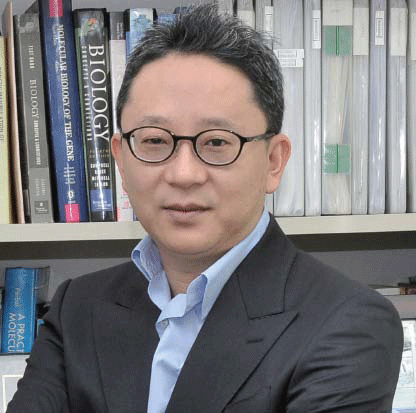
Dean TantilloWe are delighted to announce that Professor Dean Tantillo from the University of California, Davis (USA) is the winner of the 2011 NPR Lecture Award. Professor Tantillo was selected for his work in the field of enzymology.
“It is an honor to be chosen as the 2012 NPR lecturer,” Professor Tantillo commented on receiving the award. “My students at UC Davis have worked hard to show how theoretical chemistry can contribute to natural products research and I am delighted that a fantastic journal like NPR supports this growing part of the natural products community. Thanks!”

The conference at which the lecture will be delivered will be announced in due course.

The NPR Lecture Award is awarded to a researcher who has made a significant contribution to the field of natural products and who has also had some involvement with the journal. You can view Professor Tantillo’s recent article for NPR below:

Biosynthesis via carbocations: Theoretical studies on terpene formation
Dean J. Tantillo
Nat. Prod. Rep., 2011, 28, 1035-1053
DOI: 10.1039/C1NP00006C

Digg This
Reddit This
Stumble Now!
Share on Facebook
Bookmark this on Delicious
Share on LinkedIn
Bookmark this on Technorati
Post on Twitter
Google Buzz (aka. Google Reader)

New additions to the macrocyclic bisbibenzyl family on the cover of NPR issue 2

Issue 2 of NPR is now online, including our regular Hot off the Press feature from Robert A. Hill and Andrew Sutherland and the latest marine natural products review from John Blunt et al.
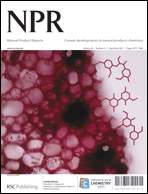
The interesting cover article is from David Harrowven and Sarah Kostiuk, highlighting their review on the synthesis and stereochemistry of newly discovered macrocyclic bisbenzyl natural products, a group commonly, but not exclusively, found in the bryophyte plant family. The review provides at timely update to that by G. M. Keserű and M. Nógrádi in 1995.

The issue also includes a Highlight article from Paris Hamilton and Dev Arya on natural product DNA major groove binders, and reviews on the biosynthesis of 3-amino-5-hydroxybenzoic acid-derived NPs and angucyclines.

View the issue

Digg This
Reddit This
Stumble Now!
Share on Facebook
Bookmark this on Delicious
Share on LinkedIn
Bookmark this on Technorati
Post on Twitter
Google Buzz (aka. Google Reader)

Influenza Neuroaminidase on the cover of NPR Issue 1, 2012

Welcome to NPR Issue 1, 2012

Looking back on 2011, we’d like to thank all our authors, readers and referees for what has been another very successful year for Natural Product Reports. A big thanks also goes to the NPR Editorial Board for their great support and enthusiasm.

Read the 2012 Editorial by NPR Chair Professor Bradley Moore and Editor Dr Richard Kelly reflecting on this year’s many highlights and catch a glimpse of what to look ahead to for a bright 2012!


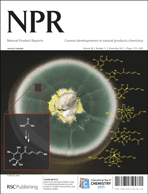
On the cover of this first Issue is the work of Judith M. Rollinger et al., reviewing the increasing research efforts of the past decade on neuroaminidase (NA) for lead discovery strategies from nature, focusing on the structure, function and druggability of influenza NA, and its inhibition by natural products. This review will be free to access for the next 6 weeks.

Influenza neuraminidase: A druggable target for natural products
Ulrike Grienke, Michaela Schmidtke, Susanne von Grafenstein, Johannes Kirchmair, Klaus R. Liedl and Judith M. Rollinger
DOI: 10.1039/C1NP00053E

Also in this Issue, read:


    We hope you enjoy reading our first issue for this new volume of NPR and we wish you all the warmest Season’s Greetings.

    Digg This
    Reddit This
    Stumble Now!
    Share on Facebook
    Bookmark this on Delicious
    Share on LinkedIn
    Bookmark this on Technorati
    Post on Twitter
    Google Buzz (aka. Google Reader)

    Nominations for the 2012 RSC Prizes and Awards now open

    Nominations for the 2012 RSC Prizes and Awards close on the 15 January 2012

    Our Prizes and Awards represent the dedication and outstanding achievements and are a platform to showcase inspiring science to gain the recognition deserved. Don’t forget to nominate colleagues who have made a significant contribution to advancing the chemical sciences.

    View our full list of Prizes and Awards and use the online system to nominate a colleague.

    Digg This
    Reddit This
    Stumble Now!
    Share on Facebook
    Bookmark this on Delicious
    Share on LinkedIn
    Bookmark this on Technorati
    Post on Twitter
    Google Buzz (aka. Google Reader)

    New Editorial Board members for NPR

    We are delighted to announce the appointment of two new members to the Editorial Board of Natural Products Reports, Professors Ikuro Abe and Dirk Trauner who will be joining the Board in January 2012.

    Ikuro Abe received his PhD degree in 1989 from The University of Tokyo under the direction of Professor Yutaka Ebizuka, where he studied chemistry and biochemistry of natural products biosynthesis.  After two years postdoctoral research with Professor Guy Ourisson at the CNRS Institut de Chimie des Substances Naturelles, and mostly with Professor Michel Rohmer at the Ecole Nationale Supérieure de Chimie de Mulhouse, in France (1989-1991), he went to the USA to work with Professor Glenn D. Prestwich at the State University of New York at Stony Brook (1991-1996) and then at The University of Utah (1996-1998) as a Research Assistant Professor.  In 1998, he returned to Japan to the University of Shizuoka, School of Pharmaceutical Sciences (1998-2009).  In 2009, he moved back to The University of Tokyo, Graduate School of Pharmaceutical Sciences as Professor of Natural Products Chemistry.

    His main research interests focus on exploring and engineering natural products biosynthesis, see below for some examples of his work:

    Enzymatic synthesis of cyclic triterpenes
    Ikuro Abe
    DOI: 10.1039/B616857B

    Structure and function of the chalcone synthase superfamily of plant type III polyketide synthases
    Ikuro Abe and Hiroyuki Morita
    DOI: 10.1039/B909988N


    Dirk Trauner was born and grew up in Linz, Austria. After studying biology and then biochemistry at the University of Vienna, he joined Professor Johann Mulzerʼs group at the Free University of Berlin to pursue natural products synthesis. In the late 1990s, he was a postdoctoral fellow with Professor Samuel J. Danishefsky at the Memorial Sloan-Kettering Cancer Center in New York City. In 2000, Dirk joined the University of California, Berkeley, where he rose through the ranks to become an Associate Professor of Chemistry. In summer of 2008, he moved to the University of Munich, where he currently resides as a Professor for Chemical Biology and Genetics.

    His research interests range from organic synthesis and natural products to chemical neurobiology and optochemical genetics. View his contribution to our Synthesis themed issue below:

    The chemistry of marine furanocembranoids, pseudopteranes, gersolanes, and related natural products
    Paul A. Roethle and Dirk Trauner
    DOI: 10.1039/B705660P

    Digg This
    Reddit This
    Stumble Now!
    Share on Facebook
    Bookmark this on Delicious
    Share on LinkedIn
    Bookmark this on Technorati
    Post on Twitter
    Google Buzz (aka. Google Reader)

    New Advisory Board members for NPR

    The Editorial Office is pleased to announce the recent appointment of two new Advisory Board members for Natural Product Reports, Yeo Joon Yoon and Vanderlan da Silva Bolzani.

    Yeo Joon Yoon received his PhD in chemical and biological engineering from Seoul National University in 2000. He has worked with Prof Charles R. Hutchinson at the University of Wisconsin at Madison as a predoctoral researcher and also with Prof David H. Sherman at the University of Minnesota as a postdoctoral researcher. In 2002 he returned to Korea as Assistant Professor of Chemical Engineering and Bioengineering at the University of Ulsan and then moved to Ewha Womans University in 2004, where he is Associate Professor of Chemistry.

    His major scientific interests are the characterization of biosynthetic pathways for secondary metabolites, focusing on polyketides and aminoglycosides in actinomycetes, combinatorial biosynthesis of novel natural products, and the application of metabolic engineering and synthetic biology to the production of secondary metabolites.


    Vanderlan da Silva Bolzani is full professor at Sao Paulo State University (UNESP), and has published over 186 research publications, 5 patents and 4 book chapters. A Fellow of the Royal Society of Chemistry (UK) and a Science Productivity CNPq Fellow, she has received several awards, the most recent is the Distinguished Woman in Science Chemistry and Chemical Engineering award conceived by the ACS & IUPAC. Her PhD degree in Organic Chemistry was obtained under the guidance of Professor Otto Richard Gottlieb, University of São Paulo and after a post-doctorate at Virginia Polytechnic Institute (VPISU-USA) she joined the São Paulo State University (UNESP). Dr. Bolzani is currently is Vice-Director of the UNESP Innovation Agency (AUIN), was President of the Brazilian Chemical Society from 2008-2010, and is currently Counsellor. 

    Her field of interest is plant science, and she has been involved in the isolation, bioactivity and function of secondary metabolites and peptides from plants. Also she has studied biosynthesis of piperidine alkaloids, and recently has been involved in metabolomic studies of medicinal plants and sugar cane. She has strong work collaborations with national pharmaceutical and cosmetic industries looking for new drugs from plants species. 

    Digg This
    Reddit This
    Stumble Now!
    Share on Facebook
    Bookmark this on Delicious
    Share on LinkedIn
    Bookmark this on Technorati
    Post on Twitter
    Google Buzz (aka. Google Reader)

    Degradation of lignin in bacteria and fungi on the cover of NPR issue 12


    Natural Product Reports’ last issue of the year is now published on line.

    On the cover of this December issue is an article by Timothy Bugg et al. at the University of Warwick (UK), which highlights recent progress in the understanding of the microbial breakdown of lignin, and catabolic pathways for the breakdown of lignin components.

    Also check out our latest Hot of the Press article by Robert A. Hill and Andrew Sutherland, discover the potential of combinatorial biosynthesis in plants, read all about the stereochemical aspects of the biosynthetic pathways to terpenes, and learn on curcumin’s multitargeting powers.

    All of this in a very successful 2011 last issue. We hope you enjoy it!

    Digg This
    Reddit This
    Stumble Now!
    Share on Facebook
    Bookmark this on Delicious
    Share on LinkedIn
    Bookmark this on Technorati
    Post on Twitter
    Google Buzz (aka. Google Reader)

    2012 NPR Lectureship – nominations now open!

    Nominations are now open for the 2012 NPR Lectureship.

    Anyone can make a nomination for the award. Simply send the name of the person you would like to nominate, along with a brief justification, to the Editor, Dr Richard Kelly. All nominations should be received by Wednesday 30th November.

    The NPR Lectureship is an annual event which is held at an international meeting of the recipient’s choosing. The recipient will be someone who has made significant research contribution to natural products chemistry in its broadest sense. The winner will be selected by a panel of judges, who will announce the result in early 2012.

    Previous winners of the award include John Blunt of the University of Canterbury, New Zealand and Jason Micklefield of the University of Manchester, UK.

    Digg This
    Reddit This
    Stumble Now!
    Share on Facebook
    Bookmark this on Delicious
    Share on LinkedIn
    Bookmark this on Technorati
    Post on Twitter
    Google Buzz (aka. Google Reader)

    NPR Issue 11 now available online


    The latest issue of Natural Product Reports is now available online and features a review by Andrew M. Harned and Kelly A. Volp (University of Minnesota) on the cover. Their article highlights the sorbicillinoid family of natural products and examines their isolation, biosynthesis, and synthetic studies.

    Also in this issue, a Highlight Article by Guy Carter on Natural products and Pharma 2011: Strategic changes spur new opportunities, and reviews examining glyco(randomization/diversification) strategies, by Richard Gantt et al., and shedding light on the syrbactins’ chemistry and biology, by Daniel Krah et al.

    Why not take a look now! Access the full issue here, or follow the links to the individual articles:

    Natural products and Pharma 2011: Strategic changes spur new opportunities
    Guy T. Carter, Nat. Prod. Rep., 2011, 28, 1783-1789

    The sorbicillinoid family of natural products: Isolation, biosynthesis, and synthetic studies
    Andrew M. Harned and Kelly A. Volp, Nat. Prod. Rep., 2011, 28, 1790-1810

    Enzymatic methods for glyco(diversification/randomization) of drugs and small molecules
    Richard W. Gantt, Pauline Peltier-Pain and Jon S. Thorson, Nat. Prod. Rep., 2011, 28, 1811-1853

    The chemistry and biology of syringolins, glidobactins and cepafungins (syrbactins)
    Daniel Krahn, Christian Ottmann and Markus Kaiser, Nat. Prod. Rep., 2011, 28, 1854-1867

    Digg This
    Reddit This
    Stumble Now!
    Share on Facebook
    Bookmark this on Delicious
    Share on LinkedIn
    Bookmark this on Technorati
    Post on Twitter
    Google Buzz (aka. Google Reader)