NJC Biophosphates thematic issue at ICPC 2010

NJC was delighted to introduce a high-profile thematic issue on Biophosphates at the 18th International Conference on Phosphorus Chemistry (ICPC 2010) held in Wroclaw (Poland) this past July.

This themed issue, guest-edited by Barbara Nawrot and Jean-Pierre Majoral, deals with the large scientific area of biophosphates, lying at the interface of chemistry and biology. All contributions are a tribute to Professor Wojciech J. Stec‘s great scientific achievements, and a nice surprise gift on the occasion of his 70th birthday.

Prof. Wojciech J. Stec receiving the Biophosphates theme issue. Photo by M.K. Margielski

Prof. Stec was presented with the theme issue on the one-day symposium organized within the conference, comprising presentations by leading scientists including George M. Blackburn, Karol S. Bruzik, Marvin H. Caruthers, Charles McKenna, Gerald Zon, Jonathan P. Waltho who all joined in to express their appreciation of Prof. Stec’s outstanding contribution to the fields of phosphorus and bioorganic chemistry. Colleagues and friends then met for a dinner reception to celebrate Prof. Stec’s birthday in a relaxed and joyful atmosphere.
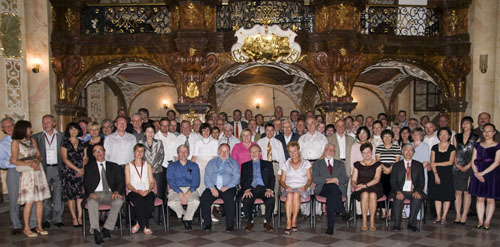
Speakers and delegates attending the symposium in the honour of Prof. Stec. Photo by M.K. Margielski

Why not have a look at the Biophosphates thematic issue, available online at: NJC 2010 Issue 5
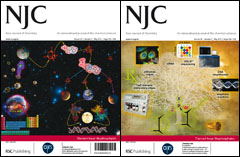
Take your pick amongst the 26 articles, including 7 reviews, on a variety of topics including the synthesis and mechanistic studies of nucleotides and oligonucleotides, enzymes and gene expression inhibitors, nucleic acid analogs with novel functionalities and potential therapeutics.

Digg This
Reddit This
Stumble Now!
Share on Facebook
Bookmark this on Delicious
Share on LinkedIn
Bookmark this on Technorati
Post on Twitter
Google Buzz (aka. Google Reader)

Top ten most accessed articles in July

This month sees the following articles in New Journal of Chemistry that are in the top ten most accessed:-

A colorimetric and fluorescent chemosensor for copper ions in aqueous media and its application in living cells 
Huan-Huan Wang, Lin Xue, Zhang-Jian Fang, Guo-Ping Li and Hua Jiang 
New J. Chem., 2010, 34, 1239-1242 DOI: 10.1039/C0NJ00168F , Letter 

Synthesis and anion binding properties of novel 3,12- and 3,7-bis(4′-nitrophenyl)-azo-calix[4]pyrrole receptors 
Bhaskar Garg, Tanuja Bisht and Shive Murat Singh Chauhan 
New J. Chem., 2010, 34, 1251-1254, DOI: 10.1039/C0NJ00315H  

Synthesis and characterization of novel cholesterol based mesogenic compounds using ‘click’ chemistry 
K. C. Majumdar, Shovan Mondal and Randhir K. Sinha 
New J. Chem., 2010, 34, 1255-1260, DOI: 10.1039/B9NJ00744J

The first supramolecular ion triplet complex 
Jens Eckelmann, Vittorio Saggiomo, Frank D. Sönnichsen and Ulrich Lüning 
New J. Chem., 2010, 34, 1247-1250, DOI: 10.1039/C0NJ00160K 

Dibenzo[2,3:5,6]pyrrolizino[1,7-bc]indolo[1,2,3-lm]carbazole: a new electron donor 
Claude Niebel, Vladimir Lokshin, Amos Ben-Asuly, Wladimir Marine, Artak Karapetyan and Vladimir Khodorkovsky 
New J. Chem., 2010, 34, 1243-1246, DOI: 10.1039/C0NJ00100G  

Binding induced destruction of an excimer in anthracene-linked benzimidazole diamide: a case toward the selective detection of organic sulfonic acids and metal ions 
Kumaresh Ghosh, Tanushree Sen and Amarendra Patra 
New J. Chem., 2010, 34, 1387-1393, DOI: 10.1039/B9NJ00789J  

A bipolar host containing 1,2,3-triazole for realizing highly efficient phosphorescent organic light-emitting diodes 
Myoung Ki Kim, Jongchul Kwon, Tae-Hyuk Kwon and Jong-In Hong 
New J. Chem., 2010, 34, 1317-1322, DOI: 10.1039/C0NJ00091D  

The modification of M41S materials: addition of metal clusters and nanoparticles 
Nicole S. Hondow, George A. Koutsantonis, Rebecca O. Fuller, Hamzah Fansuri, Martin Saunders, Robert L. Stamps and Dongke Zhang 
New J. Chem., 2010, 34, 1286-1294, DOI: 10.1039/B9NJ00626E 

Synthesis, crystal structures, luminescent and thermal properties of two new metal-organic coordination polymers based on zinc(ii) carboxylates 
Sergey A. Sapchenko, Danil N. Dybtsev, Denis G. Samsonenko and Vladimir P. Fedin 
New J. Chem., 2010, Advance Article, DOI: 10.1039/C0NJ00196A  

A multi-walled carbon nanotube/poly(urea-formaldehyde) composite prepared by in situ polycondensation for enhanced electrochemical sensing 
Bangguo Wei, Luyan Zhang and Gang Chen 
New J. Chem., 2010, 34, 453-457, DOI: 10.1039/B9NJ00670B
http://pubs.rsc.org/en/Content/ArticleLanding/2010/NJ/B9NJ00670B

Why not take a look at the articles today and blog your thoughts and comments below.

Fancy submitting an article to New Journal of Chemistry? Then why not submit to us today or alternatively email us your suggestions.

Digg This
Reddit This
Stumble Now!
Share on Facebook
Bookmark this on Delicious
Share on LinkedIn
Bookmark this on Technorati
Post on Twitter
Google Buzz (aka. Google Reader)

Complex amphiphiles for self-assembly and molecular recognition: a review

NJC Perspective article hot of the press – read it now!

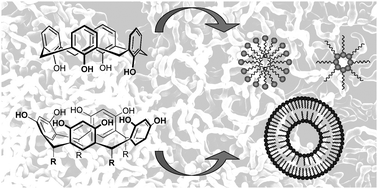
Self-assembly of amphiphilic calixarenes and resorcinarenes in water, Kaisa Helttunen and Patrick Shahgaldian, New J. Chem., 2010, DOI:10.1039/C0NJ00123F

Kaisa Helttunen (University of Jyväskylä) and Patrick Shahgaldian (University of Applied Science Northwestern Switzerland) present the developments of the chemistry of amphiphilic calixarenes and resorcinarenes with a clear focus on the synthetic paths used for their production and their self-assembly properties in water.

Digg This
Reddit This
Stumble Now!
Share on Facebook
Bookmark this on Delicious
Share on LinkedIn
Bookmark this on Technorati
Post on Twitter
Google Buzz (aka. Google Reader)

MOFs, MILs and more

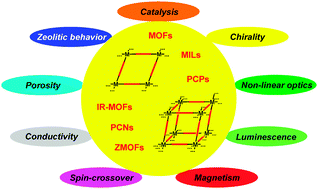
In this Perspective article, authors C. Janiak and J. K. Vieth, at the University of Freiburg, Germany, cover the concepts of porous coordination networks, including metal–organic frameworks (MOFs), Materials Institute Lavoisier (MILs), iso-reticular metal–organic frameworks (IR-MOFs), porous coordination networks (PCNs), zeolitic metal–organic frameworks (ZMOFs) and porous coordination polymers (PCPs) , and highlight their associated functional properties. 

Read this NJC Perspective today : 

MOFs, MILs and more : concepts, properties and applications for porous coordination networks (PCNs) Christoph Janiak and Jana K. Vieth,  New J. Chem., 2010, DOI: 10.1039/C0NJ00275E

This article will be part of the forthcoming thematic issue on ‘Coordination Polymers : Structure and Function’, guest-edited by Prof. Kumar Biradha, to be out in the November issue of NJC.

Digg This
Reddit This
Stumble Now!
Share on Facebook
Bookmark this on Delicious
Share on LinkedIn
Bookmark this on Technorati
Post on Twitter
Google Buzz (aka. Google Reader)

En route to Elemental Germanium

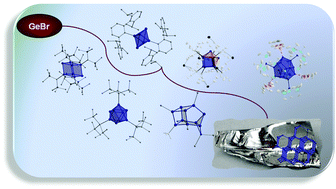
Check out the recent NJC Perspective article by Andreas Schnepf (University of Karlsruhe) on metalloid cluster compounds of germanium.

In this review, the author presents a novel class of cluster compounds in group 14 chemistry, shedding light on the synthesis, structural features and bonding properties of these structures in the borderland between the molecular and solid state. 

Metalloid cluster compounds of germanium: novel structural motives on the way to elemental germanium! Andreas Schnepf, New J. Chem., 2010, DOI: 10.1039/C0NJ00263A

Digg This
Reddit This
Stumble Now!
Share on Facebook
Bookmark this on Delicious
Share on LinkedIn
Bookmark this on Technorati
Post on Twitter
Google Buzz (aka. Google Reader)

Main Group thematic issue now online

NJC is delighted to present this month’s thematic issue on Main Group Chemistry, guest-edited by Prof. Phil Andrews

This themed issue captures and reflects the current frontlines in the field of main group chemistry. The articles and reviews provide a broad coverage of systems incorporating elements ranging from alkali and alkaline earth metals to both metallic and non-metallic elements of the p block. Most of the contributions are from speakers in three symposia (at the upcoming Pacifichem 2010 conference) focused on main group chemistry. These are:

  • ‘Organoboron, Organosilicon and Organophosphorus as Optoelectronic and Energy-Related Materials’,
  • ‘Early Main Group Chemistry’,
  • ‘Functional Molecules of the Heavier Main Group and Transition Metal Elements’,

led by Professors Suning Wang, Phil Andrews, and Fumiyuki Ozawa respectively.

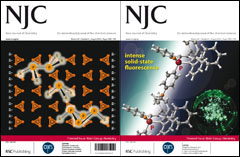
The outside front cover supplied by Christopher C. Cummins represents his work on the radical synthesis of trialkyl, triaryl, trisilyl and tristannyl phosphines from P4. On the inside front cover,  Shigehiro Yamaguchi and colleagues illustrate their research on fascinating aspects of intense fluorescence of 1-aryl-2,3,4,5-tetraphenylphosphole oxides in the crystalline state.

Take you pick amongst the 36 articles, including 2 Perspectives and 8 Letters by following this link to access the issue.

Digg This
Reddit This
Stumble Now!
Share on Facebook
Bookmark this on Delicious
Share on LinkedIn
Bookmark this on Technorati
Post on Twitter
Google Buzz (aka. Google Reader)

NJC’s impact factor over 3!

Newly released ISI citation data shows the impact factor for NJC hitting a record high, with a 2009 impact factor of 3.006.

We would like to thank all our authors, referees and readers for their continued support, which has allowed NJC to maintain its position as one of the top full-paper multidisciplinary chemistry journals. NJC focuses on interdisciplinary research that bridges different fields of chemistry or chemistry and other sciences. The Journal publishes original research articles in both short and long formats, as well as Perspective reviews. Submissions to NJC have risen dramatically the over the past year; the current rate of submissions is 50% higher than that of a year ago. Nevertheless, our editors remain committed to providing authors with rapid yet personalised service.

NJC, founded in 1977, is a co-publication of the French national scientific research centre (CNRS) and RSC Publishing since 1998.

Denise Parent (CNRS) & Sarah Ruthven (RSC Publishing)

Digg This
Reddit This
Stumble Now!
Share on Facebook
Bookmark this on Delicious
Share on LinkedIn
Bookmark this on Technorati
Post on Twitter
Google Buzz (aka. Google Reader)