Archive for the ‘Hot Article’ Category

NJC Hot Articles

Here are the latest Hot Articles published in NJC, selected by the journal editorial team. All are free to access for one month, so why not take your pick and have a read now?

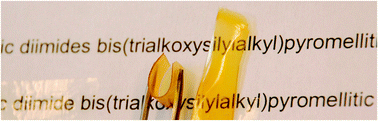
Precursors for pyromellit-bridged silica sol–gel hybrid materials by Stefan Pfeifer, Anke Schwarzer, Dana Schmidt, Erica Brendler, Michael Veith and Edwin Kroke, New J. Chem., 2012, Advance Article, DOI: 10.1039/C2NJ40538E, Paper
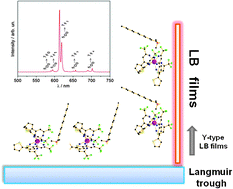
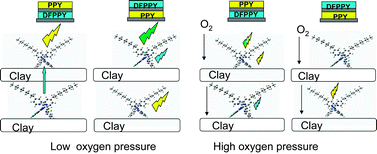
Dual emitting Langmuir–Blodgett films of cationic iridium complexes and montmorillonite clay for oxygen sensing by Kazuya Morimoto, Takahiro Nakae, Keishi Ohara, Kenji Tamura, Shin-ichi Nagaoka and Hisako Sato, New J. Chem., 2012, Advance Article, DOI: 10.1039/C2NJ40351J, Paper
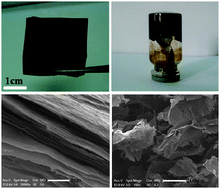
Self-assembly of graphene oxide on the surface of aluminum foil by Qingye Liu, Meng He, Xiaojuan Xu, Lina Zhang and Junping Yu, New J. Chem., 2012, Advance Article, DOI: 10.1039/C2NJ40493A, Paper
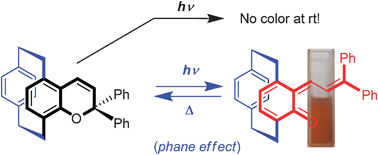
Photochromism of novel chromenes constrained to be part of [2.2]paracyclophane: remarkable ‘phane’ effects on the colored o-quinonoid intermediates by Jarugu Narasimha Moorthy, Susovan Mandal and Amrit Kumar, New J. Chem., 2013, Advance Article, DOI: 10.1039/C2NJ40575J, Paper
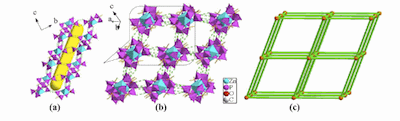
Mixed-solvothermal synthesis, structures, luminescent and surface photovoltage properties of four new transition metal diphosphonates with a 3D supramolecular structure by Hui Tian, Yanyu Zhu, Zhen-Gang Sun, Fei Tong, Jiang Zhu, Wei Chu, Shou–Hui Sun and Ming–Jing Zheng, New J. Chem., 2012, Accepted Manuscript, DOI: 10.1039/C2NJ40737J, Paper
 

Digg This
Reddit This
Stumble Now!
Share on Facebook
Bookmark this on Delicious
Share on LinkedIn
Bookmark this on Technorati
Post on Twitter
Google Buzz (aka. Google Reader)

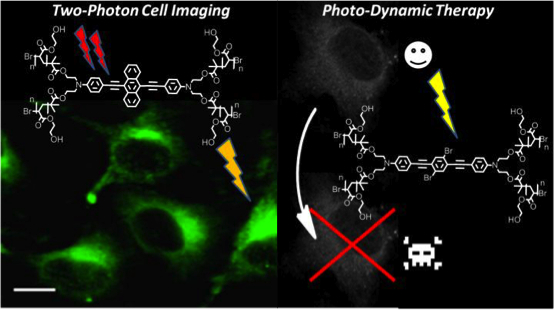
Water-soluble chromophores shining like a star

In this NJC article, Cyrille Monnereau and his colleagues (University of Lyon, France) report an Atom Transfer Radical Polymerisation (ATRP) approach towards star-shaped chromophores, which bear hydrophilic oligomeric arms that form an “insulating shell” around the nano-sized molecules, resulting in their solubility in water with good conservation of their fluorescence quantum yield. These new amphiphilic chromophores are promising candidates for cellular fluorescence and photodynamic therapy. The authors claim that this synthetic strategy for photoactive species is straightforward and adaptable.

“Water-soluble chromophores with star-shaped oligomeric arms: synthesis, spectroscopic studies and first results in bio-imaging and cell death induction” Cyrille Monnereau, Sophie Marotte, Pierre-Henri Lanoë, Olivier Maury, Patrice Baldeck, David Kreher, Arnaud Favier, Marie-Therese Charreyre, Jacqueline Marvel, Yann Leverrier and Chantal Andraud, New J. Chem., 2012, Accepted Manuscript, DOI: 10.1039/C2NJ40407A.


Interested to know more? Why not read the full article now and let us know your thoughts and comments below!
This Hot Article will be free to access for a period of 4 weeks.


To stay up-to-date with the latest NJC developments, sign up to its free table-of-contents email alert!
Digg This
Reddit This
Stumble Now!
Share on Facebook
Bookmark this on Delicious
Share on LinkedIn
Bookmark this on Technorati
Post on Twitter
Google Buzz (aka. Google Reader)

Hot paper : Eu(diketonato) Complexes with potential applications in biological assays.

In this NJC paper, Marina Lezhnina et al (Muenster University of Applied Sciences-Chemical Engineering, Germany) report the synthesis and photophysical properties of Eu complexes attached to epoxy-functionalized phenantroline ligands.

The authors show how these complexes can be conveniently attached to thiol groups, in the present example gluthathione, and still retain the characteristic red emission of Eu centers.

Luminescence of a Novel Eu(diketonato) – Epoxyphenanthroline Complex and Covalent Coupling to Peptides via the Epoxigroup Marina M. Lezhnina, Diana Hofmann, Beatrix Santiago-Schübel, Peter Klauth, Ulrich H. Kynast New J. Chem., 2012, Advance Article DOI: 10.1039/C2NJ40505A

Interested in reading further? Why not download the full article now, FREE to access for a period of 4 weeks!

Digg This
Reddit This
Stumble Now!
Share on Facebook
Bookmark this on Delicious
Share on LinkedIn
Bookmark this on Technorati
Post on Twitter
Google Buzz (aka. Google Reader)

Some current hot NJC papers!

The following articles are free for you to read for a limited time only!

Synthesis of a functionalized europium complex and deposition of luminescent Langmuir–Blodgett (LB) films by Renata D. Adati, Felippe J. Pavinatto, Jorge H. S. K. Monteiro, Marian R. Davolos, Miguel Jafelicci and Osvaldo N. Oliveira, New J. Chem., 2012, Advance Article DOI: 10.1039/C2NJ40199AThis paper will be a cover of NJC‘s October 2012 issue.
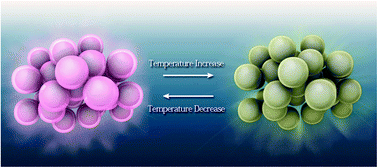
An amorphous array of poly(N-isopropylacrylamide) brush-coated silica particles for thermally tunable angle-independent photonic band gap materials by Yoshie Gotoh, Hiromasa Suzuki, Naomi Kumano, Takahiro Seki, Kiyofumi Katagiri and Yukikazu Takeoka, New J. Chem., 2012, Advance Article DOI: 10.1039/C2NJ40368DThis work will be featured as a cover of the November 2012 issue.
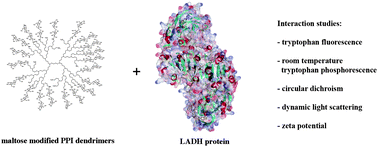
Impact of maltose modified poly(propylene imine) dendrimers on liver alcohol dehydrogenase (LADH) internal dynamics and structure by Michal Ciolkowski, Inessa Halets, Dzmitry Shcharbin, Dietmar Appelhans, Brigitte Voit, Barbara Klajnert and Maria Bryszewska, New J. Chem., 2012, Advance Article DOI: 10.1039/C2NJ40406K
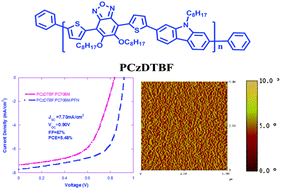
Highly efficient polymer solar cells based on poly(carbazole-alt-thiophene-benzofurazan) by Bin Zhang, Xiaowen Hu, Minquan Wang, Huiping Xiao, Xiong Gong, Wei Yang and Yong Cao, New J. Chem., 2012, Advance Article DOI: 10.1039/C2NJ40309A
Digg This
Reddit This
Stumble Now!
Share on Facebook
Bookmark this on Delicious
Share on LinkedIn
Bookmark this on Technorati
Post on Twitter
Google Buzz (aka. Google Reader)

How good are the crystallisation methods for co-crystals?

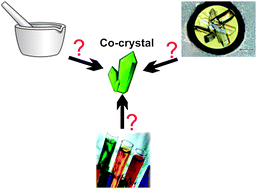
In this NJC Hot paper, Fucke et al. attempt to answer a very important question relating to co-crystal formation and screening. Piroxicam, a non-steroidal anti-inflammatory drug, was chosen as a model system and subjected to extensive co-crystal screening using twenty different acids as co-crystal formers, six crystallisation techniques and five solvents. The work explores in comprehensive detail the use of different techniques for obtaining co-crystals and compares their efficacy. The authors offer several thoughts on how their results might usefully be applied to improve co-crystal screens.

How good are the crystallisation methods for co-crystals? A comparative study of piroxicam by Katharina Fucke, Svetlana A. Myz, Tatyana P. Shakhtshneider, Elena V. Boldyreva and Ulrich J. Griesser; New J. Chem., 2012, Advance Article, DOI: 10.1039/C2NJ40093F, Paper

Interested to know more? Why not read the full article now and let us know your thoughts and comments below!

This Hot Article will be free to access for a period of 4 weeks.

To stay up-to-date with the latest NJC developments, sign up to its free table-of-contents email alert!

Digg This
Reddit This
Stumble Now!
Share on Facebook
Bookmark this on Delicious
Share on LinkedIn
Bookmark this on Technorati
Post on Twitter
Google Buzz (aka. Google Reader)

Using imidazolium silanthiolates to simulate the interactions in the active site of cysteine proteases

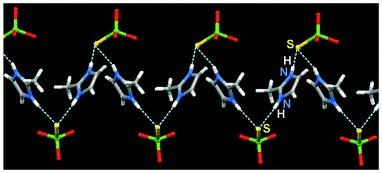
In this NJC paper, Anna  Dolega and co-workers (Gdansk University of Technology, Poland) have prepared three imidazolium silanethiolates relevant to the active site of cysteine protease.

By using solid state characterization techniques and modeling, the authors were able to present the first example of proton transfer along the chain of NH+…S hydrogen bonds.  A cooperative effect in the chain consisting of silanethiolate and imidazole residues linked by NH+…S hydrogen bond was proposed to be due to the polarization of electron density connected with the increase in the Mulliken partial charge on the sulfur atom.

One-dimensional chains

Imidazolium silanethiolates relevant to the active site of cysteine proteases. A cooperative effect in a chain of NH+ S hydrogen bonds Katarzyna Baranowska, Natalia Piwowarska, Aleksander Herman and Anna Dołęga New J. Chem., 2012, Advance Article DOI: 10.1039/C2NJ40114B

Interested in reading further? Why not download the full article now, FREE to access for a period of 4 weeks!

Digg This
Reddit This
Stumble Now!
Share on Facebook
Bookmark this on Delicious
Share on LinkedIn
Bookmark this on Technorati
Post on Twitter
Google Buzz (aka. Google Reader)

“Naked-eye” detection of chirality

Chiral analysis continues to receive considerable attention since enantiomers often differ in their pharmacological activity and pharmacokinetic profile.

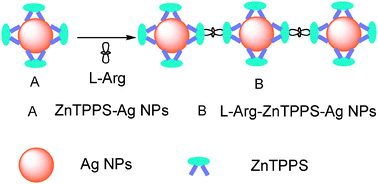
In this NJC letter, Haibing Li and co-workers from Central China Normal University at Wuhan (P.R. China) report a colorimetric sensor that displays a selective and strong response to L-histidine resulting from the agglomeration of silver nanoparticles. The authors believe that the self-assembly of nanoparticles into clusters is an effective approach to improve the sensitivity of chiral detection.

colorimetric amino acid detection

“Chiral colorimetric recognition of amino acids based on silver nanoparticle clusters” Yao Sun, Liang Zhang and Haibing Li, New J. Chem., 2012, Advance Article. DOI: 10.1039/C2NJ40098G.

Interested to know more? Why not read by accessing the full article now! This “Hot article” will be FREE to access for a period of 4 weeks.
Digg This
Reddit This
Stumble Now!
Share on Facebook
Bookmark this on Delicious
Share on LinkedIn
Bookmark this on Technorati
Post on Twitter
Google Buzz (aka. Google Reader)

NJC’s Most Cited Papers from 2011

Hurry! These articles are free to access until 5th June 2012…

“Preparation of graphene-TiO2 composites with enhanced photocatalytic activity”
K. Zhou, Y.  Zhu, X. Yang, X. Jiang and C. Li
New J. Chem., 2011, 35(2), 353–359. DOI: 10.1039/c0nj00623h — 30 cites

“Development of luminescent iridium(III) polypyridine complexes as chemical and biological probes”
K. K.-W. Lo, S. P.-Y. Li and K. Y. Zhang
New J. Chem., 2011, 35(2), 265-287. DOI: 10.1039/c0nj00478bPerspective review — 21 cites

“Facile synthesis of an ultramicroporous MOF tubular membrane with selectivity towards CO2
S. Aguado, C.-H. Nicolas, V. Moizan-Basle, C. Nieto, H. Amrouche, N. Bats, N. Audebrand and D. Farrusseng
New J. Chem., 2011, 35(1), 41-44. DOI: 10.1039/c0nj00667j — 16 cites

“Multifunctional ligands in transition metal catalysis”
R.H. Crabtree
New J. Chem., 2011, 35(1), 18-23. DOI: 10.1039/c0nj00776eFocus review — 12 cites

“Fabrication of free-standing graphene/polyaniline nanofibers composite paper via electrostatic adsorption for electrochemical supercapacitors”
S. Liu, X. Liu, Z. Li, S. Yang and J. Wang
New J. Chem., 2011, 35(2), 369-374. DOI: 10.1039/c0nj00718h — 10 cites

“Guest-induced gate-opening of a zeolite imidazolate framework”
S. Aguado, G. Bergeret, M. P. Titus, V. Moizan, C. Nieto-Draghi, N. Bats and D. Farrusseng
New J. Chem., 2011, 35(3), 546-550. DOI: 10.1039/c0nj00836b — 9 Cites

“Application of ferrocene and its derivatives in cancer research”
C. Ornelas
New J. Chem., 2011, 35(10), 1973-1985. DOI: 10.1039/c1nj20172gPerspective review — 8 cites

“Synthesis, characterisation and ethylene oligomerization behaviour of N-(2-substituted-5,6,7-trihydroquinolin-8-ylidene)arylaminonickel dichlorides”
J. Yu, X. Hu, Y. Zeng, L. Zhang, C. Ni, X. Hao and W.-H. Sun
New J. Chem., 2011, 35(1), 178-183. DOI: 10.1039/c0nj00516a — 8 cites

“Rare earths: jewels for functional materials of the future”
S. V. Eliseeva and J.-C. G. Bünzli
New J. Chem., 2011, 35(6), 1165-1176. DOI: 10.1039/c0nj00969ePerspective review — 7 cites

“Tapping the near-infrared spectral region with bacteriochlorin arrays”
J. S. Lindsey, O. Mass and C.-Y. Chen
New J. Chem., 2011, 35(3), 511-516. DOI: 10.1039/c0nj00977fFocus review — 7 cites

“A fluorometric/colorimetric dual-channel Hg2+ sensor derived from a 4-amino-7-nitro-benzoxadiazole (ANBD) fluorophore”
Z. Xie, K. Wang, C. Zhang, Z. Yang, Y. Chen, Z. Guo, G.-Y. Lu and W. He
New J. Chem., 2011, 35(3), 607-613. DOI: 10.1039/c0nj00773k — 7 cites


Citation data were taken from Thomson Reuters’ Web of Science® on May 22, 2012.

Digg This
Reddit This
Stumble Now!
Share on Facebook
Bookmark this on Delicious
Share on LinkedIn
Bookmark this on Technorati
Post on Twitter
Google Buzz (aka. Google Reader)

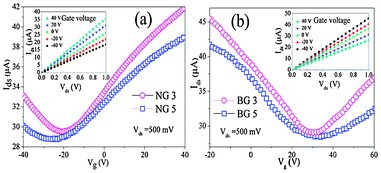
A facile strategy to prepare nitrogen and boron doped monolayer graphene from solid precursors.

In this NJC paper, Honglie Shen et al (Nanjing University of Aeronautics & Astronautics, China) report a facile strategy to prepare a nitrogen and boron doped monolayer of graphene from urea and boric acid as solid precursors.

This approach is shown to be efficient, producing graphene with excellent optical and electrical performances at relatively low cost.

Nitrogen and boron doped monolayer graphene by chemical vapor deposition using polystyrene, urea and boric acidNitrogen and boron doped monolayer graphene by chemical vapor deposition using polystyrene, urea and boric acid Tianru Wu,  Honglie Shen,  Lei Sun,  Bin Cheng,  Bin Liu and Jiancang Shen, New J. Chem., 2012, Advance Article DOI: 10.1039/C2NJ40068E

Interested in reading further? Why not download the full article now, FREE to access for a period of 4 weeks!

Digg This
Reddit This
Stumble Now!
Share on Facebook
Bookmark this on Delicious
Share on LinkedIn
Bookmark this on Technorati
Post on Twitter
Google Buzz (aka. Google Reader)

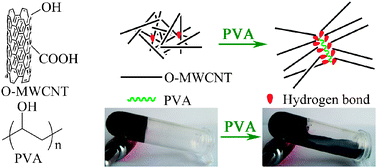
How to improve the performance of carbon nanotubes-glycerol nanofluids

J. Hao et al. (China) report the influence of polyvinyl alcohol on the thermal conductivity and the fluidity (sol-gel transition behavior) of carbon nanotubes-glycerol nanofluids.

carbon nanotubes-glycerol nanofluids

The thermal conductivity, stability, fluidity, and rheological properties were investigated by using various characterization techniques. The additional polyvinyl alcohol could amazingly reduce the viscosity of the nanofluids while the thermal conductivity was mostly maintained, even slightly further increased.

It suggests the as-prepared nanofluids may be applicable in energy transfer systems and thus pushes one step further towards real application of CNT based nanofluids.

A gel–sol transition phenomenon of oxidation multi-walled carbon nanotubes–glycerol nanofluids induced by polyvinyl alcohol by Baogang Wang, Wenjing Lou, Xiaobo Wang and Jingcheng Hao, New J. Chem., 2012, DOI: 10.1039/C2NJ20977B.

Interested to know more? Why not read the full article now and let us know your thoughts and comments below!

This Hot Article will be free to access for a period of 4 weeks.

To stay up-to-date with the latest NJC developments, sign up to its free table-of-contents email alert!

Digg This
Reddit This
Stumble Now!
Share on Facebook
Bookmark this on Delicious
Share on LinkedIn
Bookmark this on Technorati
Post on Twitter
Google Buzz (aka. Google Reader)