Publish in the first journal dedicated to the study of mechanochemistry
If your work involves the fundamentals of mechanochemistry, or you are excited by its applications and potential, then this journal is for you.
Publish in the first journal dedicated to the study of mechanochemistry
If your work involves the fundamentals of mechanochemistry, or you are excited by its applications and potential, then this journal is for you.

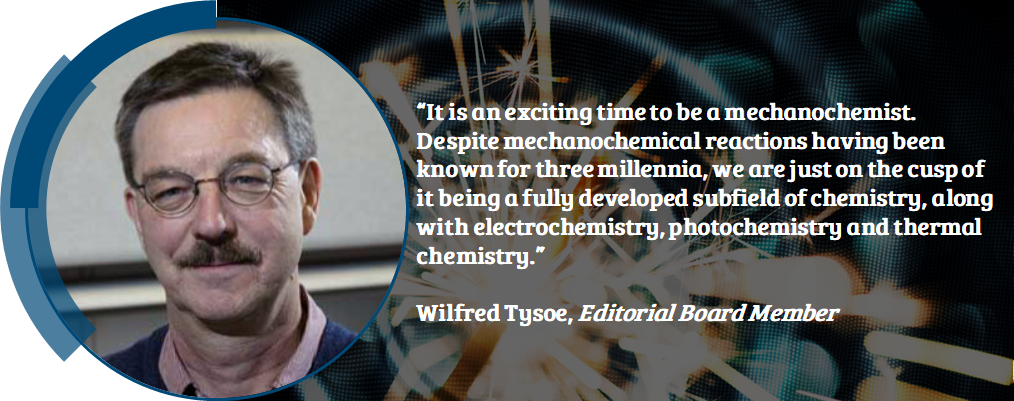
We are delighted to introduce to you Professor Wilfred Tysoe, University of Wisconsin-Milwaukee, United States, as one of our inaugural Editorial Board Members for RSC Mechanochemistry.

Learn more about Wilfred Tysoe
Wilfred Tysoe obtained first-class honours B.Sc. degree in chemical physics from the University of Manchester in England (1972), an M.Sc. degree in physical chemistry from the University of Sydney, Australia (1975) and a Ph.D. in Physical Chemistry from the University of Cambridge in England (1982) working on ultrahigh-vacuum surface science studies of catalytic reaction pathways. Before embarking on an academic career, he taught high-school physics and chemistry as part of the Voluntary Service Overseas program in Ghana in West Africa and worked for the Plessey Company in England designing optical storage devices. Following his post-doctoral studies, also on surface science and catalysis, at the University of California-Berkeley, he joined the Laboratory for Surface Studies at the University of Wisconsin-Milwaukee in 1984 where he is currently a Distinguished Professor of Chemistry. His work focuses on obtaining a detailed mechanistic understanding of processes occurring on surfaces, such as catalysis with a current focus on understanding heterogenous chiral transfer, self-assembly strategies for molecular electronics, chemical vapour deposition, and understanding tribo- and mechanochemical reaction pathways. He is a co-founding Editor-in-Chief of Tribology Letters. He has over 430 publications and over 300 invited and contributed presentations.
Read some of his recent publications:
Exploring mechanochemical reactions at the nanoscale: theory versus experiment
Nicholas Hopper, François Sidoroff, Resham Rana, Robert Bavisotto, Juliette Cayer-Barrioz, Denis Mazuyer and Wilfred T. Tysoe
Phys. Chem. Chem. Phys., 2023, 25, 15855-15861
Critical stresses in mechanochemical reactions
Resham Rana, Nicholas Hopper, François Sidoroff and Wilfred T. Tysoe
Chem. Sci., 2022, 13, 12651-12658
Resham Rana, Robert Bavisotto, Kaiming Hou and Wilfred T. Tysoe
Phys. Chem. Chem. Phys., 2021, 23, 17803-17812
Find out more about the journal on our webpage and sign up for e-alerts to make sure you receive the latest news.

We are delighted to introduce to you Dr Maria Elena Rivas, Johnson Matthey Technology Centre, UK, as one of our inaugural Editorial Board Members for RSC Mechanochemistry.
Learn more about Maria Elena Rivas
Dr Maria Elena Rivas is the Materials Research Lead in the Core Capabilities Department at Johnson Matthey Technology Centre. Her team is focused on supporting Johnson Matthey to catalyse the world’s transition to net zero by developing sustainable advanced materials, with mechanochemistry playing an important role. She received a B.Sc. in Chemistry from the Central University of Venezuela and a Ph.D. in Chemical Engineering Heterogeneous Catalysis from the Complutense University of Madrid in 2008. This was followed by post-doctoral research projects at the Centre of Catalysis and Petrochemistry/Spanish Scientific Council (2009) and the Chemical Engineering and Advanced Materials at Newcastle University (2010). She is an expert on inorganic materials synthesis, principally for the automotive, chemicals and energy markets. Facilitating technology transfer from laboratory to pilot scale and focusing on deeper understanding of solid-state synthetic routes, allowing for more efficient design of Johnson Matthey materials, by developing state-of-the-art techniques with advanced characterisation.
With a proven track record of delivering materials innovation, she has been recognised twice by the Innovating and Improving Science Award in Johnson Matthey. She is an inventor of 15 patent applications in the field of materials development, including mechanochemistry.
Read some of her recent publications:
Acoustic synthesis (solvent-free) and resonant acoustic mixing (RAM)
Maria Elena Rivas
Mechanochemistry and Emerging Technologies for Sustainable Chemical Manufacturing, 2023, 173-180
Rachel H. Blackmore, Maria Elena Rivas, George F. Tierney, Khaled M.H. Mohammed, Donato Decarolis, Shusaka Hayama, Federica Venturini, Georg Held, Rosa Arrigo, Monica Amboage, Pip Hellier, Evan Lynch, Mahrez Amri, Marianna Casavola, Tugce Eralp Erden, Paul Collier and Peter P. Wells
Phys. Chem. Chem. Phys., 2020, 22, 18774-18787
Understanding the mechanochemical synthesis of the perovskite LaMnO3 and its catalytic behaviour
Rachel H. Blackmore, Maria Elena Rivas, Tugce Eralp Erden, Trung Dung Tran, Huw R. Marchbank, Dogan Ozkaya, Martha Bricenco de Gutierrez, Alison Wagland, Paul Collier and Peter P. Wells
Dalton Trans., 2020, 49, 232-240
Find out more about the journal on our webpage and sign up for e-alerts to make sure you receive the latest news.

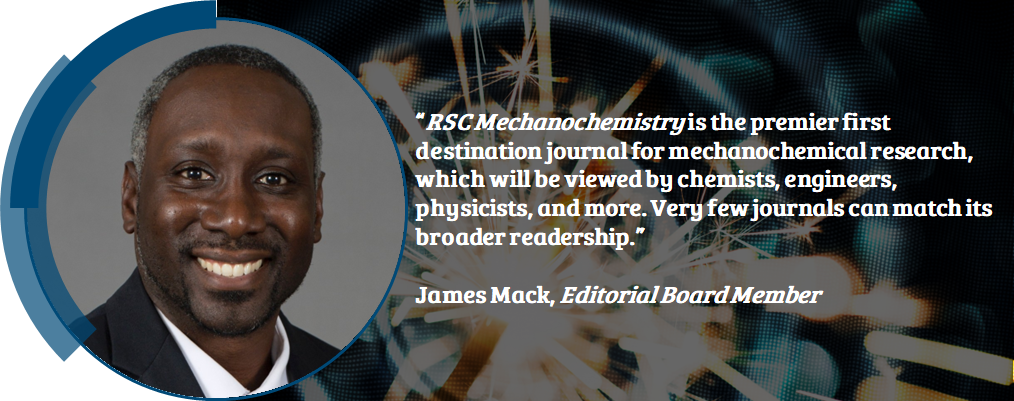
We are delighted to introduce to you Professor James Mack, University of Cincinnati, USA, as one of our inaugural Editorial Board Members for RSC Mechanochemistry.

Learn more about James Mack
James Mack is a professor of chemistry with interests in the development of environmentally benign chemical reactions. After completing his Bachelor’s degree at Middlebury College (1995), he was awarded a New England Board of Higher Education Scholarship and earned his doctoral degree at the University of New Hampshire, studying the derivations of fullerenes under the supervision of Glen P. Miller (2000). After earning his doctoral degree, he was a postdoctoral fellow with Lawrence T. Scott developing a bench top synthesis of fullerenes and nanotubes using corannulene based building blocks. He joined the faculty as an Assistant Professor at the University of Cincinnati (2003), was promoted to the rank of Associate Professor with tenure (2009) and promoted to the rank of Professor (2016). His research has been featured in the New York Times, Chemical and Engineering News and Chemistry and Industry. He is also the owner and CEO of Cinthesis, a company that uses mechanochemistry to develop environmentally benign synthetic alternatives. In addition to his research accomplishments, he received recognition for his mentorship and service by both graduate and undergraduate students.
Read some of his recent publications:
Cong Wang, Conghui Yue, Anthony Smith and James Mack
J. Organomet. Chem., 2023, 976, 122430
Joel Andersen, Hunter Starbuck, Tia Current, Scott Martin and James Mack
Green Chem., 2021, 23, 8501-8509
Developing benign syntheses using ion pairs via solvent-free mechanochemistry
Lianna N. Ortiz-Trankina, Jazmine Crain, Carl Williams III and James Mack
Green Chem., 2020, 22, 3638-3642
Find out more about the journal on our webpage and sign up for e-alerts to make sure you receive the latest news.
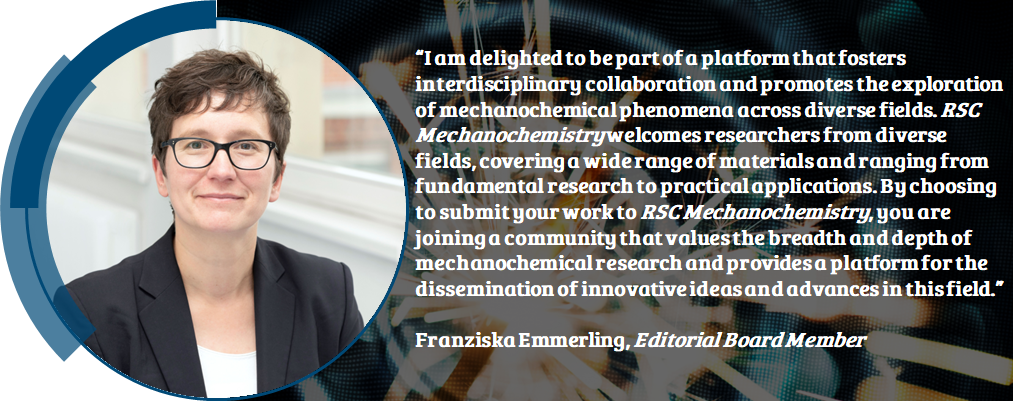
We are delighted to introduce to you Dr Franziska Emmerling, Federal Institute for Materials Research and Testing, Germany, as one of our inaugural Editorial Board Members for RSC Mechanochemistry.

Learn more about Franziska Emmerling
Dr Franziska Emmerling is Head of the Department of Materials Chemistry at the Federal Institute for Materials Research and Testing in Berlin, Germany, and a privat dozent (lecturer) at the Department of Chemistry, Humboldt University, Berlin. She received her M.Sc. in Chemistry from the Albert-Ludwigs University of Freiburg in 2001, her Ph.D. in Chemistry from the same university in 2004, and completed her Habilitation at the Humboldt University in 2018. Emmerling’s research focuses on the design, synthesis, and characterisation of novel materials, with particular emphasis on their applications in green energy and catalysis. Dr Emmerling has made significant contributions to the development of mechanochemical synthesis methods for a wide range of materials. Her expertise extends to the development and use of synchrotron-based X-ray techniques, including diffraction and spectroscopy, to characterise materials and observe structural changes in situ. Dr Emmerling is a recognised expert in materials chemistry and mechanochemistry and serves as a reviewer for prestigious journals such as Science, Nature Communications and Angewandte Chemie. With a strong record of mentorship, Dr Emmerling has guided the research of numerous Postdoctoral Researchers, and PhD, Masters and Bachelor students, leaving a lasting impact on the field of chemistry.
Read some of her recent publications:
Irina Akhmetova, Max Rautenberg, Chayanika Das, Biswajit Bhattacharya and Franziska Emmerling
ACS Omega, 2023, 8, 16687-16693
Optimizing the Green Synthesis of ZIF-8 by Reactive Extrusion Using In Situ Raman Spectroscopy
Nikita Y. Gugin, Jose A. Villajos, Olivier Dautain, Michael Maiwald and Franziska Emmerling
ACS Sustainable Chem. Eng., 2023, 11, 5175-5183
An atomistic mechanism for elasto-plastic bending in molecular crystals
Biswajit Bhattacharya, Adam A.L. Michalchuk, Dorothee Silbernagl, Nobuhiro Yasuda, Torvid Feiler, Heinz Sturm and Franziska Emmerling
Chem. Sci., 2023, 14, 3441-3450
Find out more about the journal on our webpage and sign up for e-alerts to make sure you receive the latest news.
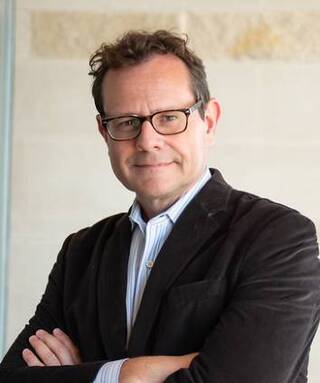
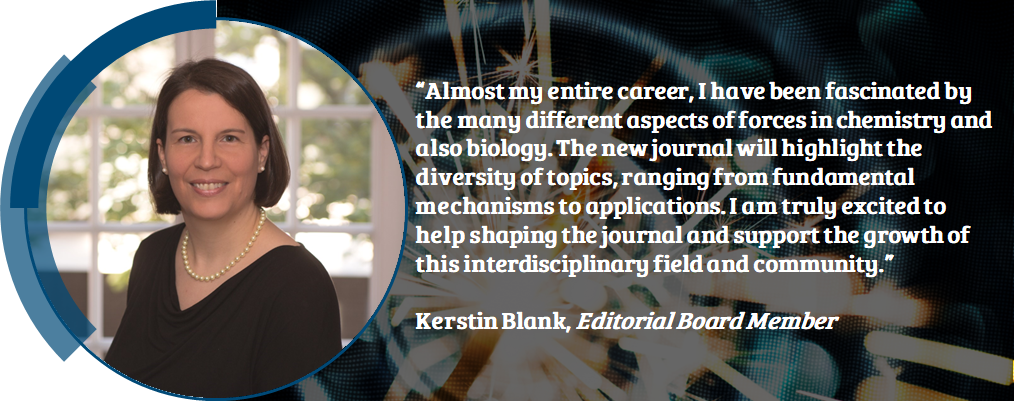
We are delighted to introduce to you Professor Kerstin Blank, Johannes Kepler University Linz, Austria, as one of our inaugural Editorial Board Members for RSC Mechanochemistry.

Learn more about Kerstin Blank
Kerstin G. Blank obtained a diploma in Biotechnology from the University of Applied Sciences in Jena in 2000. After 3 years as a project manager in Industry, she returned to Academia. She obtained a PhD in Biophysics from Ludwig-Maximilians University in Munich in 2006. After two short postdoctoral stays at the Universities in Strasbourg and Leuven, she became assistant professor at Radboud University in Nijmegen in 2009. In 2014, she moved to the Max Planck Institute of Colloids and Interfaces in Potsdam where she led the Max Planck Research Group ‘Mechano(bio)chemistry’. Since October 2021, she is full professor at Johannes Kepler University Linz where she heads the Department of Biomolecular & Selforganizing Matter. She is co-founder of the Gordon Research Conference on Multiscale Mechanochemistry & Mechanobiology. The main themes of her research are 1) mechanical structure-function relationships of protein-protein and protein-surface interactions, 2) protein-based molecular force sensors, 3) molecularly controlled mechanoresponsive hydrogels and 4) mechanosensing at cell-material interfaces.
Read some of her recent publications:
Fortified Coiled Coils: Enhancing Mechanical Stability with Lactam or Metal Staples
Patricia López-García, Aline D. de Araujo, Ana E. Bergues-Pupo, Isabell Tunn, David P. Fairlie and Kerstin G. Blank
Angew. Chem. Int. Ed., 2021, 60, 232-236
Influence of Network Topology on the Viscoelastic Properties of Dynamically Crosslinked Hydrogels
Emilia M. Grad, Isabell Tunn, Dion Voerman, Alberto S. de Léon, Roel Hammink and Kerstin G. Blank
Front. Chem., 2020, 8, 536
Decoding Biomineralization: Interaction of a Mad10-Derived Peptide with Magnetite Thin Films
Anna Pohl, Florian Berger, Ruby M. A. Sullan, Carmen Valverde-Tercedor, Kinga Freindl, Nika Spiridis, Christopher T. Lefèvre, Nicolas Menguy, Stefan Klumpp, Kerstin G. Blank and Damien Faivre
Nano Lett., 2019, 19, 8207-8215
Find out more about the journal on our webpage and sign up for e-alerts to make sure you receive the latest news

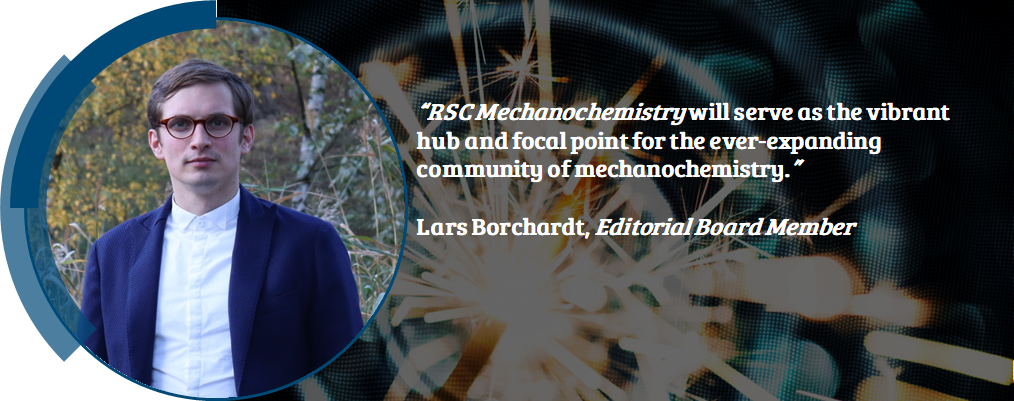
We are delighted to introduce to you Professor Lars Borchardt, Ruhr-University Bochum, Germany, as one of our inaugural Editorial Board Members for RSC Mechanochemistry.

Learn more about Lars Borchardt
Prof. Lars Borchardt is a Professor of Inorganic Chemistry at the Ruhr-University Bochum, located in Germany. He obtained his doctoral degree in Chemistry in 2013 from the Technische Universität Dresden, where his research focused on the development of porous materials for energy storage applications. Subsequently, he pursued post-doctoral research in catalysis at ETH Zürich. In 2015, he established his own independent research group, dedicated to the exploration of mechanochemistry. This groundbreaking field encompasses a diverse range of areas, including the synthesis of materials such as polymers, porous materials, and graphenes, the advancement of novel mechanocatalytic concepts for organic synthesis, and the exciting realm of photo-mechanochemistry. His profound interest lies in unraveling the underlying mechanistic principles governing mechanochemistry, as well as devising innovative setups for scaling up mechanochemical processes. His contributions to the field have been honored with prestigious awards, including the ERC starting grant, Innovators under 35-Awards, as well as the esteemed Daimler-Benz and Max-Buchner fellowships.
Read some of his recent publications:
The Sonogashira Coupling on Palladium Milling Balls – A new Reaction Pathway in Mechanochemistry
Wilm Pickhardt, Eleonora Siegfried, Sven Fabig, Marisol Fabienne Rappen, Martin Etter, Maximilian Wohlgemuth, Sven Grätz and Lars Borchardt
Angew. Chem. Int. Ed., 2023, 62, e202301490
Rationalizing the formation of porosity in mechanochemically-synthesized polymers
Annika Krusenbaum, Steffi Krause Hinojosa, Sven Fabig, Valentin Becker, Sven Grätz and Lars Borchardt
Phys. Chem. Chem. Phys., 2023, 25, 16781-16789
From Inert to Catalytically Active Milling Media: Galvanostatic Coating for Direct Mechanocatalysis
Maximilian Wohlgemuth, Maike Mayer, Marisol Rappen, Fabian Schmidt, Roman Saure, Sven Grätz and Lars Borchardt
Angew. Chem. Int. Ed., 2022, 61, e202212694
Find out more about the journal on our webpage and sign up for e-alerts to make sure you receive the latest news.
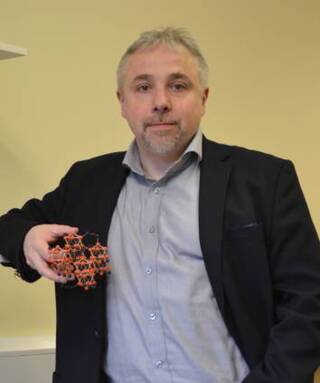
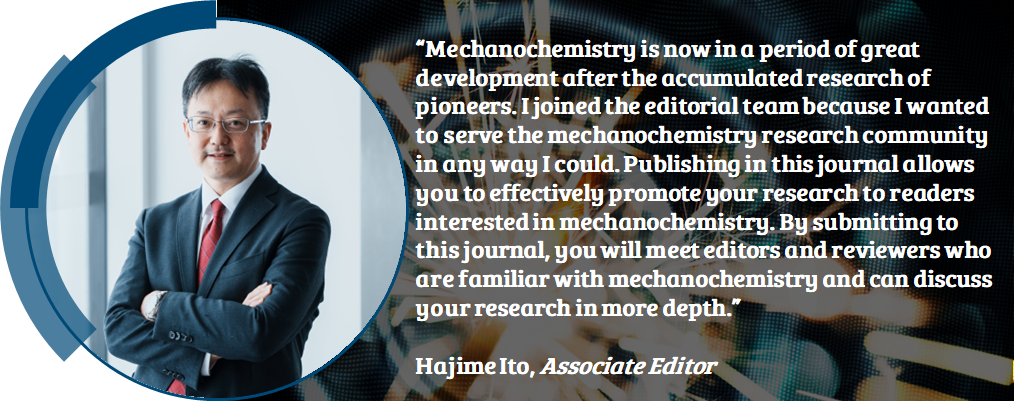
We are delighted to introduce to you Professor Hajime Ito, Hokkaido University, Japan, as one of our inaugural Associate Editors for RSC Mechanochemistry.

Learn more about Hajime Ito
Hajime Ito was born in 1968 in Osaka, Japan. He received his Ph.D. in 1996 from Kyoto University under the supervision of Prof. Yoshihiko Ito and Prof. Masahiro Murakami. He then joined the research group of Prof. Akira Hosomi at Tsukuba University before moving to the Institute for Molecular Science in Okazaki in 1999. He then worked as a visiting scientist in the research group of Prof. Kim D. Janda at The Scripps Research Institute. In 2002, he joined the research group of Prof. Masaya Sawamura at Hokkaido University. He was promoted to full professor in 2010. He became a distinguished professor in 2022. He is also appointed as the Deputy Director of the Institute of Reaction Design and Development (WPI-ICReDD) at Hokkaido University. He is also appointed as a PI for JST CREST “Innovative Reactions.”
His research interests include the development of new organic synthesis methods and organic crystalline materials through the use of organoboron, silicon, and mechanochemistry. He received the Chemical Society of Japan Award for Creative Work (2014), the SSOCJ Fujifilm Functional Materials Science Award (2017), and the HSFC DemoDay Hokkaido Governor’s Award (2022).
Read some of his recent publications:
Yunpeng Gao, Koji Kubota and Hajime Ito
Angew. Chem. Int. Ed., 2023, 62, e202217723
Tamae Seo, Koji Kubota and Hajime Ito
J. Am. Chem. Soc., 2023, 145, 6823-6837
Redox reactions of small organic molecules using ball milling and piezoelectric materials
Koji Kubota, Yadong Pang, Akira Miura and Hajime Ito
Science, 2019, 366, 1500-1504
Find out more about the journal on our webpage and sign up for e-alerts to make sure you receive the latest news.
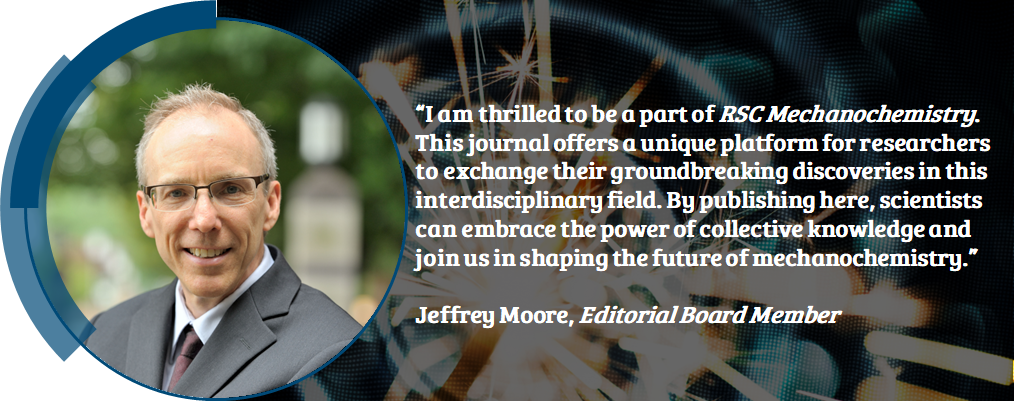
We are delighted to introduce to you Professor Jeffrey Moore, University of Illinois Urbana-Champaign, USA, as one of our inaugural Editorial Board Members for RSC Mechanochemistry.

Learn more about Jeffrey Moore
Jeffrey Moore received his B.S. in chemistry (1984) and Ph.D. in materials science and engineering (1989) from the University of Illinois. In 1990, he joined the faculty at the University of Michigan, Ann Arbor and in 1993 returned to the University of Illinois, where he was Professor of Chemistry and of Materials Science & Engineering until 2022. Jeff currently holds the titles of Stanley O. Ikenberry Research Professor of Chemistry, Stanley O. Ikenberry Endowed Chair Emeritus and Professor Emeritus of Chemistry. Jeff is a member of the National Academy of Sciences and a fellow of the American Academy of Arts & Sciences, the American Association for the Advancement of Science and the American Chemical Society (ACS). For 14 years he served as an associate editor for the Journal of American Chemical Society. He received the Royal Society of Chemistry’s 2018 Stephanie L. Kwolek Award. He has published over 400 articles covering a variety of topics. He served as Director of the Beckman Institute at the University of Illinois from 2017-2022.
Read some of his recent publications:
Plasma Electrochemistry for Carbon-Carbon Bond Formation via Pinacol Coupling
Jian Wang, Necip B. Üner, Scott Edwin Dubowsky, Matthew P. Confer, Rohit Bhargava, Yunyan Sun, Yuting Zhou, R. Mohan Sankaran and Jeffrey S. Moore
J. Am. Chem. Soc., 2023, 145, 10470-10474
Mechanically Triggered Carbon Monoxide Release with Turn-On Aggregation-Induced Emission
Yunyan Sun, William J. Neary, Zachary P. Burke, Hai Qian, Lingyang Zhu and Jeffrey S. Moore
J. Am. Chem. Soc., 2022, 144, 1125-1129
Flyby reaction trajectories: Chemical dynamics under extrinsic force
Yun Liu, Soren Holm, Jan Meisner, Yuan Jia, Qiong Wu, Toby J. Woods, Todd J. Martinez and Jeffrey S. Moore
Science, 2021, 373, 208-212
Find out more about the journal on our webpage and sign up for e-alerts to make sure you receive the latest news

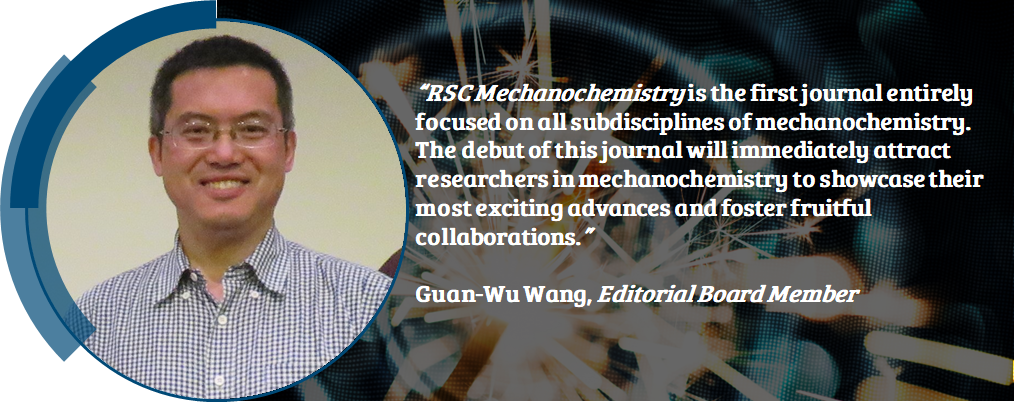
We are delighted to introduce to you Professor Guan-Wu Wang, University of Science and Technology China, China, as one of our inaugural Editorial Board Members for RSC Mechanochemistry.

Learn more about Guan-Wu Wang
Guan-Wu Wang is a Chair Professor at University of Science and Technology of China. He earned his B.S., M.S. and Ph.D. degrees from Lanzhou University in 1987, 1990, 1993, respectively. He then did his postdoctoral work at Fudan University, Kyoto University, University of Kentucky, University of Chicago and Yale University. In May of 2000, he joined the University of Science and Technology of China as a full professor. He is a recipient of the ‘‘High-Level Talent Program’’ of the Chinese Academy of Sciences (1999) and the National Science Fund for Distinguished Young Scholars (2001). His research interests include mechanochemical organic synthesis and fullerene chemistry.
Read some of his recent publications:
Zheng-Chun Yin, Mingjie Li, Chuang Niu, Wei-Feng Wang, Wen-Rui Liu, Qian-Wen Zhang and Guan-Wu Wang
Angew. Chem. Int. Ed., 2023, 62, e202304321
[60]Fullerene-Fused Cyclopentanes: Mechanosynthesis and Photovoltaic Application
Gang Shao, Chuang Niu, Hong-Wei Liu, Huan Yang, Jun-Shen Chen, Yang-Rong Yao, Shangfeng Yang and Guan-Wu Wang
Org. Lett., 2023, 25, 1229-1234
Hui Xu and Guan-Wu Wang
J. Org. Chem., 2022, 87, 8480-8491
Find out more about the journal on our webpage and sign up for e-alerts to make sure you receive the latest news.