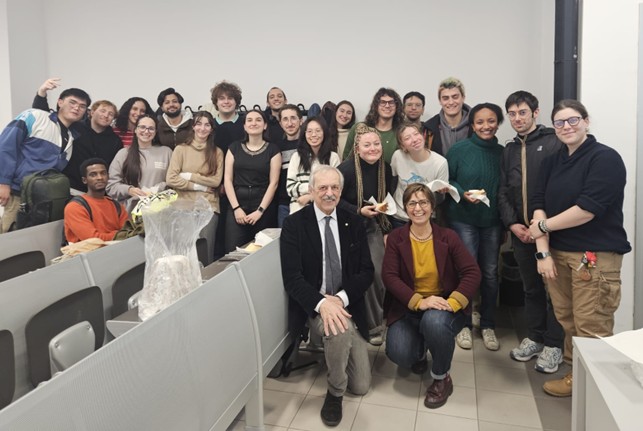

Advisory board member Lucia Maini and her mechanochemistry students at the University of Bologna have selected their favourite articles from RSC Mechanochemistry. The students’ perspectives on the articles and the field of mechanochemistry will be presented in a series of six blog posts. The first group of students will discuss:
Fluorination of mechanochemically synthesized metal–organic frameworks for PFAS adsorption in water
The article considers combining the noticeable adsorbing properties of metal–organic frameworks (MOFs) with fluorine functionalization to address environmental remediation concerns. It explores the possibility of employing fluorine-decorated MOFs, and it compares their properties with the non-fluorinated counterpart, as a novel anti-pollution tool to trap per- and polyfluoroalkyl substance (PFAS) polluted waters, since they lead to severe health issues due to their high toxicity and persistence.
TPP-mCPW(Ph) and TPP-mCPW(p-FPh) MOFs were mechanochemically synthesized, obtaining diamond-like structures that showed optimal stability in aqueous media. The structures have been assessed with PXRD measurements while the outcome of PFAS adsorption has been confirmed through 19F-NMR. The fluorinated TPP-mCPW(p-FPh) MOF has been demonstrated to have an open pore structure able to rearrange to a closed pore structure upon exposure to heating, solvents and specific guest molecules, while the non-fluorinated counterpart only partially interconverts between the two structures. This feature has been exploited to trap NaPFO molecules in the void channels of the fluorinated MOF, which engages in halogen bonding and F-F interactions that stabilize adsorption of the guest molecule, showing greater efficiency than its TPP-mCPW(Ph) counterpart.
Continuous research on these versatile and tunable MOFs can lead to innovations in many fields, such as gas storage and catalysis. In particular, this research could pave the way to sustainable, fast and effective decontamination motions, guaranteeing little-to-no waste throughout the production of the MOFs and improving water quality, which is one of the major concerns the scientific community is being called to face to date.
What drew you to study Mechanochemistry initially, and what areas have you found most interesting?
Initially mechanochemistry was just an excuse to spend more time together, but after a few lectures we found out how fascinating it is. We think it is a particularly interesting field of chemistry because it is strikingly changing the approach to materials synthesis, thanks to its sustainable and green nature, which are important aspects for future chemists like us.
Why did you choose this article, did you find anything surprising?
The initial reason that draw us to this article is the fact that it combines hot topics of the most recent scientific research, such as MOFs, which recently won the Nobel Prize for Chemistry in 2025, mechanochemical synthetic pathways, and land pollution issues. The biggest surprise in this article is how this article offers a new perspective on PFAS decontamination with a simple, fast and performative solution.
Why is this article important, what gap in the literature does this research aim to fill?
When the pollution subject is discussed, usually, we hear only about CO2 emissions and greenhouse gas emissions, but the water pollution is a topic that is not as broadly tackled. This article serves to bring more attention to this topic, discussing other aspects, like water pollution, which are as important. The experiments carried out in this research provide a feasible and efficient option for water anti-pollution actions that could restore ecosystems and improve human health, protecting it from this class of contaminants.
Consider the real-world applications or implications of this article, what are the strengths and/or limitations of this article that may need to be explored further?
In the article it is reported that there is a necessity to further investigate the role of fluorine in the sequestration of PFAS in MOFs, and this mechanistic point can be further explored. It could be interesting, in the future, to tailor MOFs that can perform more than one function at the same time, for example providing a combined solution for catalysis and PFAS absorption, or other joint possibilities.

Eya Arfaoui, Mary Goffe and Chiara Pasolini
Discussion of this article was carried out by three students who are currently in the second year of a Master’s Degree in Photochemistry and Molecular Materials at the University of Bologna. Their names are Eya Arfaoui, Mary Goffe and Chiara Pasolini. Not only are they a trio in this work, but also in life, they support each other through their academic and personal lives. Eya was born in Trento, she has Tunisian origins, and she is a big fan of organic and physical chemistry, novels and chit-chats in front of a hot cup of tea. She graduated in October 2024 in Industrial Chemistry. Mary was born in Bologna, she has Ethiopian origins, and she is interested in computational photochemistry, yoga and international relations. She graduated in Industrial Chemistry in July 2024. Chiara was born in Brescia, she has a deep but tormented love for electrochemistry and in day-to-day life she splits herself between chemistry, yoga, books and beers with friends.
Check out the article, published in RSC Mechanochemistry:
Fluorination of mechanochemically synthesized metal–organic frameworks for PFAS adsorption in water
Danilo Marchetti, Enrico Dalcanale, Roberta Pinalli, Mauro Gemmi, Alessandro Pedrini and Chiara Massera
RSC Mechanochem., 2025, 2, 662-669
Discover all of the selected articles in the RSC Mechanochemistry Students’ Choice collection.
 |
Are you ready to contribute to the future of mechanochemistry? RSC Mechanochemistry offers you an inclusive and dedicated home for the ideas, scientific language and approaches that cut across the many disciplines mechanochemistry touches. Here we are seeking to build knowledge, as well as foster innovation and discovery at this forefront of chemistry. Whether you are seeking to understand the fundamentals of mechanochemistry, or you are excited by its applications and potential, this journal is for you. All of the content in this journal is gold open access, which means that you can read every article for free, and we are covering all publication costs until mid-2026. |