Fortifying Sustainably: Sustainable Food Technology’s Outstanding Early Career Research Award 2025

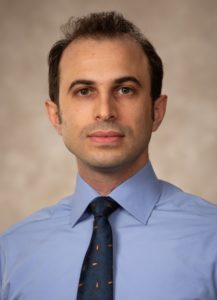
We are delighted to announce the recipients of the Outstanding Early Career Research Award 2025 from Sustainable Food Technology: a team comprising Luke Wayne Browning, Huafu Wang, James Ward Taylor, Pete Wilde, Marc Rodriguez-Garcia, Lynette Anne Makins Holland  and Tuomas P. J. Knowles.

Their award-winning paper, Digestibility and enteric release achieved with microencapsulates made from emulsion-templated plant proteins, introduces a plant protein microcapsule which stabilises functional ingredients in food and drinks from manufacture through to digestion, while avoiding polymers and microplastic formation.

In their words:

“We have developed a novel plant protein microencapsulate containing vitamin D2 and the study described in our manuscript characterises the digestibility and controlled release of cargo throughout digestive phases. With our unique processing and oil-emulsification of pea protein, we show that robust microcapsules can be formed by spray drying with microscopic sizing that are dispersible and stable in aqueous systems under conditions relevant to beverage manufacture. Importantly, our production process does not negatively impact the digestibility of the microcapsules, and it promotes a favourable digestion profile for the enteric release of the vitamin D2 cargo.

“Employing the static in vitro INFOGEST digestion model, we examined the disintegration of microcapsules throughout digestive phases whilst quantifying release of vitamin D2 cargo by HPLC simultaneously. Our results demonstrate that these microcapsules exhibit resilience in the oral and gastric phases and are completely susceptible to the intestinal phase, thereby delivering the cargo to the site where small molecules, such as vitamins, are effectively absorbed. This novel encapsulate addresses the growing need for robust microcapsules made from natural, biodegradable and edible materials.”

Receiving the award, they add:

“We are completely thrilled to receive the Outstanding Early Career Research Award from our research published in the RSC Sustainable Food Technology journal. The award recognises all the creative and diligent efforts these past few years, and showcases fruitful collaborations between Xampla, Quadram Institute and the Department of Chemistry, University of Cambridge.

Our work represents a collaborative effort of highly multidisciplinary scientists from both academia and industry and we believe our findings will inspire further advances in encapsulates and other structured materials made from natural polymers. We want to thank and congratulate all the team who have contributed to this work.”

We are proud to celebrate this outstanding contribution to the field and look forward to what this team uncovers next!

🔗 Read the  winners’ paper here!

About the team:

Luke Browning works as Senior Protein Scientist for Xampla, following a PhD and Post-doc at Department of Plant Sciences, University of Cambridge, and two years in industry as a manufacturing and QC scientist. His background and research themes have included the detection, quantification and characterisation of various plant proteins in fundamental, agricultural and biomaterials contexts. At Xampla, he leads on ways to extract and manipulate the physico-chemical properties of plant proteins from a variety of sources for producing biodegradable microcapsules, films and coatings.

Huafu Wang worked as a Senior Analytical Chemist for Xampla. From a background in chemistry and biochemistry, he has extensive experience in analytical method development and validation for beverage, food and pharmaceutical sectors. His role in this paper involved HPLC analyses for vitamin D.

James Ward Taylor works as Innovation Manager for Xampla, following a PhD at the University of Glasgow, and a Post-doc at Radboud University, Nijmegen. From a background in physical organic chemistry and self-assembly of soft matter, he researches new ways to control the self-assembly of proteins and other biomolecules to produce edible, biodegradable microcapsules, films and coatings. His role in this paper was in the microencapsulation process, using Xampla’s technology to effectively encapsulate vitamin D, and demonstrating its controlled release properties.

Professor Pete Wilde is an Emeritus Fellow of Quadram Institute. His early research focused on the interfacial properties of proteins and their role in food functionality such as foams and emulsions. Later, his research investigated how food microstructure changes during digestion and how this influences nutrient absorption, satiety, and metabolic health. He has a broad interest in how food structure impacts health outcomes, including obesity and type 2 diabetes, and how digestion can be modulated to improve physiological responses. He has published over 135 papers, delivered invited international lectures, and holds editorial and honorary academic positions in the field of food science.

Marc Rodriguez-Garcia is Xampla’s co-founder, having developed the technology with Professor Knowles at the University of Cambridge. With a PhD from the University of Glasgow, his expertise lies in the use of natural biopolymers in microencapsulation and other structured materials. Marc is a unique CTO with incredible scientific knowledge combined with strong commercial acumen.

Lynette Holland is Principal Scientist at Xampla, developing natural biodegradable fragrance encapsulates using plant polymers. Lynette has over 20 years of R&D experience in the fragrance industry previously developing fragrance delivery systems at Procter & Gamble and Coty, with over 40 patent filings. She leads the encapsulation technology development at Xampla and manages the IP portfolio.

Professor Tuomas Knowles is Board Scientific Advisor at Xampla, and the co-founder of three other Cambridge University spin-outs, Fluidic Analytics, Wren Therapeutics and Transition Bio. Professor Knowles has received a number of distinguished awards, including the Corday-Morgan Prize from the Royal Society of Chemistry and the Raymond and Beverly Sackler International Prize in Biophysics.

Follow us on LinkedIn and Bluesky for new articles and the latest news from Sustainable Food Technology and related journals at the Royal Society of Chemistry.

Get future updates directly to your inbox with our newsletters and email alerts. Sign up here.

Sustainable Food technology April 2026 Newsletter 

Welcome to the latest Sustainable Food Technology newsletter! We’re pleased round-up of the latest journal news, as well as information on our themed collections and upcoming events.

Get future updates directly to your inbox with our email alerts. Sign up here.

Latest news

Our 2026 #RSCPoster conference took place on LinkedIn for 24 hours, from 3-4 March. We’re pleased to share the winner in the #RSCFood category is Bhawana Yadav for the poster Gum arabic/PVA nanofiber encapsulating perillyl alcohol-inclusion complex for sustainable active fruit packaging!

This year’s runner-up is Jessica Frahn, who presented Characterising Pure Glucose Fatty Acid Esters Impact on Monoglyceride Crystallisation.

Congratulations to the winner and runner up, and our thanks to the all of the contributors for their excellent posters. Find out about the winners in other categories on our web page: 2026 #RSCPoster winners.

We were pleased to highlight the contributions of women in sustainable food technology research, with a special article collection which you can read here: Celebrating International Women’s Day 2026: Women in Sustainable Food Technology.

Themed Collections

A banner with the event details

We are delighted to announce a new open call for papers for our themed collection on “Advances in Nature-Inspired Nanotechnologies for a Safer and Sustainable Food Future“. Guest edited by Editorial Board Member Professor Adriano Brandelli, along with Professor Mustafa Akbulut and Dr Miguel Ângelo Cerqueira, this collection aims to promote sustainable advances in food-based nanotechnology. Submissions are open now until the 28th July 2026.

Submit your work to Sustainable Food Technology

Find out more about Sustainable Food Technology on our webpage, where you can also find our author guidelines.

Publishing open access with RSC journals unlocks the full potential of your research – bringing increased visibility, wider readership and higher citation potential to your work. As a not-for-profit organisation serving the chemical sciences community, we ensure that our article processing charge (APC) remains the most competitive of major publishers. More details can be found here and the APC for Sustainable Food Technology is £2200. You can also use our journal finder tool to check if your institution currently has an agreement with the RSC that may entitle you to a discount of the APC.

Stay Connected:

Follow us on LinkedIn and Bluesky for new articles and the latest news from Sustainable Food Technology and related journals at the Royal Society of Chemistry.


Sustainable Food technology January 2026 Newsletter

Welcome to the first Sustainable Food Technology newsletter of 2026! We’re pleased to share a recap of the most important developments in 2025. We wish all of our readers, editors, reviewers and authors a successful year ahead. Get future updates directly to your inbox with our email alerts. Sign up here.

Latest News


We are very excited to announce that the 2026 #RSCPoster Conference will be taking place for 24 hours starting 3rd March 2026, 12:00 UTC.

The #RSCPoster conference is an annual event that has become a staple on many scientific community calendars. Held entirely online on LinkedIn over 24 hours, the unique format removes the environmental and financial costs of attending a traditional conference, and helps scientific researchers share their work and network across disciplines, wherever they are in the world. Find out more and join in: https://rsc.li/poster

2025 in Review

Sustainable Food Technology received its first Web of Science impact factor of 5.3, placing it in the top quartile for “Food Science & Technology”. We are grateful to our authors for contributing their high-quality work to the journal, as Sustainable Food Technology marks this latest stage in its development. We also thank our editors and reviewers for their professional and insightful handling of these manuscripts, reviewing papers to their first decision in an average of 48 days.

Yu-Hsuan How, Emily Min-Yan Lim, Ianne Kong, Phei-Er Kee, and Liew-Phing Pui received the Outstanding Early Career Researcher Award 2024 award for their paper “Development of carboxymethyl cellulose–chitosan based antibacterial films incorporating a Persicaria minor Huds. essential oil nanoemulsion”. Find out more about the team and their manuscript on our blog post.

Sustainable Food Technology now applies Article Processing Charges to manuscripts submitted after 1 November 2025. Publishing open access with RSC journals unlocks the full potential of your research – bringing increased visibility, wider readership and higher citation potential to your work. As a not-for-profit organisation serving the chemical sciences community, we ensure that our article processing charge (APC) remains the most competitive of major publishers. More details can be found here and the APC for Sustainable Food Technology is £2100. You can also use our journal finder tool to check if your institution currently has an agreement with the RSC that may entitle you to a discount of the APC.

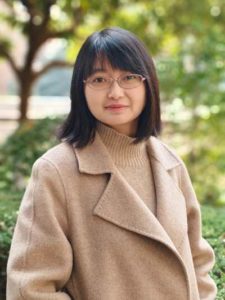
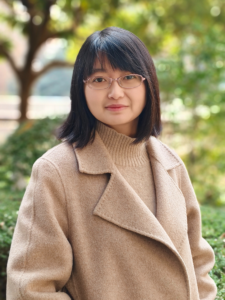
Prof. Xin Rui of Nanjing Agricultural University in China joined Sustainable Food Technology in 2025 as an Associate Editor. A leading expert in food science and technology, Prof. Rui is a Full Professor at Nanjing Agricultural University in China, where she leads research in plant-derived proteins and food fermentation.

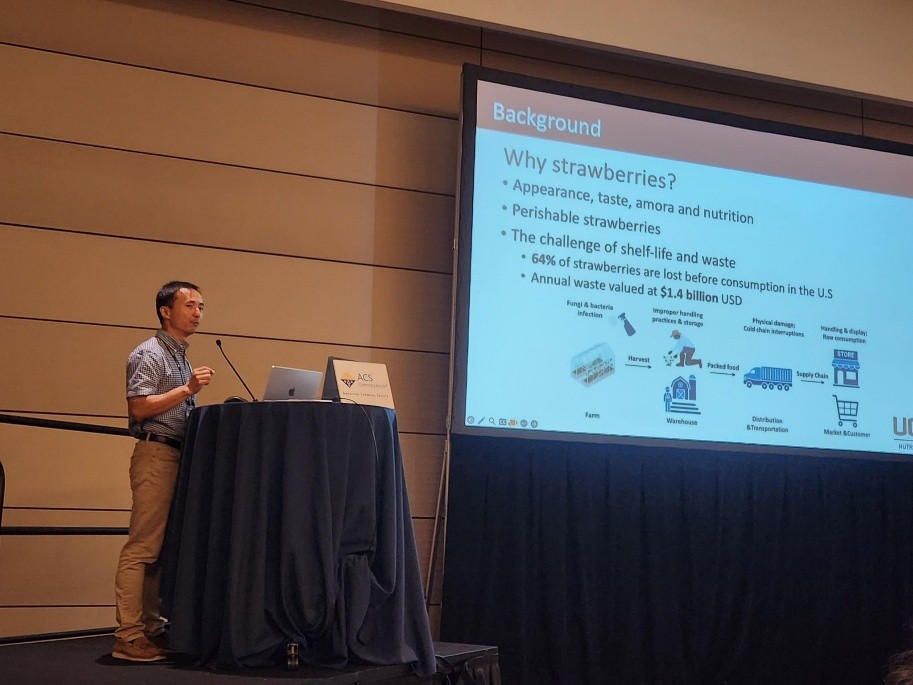
Sustainable Food Technology hosted a half-day symposium at the ACS Fall 2025 meeting in Washington DC, chaired by our Editorial Board Member Prof. Qin Wang. The journal’s editors also met with the community at the EFFoST International Conference, Future Foods Congress, and Green Food Tech.

Submit your work to Sustainable Food Technology

Find out more about Sustainable Food Technology on our webpage, where you can also find our author guidelines.

Publishing open access with RSC journals unlocks the full potential of your research – bringing increased visibility, wider readership and higher citation potential to your work. As a not-for-profit organisation serving the chemical sciences community, we ensure that our article processing charge (APC) remains the most competitive of major publishers. More details can be found here and the APC for Sustainable Food Technology is £2200. You can also use our journal finder tool to check if your institution currently has an agreement with the RSC that may entitle you to a discount of the APC.

Stay Connected

Follow us on LinkedIn and Bluesky for new articles and the latest news from Sustainable Food Technology and related journals at the Royal Society of Chemistry.

Late 2025 Newsletter

As we enter the last quarter of 2025, we are excited to share our latest updates with Sustainable Food Technology community.

Get future updates directly to your inbox with our email alerts. Sign up here.

Latest News

Promotional image of the research group. From Left to right: Yu-Hsuan How, Emily Min-Yan Lim, Ianne Kong and Liew-Phing Pui


Sustainable Food Technology has received its first Web of Science impact factor of 5.3, placing it in the top quartile for “Food Science & Technology”. We are grateful to our authors for contributing their high-quality work to the journal, as Sustainable Food Technology marks this latest stage in its development. We also thank our editors and reviewers for their professional and insightful handling of these manuscripts, reviewing papers to their first decision in an average of 48 days.

We are proud to announce the recipients of the Outstanding Early Career Researcher Award 2024 from Sustainable Food Technology. Yu-Hsuan How, Emily Min-Yan Lim, Ianne Kong, Phei-Er Kee, and Liew-Phing Pui receive the award for their paper “Development of carboxymethyl cellulose–chitosan based antibacterial films incorporating a Persicaria minor Huds. essential oil nanoemulsion”. Our congratulations to the winners! Find out more about the team and their manuscript on our blog post.

Sustainable Food Technology now applies Article Processing Charges to manuscripts submitted after 1 November 2025. Publishing open access with RSC journals unlocks the full potential of your research – bringing increased visibility, wider readership and higher citation potential to your work. As a not-for-profit organisation serving the chemical sciences community, we ensure that our article processing charge (APC) remains the most competitive of major publishers. More details can be found here and the APC for Sustainable Food Technology is £2200. You can also use our journal finder tool to check if your institution currently has an agreement with the RSC that may entitle you to a discount of the APC.

Research Spotlight

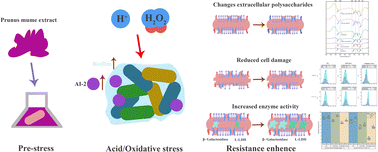
In “Prunus mume extract promoted biofilm formation of Lactiplantibacillus plantarum JB1 to improve acid and oxidative stress resistance”, Zhang et al. show that a natural resource obtained from this fruit can improve a variety of outcomes connected to fermented foods and probiotics. Read the article to find out more about the extract’s effects and mechanism.


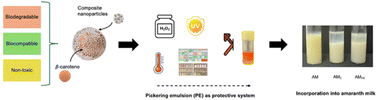
Pickering emulsion stabilized by biocomposite nanoparticles as a protective system for β-carotene” by Lizardi-Mendoza et al. demonstrates a naturally-derived compound that acts as a substitute for synthetic emulsifiers and assists in the retention of β-carotene in an oil phase through food production. This helps improve the functional benefit of the food, and meets consumer demand for alternatives to synthetic emulsifiers.


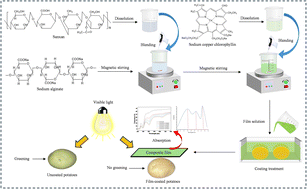
Erihemu et al. have developed a composite coating film to control the greening of potato tubers under light exposure after harvesting. Visual quality is maintained and chlorophyll accumulation reduced, demonstrating the method’s value in food preservation. Find out more in the paper, “Photodynamic regulation of potato greening: sodium copper chlorophyllin-functionalized alginate/sanxan nanocomposite films with spectral-selective barrier properties”.


Sustainable Food Technology in the Community

Sustainable Food Technology was delighted to host a dedicated half-day symposium at the recent ACS Fall 2025 meeting in Washington DC, featuring talks from Lingyun Chen, Maleeka Singh, Yangchao Luo, Zhenlei Xiao and Hao Feng, and hosted by our Editorial Board Member Prof. Qin Wang. Thank you to all of our excellent speakers, to Qin for hosting the event, and to everyone who attended the successful session.


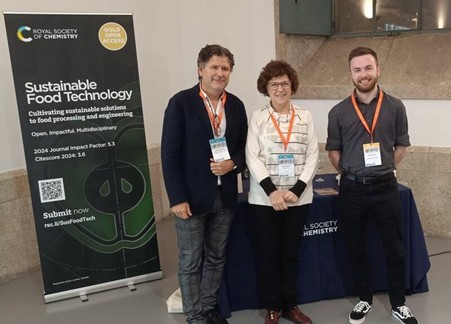
Assistant Editor Michael Whitelaw (right) joined the 39th EFFoST International Conference 2025 in Portugal to represent the journal, enjoy an exciting scientific program, and meet the delegates, including our Editor-in-Chief Jorge Barros-Velazquez (left) and Advisory Board member Olga Martín-Belloso (centre).


Editorial Board

We’re excited to announce that Prof. Xin Rui, a leading expert in food science and technology, joined Sustainable Food Technology in 2025 as an Associate Editor. Prof. Rui is a Full Professor at Nanjing Agricultural University in China, where she leads research in plant-derived proteins and food fermentation. Her academic journey began with a bachelor’s and master’s degree in food science from China Agricultural University, followed by a PhD in bioresource engineering from McGill University. Prof. Rui has led several key projects, including three National Natural Science Foundation of China projects, and has published over 120 peer-reviewed papers.


Collections

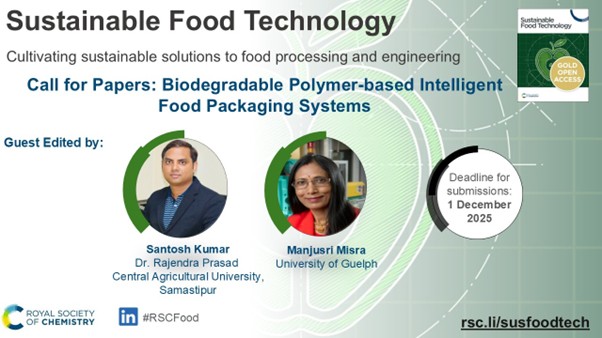
Our themed collection on Biodegradable polymer-based intelligent food packaging systems is open for submissions until 1 December 2025. Guest Edited by Santosh Kumar (Dr. Rajendra Prasad Central Agricultural University) and Samastipur Manjusri Misra (University of Guelph), this special issue aims to cover various emerging technologies involved in the development of biopolymer based intelligent food packaging systems, which have been researched profusely in recent years. See our call for papers for more information and instructions on submitting your work.


Stay Connected

Follow us on LinkedIn and Bluesky for new articles and the latest news from Sustainable Food Technology and related journals at the Royal Society of Chemistry.


Driving Innovation Forward: Meet the Sustainable Food Technology Names 2024 Outstanding Early Career Researcher Award Winners

Promotional image of the research group. From Left to right: Yu-Hsuan How, Emily Min-Yan Lim, Ianne Kong and Liew-Phing Pui

We are proud to announce the recipients of the Outstanding Early Career Researcher Award 2024 from  Sustainable Food Technology for their work Development of carboxymethyl cellulose–chitosan based antibacterial films incorporating a Persicaria minor Huds. essential oil nanoemulsion.

In their award-winning study, the team developed a bioactive food packaging material made from carboxymethyl cellulose (CMC) and chitosan (CS), infused with nanoemulsions of Persicaria minor essential oil. Compared to coarse emulsions, the nanoemulsion offered enhanced droplet stability, stronger antibacterial properties, and better physical performance when incorporated into biopolymer films.

At a 12% v/v concentration, the film showed optimal characteristics: low moisture content, improved flexibility, high antioxidant activity, and strong antibacterial effects against E. coli and B. subtilis. These findings present a promising, sustainable alternative to plastic packaging, capable of reducing foodborne pathogens while aligning with global sustainability goals.

About the research team:

  • Liew-Phing Pui brings 17+ years of experience in functional foods and edible packaging, with over 100 peer-reviewed articles and leadership in research and professional societies.
  • Yu-Hsuan How specializes in probiotic food microorganisms and edible film development, with 40 published articles to date.
  • Emily Min-Yan Lim focuses on sustainable food tech and biopolymer-based antibacterial films.
  • Ianne Kong works on food innovation and essential oil applications for packaging.
  • Phei-Er Kee has expertise in fermentation tech and sustainable waste management, with over 50 publications.

In their words, the research group shares:

“We are truly honoured to receive the 2024 Outstanding Early Career Research Award from Sustainable Food Technology. This recognition reflects the collective efforts of our entire team, and we sincerely thank our co-authors for their dedication, effort and teamwork, which were essential to achieving this milestone. This award inspires us to continue pursuing innovative approaches to sustainable food packaging and technology.”

🔗Read the winners’ paper here!

Join us on LinkedIn to celebrate our winners!


Sustainable Food Technology is open for submissions. Find out more on the journal webpagesign up for email alerts or submit


Prof. Xin Rui Joins Sustainable Food Technology as Associate Editor

We’re excited to announce that Prof. Xin Rui, a leading expert in food science and technology, has joined Sustainable Food Technology as an Associate Editor.

Prof. Rui is a Full Professor at Nanjing Agricultural University in China, where she leads research in plant-derived proteins and food fermentation. Her academic journey began with a bachelor’s and master’s degree in food science from China Agricultural University, followed by a PhD in bioresource engineering from McGill University.

Her research interests focus on:

  • Developing hypo-allergic foods from plant-derived proteins
  • Improving the techno-functional properties of plant proteins
  • Creating plant-based fermented foods
  • Exploring alternative sources of protein for a sustainable food future


Prof. Rui has led several key projects, including three National Natural Science Foundation of China projects, and has published over 120 peer-reviewed papers. Her experience in food science extends beyond her own lab, having also served as a guest editor for multiple journals in the field.

We are confident that her expertise will help shape the future of sustainable food science, and we’re thrilled to have her on the editorial board.

Join us on LinkedIn to welcome Prof. Rui aboard!


Sustainable Food Technology is open for submissions. Find out more on the journal webpagesign up for email alerts or submit your manuscript now.

Meet the winners of the Sustainable Food Technology Outstanding Early Career Researcher Award 2023

We are thrilled to announce the launch of our prestigious Outstanding Early Career Research Award, aimed at recognising and celebrating outstanding contributions to Sustainable Food Technology. This initiative seeks to honour the dedication, innovation, and impactful research of promising early career researchers.

Rice bran, a commonly disregarded byproduct of rice processing, takes centre stage in the research led by Ali Ubeyitogullari, Sumanjot Kaur, and Jingyi Chen. Their study, Formation of nanoporous aerogels from defatted rice bran via supercritical carbon dioxide drying, explores the untapped potential of defatted rice bran, demonstrating how it can be upcycled to create food-grade starch and protein-based nanoporous aerogels using a green approach based on supercritical carbon dioxide technology.

These aerogels, characterized for their properties, possess a three-dimensional interconnected open porous structure, making them ideal for delivering bioactive compounds. By adding value to defatted rice bran, the team not only enhances the sustainability of rice production but also opens avenues for innovative applications in food technology.

Meet the team


Dr Ali Ubeyitogullari: A food engineer with a PhD in food science & technology, Dr Ubeyitogullari is currently an Assistant Professor at the University of Arkansas Division of Agriculture. Leading the Food Engineering for Health Lab, his research focuses on leveraging sustainable food processing technologies to enhance human health and wellness.

Dr Sumanjot Kaur: With a background in food technology, Sumanjot Kaur is a PhD student at the University of Arkansas. Her work spans generating health-promoting bioactive compounds and nanoporous materials from rice processing byproducts to enhancing the quality of soybean-based ingredients, contributing to sustainable food systems.

Dr Jingyi Chen: Dr Chen’s journey from chemistry to biochemistry led her to become a Professor at the University of Arkansas. Her research delves into designing functional nanomaterials for energy conversion and human-health related applications, striving for efficient and sustainable material usage.

In response to winning the Outstanding Early Career Researcher Award, the team expressed gratitude for the recognition and emphasized their commitment to innovation. “We are honoured to receive the award,” they remarked, “and appreciate the Sustainable Food Technology team for recognizing the impact of our work. Their acknowledgement fuels our passion to continue innovating and making a positive difference.”

Head over to LinkedIn and join us to congratulate Dr Ali Ubeyitogullari, Sumanjot Kaur, and Dr Jingyi Chen!

Olga Martín-Belloso Awarded Lifetime Achievement at EFFoST 2023

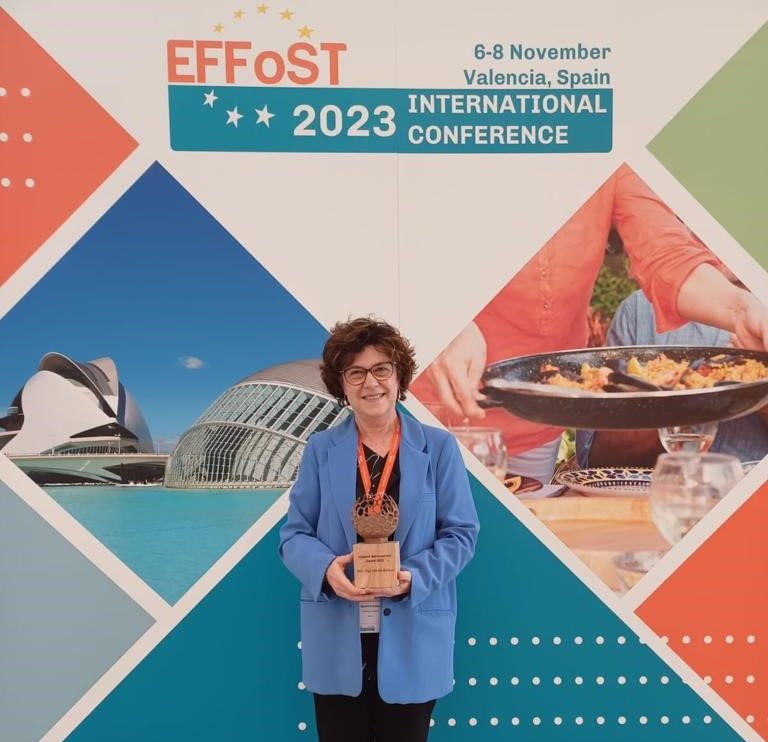
Olga Martín-Belloso, Advisory Board member for Sustainable Food Technology, was honoured with the Lifetime Achievement Award at the European Federation of Food Science and Technology (EFFoST) Annual Conference last week in Valencia. Professor Martín-Belloso is a Food Technology professor at the Universitat de Lleida (UdL) and the Principal Investigator of Agrotecnio’s Novel Technologies for Food Processing research group.

Every year, the EFFoST hosts an international conference that brings together academics, engineers, policymakers, professionals, and students from a variety of food-related sectors. The University of Valencia and the Institute of Agrochemistry and Food Technology (IATA-CSIC) hosted this year’s event. The 2023 conference was the 37th edition and focused on Sustainable Food and Industry 4.0: Towards the 2030 Agenda.

During the EFFoST 2023 closing ceremony, Olga Martín-Belloso received the Lifetime Achievement Award in recognition of her remarkable leadership, vision, and pioneering work in research on the development of safe and healthy new food products using new methodologies. This distinguished award is granted to those whose lifetime work has significantly contributed to the advancement of European food science and technology skills.

Join us to congratulate Prof. Olga Martín- Belloso!


Sustainable Food Technology is open for submissions. Find out more on the journal webpagesign up for email alerts or submit your manuscript now.

Infoday Food Proteins from Biotechnology

DECHEMA promotes scientific and technical exchange among experts from different disciplines, organizations and generations.

DECHEMA-Haus, Frankfurt am Main, 30. November 2023

Join us in Frankfurt to explore the present and future landscape of food and nutrition. Discover the current innovations in food and what exciting developments the future holds. Delve into the realms of possibility and discern what might still be considered utopian.

Immerse yourself in a gathering where experts from both science and industry will enlighten you on the current state of food biotechnology and emerging trends. Visionaries from start-ups and established players in food tech will share their perspectives on the future of nutrition, engaging in critical scientific discussions.

Join the info day, thoughtfully organized by DECHEMA’s food biotechnology division, covering compelling topics like cultured meat production, precision fermentation, single-cell protein, and the underlying technologies. Explore the enduring significance of traditional techniques such as fermentation using microorganisms and enzymatic processing, aimed at enhancing taste, digestibility, and the techno-functional properties of food proteins.

Envision the future of diets and food production. Witness the ongoing major transformations and grasp the opportunities arising for food security, a balanced, health-promoting diet, and the mitigation of climate change. Recognize modern food biotechnology as a catalyst for sustainable food production. The Food Proteins from Biotechnology info day aspires to be a platform fostering discussion and exchange among science, industry, and society.

The PROGRAMME is available online, and you have the chance to actively participate in the info day by submitting your last-minute poster. Seize this opportunity to contribute to the dialogue shaping the future of food.

Professors Bhesh Bhandari and Olga Martín-Belloso Receive Lifetime Achievement Awards

Congratulations to Bhesh Bhandari and Olga Martín-Belloso on their lifetime achievement awards!

We are very proud to announce that two of the Advisory Board Members for Sustainable Food Technology, Bhesh Bhandari and Olga Martín-Belloso, were presented with lifetime achievement awards from the International Association of Engineering and Food (IAEF) at this year’s ICEF14 conference in Nantes. The pictures contain (from left to right): Professor Alain Le-Bail, Professor Gustavo Barbosa-Cánovas, Professor Olga Martín-Belloso/Professor Bhesh Bhandari, Professor Petros Taoukis.


Please join us in congratulating Professors Bhandari and Martín-Belloso on behalf of Sustainable Food Technology!

Sustainable Food Technology is open for submissions. Find out more on the journal webpagesign up for email alerts or submit your manuscript now.