Archive for April, 2016

Polymer Photocatalysts for Solar Fuels Synthesis, 13-14 April 2016

EES and Catalysis, Science and Technology were delighted to support the Polymer Photocatalysts for Solar Fuels Synthesis which took place on 13-14t April 2016.

The two-day workshop at University College London on 13th and 14th April, focussed on polymer photocatalysts in the widest sense of the word (e.g. conjugated polymers, carbon nitride, graphene oxide) and their application in photocatalytic water splitting and CO2 reduction.

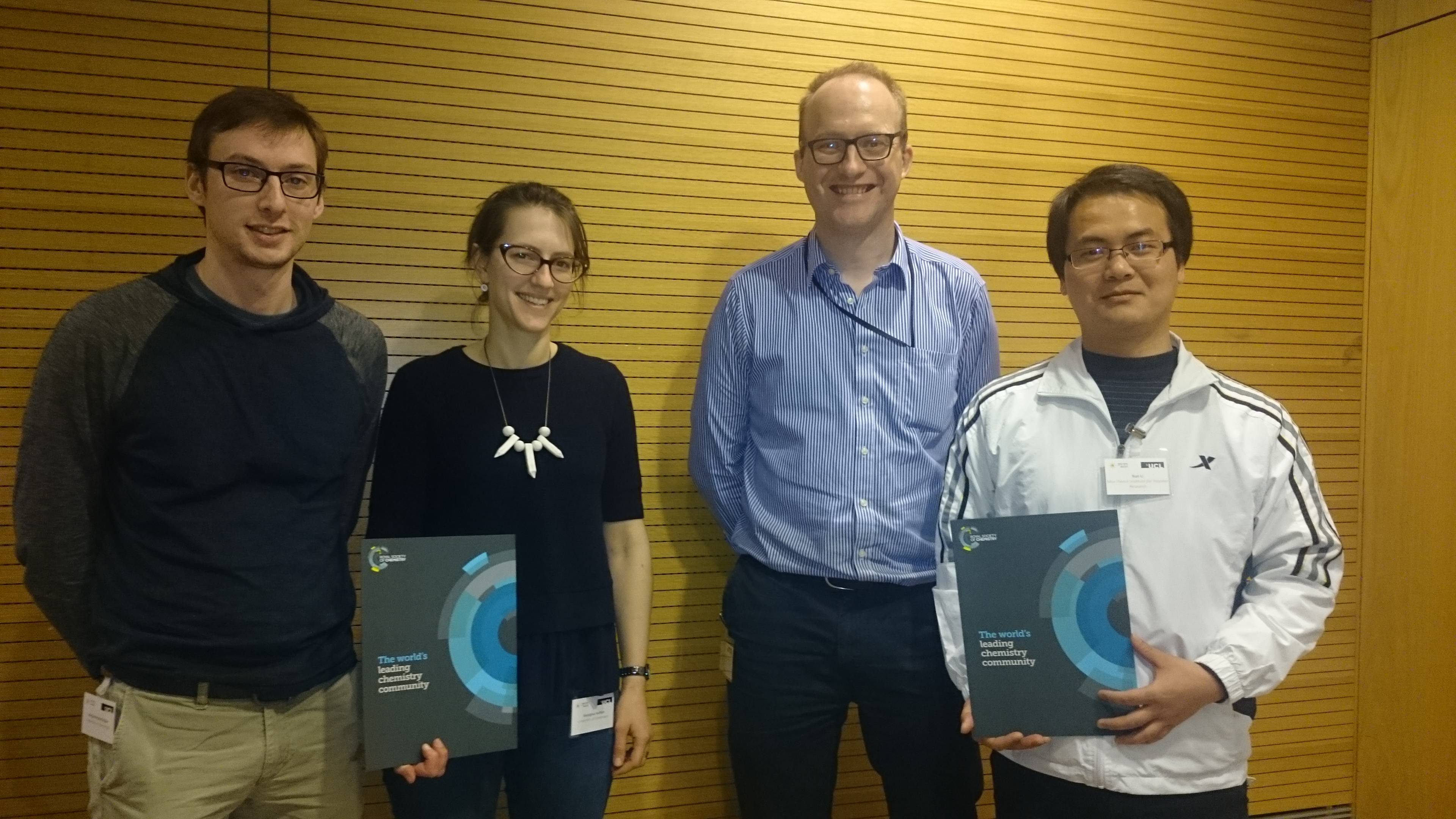
From left to right; Benjamin Martindale, Georgina Hutton, Martijn Zwijnenburg (conference organiser), Run Li.

The prize winners were;

EES poster prize: Georgina Hutton & Benjamin Martindale , Reisner group, Cambridge. Poster title: Solar hydrogen production using carbon quantum dots and a molecular catalyst.

Catalysis, Science and Technology poster prize: Run Li, Zhang group, Max Planck Institute for Polymer research, Mainz, Germany.  Poster title: Photocatalytic Selective Bromination of Aromatic Compounds using Microporous Organic Polymers with Visible Light.

Digg This
Reddit This
Stumble Now!
Share on Facebook
Bookmark this on Delicious
Share on LinkedIn
Bookmark this on Technorati
Post on Twitter
Google Buzz (aka. Google Reader)

IWPEEA-2016 Liverpool, 21-24 August 2016

EES are pleased to support the International Workshop on Plasmas for Energy and Environmental Applications IWPEEA-2016 which will take place in Liverpool, UK from 21 – 24 August 2016.

This workshop will bring together people from academia and industry who are interested in the latest scientific and technological advances in core areas of emerging plasma technology for environmental clean-up and energy applications.

Topics

The workshop will cover the following topics:

  1. Plasma generation, diagnostics and modelling for energy and environmental applications.
  2. Plasma chemistry for energy conversion and fuel and chemical synthesis (e.g. greenhouse gas conversion, ammonia synthesis, hydrogen production, CO2 to fuels/chemicals etc.)
  3. Plasma environmental clean-up (e.g. removal of VOCs, NOx, odour, tars, PM and PAHs, sterilisation, ozone generation etc.)
  4. Plasma treatment of waste liquid (e.g. wastewater treatment)
  5. Plasma solid waste treatment (e.g. plasma gasification, pyrolysis, vitrification etc.)
  6. Plasma synthesis of catalysts and energy materials (e.g. carbon nanomaterials)

Plenary Speakers

• Prof. Christopher Whitehead, The University of Manchester, UK ◦Plasma-catalysis: What do we still need to know?
• Prof. Annemie Bogaerts, University of Antwerp, Belgium ◦Plasma chemistry modeling for CO2 conversion: A better understanding of energy efficiency and product formation
• Prof. Gerard van Rooij, DIFFER, The Netherlands ◦CO2 reduction by microwave plasma as a route to solar fuels
• Dr. Antoine Rousseau, École Polytechnique, France ◦Air treatment using plasma-sorbent coupling
• Prof. Bruce R Locke, Florida State University, USA ◦Plasma liquid (TBC)
Invited Lectures

•Prof. Davide Mariotti, Ulster University, UK ◦Third generation photovoltaics with atmospheric pressure plasmas
•Prof. Wei Chu, Sichuan University, China ◦Plasma assisted preparation of new catalysts for CO2 conversion to feasible products
•Dr. Hyun-Ha Kim, AIST, Japan ◦Plasma-catalysis: From catalyst screening to NH3 synthesis
•Dr. Qi Wang, Technische Universiteit Eindhoven, The Netherlands ◦Nitrogen fixation by plasma: A touch on future application?

‌Oral and poster abstract submissions are now invited for IWPEEA-2016 on any of the themes listed above.  Please see the website for more details.

Digg This
Reddit This
Stumble Now!
Share on Facebook
Bookmark this on Delicious
Share on LinkedIn
Bookmark this on Technorati
Post on Twitter
Google Buzz (aka. Google Reader)

CO2 photoreduction: shining a light on surface activation

CO2 photoreduction

Harnessing sunlight to produce fuel from CO2

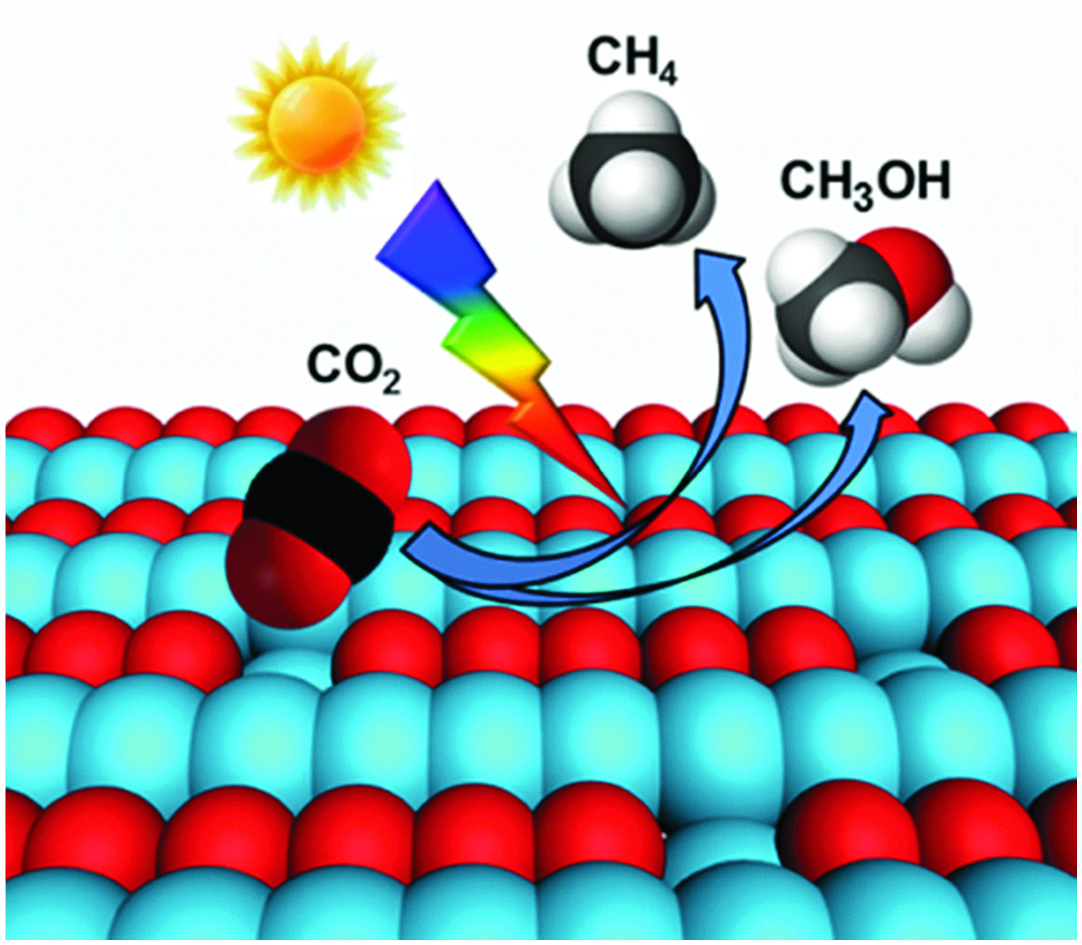
Photocatalytic reduction of CO2 to solar fuels such as methane or methanol may be a promising route to sustainably meet our energy needs. Yet many existing photocatalysts suffer from poor product selectivity and efficiency, caused in part by the competing hydrogen evolution reaction that can occur in the presence of water.

Jinlong Gong and colleagues at Tianjin University, China, highlight recent strategies used to improve the adsorption and activation of CO2 at the catalyst surface – an important and under-researched step in this process – and discuss conditions influencing the reaction pathways leading to the photoreduction products. They also review how chemisorption of the molecule can be enhanced by tailoring properties such as catalyst surface area, surface defects and noble metal co-catalysts, and how factors such as electrolyte pH and CO2 absorption mode can influence product distribution.


Want to know more? Read this review article online, which is free to access until 6 May 2016:

CO2 photo-reduction: insights into CO2 activation and reaction on surfaces of photocatalysts” by X. Chang et al., DOI: 10.1039/C6EE00383D

Digg This
Reddit This
Stumble Now!
Share on Facebook
Bookmark this on Delicious
Share on LinkedIn
Bookmark this on Technorati
Post on Twitter
Google Buzz (aka. Google Reader)