Archive for May, 2015

HOT Articles in EES

The following HOT articles have been highlighted by the reviewers of the articles as being particularly interesting or significant pieces of research. These are all free to access until 18/06/2015. The order they appear in the list has no meaning or ranking.


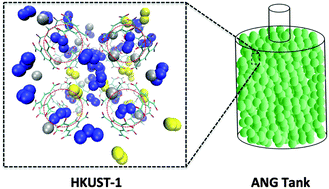
A thermodynamic tank model for studying the effect of higher hydrocarbons on natural gas storage in metal–organic frameworks
Hongda Zhang, Pravas Deria, Omar K. Farha, Joseph T. Hupp and Randall Q. Snurr
DOI: 10.1039/C5EE00808E, Paper
C5EE00808E GA


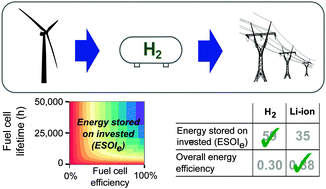
Hydrogen or batteries for grid storage? A net energy analysis
Matthew A. Pellow, Christopher J. M. Emmott, Charles J. Barnhart and Sally M. Benson
DOI: 10.1039/C4EE04041D, Analysis
C4EE04041D GA


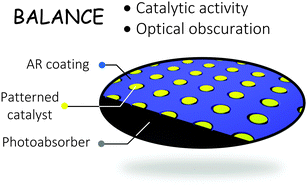
A quantitative analysis of the efficiency of solar-driven water-splitting device designs based on tandem photoabsorbers patterned with islands of metallic electrocatalyst
Yikai Chen, Ke Sun, Heather Audesirk, Chengxiang Xiang and Nathan S. Lewis
DOI: 10.1039/C5EE00311C, Paper
C5EE00311C GA


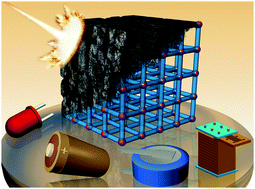
Metal–organic frameworks and their derived nanostructures for electrochemical energy storage and conversion
Wei Xia, Asif Mahmood, Ruqiang Zou and Qiang Xu
DOI: 10.1039/C5EE00762C, Review Article
C5EE00762C GA


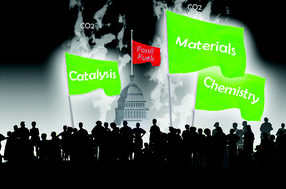
You can’t have an energy revolution without transforming advances in materials, chemistry and catalysis into policy change and action
Geoffrey A. Ozin
DOI: 10.1039/C5EE00907C, Perspective
C5EE00907C GA


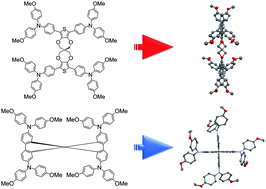
A simple spiro-type hole transporting material for efficient perovskite solar cells
Paramaguru Ganesan, Kunwu Fu, Peng Gao, Ines Raabe, Kurt Schenk, Rosario Scopelliti, Jingshan Luo, Lydia H. Wong, Michael Grätzel and Mohammad Khaja Nazeeruddin
DOI: 10.1039/C4EE03773A, Communication
C4EE03773A GA

Digg This
Reddit This
Stumble Now!
Share on Facebook
Bookmark this on Delicious
Share on LinkedIn
Bookmark this on Technorati
Post on Twitter
Google Buzz (aka. Google Reader)

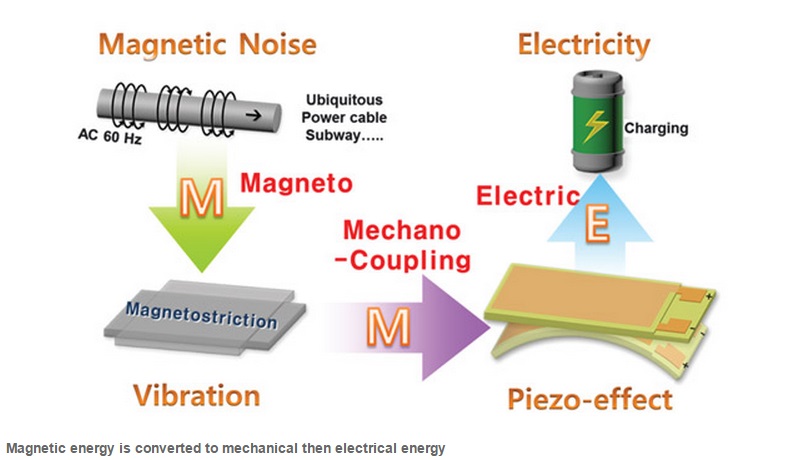
Electricity harvested from magnetic noise

In Korea, Jungho Ryu and colleagues at the Korea Institute of Materials Science, have designed a magneto–mechano–electric generator that harvests magnetic energy from the environment.  It is made from a magnetostrictive single crystal composite that elongates and contracts in a low frequency magnetic field. The strain induced in this material outputs a voltage and Ryu’s team have demonstrated that their device can harvest energy from a vacuum pump cable to power 35 light emitting diodes. They are conducting further studies to improve its power density and the materials science community is excited about how this technology could be utilised in the future.

Want to know more?

Read the full article in Chemistry World by Heather Powell.

Or, take a look at the original article which is free to access until 15th June 2015:

Ubiquitous magneto-mechano-electric generator” by J. Ryu et al., DOI:10.1039/C5EE00414D

Digg This
Reddit This
Stumble Now!
Share on Facebook
Bookmark this on Delicious
Share on LinkedIn
Bookmark this on Technorati
Post on Twitter
Google Buzz (aka. Google Reader)

Professor Henry Snaith elected Fellow of the Royal Society

Credit: University of Oxford

We are pleased to announce that Professor Henry Snaith, of the Clarendon Laboratory at Oxford University and Energy and Environmental Science Advisory Board member, has been elected a fellow of the Royal Society. Fellows of the Royal Society are elected for life through a peer review process on the basis of excellence in science and we would like to congratulate Henry on this achievement.

As head of the Photovolatic and Optoelectronic Device Group, Henry leads an interdisciplinary research team which focusses on optoelectronic materials synthesis, device development and characterisation with the primary focus of developing low cost photovoltaic concepts. Henry has pioneered the development of hybrid materials for energy and photovoltaics and the recent discovery of highly efficient perovskite solar cells has received much attention by the academic community and by industry as a low-cost alternative to silicon photovoltaics.

Read a selection of Henry’s papers – free to access until 15th June 2015:

Low-temperature processed meso-superstructured to thin-film perovskite solar cells, James M. Ball, Michael M. Lee, Andrew Hey and Henry J. Snaith, Energy Environ. Sci., 2013,6, 1739-1743, DOI: 10.1039/C3EE40810H

Formamidinium lead trihalide: a broadly tunable perovskite for efficient planar heterojunction solar cells, Giles E. Eperon, Samuel D. Stranks, Christopher Menelaou, Michael B. Johnston, Laura M. Herz and Henry J. Snaith, Energy Environ. Sci., 2014,7, 982-988, DOI: 10.1039/C3EE43822H

Sub-150 °C processed meso-superstructured perovskite solar cells with enhanced efficiency, Konrad Wojciechowski, Michael Saliba, Tomas Leijtens, Antonio Abate and Henry J. Snaith, Energy Environ. Sci., 2014,7, 1142-1147, DOI: 10.1039/C3EE43707H

Digg This
Reddit This
Stumble Now!
Share on Facebook
Bookmark this on Delicious
Share on LinkedIn
Bookmark this on Technorati
Post on Twitter
Google Buzz (aka. Google Reader)