Archive for August, 2015

HOT Articles in EES

The following HOT articles have been highlighted by the reviewers of the articles as being particularly interesting or significant pieces of research. These are all free to access until 30/9/2015. The order they appear in the list has no meaning or ranking.


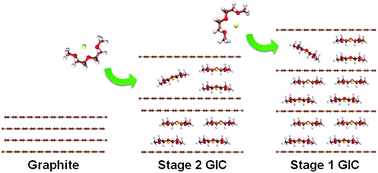
Sodium intercalation chemistry in graphite
Haegyeom Kim, Jihyun Hong, Gabin Yoon, Hyunchul Kim, Kyu-Young Park, Min-Sik Park, Won-Sub Yoon and Kisuk Kang
Journal Article
DOI: 10.1039/C5EE02051D, Paper
C5EE02051D GA


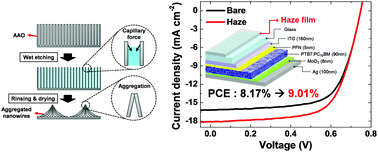
Broadband and ultrahigh optical haze thin films with self-aggregated alumina nanowire bundles for photovoltaic applications
Gumin Kang, Kyuyoung Bae, Minwoo Nam, Doo-Hyun Ko, Kyoungsik Kim and Willie J. Padilla
Journal Article
DOI: 10.1039/C5EE01757B, Communication
C5EE01757B GA


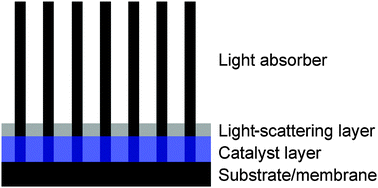
Functional integration of Ni–Mo electrocatalysts with Si microwire array photocathodes to simultaneously achieve high fill factors and light-limited photocurrent densities for solar-driven hydrogen evolution
Matthew R. Shaner, James R. McKone, Harry B. Gray and Nathan S. Lewis
Journal Article
DOI: 10.1039/C5EE01076D, Paper
C5EE01076D GA


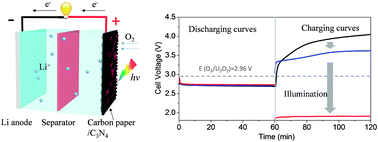
Reducing the charging voltage of a Li–O2 battery to 1.9 V by incorporating a photocatalyst
Yang Liu, Na Li, Shichao Wu, Kaiming Liao, Kai Zhu, Jin Yi and Haoshen Zhou
Journal Article
DOI: 10.1039/C5EE01958C, Communication
C5EE01958C GA


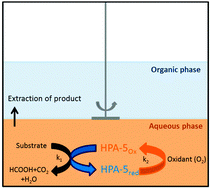
Biomass oxidation to formic acid in aqueous media using polyoxometalate catalysts – boosting FA selectivity by in-situ extraction
Jenny Reichert, Birgit Brunner, Andreas Jess, Peter Wasserscheid and Jakob Albert
Journal Article
DOI: 10.1039/C5EE01706H, Paper
C5EE01706H GA


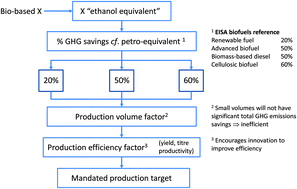
Balancing the bioeconomy: supporting biofuels and bio-based materials in public policy
Jim Philp
Journal Article
DOI: 10.1039/C5EE01864A, Opinion
C5EE01864A GA


Digg This
Reddit This
Stumble Now!
Share on Facebook
Bookmark this on Delicious
Share on LinkedIn
Bookmark this on Technorati
Post on Twitter
Google Buzz (aka. Google Reader)

Battery Buffer: Layered oxide that shrinks when ions intercalated

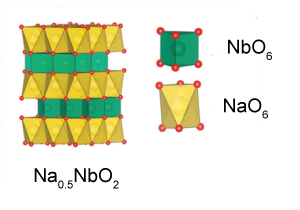
Battery electrodes are typically made from layered oxide materials. However, these layered oxides often undergo a positive ‘strain effect’ or expansion when ions are incorporated into their structure. This can leads to inferior long-term cycling stability and reduced battery safety. However, scientists at the Chinese Academy of Sciences, have synthesised a negative strain layered oxide, Na0.5NbO2, which exhibits high stability, a long cycling life and an impressive rate performance. This material shrinks on intercalation of sodium ions which is thought to be a result of enhanced interlayer Na–O interactions and weakened Nb–Nb and Nb–O bonding. The researchers have also found that the material is suitable as an independent electrode material and as a buffer in composite electrodes, yet the high cost of niobium and the difficulty of synthesis may limit its future application. The lattice shrinks upon intercalation of sodium ions

Want to know more?

Read the full article in Chemistry World by Laura Fisher.

Or, take a look at the original article which is free to access until 9th September 2015:

Anti-P2 structured Na0.5NbO2 and its negative strain effect” by X. Wang et al.DOI:10.1039/C5EE01745A

Digg This
Reddit This
Stumble Now!
Share on Facebook
Bookmark this on Delicious
Share on LinkedIn
Bookmark this on Technorati
Post on Twitter
Google Buzz (aka. Google Reader)