Archive for October, 2013

Powering Growth through Open Innovation: Register for the Chemistry World Webinar

Do you want to embrace open innovation, but not sure where to start? This webinar will provide a short overview of the open innovation concept, the best practice and platforms used by Syngenta to engage with innovation from anywhere in support of its corporate ambition “to bring greater food security in an environmentally sustainable way to an increasing populous world by creating a worldwide step-change in farm productivity

Our next free, one hour, interactive Chemistry World Webinar, being streamed on Thursday 24 October at 12:00 (BST), will provide a short overview of the open innovation concept, the best practice and platforms.

Register here or add this event to your calendar

Digg This
Reddit This
Stumble Now!
Share on Facebook
Bookmark this on Delicious
Share on LinkedIn
Bookmark this on Technorati
Post on Twitter
Google Buzz (aka. Google Reader)

Renewable Energy Storage in Biomass?

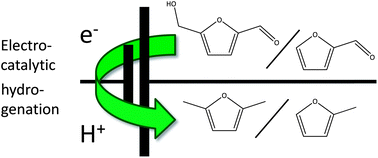
Researchers at TU Braunschweig under the direction of Professor Uwe Schröder have demonstrated highly selective electrochemical hydrogenation of two furanics, common biomass derivatives.

Chemical hydrogenation of biomass substrates can be a difficult prospect.  High pressures of H2 at high temperature would make any chemist with a reasonable expectation of longevity understandably squeamish.  According to research from the University of Technology at Braunschweig, a potentiostat may be the organic chemist’s best friend.

In their recent article in EES, the authors, Schröder and Nilges, demonstrate the electrochemical conversion of furfural and 5-hydroxymethylfurfural to 2-methylfuran and 2,5-dimethylfuran, respectively.  These substrates are derived from lignocellulosic biomass or from polysaccharides such as cellulose and starch.  By demonstrating selective electroorganic reduction at copper and lead electrodes, this work opens the possibility of inexpensive electrochemical reactors that could improve the value of biomass-derived compounds.

One main problem is the competing hydrogen evolution reaction (HER).  This is a common hurdle for reductive electrochemistry on most electrode surfaces and can severely limit Faradaic efficiency.  The authors report that for this system, running high concentrations (500 mM) of substrate can reduce percentage of electrons lost to HER.  While this presents a challenge for scaling-up, these products actually separate from the aqueous electrolyte solution, forming another phase that is relatively easy to remove.

Looking to the future, this work represents an intriguing combination of renewable energy strategies – using renewable sources of energy to convert biomass to more useful or at least more energy dense chemicals.  Certainly, the energy future poses some daunting challenges that resist any single silver bullet.  By combining renewable energy storage with biofuel substrates, some challenging steps in both fields might be avoidable.

By Michael Doud

Read the article in EES:

Electrochemistry for biofuel generation: production of furans by electrocatalytic hydrogenation of furfurals
Peter Nilges and Uwe Schröder
DOI: 10.1039/C3EE41857J, Communication

Digg This
Reddit This
Stumble Now!
Share on Facebook
Bookmark this on Delicious
Share on LinkedIn
Bookmark this on Technorati
Post on Twitter
Google Buzz (aka. Google Reader)

This week’s HOT articles

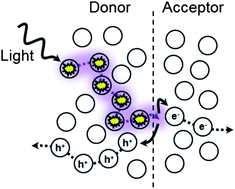
Exciton diffusion in organic photovoltaic cells
S. Matthew Menke and Russell J. Holmes
DOI: 10.1039/C3EE42444H, Review Article

A carbon quantum dot decorated RuO2 network: outstanding supercapacitances under ultrafast charge and discharge
Yirong Zhu, Xiaobo Ji, Chenchi Pan, Qingqing Sun, Weixin Song, Laibing Fang, Qiyuan Chen and Craig E. Banks
DOI: 10.1039/C3EE41776J, Paper

First-row transition metal dichalcogenide catalysts for hydrogen evolution reaction
Desheng Kong, Judy J. Cha, Haotian Wang, Hye Ryoung Lee and Yi Cui
DOI: 10.1039/C3EE42413H, Communication

A monolithic device for solar water splitting based on series interconnected thin film absorbers reaching over 10% solar-to-hydrogen efficiency
T. Jesper Jacobsson, Viktor Fjällström, Martin Sahlberg, Marika Edoff and Tomas Edvinsson
DOI: 10.1039/C3EE42519C, Paper

Digg This
Reddit This
Stumble Now!
Share on Facebook
Bookmark this on Delicious
Share on LinkedIn
Bookmark this on Technorati
Post on Twitter
Google Buzz (aka. Google Reader)

Solar water splitting: 10 % solar-to-hydrogen conversion efficiency using series interconnected thin-film absorbers

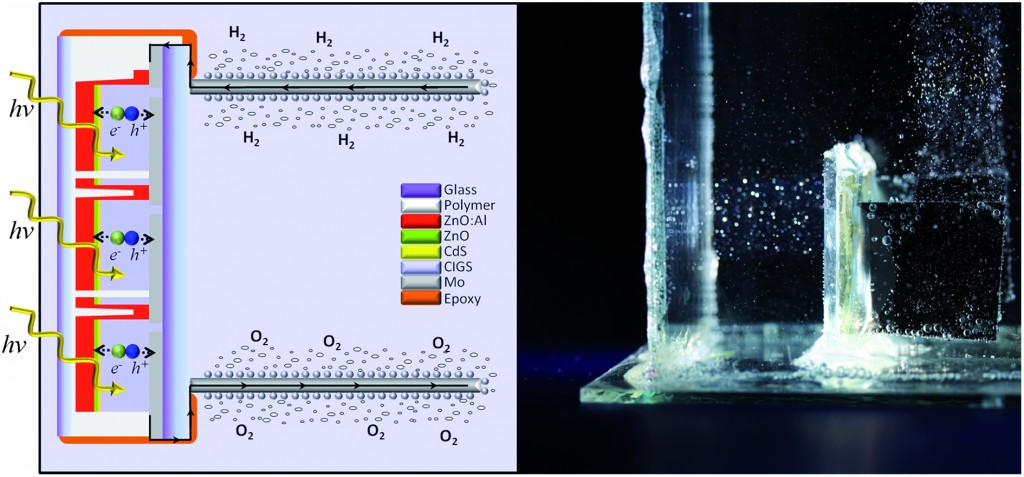
Researchers from Sweden have demonstrated a process where the crucial 10 % solar-to-hydrogen (STH) efficiency threshold – required for a device to be considered commercially viable – is met by connecting a number of solar-absorbers in series along with a Pt-based catalyst.

Harnessing the power of the sun to directly split water in order to produce hydrogen is anticipated to be an important process in post-carbon, green economies.

Normally there is a trade-off between high solar-absorption and high water splitting efficiency due to the mismatch between the energy required for water splitting (about 2 eV) and the most efficient band-gap for harvesting solar light (about 1.35 eV).

In their recent article, the research group from Uppsala University have overcome this problem by interconnecting 3 cells, based on the semiconductor CuInxGa1-xSe2 (CIGS), into a single monolithic device. By placing the semiconductors in series, and tuning them for efficient absorption of the solar spectrum (achieved by varying the In:Ga ratio), their device can have both a high solar absorption efficiency and a sufficiently high electrochemical potential to drive the water splitting reaction.

Due to the relative simplicity of the approach, the authors suggest that this may be an economically compatible route to green H2 production. What’s more, they claim that this novel approach has room for an increase of several percentage points in STH efficiency, and that it has opened the door to many other photoabsorbers, which were previously disregarded due to too-low band gaps, being re-investigated. In any case, the outlook for this field certainly looks bright.

By Aled D. Roberts

Take a look at the article in EES:

A monolithic device for solar water splitting based on series interconnected thin film absorbers reaching over 10 % solar-to-hydrogen efficiency
Jesper Tor Jacobsson, Viktor Fjällström, Martin Sahlberg, Marika Edoff and Tomas Edvinsson
DOI: 10.1039/C3EE42519C, Paper

Digg This
Reddit This
Stumble Now!
Share on Facebook
Bookmark this on Delicious
Share on LinkedIn
Bookmark this on Technorati
Post on Twitter
Google Buzz (aka. Google Reader)

This week’s HOT articles

Take a look at this week’s selection…

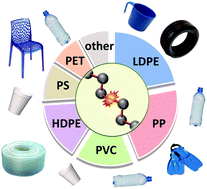
Retrieving and converting energy from polymers: deployable technologies and emerging concepts
Bilge Baytekin, H. Tarik Baytekin and Bartosz A. Grzybowski  


Exceeding the Shockley–Queisser limit in solar energy conversion
Cory A. Nelson, Nicholas R. Monahan and   X.-Y. Zhu  

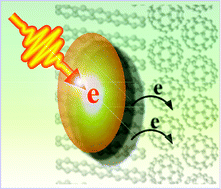
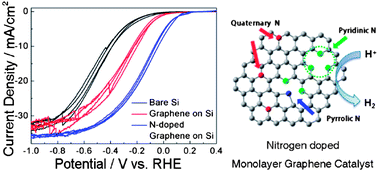
N-doped monolayer graphene catalyst on silicon photocathode for hydrogen production
Uk Sim, Tae-Youl Yang, Joonhee Moon, Junghyun An, Jinyeon Hwang, Jung-Hye Seo, Jouhahn Lee, Kye Yeop Kim, Joohee Lee, Seungwu Han, Byung Hee Hong and Ki Tae Nam   


Digg This
Reddit This
Stumble Now!
Share on Facebook
Bookmark this on Delicious
Share on LinkedIn
Bookmark this on Technorati
Post on Twitter
Google Buzz (aka. Google Reader)

2nd International Conference on Clean Energy Sciences

The 2nd International Conference on Clean Energy Sciences (ICCES2) will take place on the 13-16 April 2014 in Qingdao, China.

The search for sources of clean energy is becoming increasingly urgent as the supply of available energy from fossil fuels decreases and concerns increase about their environmental impact. Alternative sources of clean energy, such as solar energy and biofuels offer great potential; however there are big challenges to be overcome before current clean energy generation and energy storage technologies make these a viable alternative.

This 2nd International Conference on Clean Energy offers a unique opportunity for international researchers to discuss the latest developments in clean energy and energy storage research, and the fundamental issues surrounding the scientific challenges faced ahead.

Important dates:

Deadline for oral abstract submission: 10 November, 2013
Deadline for poster abstract submission: 9 January, 2014
Deadline for early registration: 30 January, 2014
Deadline for normal registration: 13 March, 2014

More information can be found on the website: www.icces.cn

Digg This
Reddit This
Stumble Now!
Share on Facebook
Bookmark this on Delicious
Share on LinkedIn
Bookmark this on Technorati
Post on Twitter
Google Buzz (aka. Google Reader)

Photonics and Energy Conversion: From High Temperature Photonic Crystals to Nanowire Array Photoanodes

Nanophotonic concepts, ranging from photonic crystals to nanowire arrays, are of tremendous interest in both solid state and photoelectrochemical (PEC) energy conversion devices.

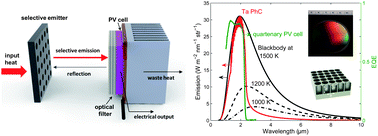
Rinnerbauer et al, in 2012, presented a review on an emerging direction in photonics, high-temperature nanophotonics using large area 2D metallic photonic crystals aimed at solid-state energy conversion. Recently, Hu et al have shown impressive optical results in GaAs nanowire array photoanodes (for PEC devices) that occupy <5% of the fractional area of the electrode, due to efficient incoupling into the resonant waveguide modes. Despite the differences in their intended application, both papers share a common theme: use of fundamental yet scalable nanophotonic concepts in energy conversion.

Photonic crystals (PhCs) are periodically nanostructured metamaterials with unique optical properties and flexibility in the design of their density of states. In their review, Rinnerbauer et al demonstrate the efficiency of selective emitters based on 2D photonic crystals in refractory metals (like Tantalum and Tungsten). These PhCs are paving the way for high efficiency high temperature thermal-to-electricity conversion schemes based on selective emitters and absorbers, like TPV, solar thermal and solar TPV.

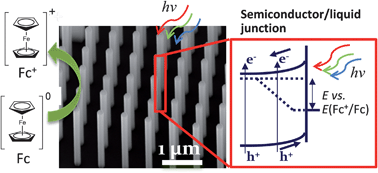
Work by Hu et al shows that enhanced optical absorption, in conjunction with radial carrier-collection, results in high external quantum yields (EQYs) when the periodic nanowire arrays of GaAs are used as energy-conversion devices. The key to the absorption properties of these arrays is guided and leaky optical waveguide modes determined through a combination of experimental and theoretical analysis.

Nanophotonic device design certainly has a big role in the future of energy-conversion. A variety of schemes have been proposed and demonstrated in both solid state and PEC systems and these papers represent critical steps in nanophotonic energy conversion.

By Prineha Narang

Read the papers here:

Recent developments in high-temperature photonic crystals for energy conversion
Veronika Rinnerbauer, Sidy Ndao, Yi Xiang Yeng, Walker R. Chan, Jay J. Senkevich, John D. Joannopoulos, Marin Soljacic and Ivan Celanovic
DOI: 10.1039/c2ee22731b

Optical, electrical, and solar energy-conversion properties of gallium arsenide nanowire-array photoanodes
Shu Hu, Chun-Yung Chi, Katherine T. Fountaine, Maoqing Yao, Harry A. Atwater, P. Daniel Dapkus, Nathan S. Lewis and Chongwu Zhou
DOI: 10.1039/c3ee40243f

Interested in photonics research? See our collection of articles on photonics that are free to access for a limited time here.

Digg This
Reddit This
Stumble Now!
Share on Facebook
Bookmark this on Delicious
Share on LinkedIn
Bookmark this on Technorati
Post on Twitter
Google Buzz (aka. Google Reader)

Sustainability at All Stages: A New Tool for Assessing Novel Chemical Processes

A novel method developed by energy researchers offers a way to assess sustainability of chemical processes at an early stage.

When developing novel chemical conversions, researchers have faced the challenge of assessing and predicting the broader environmental and economic impact of their work. Previously, no defined method was available for comparing criteria for overall sustainability of the new processes at an early state of development. Patel et al. have developed a multi-criteria method to assess future sustainability that can be applied at an early stage to help guide innovation.
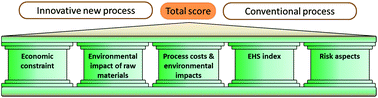
Early stage process development is a time when there is flexibility to pursue sustainable options. In a recently published EES paper, Patel et al. propose that their method can help researchers analyze the processes they are developing within a broader economic, environmental, and social context. The method described in the paper is a data-based assessment tool for chemists to determine comparative sustainability of different processes. The criteria assessed are environmental constraint, environmental impact of raw materials, process costs and environmental impact, EHS index, and risk aspects. The paper describes the method for applying these criteria to chemical processes to create a score by which different processes can be compared.

Patel et al. apply their method to a catalytic process for the production of but-1,3-diene from ethanol that is currently being developed, and compare it to the dominant conventional method for production of but-1,3-diene from naphtha in a steam cracker. When they applied their method to these processes, the bioethanol-based process scored better than the petrochemical process overall, and the scores for the various criteria were in line with known data. While the input data may be less well defined for novel processes, that this method seems to be predictive and provides a comparison of different processes suggests that in most cases it can be useful for providing a broad assessment of sustainability factors, and can therefore aid early stage decision making.

It’s great that we’re at a point where there is encouragement for researchers to consider sustainability issues at all stages of development, and that people are thinking about ways to make it practical to do so. I think this new method will prove to be a concrete tool for researchers developing novel chemical conversion processes to start thinking about sustainability on the front end. Not only will it provide a relatively quick way to assess new processes in terms of sustainability, it can help guide research targets and goals, prompt consideration of potential alternatives, and encourage researchers to think about their results in a broader context.

Read about the details of this new approach in the full EES article here:

Sustainability assessment of novel chemical processes at early stage: application to biobased processes
Akshay D. Patel, Koen Meesters, Herman den Uil, Ed de Jong, Kornelis Blok and Martin K. Patel
Energy Environ. Sci., 2012, 5, 8430
DOI: 10.1039/c2ee21581k

By Paige Johnson

Digg This
Reddit This
Stumble Now!
Share on Facebook
Bookmark this on Delicious
Share on LinkedIn
Bookmark this on Technorati
Post on Twitter
Google Buzz (aka. Google Reader)