
Archive for the ‘Uncategorized’ Category

3rd Dalton Transactions International Symposium – Bioinorganic Chemistry

Banner for Dalton Transactions Symposium

The 3rd Dalton Transactions International Symposium was held at Osaka University and International Institute for Carbon-Neutral Energy Research (I2CNER) at Kyushu University, Japan from the 14th-16th November. The aim of the event was to bring together scientists from around the world to discuss the exciting and ever expanding subject of bioinorganic chemistry and the symposium certainly delivered!

The conference began at Osaka University with a lecture titled ‘Reactivity of Mononuclear Copper Active-Oxygen Complexes’, by Shinobu Itoh (Osaka University) who examined the catalytic mechanism of the copper monooxygenases. This was followed by an overview of ligand design and metal complexes for use as diagnostic tools and therapeutic agents by Chris Orvig (University of British Columbia, Canada). Shun Hirota (Nara Institute of Science and Technology, Japan) gave an insightful look into ‘Structural Changes of Metalloproteins and Metal-Peptide Complexes’ before we briefly broke for lunch. Rejuvenated, Erwin Reisner (University of Cambridge, UK) spoke on solar fuel-producing hybrid systems and the prospects for replacing enzymes with synthetic catalysts, he was followed by Takashi Hayashi (Osaka University) speaking on the ‘Construction of Supramolecular Hemoprotein Self-Assembly Systems’. Nils Metzler-Nolte (Ruhr University, Germany) began the final session of the day with a talk on ’Bioorganometallic Chemistry: Synthetic Strategies and Biomedical Applications for Metal-Peptide Bioconjugates’ with some interesting results on cell delivery and organelle localisation. The day in Osaka was then concluded by Kazuya Kikuchi (Osaka University) discussing his work into designing fluorogenetic labelling systems.
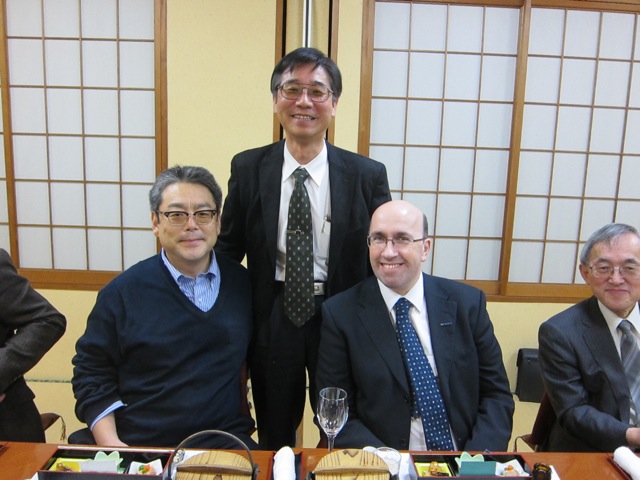
Professors Seiji Ogo, Yoshio Hisaeda, Tsutomu Katsuki and Dr Jamie Humphrey

Professor Seiji Ogo, Professor Yoshio Hisaeda, Dr Jamie Humphrey and Professor Tsutomu Katsuki enjoying dinner in Fukuoka

The Symposium then moved onto Fukuoka on Kyushu island, to 12CNER at Kyushu University, where the day was opened with a welcome by the Director of 12CNER, Professor Petros Sofronis. The scientific sessions began with Seiji Ogo (I2CNER, Kyushu University), who discussed his research into an [NiFe]hydrogenase mimic as a potential catalyst for electron extraction from hydrogen. Research into a range of novel nanomaterials containing Vitamin B12 activity was then discussed by Yoshio Hisaeda (Kyushu University). The bioinspired system his team have developed works under irradiation with visible light and can be applied to the degradation of organic halide pollutants. Chris Orvig, Erwin Reisner and Nils Metzler-Nolte were able to maximise their contribution to the symposium by joining us again at Kyushu University and sharing their expertise in their fields. The event was then rounded off by two excellent discussions; Yoshinori Naruta’s (Kyushu University) lecture on ‘Oxygen Activation with Bio-Inspired Molecular Catalysts’ and ‘Oxygen Atom Transfer and Dehydrogenation Reactions using Molecular Oxygen as Oxidant’ presented by Tsutomu Katsuki (Kyushu University).

The symposium was a great event for which we owe much thanks and gratitude to the local hosts, in particular Dalton Transactions Regional Associate Editor Shinobu Itoh, in Osaka and Advisory Board member Profesor Seiji Ogo in Fukuoka and all the speakers.  For more information about the symposium, including a full programme about the 2 day event see the website.

On the topicof one of the topics covered by the Symposium, next year Dalton Transactions will be publishing a themed issue ‘Application of inorganic chemistry for non-cancer therapeutics’, with guest editor Professor Kathy Franz (Duke University, NC, USA).

Some recent Dalton Perspectives which may also be of interest include

Approaches to efficient molecular catalyst systems for photochemical H2 production using [FeFe]-hydrogenase active site mimics, Mei Wang, Lin Chen, Xueqiang Li and Licheng Sun, Dalton Trans., 2011, Advance Article, DOI: 10.1039/C1DT11166C

Synthesis and bio-functionalization of magnetic nanoparticles for medical diagnosis and treatment Thomas D. Schladt, Kerstin Schneider, Hansjörg Schild and Wolfgang Tremel,Dalton Trans., 2011, 40, 6315-6343, DOI: 10.1039/C0DT00689K

Digg This
Reddit This
Stumble Now!
Share on Facebook
Bookmark this on Delicious
Share on LinkedIn
Bookmark this on Technorati
Post on Twitter
Google Buzz (aka. Google Reader)

Gaseous silanetriols: partners or loners?

Silanetriols are compounds of the general formula Si(OH)3R which readily form polysiloxanes by condensation, by substituting R for condensation resistant ligands a range of crystal structures have been identified for different solid state silanetriol compounds. Norbert W. Mitzel and colleagues have been investigating the intermolecular forces of gaseous silanetriols, the first investigation of its kind, with the aim of discovering if tert-butylsilanetriol [tBuSi(OH)3] dimerises via H-bonds or remains monomeric when in the gas state.


Intrigued? To find out more about the teams findings, including the taste of their silanetriol, read the full HOT article which is free to access until the 20th of December

Silanetriols in the gas phase: single molecules vs. hydrogen-bonded dimers

Stefan Spirk, Raphael J. F. Berger, Christian G. Reuter, Rudolf Pietschnig and Norbert W. Mitzel
Dalton Trans., 2012, Advance Article
DOI: 10.1039/C1DT11740H, Communication

Digg This
Reddit This
Stumble Now!
Share on Facebook
Bookmark this on Delicious
Share on LinkedIn
Bookmark this on Technorati
Post on Twitter
Google Buzz (aka. Google Reader)

Professor Philip Mountford announced as new Dalton Transactions Editorial Board Chair

Professor Philip Mountford

Professor Philip Mountford

We are delighted and thrilled to announce that Professor Philip Mountford, from the University of Oxford, UK, has been appointed as the new Chair of the Dalton Transactions Editorial Board, with effect from 1st January 2012.

Philip’s research interests centre around studies of the bonding and stoichiometric and catalytic reactivity of organometallic and related compounds of the early transition and lanthanide metals, and, more recently, the alkaline earth metals. This research has a particular emphasis on compounds with metal-nitrogen multiple bonds, olefin polymerization and ring-opening polymerization towards “green” polymers. Philip is a Fellow of the Royal Society of Chemistry and a past recent recipient of the RSC’s Sir Edward Frankland Fellowship. He has been a Visiting Professor at several European universities and recently served as Acting Head of Inorganic Chemistry in Oxford.

Of his forthcoming role, Philip says: “I am delighted and honored to be taking over from Chris Orvig as Chair of the Editorial Board of Dalton Transactions at such an exciting time in the journal’s history. During my period as Chair, I will strive, together with Jamie Humphrey and the RSC editorial team, the Editorial Board and the Advisory Board, to not only maintain but to exceed Dalton Transactions’ current position and its reputation for quality papers, fair and robust refereeing, excellent technical support and impressive submission to publication times.”

We’d like to take this opportunity to thank the outgoing Chair, Professor Chris Orvig, who has successfully led the Editorial Board through a period of significant achivements for the journal.  Chris’ term of office finishes at the end of 2011.

Read some of Philip Mountford’s recently published articles by following the links below:

The First Group 4 Metal Bis(imido) and Tris(imido) Complexes†
Andrew Schwarz, A J Nielson, Philip Mountford and Nikolas Kaltsoyannis
Chem. Sci., 2011, Accepted Manuscript
DOI: 10.1039/C1SC00786F

Titanium alkoxyimido (Ti=N–OR) complexes: reductive N–O bond cleavage at the boundary between hydrazide and peroxide ligands
Andrew D. Schwarz, Ainara Nova, Eric Clot and Philip Mountford
Chem. Commun., 2011, 47, 4926-4928
DOI: 10.1039/C1CC10862J

Low-coordinate rare-earth complexes of the asymmetric 2,4-di-tert-butylphenolate ligand prepared by redox transmetallation/protolysis reactions, and their reactivity towards ring-opening polymerisation
Lawrence Clark, Glen B. Deacon, Craig M. Forsyth, Peter C. Junk, Philip Mountford and Josh P. Townley
Dalton Trans., 2010, 39, 6693-6704
DOI: 10.1039/C0DT00023J

Synthesis and ethylene trimerisation capability of new chromium(II) and chromium(III) heteroscorpionate complexes
Alexander F. R. Kilpatrick, Shaneesh Vadake Kulangara, Michael G. Cushion, Robbert Duchateau and Philip Mountford
Dalton Trans., 2010, 39, 3653-3664
DOI: 10.1039/B926333K

Digg This
Reddit This
Stumble Now!
Share on Facebook
Bookmark this on Delicious
Share on LinkedIn
Bookmark this on Technorati
Post on Twitter
Google Buzz (aka. Google Reader)

Call for papers: Themed issue – Application of inorganic chemistry for non-cancer therapeutics

We are pleased to announce an upcoming themed issue on the topic of the application of inorganic chemistry for non-cancer therapeutics, guest edited by Kathy Franz. It is our pleasure to invite you to contribute to this themed issue.

In this issue we seek to showcase the many ways in which principles of inorganic chemistry can be applied to tackle challenges in human health and disease. Recent themed issues of Dalton Transactions have explicitly covered metal anticancer compounds (2009) and radiopharmaceuticals (2011). This themed issue will emphasize other arenas where the creativity of inorganic chemists can contribute to the development of novel therapeutic agents.

How to submit?

All types of manuscript, Communications, Full Papers and Perspectives, will be considered for publication. We aim to publish this themed issue in 2012 and therefore would like to receive manuscripts by 15th November 2011. The manuscript should be prepared according to the format for regular articles and should be submitted via our online system. All invited manuscripts will be subjected to the normal refereeing procedure.

Deadline for Submission: 15th November 2011

Please indicate on submission that your manuscript is intended for this themed issue and direct any questions to theDalton Transactions Editorial Office.

We invite you to also check out previous themed issues featuring in Dalton Transactions. Read them here now.

Digg This
Reddit This
Stumble Now!
Share on Facebook
Bookmark this on Delicious
Share on LinkedIn
Bookmark this on Technorati
Post on Twitter
Google Buzz (aka. Google Reader)

HOT article: Jahn-Teller distortion for modifying magnetic properties

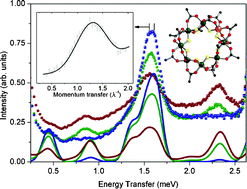
In this HOT article, a detailed study of the impact of a Jahn-Teller distorted Cu(II) ion in the anti-ferromagnetically coupled ring, Cr7Cu, is reported. The Jahn-Teller distortions are identified using spectroscopic techniques and a theoretical characterization is also presented. The problem is important for molecular magnetism as the origin of Jahn-Teller related magnetic anisotropy and consequently the barrier for the spin reversal is single molecular magnets.

Read more about these interesting magnetic effects for FREE at:

Modification of the magnetic properties of a heterometallic wheel by inclusion of a Jahn–Teller distorted Cu(II) ion
Michael L. Baker, Stergios Piligkos, Alberto Bianchi, Stefano Carretta, David Collison, Joseph J. W. McDouall, Eric J. L. McInnes, Hannu Mutka, Grigore A. Timco, Floriana Tuna, Prabha Vadivelu, Høgni Weihe, Hans U. Güdel and Richard E. P. Winpenny
Dalton Trans., 2011, Advance Article
DOI: 10.1039/C1DT10547G

Digg This
Reddit This
Stumble Now!
Share on Facebook
Bookmark this on Delicious
Share on LinkedIn
Bookmark this on Technorati
Post on Twitter
Google Buzz (aka. Google Reader)

Highest ever Immediacy Index for Dalton Transactions

The 2010 Journal Citation Reports have recently been published by Thomson ISI, and the immediacy index for Dalton Transactions was announced to be a record high value for the journal, leading the field with a value of 0.81!  Published alongside the more well known impact factors, the immediacy index is considered to be a measure of how topical and urgent the work in a journal is.

Dalton Transactions’ latest impact factor was also published, as 3.65, representing a more than 20% growth in impact factor over the last 5 years!

The Impact Factor for 2010 is calculated from the total number of citations given in 2010 to articles published in 2008 and 2009, divided by the number of articles published in 2008 and 2009.

The Immediacy Index for 2010 is calculated from the total number of citations given in 2010 to articles published in 2010, divided by the number of articles published in 2010.

We thank all our authors and referees who continue to supported the journal. Please visit our website to learn more about Dalton Transactions, or submit an article today.

Information about the latest impact factors for other RSC journals is available here.

Digg This
Reddit This
Stumble Now!
Share on Facebook
Bookmark this on Delicious
Share on LinkedIn
Bookmark this on Technorati
Post on Twitter
Google Buzz (aka. Google Reader)

Optical electron transfer for smart devices

In molecular computing how does structure influence electron transfer ?

In their Dalton Transactions Hot Article, Frederic Paul and his team look at the intramolecular electron transfer in a fluorenyl iron compound with a view to optimising mixed valent compounds for smart molecular devices.

Optical electron transfer through 2,7-diethynylfluorene spacers in mixed-valent complexes containing electron-rich “(η2-dppe)(η5-C5Me5)Fe” endgroups
Floriane Malvolti, Cedric Rouxel, Olivier Mongin, Philippe Hapiot, Loic Toupet, Mireille Blanchard-Desce and Frédéric Paul, Dalton Trans., 2011, DOI: 10.1039/C1DT10231A

Digg This
Reddit This
Stumble Now!
Share on Facebook
Bookmark this on Delicious
Share on LinkedIn
Bookmark this on Technorati
Post on Twitter
Google Buzz (aka. Google Reader)

Top Ten most-read Dalton Transactions articles in March

Read the most-read Dalton Transactions articles of March 2011, listed below:

Duncan Wass and Neil Robertson, Dalton Trans., 2011, 40, 3775-3776
DOI: 10.1039/C1DT90027G

Mathias Köberl, Mirza Cokoja, Wolfgang A. Herrmann and Fritz E. Kühn, Dalton Trans., 2011, Advance Article
DOI: 10.1039/C0DT01722A
 
Antje Modrow, Dordaneh Zargarani, Rainer Herges and Norbert Stock, Dalton Trans., 2011, 40, 4217-4222
DOI: 10.1039/C0DT01629B
 
Kai-Ju Wei, Jia Ni, Yong-Shu Xie, Yangzhong Liu and Qing-Liang Liu, Dalton Trans., 2007, 3390-3397
DOI: 10.1039/B703363J
 
Christine J. Cooper, Matthew D. Jones, Simon K. Brayshaw, Benjamin Sonnex, Mark L. Russell, Mary F. Mahon and David R. Allan, Dalton Trans., 2011, 40, 3677-3682
DOI: 10.1039/C0DT01740J
 
F. Richard Keene, Dalton Trans., 2011, 40, 2405-2418
DOI: 10.1039/C0DT00755B
 
Muhammad Arif Nadeem, Aaron W. Thornton, Matthew R. Hill and John Arron Stride, Dalton Trans., 2011, 40, 3398-3401
DOI: 10.1039/C0DT01531H
 
Joydev Dinda, Sébastien Liatard, Jérôme Chauvin, Damien Jouvenot and Frédérique Loiseau, Dalton Trans., 2011, 40, 3683-3688
DOI: 10.1039/C0DT01197E
 
Shiwei Lin, Wenli Liu, Yangguang Li, Qiong Wu, Enbo Wang and Zhiming Zhang, Dalton Trans., 2010, 39, 1740-1744
DOI: 10.1039/B905079E
 
Thomas D. Schladt, Kerstin Schneider, Hansjörg Schild and Wolfgang Tremel, Dalton Trans., 2011, Advance Article
DOI: 10.1039/C0DT00689K
 
To keep up-to-date with all the best inorganic research articles, sign up for the journal’s e-alerts here
Digg This
Reddit This
Stumble Now!
Share on Facebook
Bookmark this on Delicious
Share on LinkedIn
Bookmark this on Technorati
Post on Twitter
Google Buzz (aka. Google Reader)

Top Ten most-read Dalton Transactions articles in February

Read the most-read Dalton Transactions articles of February 2011, listed below:

Zheng-Ming Hao and Xian-Ming Zhang, Dalton Trans., 2011, 40, 2092-2098
DOI: 10.1039/C0DT00979B

Krishna P. Bhabak, Bhaskar J. Bhuyan and Govindasamy Mugesh, Dalton Trans., 2011, 40, 2099-2111
DOI: 10.1039/C0DT01057J
 
Arghya Basu and Gopal Das, Dalton Trans., 2011, 40, 2837-2843
DOI: 10.1039/C0DT01549K
 
Sanjit Nayak, Hari Pada Nayek, Stefanie Dehnen, Annie K. Powell and Jan Reedijk, Dalton Trans., 2011, 40, 2699-2702
DOI: 10.1039/C0DT01463J
 
Partha Mahata, Debajit Sarma, C. Madhu, A. Sundaresen and Srinivasan Natarajan, Dalton Trans., 2011, 40, 1952-1960
DOI: 10.1039/C0DT01137A
 
Biao Wu, Jin Yang, Xiaojuan Huang, Shaoguang Li, Chuandong Jia, Xiao-Juan Yang, Ning Tang and Christoph Janiak, Dalton Trans., 2011, Advance Article
DOI: 10.1039/C0DT01561J
 
Mitsushiro Nomura, Dalton Trans., 2011, 40, 2112-2140
DOI: 10.1039/C0DT01025A
 
Rajat Saha, Susobhan Biswas, Ian M. Steele, Kamalendu Dey and Golam Mostafa, Dalton Trans., 2011, 40, 3166-3175
DOI: 10.1039/C0DT01256D
 
Shu-Hua Zhang, Ning Li, Cheng-Min Ge, Chao Feng and Lu-Fang Ma, Dalton Trans., 2011, 40, 3000-3007
DOI: 10.1039/C0DT01498B
 
Claudio Gandolfi, Tatiana Cotting, Paulo N. Martinho, Olha Sereda, Antonia Neels, Grace G. Morgan and Martin Albrecht, Dalton Trans., 2011, 40, 1855-1865
DOI: 10.1039/C0DT01222J

To keep up-to-date with all the best inorganic research articles, sign up for the journal’s e-alerts here

Digg This
Reddit This
Stumble Now!
Share on Facebook
Bookmark this on Delicious
Share on LinkedIn
Bookmark this on Technorati
Post on Twitter
Google Buzz (aka. Google Reader)

Perspective: Nanosalts in catalysis

In their Dalton Transactions Perspective article, Valentine Ananikov and Irina Beletskaya introduce the new concept of nanosalt particles and their fascinating application in catalysis. Read more in their review article below.

Preparation of metal “nanosalts” and their application in catalysis: heterogeneous and homogeneous pathways
Valentine P. Ananikov and Irina P. Beletskaya
Dalton Trans., 2011, Advance Article
DOI: 10.1039/C0DT01277G, Perspective

Digg This
Reddit This
Stumble Now!
Share on Facebook
Bookmark this on Delicious
Share on LinkedIn
Bookmark this on Technorati
Post on Twitter
Google Buzz (aka. Google Reader)