Archive for the ‘News’ Category

Top ten most accessed articles in January

This month sees the following articles in Dalton Transactions that are in the top ten most accessed:-

Applications of luminescent inorganic and organometallic transition metal complexes as biomolecular and cellular probes 
Kenneth Kam-Wing Lo ,  Alex Wing-Tat Choi and Wendell Ho-Tin Law 
Dalton Trans., 2012, Advance Article DOI: 10.1039/C2DT11892K     

New trends in polyoxometalate photoredox chemistry: From photosensitisation to water oxidation catalysis 
Carsten Streb  
Dalton Trans., 2012, 41, 1651-1659 DOI: 10.1039/C1DT11220A     

Luminescent bis-tridentate ruthenium(ii) and osmium(ii) complexes based on terpyridyl-imidazole ligand: synthesis, structural characterization, photophysical, electrochemical, and solvent dependence studies 
Chanchal Bhaumik ,  Shyamal Das ,  Dinesh Maity and Sujoy Baitalik  
Dalton Trans., 2012, 41, 2427-2438 DOI: 10.1039/C1DT11645B     

New class of Preyssler-lanthanide complexes with modified and extended structures tuned by the lanthanide contraction effect 
Chao Qin ,  Xue-Zhi Song ,  Sheng-Qun Su ,  Song Dang ,  Jing Feng ,  Shu-Yan Song ,  Zhao-Min Hao and Hong-Jie Zhang  
Dalton Trans., 2012, 41, 2399-2407 DOI: 10.1039/C1DT11448D     

2,2′:6′,2”-Terpyridine substituted in the 4′-position by the solubilizing and sterically demanding tert-butyl group: a surprisingly new ligand 
Edwin C. Constable ,  Nik Hostettler ,  Catherine E. Housecroft ,  Peter Kopecky ,  Markus Neuburger and Jennifer A. Zampese  
Dalton Trans., 2012, 41, 2890-2897 DOI: 10.1039/C2DT12142E     

Auxiliary ligand-directed structural variation from 2D?3D polythreaded net to 3-fold interpenetrating 3D pillar-layered framework: Syntheses, crystal structures and magnetic properties 
Jun Zhao ,  Dong-Sheng Li ,  Xi-Jun Ke ,  Bin Liu ,  Kun Zou and Huai-Ming Hu  
Dalton Trans., 2012, 41, 2560-2563 DOI: 10.1039/C2DT12170K    

Iron(ii) complexes of new hexadentate 1,1,1-tris-(iminomethyl)ethane podands, and their 7-methyl-1,3,5-triazaadamantane rearrangement products 
Sara A. Diener ,  Amedeo Santoro ,  Colin A. Kilner ,  Jonathan J. Loughrey and Malcolm A. Halcrow  
Dalton Trans., 2012, Advance Article DOI: 10.1039/C2DT11911K     

Recent advances on the chemistry of transition metal complexes of 2-(arylazo)pyridines and its arylamino derivatives 
Subhas Samanta ,  Pradip Ghosh and Sreebrata Goswami  
Dalton Trans., 2012, 41, 2213-2226 DOI: 10.1039/C2DT10986G     

Entangled coordination polymers with mixed N- and O-donor organic linkers: A case of module-matching priority 
Li-Wei Han ,  Yun Gong ,  Zu-Jin Lin ,  Jian Lü and Rong Cao  
Dalton Trans., 2012, Advance Article DOI: 10.1039/C2DT11899H    
 
Water oxidation catalysed by manganese compounds: from complexes to ?biomimetic rocks? 
Mathias Wiechen ,  Hans-Martin Berends and Philipp Kurz  
Dalton Trans., 2012, 41, 21-31 DOI: 10.1039/C1DT11537E     

Why not take a look at the articles today and blog your thoughts and comments below.

Fancy submitting an article to Dalton Transactions? Then why not submit to us today or alternatively email us your suggestions.

Digg This
Reddit This
Stumble Now!
Share on Facebook
Bookmark this on Delicious
Share on LinkedIn
Bookmark this on Technorati
Post on Twitter
Google Buzz (aka. Google Reader)

Unexpected isomerism

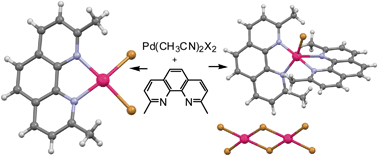
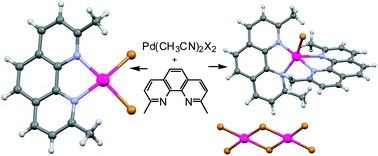
Phenanthroline-based complexes are increasingly finding use in heterogenous catalysis. One class of phenanthroline ligand is neocuproine – a dimethyl substituted derivative which Fabio Ragaini and his team have been interested in to mechanistically study the carbonylation of nitroarenes to carbamates.

When Ragaini et al. started working with the palladium neocuproine complexes, it appeared that minor variations in the synthetic procedure gave products with very different solubility properties, even though the elemental analysis data matched what was expected. In light of this, Ragaini and his team scoured the literature, upon which they discovered inconsistencies regarding the reported solubility of the [Pd(Neoc)X2] (X = Cl, Br, I) complexes.

Bearing this in mind,  Ragaini et al. decided to further investigate the nature of these compounds. They discovered that for each compound in the series, two structural isomers exist: one isomer is neutral and the second is ionic. Formation of the ionic isomer occurs under a much wider range of experimental conditions than the neutral isomer. The ionic isomer must have been synthesised in previous reports even if formation of the neutral one was claimed, say the authors.

It has already been shown that the way palladium–phosphine complexes are synthesised can affect the nature of the final product, in particular its catalytic activity. Ragaini and colleagues’ paper reiterates this for nitrogen-containing ligands and highlights the importance of correctly identifying a product’s structure.

Read the Dalton Transactions article in full to find out more:
Unexpected isomerism in “[Pd(2,9-dimethylphenanthroline)X2]” (X = Cl, Br, I) complexes: a neutral and an ionic form exist
Martino Rimoldi, Fabio Ragaini, Emma Gallo, Francesco Ferretti, Piero Macchi and Nicola Casati

Digg This
Reddit This
Stumble Now!
Share on Facebook
Bookmark this on Delicious
Share on LinkedIn
Bookmark this on Technorati
Post on Twitter
Google Buzz (aka. Google Reader)

Silver Complexes Kill Cancer Cells

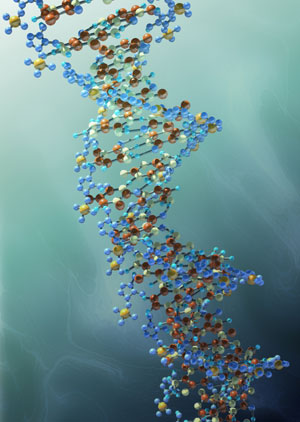
Cisplatin is a well known chemotherapy drug used to treat a range of cancers. While the drug can be an effective treatment there are notable unwanted side-effects, which can include nausea, vomiting, kidney damage and loss of hearing. This new research from Leeds University by Charlotte Willans et al. details the activity of a range of silver complexes containing N-heterocyclic carbene (NHC) ligands which show comparable and even enhanced cytotoxicity compared to cisplatin. As the compounds don’t contain platinum they are likely to be less toxic and therefore exhibit fewer and less severe side-effects.

The team synthesised a series of monodentate, bidentate and macrocyclic cationic silver bis(NHC) complexes and tested their activity with cell lines of breast and colon cancer (MCF7 and DLD1 lines respectively). They found that the bidentate complexes showed enhanced cytotoxicity over the monodentate and macrocyclic ligands, which were similar to cisplatin. As yet the exact mechanisms of action are still unclear but are likely linked to the stabilities of the complexes.

For more information about this exciting research you can download the article which is free to access for 4 weeks. You can also keep up to date with all the latest news in inorganic chemistry by following us on twitter or signing up to the Dalton Transactions e-alert service.

Enhanced cytotoxicity of silver complexes bearing bidentate N-heterocyclic carbene ligands
Charlotte E. Willans, Diana C F Monteiro, Roger M Phillips, Benjamin D Crossley and Jake Fielden
Dalton Trans., 2012, Accepted Manuscript
DOI: 10.1039/C2DT12399A

Also of interest from the collection ‘Highlights in Chemistry’

Therapeutic applications of gold complexes: lipophilic gold(III) cations and gold(I) complexes for anti-cancer treatment
Chi-Ming Che and Raymond Wai-Yin Sun 
Chem. Commun., 2011, 47, 9554-9560
DOI: 10.1039/C1CC10860C, Highlight

Digg This
Reddit This
Stumble Now!
Share on Facebook
Bookmark this on Delicious
Share on LinkedIn
Bookmark this on Technorati
Post on Twitter
Google Buzz (aka. Google Reader)

Top ten most accessed articles in December

This month sees the following articles in Dalton Transactions that are in the top ten most accessed:-

Neutral cuprous complexes as ratiometric oxygen gas sensors 
Xiaohui Liu, Wei Sun, Luyi Zou, Zhiyuan Xie, Xiao Li, Canzhong Lu, Lixiang Wang and Yanxiang Cheng 
Dalton Trans., 2012, 41, 1312-1319 DOI: 10.1039/C1DT11777G  
  

A porous metal–organic framework (MOF) with unusual 2D→3D polycatenation based on honeycomb layers 
Xiaoliang Zhao, Jianmin Dou, Di Sun, Peipei Cui, Daofeng Sun and Qingyin Wu 
Dalton Trans., 2012, 41, 1928-1930 DOI: 10.1039/C2DT11898J  

Crystal growth of nanoporous metal organic frameworks 
Martin P. Attfield and Pablo Cubillas 
Dalton Trans., 2012, Advance Article DOI: 10.1039/C2DT12006B  
  

Water oxidation catalysed by manganese compounds: from complexes to ‘biomimetic rocks’ 
Mathias Wiechen, Hans-Martin Berends and Philipp Kurz 
Dalton Trans., 2012, 41, 21-31 DOI: 10.1039/C1DT11537E    

Nitrogen-rich porous covalent imine network (CIN) material as an efficient catalytic support for C–C coupling reactions 
Manas K. Bhunia, Swapan K. Das, Pradip Pachfule, Rahul Banerjee and Asim Bhaumik 
Dalton Trans., 2012, 41, 1304-1311 DOI: 10.1039/C1DT11350J    

Two novel 3-D coordination polymers with 5-methoxyisophthalate and flexible N-donor co-ligands showing pentanuclear or alternate mono/binuclear Cu(ii) units 
Lu-Fang Ma, Jun-Wei Zhao, Min-Le Han, Li-Ya Wang and Miao Du 
Dalton Trans., 2012, 41, 2078-2083 DOI: 10.1039/C1DT11206F    

A pair of 3D homochiral metal–organic frameworks: spontaneous resolution, single-crystal-to-single-crystal transformation and selective adsorption properties 
Xiao-Dan Zheng, Mei Zhang, Long Jiang and Tong-Bu Lu 
Dalton Trans., 2012, 41, 1786-1791 DOI: 10.1039/C1DT11825K    

New photoluminescence acylhydrazidate-coordinated complexes 
Juan Jin, Fu-Quan Bai, Ming-Jun Jia, Yu Peng, Jie-Hui Yu and Ji-Qing Xu 
Dalton Trans., 2012, Advance Article DOI: 10.1039/C1DT11846C    

Unusual coordination mode of tetradentate Schiff base cobalt(iii) complexes 
Anish Cyriac, Jong Yeob Jeon, Jobi Kodiyan Varghese, Ji Hae Park, Soo Young Choi, Young Keun Chung and Bun Yeoul Lee 
Dalton Trans., 2012, 41, 1444-1447 DOI: 10.1039/C2DT11871H    

A highly selective and sensitive BODIPY-based colourimetric and turn-on fluorescent sensor for Hg2+ ions 
Xiong-Jie Jiang, Cheok-Lam Wong, Pui-Chi Lo and Dennis K. P. Ng 
Dalton Trans., 2012, 41, 1801-1807 DOI: 10.1039/C1DT11546D    

Why not take a look at the articles today and blog your thoughts and comments below.

Fancy submitting an article to Dalton Transactions? Then why not submit to us today or alternatively email us  your suggestions.

Digg This
Reddit This
Stumble Now!
Share on Facebook
Bookmark this on Delicious
Share on LinkedIn
Bookmark this on Technorati
Post on Twitter
Google Buzz (aka. Google Reader)

Carboxylate complexes going for gold!

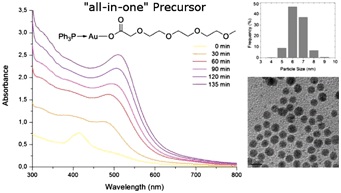
Gold nanoparticles (Au-NPs) are attractive for applications in important technological fields as components of biosensors, novel catalysts and new optical, magnetic or electrical devices. Traditional techniques for their preparation include thermal decomposition of organometallic precursors, chemical reduction of Au(I) ions, and electrochemical and photochemical processes. Methods based on reduction by sodium borohydride or citrate ions have been used successfully as the reducing agent acts also as a stabilizer and prevents further aggregation.

As an alternative, Heinrich Lang, from Chemnitz University of Technology, and coworkers have developed a family of gold(I) carboxylate complexes which can be used as precursors for the preparation of Au-NPs in a single step. The ligand works as the reducing and stabilizing part, simultaneously, in one molecule. After thermally induced decomposition of the complexes, Au-NPs are obtained with sizes in the range from 3.3 to 6.5 nm, and almost homogenous size distribution. The ethylene glycol-functionalized carboxylates were obtained from easy chemical reactions using available ethylene gycol or directly from commercial suppliers, and the complexes obtained by a two step procedure.  The authors report than larger chain lengths increased stability and slowed particle growth.

To find out more about it, read the full paper in Dalton Transactions.

Gold nanoparticles generated by thermolysis of “all-in-one” gold(I) carboxylate complexes
André Tuchscherer, Dieter Schaarshmidt, Steffen Schulze, Michael Hietschold, Heinrich Lang,
Dalton Transactions, 2012, Advance Article
DOI: 10.1039/c2dt11748g

Digg This
Reddit This
Stumble Now!
Share on Facebook
Bookmark this on Delicious
Share on LinkedIn
Bookmark this on Technorati
Post on Twitter
Google Buzz (aka. Google Reader)

Bacteria are not welcome here: antibacterial surfaces produced in glass

To catch a bacterial infection after a visit to a hospital for a health checkup is not a funny way to become sick. Even worse is when the infection came from a device which was supposed to help you to get better, not sicker, such as a medical device. Intra-hospital infections are difficult to avoid as some viruses or bacterias deposit on any surface available, which may become in contact with a healthy person, with potential health consequences.  Numerous approaches have been looked at in order to create materials with anti-bacterial capabilities. In this direction, silver and copper nanoparticles (AgNP and CuNP) are attractive as they may be able to avoid propagation of several microorganisms, including E. coli and S. aureus. Several methods have been tried to successfully immobilize the nanoparticles to a surface.

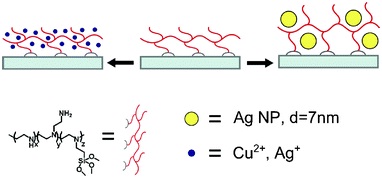
Giacomo Dacarro and coworkers at the Università degli Studi di Pavia at Italy, have devised a new way to chemically modify Si-OH terminated surfaces (glass, quartz, SiO2) by using a novel silane-derivatized polyethylenimine (PEI) and testing its ability to coordinate Ag+ and Cu2+ ions, and silver nanoparticles. The functionalized glasses are very effective in fighting against E. coli and S. aureus propagation, and may be an novel platform for use in designing smart, hybrid multifunctional materials.

Read more about his paper published in Dalton Transactions.

Monolayers of polyethilenimine on flat glass: a versatile platform for cations coordination and nanoparticles grafting in the preparation of antibacterial surfaces
Giacomo Dacarro, Lucia Cucca, Pietro Grisoli, Piersandro Pallavicini, Maddalena Patrini and Angelo Taglietti
Dalton Trans., Advance Article, 2012.
DOI: 10.1039/c1dt11373a 

Digg This
Reddit This
Stumble Now!
Share on Facebook
Bookmark this on Delicious
Share on LinkedIn
Bookmark this on Technorati
Post on Twitter
Google Buzz (aka. Google Reader)

Nano strikes again! Cross coupling catalytic activity of copper nanoparticles supported on silicon nanowires

Noble metals are highly regarded as unique catalysts for use in several reactions, many of them of interest for the pharmaceutical industry. However, their cost may be a reason why not to be considered in several applications.  When used in the form of nanoparticles, an increase of their activity is expected as a result of their large specific surface area, even when small amounts are used, which can save money and time. In the search for more efficient ways to form C-N bonds, a variety of homogenous catalysts such as Cu, Pd and Rh have been investigated in order to tune them and improve their ability to promote cross-coupling reactions among aryl halides and amines. Specifically, copper mediated Ullmann condensation is attractive as it is cheaper than Pd or Rh.

Zhenhui Kang and his group at the Institute of Functional Nano and Soft Materials and the Jiangsu Key Laboratory for Carbon-Based Functional Materials and Devices at Soochow University have developed a new catalyst based on copper nanoparticles inmovilized on silicon nanowires (CuNPs@SiNWs). This catalyst is able to enhance the coupling reaction at 110 °C among benzene halides and aniline in good yields, without the use of any ligand or additive. Even deactivated aryl bromides and inert chlorobenzene were reactive under the action of this novel catalysts. The authors suggest that the use of SiNWs as an alternative substrate support may be of interest of other researchers in the quest of superior heterogeneous catalysts.  

For further information, read the work by Zhenhui Kang and coworkers published in Dalton Transactions.

Copper nanoparticles modified silicon nanowires with enhanced cross-coupling catalytic ability
Keming Pan, Hai Ming, Hang Yu, Hui Huang, Yang Liu, Zhenhui Kang
Dalton Trans., Advance Article, 2012.
DOI: 10.1039/c2dt12182d

Digg This
Reddit This
Stumble Now!
Share on Facebook
Bookmark this on Delicious
Share on LinkedIn
Bookmark this on Technorati
Post on Twitter
Google Buzz (aka. Google Reader)

Happy Chinese New Year

The Dalton Transactions team wishes you every success in the Year of the Dragon, and we hope that you enjoy your New Year holiday.

In celebration we have made these recently promoted Dalton Transactions Hot articles free to access for the whole of February:

Ba2AgInS4 and Ba4MGa5Se12 (M = Ag, Li): syntheses, structures, and optical properties
Wenlong Yin, Kai Feng, Dajiang Mei, Jiyong Yao, Peizhen Fu and Yicheng Wu
DOI: 10.1039/C2DT11895E

Synthesis and properties of a dendritic FRET donor–acceptor system with cationic iridium(III) complex core and carbazolyl periphery
Yanfang Li, Yang Liu and Ming Zhou
DOI: 10.1039/C1DT11716E

Three novel Bi(III) complexes with in situ generated anilate ligands: unusual oxidation of cyclohexanedione to dihydroxy benzoquinone
Hui Gao and Xian-Ming Zhang
DOI: 10.1039/C1DT11258A

(Zn, Mg)2GeO4:Mn2+ submicrorods as promising green phosphors for field emission displays: hydrothermal synthesis and luminescence properties
Mengmeng Shang, Guogang Li, Dongmei Yang, Xiaojiao Kang, Chong Peng, Ziyong Cheng and Jun Lin
DOI: 10.1039/C1DT10673B

Dalton Transactions supports an online virtual web community for inorganic chemists, providing links to international research groups, conferences and events, and highlighting the latest research in the field. Be a part of this by accessing the Dalton Transactions blog, following us on twitter or signing up to our e-alert service.

Images courtesy of Shutterstock

Digg This
Reddit This
Stumble Now!
Share on Facebook
Bookmark this on Delicious
Share on LinkedIn
Bookmark this on Technorati
Post on Twitter
Google Buzz (aka. Google Reader)

Top ten most accessed articles in November

This month sees the following articles in Dalton Transactions that are in the top ten most accessed:-

Water oxidation catalysed by manganese compounds: from complexes to ‘biomimetic rocks’ 
Mathias Wiechen, Hans-Martin Berends and Philipp Kurz 
Dalton Trans., 2012, 41, 21-31 DOI:10.1039/c1dt11537e 

Self-assembly in inorganic chemistry 
Paul E. Kruger and Thorfinnur Gunnlaugsson 
Dalton Trans., 2011, 40, 12003-12004 DOI:10.1039/c1dt90162a 

Paramagnetic metal complexes of diamido donor ligands 
Cassandra E. Hayes and Daniel B. Leznoff 
Dalton Trans., 2012, Advance Article DOI:10.1039/c1dt11559f 

A series of pillar-layer metal?organic frameworks based on 5-aminoisophthalic acid and 4,4′-bipyridine 
Hai-Ning Wang, Xing Meng, Chao Qin, Xin-Long Wang, Guang-Sheng Yang and Zhong-Min Su 
Dalton Trans., 2012, 41, 1047-1053 DOI:10.1039/c1dt11304f 

The future of metal-organic frameworks 
Neil R. Champness 
Dalton Trans., 2011, 40, 10311-10315 DOI:10.1039/c1dt11184a 

A cationic iridium(iii) complex showing aggregation-induced phosphorescent emission (AIPE) in the solid state: synthesis, characterization and properties 
Guo-Gang Shan, Ling-Yu Zhang, Hai-Bin Li, Shuang Wang, Dong-Xia Zhu, Peng Li, Chun-Gang Wang, Zhong-Min Su and Yi Liao 
Dalton Trans., 2012, 523-530 DOI:10.1039/c1dt11215e 

The structure and reactivity of iron nitride complexes 
Jeremy M. Smith and Deepak Subedi 
Dalton Trans., 2012, Advance Article DOI:10.1039/c1dt11674f 

A novel Zn4O-based triazolyl benzoate MOF: synthesis, crystal structure, adsorption properties and solid state 13C NMR investigations 
Jörg Lincke, Daniel Lässig, Karolin Stein, Jens Moellmer, Anusree Viswanath Kuttatheyil, Christian Reichenbach, Andreas Moeller, Reiner Staudt, Grit Kalies, Marko Bertmer and Harald Krautscheid 
Dalton Trans., 2012, 817-824 DOI:10.1039/c1dt11431j 

Stepwise synthesis of a hydrido, N-heterocyclic dicarbene iridium(iii) pincer complex featuring mixed NHC/abnormal NHC ligands 
Weiwei Zuo and Pierre Braunstein 
Dalton Trans., 2012, 41, 636-643 DOI:10.1039/c1dt11511a 

Luminescent Ir(iii) complexes containing benzothiazole-based tridentate ligands: synthesis, characterization, and application to organic light-emitting diodes 
Junpei Kuwabara, Tomomi Namekawa, Masa-aki Haga and Takaki Kanbara 
Dalton Trans., 2012, 41, 44-46 DOI:10.1039/c1dt11560j 

Why not take a look at the articles today and blog your thoughts and comments below.

Fancy submitting an article to Dalton Transactions? Then why not submit to us today or alternatively email us  your suggestions.

Digg This
Reddit This
Stumble Now!
Share on Facebook
Bookmark this on Delicious
Share on LinkedIn
Bookmark this on Technorati
Post on Twitter
Google Buzz (aka. Google Reader)

Call for Papers: Polyoxometalates

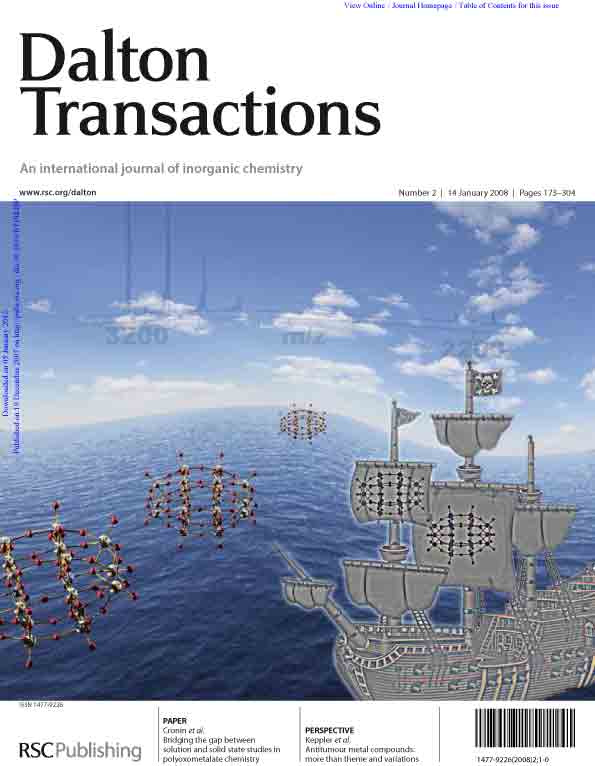
We are pleased to announce an upcoming themed issue on Polyoxometalates, guest edited by Leroy Cronin and Deliang Long. It is our pleasure to invite you to contribute to this themed issue.
 
During the last few years, poloyoxometalate (POM) chemistry has growth significantly. Thanks to its versatile nature in terms of structure, size, redox chemistry, photochemistry, and charge distribution, POM chemistry is one of the areas in inorganic chemistry that is developing most rapidly. Today, developments in POM research continue at a great pace, and new areas are emerging that are multidisciplinary, and exploit the great structural and electronic diversity of POM-based systems. The future of POM chemistry has many exciting new dimensions, interacting with materials, nanotechnology, biology, surfaces, catalysis, supramolecular materials, colloid science, and electronic materials. This Dalton Transactions themed issue will highlight to the inorganic research community the latest and very best research in POM chemistry.


How to submit?
All types of manuscript, Communications, Full Papers and Perspectives, will be considered for publication. We aim to publish this themed issue in the second half of 2012 and therefore would like to receive manuscripts by 28th February 2012. The manuscript should be prepared according to the format for regular articles and should be submitted via our online system. All invited manuscripts will be subject to the normal refereeing procedure.
 
Read some recently published polyoxometalate articles:
 
 
Digg This
Reddit This
Stumble Now!
Share on Facebook
Bookmark this on Delicious
Share on LinkedIn
Bookmark this on Technorati
Post on Twitter
Google Buzz (aka. Google Reader)