Nano-catalysis: call for papers

Submit an article to the high-profile PCCP themed issue on Controlled Nanostructures for Applications in Catalysts, which will be Guest Edited by Professor Ferdi Schüth (MPI Mülheim). The themed issue will be published in early 2011.

Deadline for Submission: 15 September 2010

The controlled fabrication of nanostructures has seen tremendous development over the last ten years or so. This progress was made possible by a combination of findings from different fields, such as the synthesis of ordered mesoporous materials, controlled preparation of size controlled nanoparticles, patterned functionalization of surfaces, integration of nanoparticles and dendrimers, among others. Such controlled nanostructures have been used in a variety of fields, but one of the most interesting applications is catalysis.

These nanostructured catalysts can have novel properties by the integration of different functional subunits or can catalyze novel types of conversions, such as cascade reactions by the integration of different catalytic functions. Moreover, the possibility to control the materials precisely on the nanoscale opens opportunities for fundamental studies, since these well ordered, structures and characterized materials are excellent model catalysts.

This themed issue will focus on the physical chemistry of these materials and their catalytic applications. Contributions should contain significant physical insight, therefore purely synthetic work cannot be considered for this issue. The purpose of this themed issue is to collect together the exciting work in this area and we believe it will make an important and lasting contribution to this area.

Submissions, either communications or full papers, should be high-quality manuscripts of original, unpublished research, containing important new physical insight.

All submissions will be subject to rigorous peer review to meet the usual high standards of PCCP.

Digg This
Reddit This
Stumble Now!
Share on Facebook
Bookmark this on Delicious
Share on LinkedIn
Bookmark this on Technorati
Post on Twitter
Google Buzz (aka. Google Reader)

Solid state and cluster structure prediction

This week’s issue of PCCP is all about ‘Solid state and cluster structure prediction‘ – take a look today!

This exciting themed issue is Guest Edited by Scott M. Woodley and Richard Catlow, University College London, UK.

Solid state and cluster structure predictionPrediction of the structures at the atomic level of molecules and materials remains one of the core challenges of chemistry. Computational chemistry and physics have given us powerful tools over the last few decades for accurate modelling of atomic level structures. But how far can we predict structures? That is, to what extent are we able, given knowledge of the chemical composition of a system, to identify reliably the thermodynamically stable structure?

This issue attempts to provide at least partial answers to this question by presenting a number of recent studies of the prediction of structures of both crystals and nanoparticles.

Want to read more about our upcoming themed issues? Please visit the ‘Themed Issues’ page on our website.

Digg This
Reddit This
Stumble Now!
Share on Facebook
Bookmark this on Delicious
Share on LinkedIn
Bookmark this on Technorati
Post on Twitter
Google Buzz (aka. Google Reader)

Chemical Dynamics of Large Amplitude Motion

The latest issue of PCCP is a themed issue on Chemical Dynamics of Large Amplitude Motion

PCCP is delighted to present a high-profile themed issue on Guest Edited by Professor David Nesbitt and Professor Martin Suhm, both members of the PCCP Editorial Board. Read their Editorial for the issue now – it’s great reading!

Want to read more about our upcoming themed issues? Please visit the ‘Themed Issues’ page on our website.

Digg This
Reddit This
Stumble Now!
Share on Facebook
Bookmark this on Delicious
Share on LinkedIn
Bookmark this on Technorati
Post on Twitter
Google Buzz (aka. Google Reader)

Japan-UK Symposium introduced by CSJ President

Professor Yasuhiro Iwasawa, President of the Chemical Society Japan (CSJ) and PCCP Editorial Board member, kicked of the Japan-UK Symposium this morning with his introductory lecture highlighting the collaboration between the RSC and CSJ.

Sign-up to the PCCP table-of-contents e-alert to see some of the great catalysis work we publish!

The two day event on Catalysis for a Sustainable World, held in the Chemistry Centre in London, aims to bring together scientists working from the UK and Japan. It offers an opportunity for networking and international collaboration and will begin to strengthen links between the RSC and CSJ.

Richard Pike (CEO, RSC) also made an exciting announcement about the launch of a brand new journal from RSC Publishing – Catalysis Science & Technology!

Digg This
Reddit This
Stumble Now!
Share on Facebook
Bookmark this on Delicious
Share on LinkedIn
Bookmark this on Technorati
Post on Twitter
Google Buzz (aka. Google Reader)

PCCP’s Impact Factor rises to 4.12 – a new record high!

The latest citation data released by Thomson ISI in June 2010 reveals that PCCP’s Impact Factor has risen again, to its highest ever value of 4.116

Latest Impact Factors for Physical Chemistry Journals

Latest Impact Factors for Physical Chemistry Journals

With fast publication times, and its wide, community-spanning international readership, PCCP remains the natural home for the highest-quality research in physical chemistry, chemical physics and biophysical chemistry.

Coupled with very strong recent growth in submissions, these impressive trends underline the continuing success of PCCP.

We thank all of our authors, readers and referees for their support which has led to these successes. 

Digg This
Reddit This
Stumble Now!
Share on Facebook
Bookmark this on Delicious
Share on LinkedIn
Bookmark this on Technorati
Post on Twitter
Google Buzz (aka. Google Reader)

Electrochemistry – the missing link to understanding space?

Daren Caruana and Katherine Holt discuss how electrochemistry could be the missing link to understanding chemistry in space 

To read the full Instant Insight article, click here: Cosmic dust as chemical factories

And read the PCCP Perspective article:

Astroelectrochemistry: the role of redox reactions in cosmic dust chemistry
Daren J. Caruana and Katherine B. Holt, Phys. Chem. Chem. Phys., 2010, 12, 3072

The search of the origin of life’s molecular building blocks has extended into interstellar space to find evidence of life forming chemicals. As yet no positive identification of molecules that can be considered as precursors to living systems on earth has been made. But, a rich mixture of complex chemicals has been discovered in the spaces between stars in our galaxy, which brings the question of how are these chemicals synthesised? 

Digg This
Reddit This
Stumble Now!
Share on Facebook
Bookmark this on Delicious
Share on LinkedIn
Bookmark this on Technorati
Post on Twitter
Google Buzz (aka. Google Reader)

Nobel laureate and PCCP Honorary Board member talks to Chemistry World

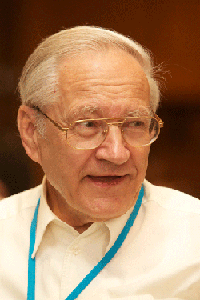
Richard Ernst

Richard Ernst, PCCP Honorary Board

PCCP Honorary Board member Richard Ernst, who won the 1991 Nobel Prize for his work on NMR spectroscopy, talks to Chemistry World about his career, the future of NMR spectroscopy and his love of Tibetan art.


Read this exciting article now!

To receive up-to-date news and contents alerts for PCCP sign-up for our e-alert today!

Digg This
Reddit This
Stumble Now!
Share on Facebook
Bookmark this on Delicious
Share on LinkedIn
Bookmark this on Technorati
Post on Twitter
Google Buzz (aka. Google Reader)