How does water behave inside narrow carbon nanotubes?

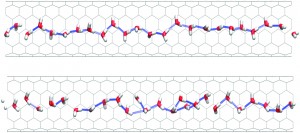
Hernandez and Schmidt investigate the role of anisotropic water-carbon interactions on water in low-diameter carbon nanotubes (CNTs) in their recent PCCP paper, and demonstrate the importance of the anisotropy. Extensive simulations provide a comprehensive picture of the effects of the interaction anisotropy on the structure and dynamics of water confined in narrow, single-walled CNTs.
water molecules in carbon nanotubes

Carbon based materials are generally accepted as being hydrophobic, but the calculated water-graphene interaction is found to be non-negligible and, moreover, orientation-dependant. The authors firstly calibrated new parameters for a Lennard-Jones potential, emphasising the anisotropy in the carbon-water interaction. They then performed molecular dynamics studies, using these parameters, of water inside various CNTs to examine properties such as structure, Lindemann index, mean square displacements and H-bonding patterns.

In contrast to previous simulations employing spherical interaction models, they found that the water molecules tend to form denser clusters displaying liquid-like behaviour, allowing for self-diffusion along the CNT axis.

Structures and hydrogen-bonding networks of water molecules inside CNTs can be radically different to those found in bulk water, due to the fact that the water molecules are confined in tubes with diameters not much larger than their own size. A central issue in many applications of CNTs is the possibility of conveying or storing fluids, hence the importance of understanding these systems.

Read about these fascinating results in this article:

Anisotropy of the Water-Carbon Interaction: Molecular Simulations of Water in Low-Diameter Carbon Nano-Tubes
Burkhard Schmidt
DOI: 10.1039/C3CP44278K

Digg This
Reddit This
Stumble Now!
Share on Facebook
Bookmark this on Delicious
Share on LinkedIn
Bookmark this on Technorati
Post on Twitter
Google Buzz (aka. Google Reader)

Novel aza-BODIPY dyes from theoretical study

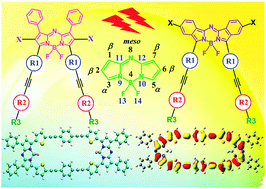
New insights into two-photon absorption properties of functionalized aza-BODIPY dyes at telecommunication wavelengths: a theoretical studyA recent theoretical study by Zhijan Wu, Aimin Ren and co-workers predicts novel BODIPY derivatives with interesting and potentially very useful nonlinear optical properties.
The group studied a series of aza-BODIPY fluorophores with structures expected to have large two-photon cross-sections at telecommunication wavelengths. They found that it is possible to finely tune the linear and non-linear optical properties by chemical modification of the aza-BODIPY core and peripheral moieties, resulting in excellent, original candidates for nonlinear transmission and fluorescent labelling materials.

Read the full paper:

New insights into two-photon absorption properties of functionalized aza-BODIPY dyes at telecommunication wavelengths: a theoretical study
Xiaoting Liu, Jilong Zhang, Kai Li, Xiaobo Sun, Zhijian Wu, Aimin Ren and Jikang Feng
DOI: 10.1039/C3CP44435J

Digg This
Reddit This
Stumble Now!
Share on Facebook
Bookmark this on Delicious
Share on LinkedIn
Bookmark this on Technorati
Post on Twitter
Google Buzz (aka. Google Reader)

Automatic tracking of the movement of single molecules

A method for automatically tracking single fluorescent molecules has been described by scientists developing new techniques in single molecule microscopy (SMM).

The ability to detect and follow single fluorescent molecules provides a unique insight into the diffusion processes occurring in material science and biological systems. SMM is fraught with technical challenges, however, with low signal-to-noise-ratios and ‘blinking’ of fluorescent molecules making them difficult to track.

To overcome these issues, a new method of data analysis is described, and made available to the scientific community as open-source Matlab code by the authors.

Read this HOT PCCP article in full:

A novel method for automatic single molecule tracking of blinking molecules at low intensities

Dominik Wöll, Christoph Kölbl, Beate Stempfle and Andreas Karrenbauer
DOI: 10.1039/C3CP44693J

This article is part of the PCCP web collection on biophysics and biophysical chemistry – take a look today!

Digg This
Reddit This
Stumble Now!
Share on Facebook
Bookmark this on Delicious
Share on LinkedIn
Bookmark this on Technorati
Post on Twitter
Google Buzz (aka. Google Reader)

Blink and you’ll miss it: PCCP article in Chemistry World

Single-molecule spectroscopy can provide new insights into the dynamics of biological and material science, but analysing the data from this technique is no simple task. To this end, scientists in Germany have developed a new method for tracking single fluorescent molecules, using linear programming solvers.
 
Whereas previous methods have involved tracking by hand or with semi-manual systems, this new algorithm means standard computers can be used instead, freeing up the researchers’ time and reducing the risk of mistakes. This new technique is essential for the on-going miniaturization of devices to the nanoscale.
 

Interested to know more? Read the full article in Chemistry World here…

Read the article from PCCP:

A novel method for automatic single molecule tracking of blinking molecules at low intensities
Dominik Wöll ,  Christoph Kölbl ,  Beate Stempfle and Andreas Karrenbauer
Phys. Chem. Chem. Phys., 2013, Advance Article
DOI: 10.1039/C3CP44693J

Digg This
Reddit This
Stumble Now!
Share on Facebook
Bookmark this on Delicious
Share on LinkedIn
Bookmark this on Technorati
Post on Twitter
Google Buzz (aka. Google Reader)

The interaction of hemoglobin and red blood cells with silver and gold nanoparticles revealed using SERS

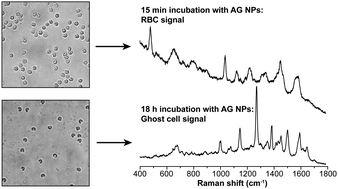
SERS reveals the specific interaction of silver and gold nanoparticles with hemoglobin and red blood cell componentsJanina Kneipp and co-authors report SERS spectra of hemoglobin using silver and gold nanoparticles in red blood cells in their recent PCCP paper, which shed light on the interactions of nanoparticles with red blood cells.
The group used small nanoparticle concentrations compared to the concentration of hemoglobin molecules, similar to the situation upon nanoparticle entry into the hemoglobin-rich environment of the red blood cell. They demonstrated the dependence of the SERS spectra on the type and size of nanoparticle used as the SERS substrate. They confirmed that the nanoparticles interact with blood cells via interaction with hemoglobin and are also in contact with many other red blood cell components. Interestingly, the evidence shows nanoparticle-induced structural changes in the lipid bilayer of the red blood cells.

Understanding these interactions are of great importance, as silver nanoparticles, found everywhere in everyday life, display high cytotoxicity. The uptake of nanoparticles into red blood is also intriguing as it does not occur by endocytosis.

Read the detail in this article today:

SERS reveals the specific interaction of silver and gold nanoparticles with hemoglobin and red blood cell components
Daniela Drescher, Tina Büchner, Don McNaughton and Janina Kneipp
DOI: 10.1039/C3CP43883J

If you enjoyed this article, keep an eye out for our themed issue on plasmonics and spectroscopy, which is soon to be published.

Digg This
Reddit This
Stumble Now!
Share on Facebook
Bookmark this on Delicious
Share on LinkedIn
Bookmark this on Technorati
Post on Twitter
Google Buzz (aka. Google Reader)

Combinatorial evaluation of metal oxides for water splitting

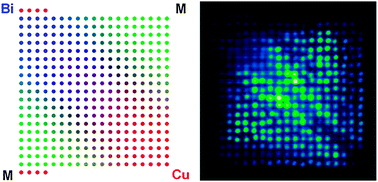
A new dispenser and scanner system has been developed that creates and screens arrays of different metal oxides, assessing there suitability for photocatalytic water-splitting reactions. The technique operates in a combinatorial fashion and has been used to screen over 3000 unique Bi:M:Cu atomic ratios, where M represents one of 22 post-transition metals.

Of the 22 metals tested, 10 were found to have a M-Cu oxide with higher photochemical activity than CuO, while 10 had a Bi-M-Cu oxide with more activity than CuBi2O4. The best performing combination was BiAgCu oxide with the ratio 22:3:11, which produced a photocurrent four times that of CuBi2O4. The material was capable of evolving hydrogen from neutral electrolyte solutions under illumination at 0.6V vs RHE when platinum was added as an electrocatalyst.

Read the full details of this fascinating PCCP article:

Screening of transition and post-transition metals to incorporate into copper oxide and copper bismuth oxide for photoelectrochemical hydrogen evolution
Sean P. Berglund, Heung Chan Lee, Paul D. Núñez, Allen J. Bard and C. Buddie Mullins
DOI: 10.1039/C3CP50540E

Table of contents image

Digg This
Reddit This
Stumble Now!
Share on Facebook
Bookmark this on Delicious
Share on LinkedIn
Bookmark this on Technorati
Post on Twitter
Google Buzz (aka. Google Reader)

Tighter control over high-power dual-pulse EPR experiments

Scientists in Germany and the USA report a method for measuring pulsed electron paramagnetic resonance (EPR) spectra using a free-electron laser as a radiation source in their Physical Chemistry Chemical Physics (PCCP) article. The high power afforded by the laser enables EPR experiments to be carried out at 240GHz, which significantly enhances the sensitivity of the technique.

The authors of the study have solved the problem of random phase shifts of the free-electron pulse using retrospective data processing, and are able to control phases between pulses, enabling two-pulse experiments that are fundamental to EPR.

Read about this exciting development today:

Phase cycling with a 240 GHz, free electron laser-powered electron paramagnetic resonance spectrometer
Devin T Edwards, Yun Zhang, Steffen J Glaser, Songi Han and Mark Sherwin
DOI: 10.1039/C3CP44492A

Digg This
Reddit This
Stumble Now!
Share on Facebook
Bookmark this on Delicious
Share on LinkedIn
Bookmark this on Technorati
Post on Twitter
Google Buzz (aka. Google Reader)

Surface plasmon coupling in end-to-end linked gold nanorods

Paul Mulvaney and co-workers investigate the optical properties of an end-to-end assembly of gold nanorods in their recent PCCP paper.

The group from the University of Melbourne used optical and electron microscopy to study the scattering properties of colloidal gold nanorods aligned end-to-end via dithiol coupling at the single particle level. They found that the nanostructures exhibited polarization-dependant optical properties, due to selective excitation of collective bonding and antibonding modes.

The authors were interested in how the angle between plasmonic structures affects coupling. They examined the coupling between both gold nanorod dimers and rod-sphere-rod trimers as a function of subtended angles of the dimer and trimer. They found that the intensity of the resonance in dimers and trimers depends strongly on the angles within the assembled structure. Additionally, they determined that the coupled longitudinal surface plasmon resonance of coupled Au nanorods exhibited a red shift as the number of rods in the chain increased.

Read this HOT article today:

Surface plasmon coupling in end-to-end linked gold nanorod dimers and trimers
Jatish Kumar, Xingzhan Wei, Steven Barrow, Alison M. Funston, K. George Thomas and Paul Mulvaney
DOI: 10.1039/C3CP44657C

If you enjoyed this article you will enjoy our themed issue on optical studies of single metal nanoparticles. Take a look!

Digg This
Reddit This
Stumble Now!
Share on Facebook
Bookmark this on Delicious
Share on LinkedIn
Bookmark this on Technorati
Post on Twitter
Google Buzz (aka. Google Reader)

PCCP themed issue: Superresolution imaging and fabrication with light – deadline approaching

Superresolution imaging and fabrication with light
Guest Editors: Françisco M. Raymo (University of Miami, USA)

Deadline for Submissions: 8 April 2013

Submit using our online submission service

There is still time to contribute to the high-profile themed issue ‘Superresolution imaging and fabrication with light’.

The themed issue will be published in PCCP in  2013. It will receive great exposure, and get significant promotion.

It is essential that all submissions to PCCP should contain new physical insight and contributions to this themed collection will be assessed on this basis.

  • Manuscripts can be submitted in any reasonable format using our online submissions service
  • Submissions should be high quality manuscripts of original, unpublished research
  • Communications and full papers can be submitted for consideration, which will be subject to rigorous peer review
  • Please indicate upon submission that your manuscript is intended for this themed is intended for the themed issue

Please contact the PCCP Editorial Office to let us know you plan to contribute an article.

Digg This
Reddit This
Stumble Now!
Share on Facebook
Bookmark this on Delicious
Share on LinkedIn
Bookmark this on Technorati
Post on Twitter
Google Buzz (aka. Google Reader)

Optical studies of single metal nanoparticles themed collection out now!

We are delighted to announce that the PCCP themed collection on Optical studies of single metal nanoparticles has now been published online – take a look today!

The themed collection was Guest Edited by Greg Hartland, Hiromi Okamoto, Michel Orrit and Peter Zijlstra – read their Editorial for this issue.

Optical studies of single metal nanoparticles themed collection features a broad range of Papers and Communications and includes the following Perspective and Hot articles:

Spectral properties and electromagnetic field enhancement effects on nano-engineered metallic nanoparticles
Kosei Ueno and Hiroaki Misawa

Optical properties of single coupled plasmonic nanoparticles
Lianming Tong, Hong Wei, Shunping Zhang, Zhipeng Li and Hongxing Xu

Single nanoparticle plasmonics
Emilie Ringe, Bhavya Sharma, Anne-Isabelle Henry, Laurence D. Marks and Richard P. Van Duyne

Surface plasmon coupling in end-to-end linked gold nanorod dimers and trimers
Jatish Kumar ,  Xingzhan Wei ,  Steven Barrow ,  Alison M. Funston ,  K. George Thomas and Paul Mulvaney 
 
Damping of the acoustic vibrations of a suspended gold nanowire in air and water environments
Todd A. Major ,  Aurélien Crut ,  Bo Gao ,  Shun Shang Lo ,  Natalia Del Fatti ,  Fabrice Vallée and Gregory V. Hartland

Nanoparticle surface electromagnetic fields studied by single-particle nonlinear optical spectroscopy
Manabendra Chandra and Kenneth L. Knappenberger 

Hyperspectral darkfield microscopy of single hollow gold nanoparticles for biomedical applications
Natasha Fairbairn ,  Agathi Christofidou ,  Antonios G. Kanaras ,  Tracey A. Newman and Otto L. Muskens

Take a look at the issue today!

Digg This
Reddit This
Stumble Now!
Share on Facebook
Bookmark this on Delicious
Share on LinkedIn
Bookmark this on Technorati
Post on Twitter
Google Buzz (aka. Google Reader)