Archive for the ‘News’ Category

Editor’s Choice: Catalysis and surface chemistry

journal cover imagePhysical Chemistry Chemical Physics (PCCP) Advisory Board member Professor Yasuhiro Iwasawa, an expert in the field of catalysis and surface chemistry, has picked his favourite articles recently published in this area in PCCP.

Read Professor Iwasawa’s Editor’s choice selection today:

Single-molecule nanoscale electrocatalysis
Hao Shen, Weilin Xu and Peng Chen
DOI: 10.1039/C000448K

Nanoporous gold: a new material for catalytic and sensor applications
Arne Wittstock, Jürgen Biener and Marcus Bäumer
DOI: 10.1039/C0CP00757A

Characterization of Fe sites in Fe-zeolites by FTIR spectroscopy of adsorbed NO: are the spectra obtained in static vacuum and dynamic flow set-ups comparable?
Gloria Berlier, Carlo Lamberti, Mickaël Rivallan and Guido Mul
DOI: 10.1039/B917646M

The role of Cu on the reduction behavior and surface properties of Fe-based Fischer–Tropsch catalysts
Emiel de Smit, Frank M. F. de Groot, Raoul Blume, Michael Hävecker, Axel Knop-Gericke and Bert M. Weckhuysen
DOI: 10.1039/B920256K

Oscillatory behaviour of catalytic properties, structure and temperature during the catalytic partial oxidation of methane on Pd/Al2O3
Bertram Kimmerle, Alfons Baiker and Jan-Dierk Grunwaldt
DOI: 10.1039/B924001B

Combined TPRx, in situ GISAXS and GIXAS studies of model semiconductor-supported platinumcatalysts in the hydrogenation of ethane
Sonja A. Wyrzgol, Susanne Schäfer, Sungsik Lee, Byeongdu Lee, Marcel Di Vece, Xuebing Li, Sönke Seifert, Randall E. Winans, Martin Stutzmann, Johannes A. Lercher and Stefan Vajda
DOI: 10.1039/B926493K

In situ time-resolved DXAFS for the determination of kinetics of structural changes of H-ZSM-5-supported active Re-cluster catalyst in the direct phenol synthesis from benzene and O2
Mizuki Tada, Yohei Uemura, Rajaram Bal, Yasuhiro Inada, Masaharu Nomura and Yasuhiro Iwasawa
DOI: 10.1039/C000843P

Hydrogen induced CO activation on open Ru and Co surfaces
Sharan Shetty and Rutger A. van Santen
DOI: 10.1039/B926731J

Size-selected clusters as heterogeneous model catalysts under applied reaction conditions
Sebastian Kunz, Katrin Hartl, Markus Nesselberger, Florian F. Schweinberger, GiHan Kwon, Marianne Hanzlik, Karl J. J. Mayrhofer, Ueli Heiz and Matthias Arenz
DOI: 10.1039/C0CP00288G

Pt promotion and spill-over processes during deposition and desorption of upd-Had and OHad on PtxRu1−x/Ru(0001) surface alloys
Harry E. Hoster, Michael J. Janik, Matthew Neurock and R. Jürgen Behm
DOI: 10.1039/C003635H

O2 adsorption and dissociation on neutral, positively and negatively charged Aun (n = 5–79) clusters
Alberto Roldán, Josep Manel Ricart, Francesc Illas and Gianfranco Pacchioni
DOI: 10.1039/C004110F

Unravelling the atomic structure of cross-linked (1 × 2) TiO2(110)
Hans Hermann Pieper, Krithika Venkataramani, Stefan Torbrügge, Stephan Bahr, Jeppe V. Lauritsen, Flemming Besenbacher, Angelika Kühnle and Michael Reichling
DOI: 10.1039/C0CP00160K

‘Nanoreactors’ for photocatalytic H2 evolution in oil–water biphase systems
Jiehua Liu, Xiangfeng Wei, Yaolun Yu, Xin Wang, Wei-Qiao Deng and Xue-Wei Liu
DOI: 10.1039/C0CP01396J

Publishing work of the highest quality in the broad fields of physical chemistry, chemical physics and biophysical chemistry, PCCP is the ideal place to publish your research.

On behalf of the Editorial Board we invite you to submit your best work to PCCP.

PCCP now offers you the chance to publish your accepted article as an Accepted Manuscript. This means that your research is available, in citable form, to the community even more rapidly. Click here to find out more.

Digg This
Reddit This
Stumble Now!
Share on Facebook
Bookmark this on Delicious
Share on LinkedIn
Bookmark this on Technorati
Post on Twitter
Google Buzz (aka. Google Reader)

Editor’s Choice: Ultracold Molecules

Physical Chemistry Chemical Physics (PCCP) Advisory Board member Professor Roman Krems, an expert in the field of ultracold molecules, has picked his favourite articles recently published in this area in PCCP.

Read Professor Krems’ Editor’s choice selection today:

A dipolar gas of ultracold molecules
K.-K. Ni, S. Ospelkaus, D. J. Nesbitt, J. Ye and D. S. Jin
DOI: 10.1039/B911779B

Cold heteromolecular dipolar collisions
Brian C. Sawyer, Benjamin K. Stuhl, Mark Yeo, Timur V. Tscherbul, Matthew T. Hummon, Yong Xia, Jacek Kłos, David Patterson, John M. Doyle and Jun Ye
DOI: 10.1039/C1CP21203F

Inelastic collisions of ultracold polar LiCs molecules with caesium atoms in an optical dipole trap
Johannes Deiglmayr, Marc Repp, Roland Wester, Olivier Dulieu and Matthias Weidemüller
DOI: 10.1039/C1CP21396B

Trapping cold molecular hydrogen
Ch. Seiler, S. D. Hogan and F. Merkt
DOI: 10.1039/C1CP21276A

Formation and dynamics of van der Waals molecules in buffer-gas traps
Nathan Brahms, Timur V. Tscherbul, Peng Zhang, Jacek Kłos, Robert C. Forrey, Yat Shan Au, H. R. Sadeghpour, A. Dalgarno, John M. Doyle and Thad G. Walker
DOI: 10.1039/C1CP21317B

Universal ultracold collision rates for polar molecules of two alkali-metal atoms
Paul S. Julienne, Thomas M. Hanna and Zbigniew Idziaszek
DOI: 10.1039/C1CP21270B

A bright, slow cryogenic molecular beam source for free radicals
J. F. Barry, E. S. Shuman and D. DeMille
DOI: 10.1039/C1CP20335E

A cryogenic beam of refractory, chemically reactive molecules with expansion cooling
Nicholas R. Hutzler, Maxwell F. Parsons, Yulia V. Gurevich, Paul W. Hess, Elizabeth Petrik, Ben Spaun, Amar C. Vutha, David DeMille, Gerald Gabrielse and John M. Doyle
DOI: 10.1039/C1CP20901A

Production of cold bromine atoms at zero mean velocity by photodissociation
W. G. Doherty, M. T. Bell, T. P. Softley, A. Rowland, E. Wrede and D. Carty
DOI: 10.1039/C0CP02472D

Cooling and collisions of large gas phase molecules
David Patterson, Edem Tsikata and John M. Doyle
DOI: 10.1039/C002764B

Publishing work of the highest quality in the broad fields of physical chemistry, chemical physics and biophysical chemistry, PCCP is the ideal place to publish your research.

On behalf of the Editorial Board we invite you to submit your best work to PCCP.

Digg This
Reddit This
Stumble Now!
Share on Facebook
Bookmark this on Delicious
Share on LinkedIn
Bookmark this on Technorati
Post on Twitter
Google Buzz (aka. Google Reader)

Call for papers: “Interfaces with Ionic Liquids” themed issue

Physical Chemistry Chemical Physics (PCCP) is delighted to announce a forthcoming high-profile themed issue:

Interfaces with Ionic Liquids

Guest Editor: Frank Endres

We invite you to submit a high quality manuscript of original, unpublished research with a focus on the interfaces of ionic liquids with gas/vacuum, solid surfaces and other liquids, both experimental and theoretical aspects.

Deadline for submissions: 30 November 2011.

This will be the official themed issue of the international Bunsentagung 2012 meeting on the theme of “Ionic Liquids” organised by the Deutsche Bunsen-Gesellschaft which takes place from 17-19 May 2012 in Leipzig, Germany.  The plenary speakers at the meeting are Ken Seddon, Masayoshi Watanabe, Doug MacFarlane and Cinzia Chiappe. We will be freely distributing the printed themed issue at this meeting, maximising the visibility and profile of all published papers.

All submissions will be subject to rigorous peer review to meet the high standards of PCCP. Further details about PCCP can be found on our website www.rsc.org/pccp.

When you submit your article, please indicate that it is for the themed issue.

Digg This
Reddit This
Stumble Now!
Share on Facebook
Bookmark this on Delicious
Share on LinkedIn
Bookmark this on Technorati
Post on Twitter
Google Buzz (aka. Google Reader)

PCCP Poster Prizes: Horizons in Hydrogen Bond Research

PCCP was delighted to sponsor the 19th Conference on “Horizons of Hydrogen Bond Research” which took place on 12-17 September in Göttingen, Germany. PCCP were pleased to award two Poster Prizes at the conference.

Congratulations to Nils Lüttschwager and Ondrej Marsálek who were awarded the PCCP Poster Prizes. The winners were presented with a PCCP Prize certificate, as well as a financial award.

PCCP will be awarding more Poster Prizes next year, so please do let us know of any suitable conferences which PCCP could sponsor in 2012.

Submit your lastest research to PCCP today!

Digg This
Reddit This
Stumble Now!
Share on Facebook
Bookmark this on Delicious
Share on LinkedIn
Bookmark this on Technorati
Post on Twitter
Google Buzz (aka. Google Reader)

RSC Research Fund – applications open

The RSC Research Fund exists to assist members of the RSC in their research by the provision of grants of up to £2000.

If you work in a university, college or school anywhere in the world and your work is held up for lack of moderate funding, the RSC Research Fund may be able to help you.

Preference will be given to those working in less well-endowed institutions and to those supporting their own research. Applications from those working in well-established universities will normally only be considered in exceptional circumstances and evidence to support such proposals must be provided.

The RSC Council is especially anxious to see inventive applications of a “pump priming” nature and is prepared to consider applications from those working in chemical education as well as chemistry research.

Members in developing countries should note particularly that additional funds have been made available to provide grants for successful applicants from such countries. Preference will be given to those able to cite collaborative research projects with institutions in countries other than their own.

Applications are limited to one per department. The closing date for applications is 31 October 2011.

Rules and Criteria for the Research Fund

Apply to the RSC Research Fund

Digg This
Reddit This
Stumble Now!
Share on Facebook
Bookmark this on Delicious
Share on LinkedIn
Bookmark this on Technorati
Post on Twitter
Google Buzz (aka. Google Reader)

Dissolving salt is more complex than you might think

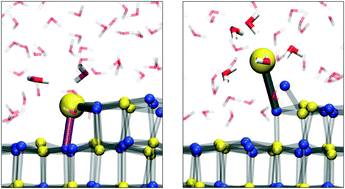
Michaelides et al. have investigated how NaCl dissolves in water using ab initio modelling of the system. The process involves several steps and begins with the loss of Cl ions. An improved understanding of the dissolution process of salt could be applied to many environmental and atmospheric chemistry problems.

This interesting research is also highlighted on the website of University College London’s Chemistry Department.

Read the full communication:

Initial stages of salt crystal dissolution determined with ab initio molecular dynamics
Li-Min Liu, Alessandro Laio and Angelos Michaelides
Phys. Chem. Chem. Phys., 2011, 13, 13162-13166
DOI: 10.1039/C1CP21077G

image

Digg This
Reddit This
Stumble Now!
Share on Facebook
Bookmark this on Delicious
Share on LinkedIn
Bookmark this on Technorati
Post on Twitter
Google Buzz (aka. Google Reader)

3D graphene structures are potential gas separation membranes

HOT PCCP Communication

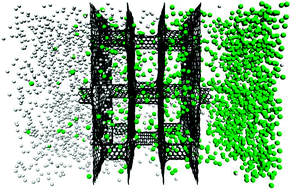
A 3D network structure made of graphene planes with carbon nanotube pillars has been modeled by Polish scientists. These materials show great promise for application as gas separation membranes.

Read the full article:

Pillared graphene as a gas separation membrane
Radosław P. Wesołowski and Artur P. Terzyk
DOI: 10.1039/C1CP21590F

image

Digg This
Reddit This
Stumble Now!
Share on Facebook
Bookmark this on Delicious
Share on LinkedIn
Bookmark this on Technorati
Post on Twitter
Google Buzz (aka. Google Reader)

PCCP Most-Read Articles for Q2 2011

Top 25 most-read PCCP articles for Q2

Characterization of nanostructured hybrid and organic solar cells by impedance spectroscopy
Francisco Fabregat-Santiago, Germà Garcia-Belmonte, Iván Mora-Seró and Juan Bisquert
DOI: 10.1039/C0CP02249G

Density functional theory for transition metals and transition metal chemistry
Christopher J. Cramer and Donald G. Truhlar
DOI: 10.1039/B907148B

Photoblinking and photobleaching of rylene diimide dyes
Mathias Haase, Christian G. Hübner, Fabian Nolde, Klaus Müllen and Thomas Basché
DOI: 10.1039/C0CP01814G

Titania supported gold nanoparticles as photocatalyst
Ana Primo, Avelino Corma and Hermenegildo García
DOI: 10.1039/C0CP00917B

Bimetallic Pt–Au nanocatalysts electrochemically deposited on graphene and their electrocatalytic characteristics towards oxygen reduction and methanol oxidation
Yaojuan Hu, Hua Zhang, Ping Wu, Hui Zhang, Bo Zhou and Chenxin Cai
DOI: 10.1039/C0CP01998D

Catalysis by metal–organic frameworks: fundamentals and opportunities
Marco Ranocchiari and Jeroen Anton van Bokhoven
DOI: 10.1039/C0CP02394A

Studying disorder in graphite-based systems by Raman spectroscopy
M. A. Pimenta, G. Dresselhaus, M. S. Dresselhaus, L. G. Cançado, A. Jorio and R. Saito
DOI: 10.1039/B613962K

Enhanced electrocatalytic performance of functionalized carbon nanotube electrodes for oxygen reduction in proton exchange membrane fuel cells
Ramaiyan Kannan, Unni Bipinlal, Sreekumar Kurungot and Vijayamohanan K. Pillai
DOI: 10.1039/C0CP02853C

Colloidal metal nanoparticles as a component of designed catalyst
Chun-Jiang Jia and Ferdi Schüth
DOI: 10.1039/C0CP02680H

Layer-by-layer assembly as a versatile bottom-up nanofabrication technique for exploratory research and realistic application
Katsuhiko Ariga, Jonathan P. Hill and Qingmin Ji
DOI: 10.1039/B700410A

Recent progress in SERS biosensing
Kyle C. Bantz, Audrey F. Meyer, Nathan J. Wittenberg, Hyungsoon Im, Özge Kurtuluş, Si Hoon Lee, Nathan C. Lindquist, Sang-Hyun Oh and Christy L. Haynes
DOI: 10.1039/C0CP01841D

Direct electro-deposition of graphene from aqueous suspensions
Matthias Hilder, Bjorn Winther-Jensen, Dan Li, Maria Forsyth and Douglas R. MacFarlane
DOI: 10.1039/C1CP20173E

Sandwich-type functionalized graphene sheet-sulfur nanocomposite for rechargeable lithium batteries
Yuliang Cao, Xiaolin Li, Ilhan A. Aksay, John Lemmon, Zimin Nie, Zhenguo Yang and Jun Liu
DOI: 10.1039/C0CP02477E

A thorough benchmark of density functional methods for general main group thermochemistry, kinetics, and noncovalent interactions
Lars Goerigk and Stefan Grimme
DOI: 10.1039/C0CP02984J

Overcoming excitonic bottleneck in organic solar cells: electronic structure and spectra of novel semiconducting donor–acceptor block copolymers
Zhenyu Guo, Samson A. Jenekhe and Oleg V. Prezhdo
DOI: 10.1039/C0CP02180F

Multiscale modeling of biological functions
Shina Caroline Lynn Kamerlin and Arieh Warshel
DOI: 10.1039/C0CP02823A

In situ Raman spectroscopy of H2 interaction with WO3 films
J. Z. Ou, M. H. Yaacob, M. Breedon, H. D. Zheng, J. L. Campbell, K. Latham, J. du. Plessis, W. Wlodarski and K. Kalantar-zadeh
DOI: 10.1039/C0CP02050H

Carbon materials for supercapacitor application
Elzbieta Frackowiak
DOI: 10.1039/B618139M

Air and water stable ionic liquids in physical chemistry
Frank Endres and Sherif Zein El Abedin
DOI: 10.1039/B600519P

Fe3O4 nanoparticle-integrated graphene sheets for high-performance half and full lithium ion cells
Liwen Ji, Zhongkui Tan, Tevye R. Kuykendall, Shaul Aloni, Shidi Xun, Eric Lin, Vincent Battaglia and Yuegang Zhang
DOI: 10.1039/C1CP20455F

Quantum mechanics/molecular mechanics methods can be more accurate than full quantum mechanics in systems involving dispersion correlations
W. M. C. Sameera and Feliu Maseras
DOI: 10.1039/C0CP02957B

In silico screening of metal–organic frameworks in separation applications
Rajamani Krishna and Jasper M. van Baten
DOI: 10.1039/C1CP20282K

A biophysical perspective of understanding nanoparticles at large
Pu Chun Ke and Monica H. Lamm
DOI: 10.1039/C0CP02891F

Hybrid simulations: combining atomistic and coarse-grained force fields using virtual sites
Andrzej J. Rzepiela, Martti Louhivuori, Christine Peter and Siewert J. Marrink
DOI: 10.1039/C0CP02981E

Hydrogen evolution via sunlight water splitting on an artificial butterfly wing architecture
Huihui Liu, QibinZhao, Han Zhou, Jian Ding, Di Zhang, Hanxing Zhu and Tongxiang Fan
DOI: 10.1039/C1CP20787C

Digg This
Reddit This
Stumble Now!
Share on Facebook
Bookmark this on Delicious
Share on LinkedIn
Bookmark this on Technorati
Post on Twitter
Google Buzz (aka. Google Reader)

Fall ACS update: Plenary lectures on air, space and water

On Sunday, at the ACS meeting plenary session, we heard 3 inspiring talks which highlighted the importance of this meeting’s theme: air, space and water.

Russell J. Hemley gave a fascinating lecture on his research into space; namely planetary gases, liquids and ices and how chemistry can help us to understand what goes on out there in all that darkness!

Neil Donahue followed, talking about air and his work on bulk aerosol properties. You can read all about his exciting research in his PCCP Perspective article published earlier this year:

Adventures in ozoneland: down the rabbit-hole
Neil M. Donahue, Greg T. Drozd, Scott A. Epstein, Albert A. Presto and Jesse H. Kroll
DOI: 10.1039/C0CP02564J

The final plenary lecture was given by Alan Townsend who highlighted the importance of water to all of chemistry and discussed its vital role in the nitrogen cycle.

Watch this space for more news from the Fall ACS in Denver!

Digg This
Reddit This
Stumble Now!
Share on Facebook
Bookmark this on Delicious
Share on LinkedIn
Bookmark this on Technorati
Post on Twitter
Google Buzz (aka. Google Reader)

Fall ACS update: ‘HOT’ papers on SERS

The 242nd ACS National Meeting started today in Denver, CO, USA, and the Physical Chemistry Division kicked off with a symposium on SERS which will run all week.

The Advances in SERS and Molecular Plasmonics symposium began with an exciting talk by Richard Van Duyne. His lecture entitled “Pushing the limits: Single molecule and single particle surface-enhanced Raman spectroscopy”, followed by further talks on single molecule SERS and plasmonically-enhanced hot spots.

Read Richard van Duyne’s PCCP Perspective, which is from the recent PCCP web-themed issue on Surface-Enhanced Raman Scattering:

Surface-enhanced Raman spectroscopy of dyes: from single molecules to the artists’ canvas
Kristin L. Wustholz, Christa L. Brosseau, Francesca Casadio and Richard P. Van Duyne
DOI: 10.1039/B904733F

Digg This
Reddit This
Stumble Now!
Share on Facebook
Bookmark this on Delicious
Share on LinkedIn
Bookmark this on Technorati
Post on Twitter
Google Buzz (aka. Google Reader)