Archive for the ‘News’ Category

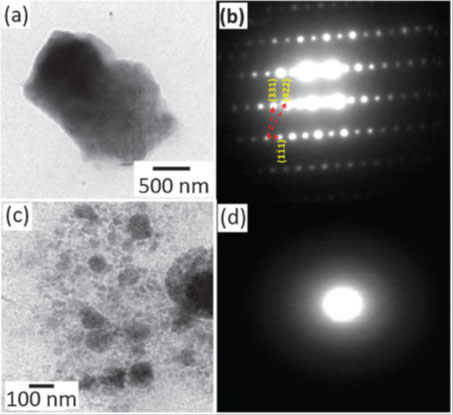
The interaction of hemoglobin and red blood cells with silver and gold nanoparticles revealed using SERS

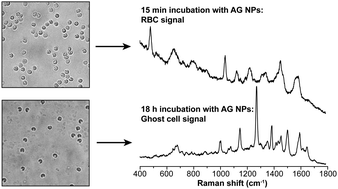
SERS reveals the specific interaction of silver and gold nanoparticles with hemoglobin and red blood cell componentsJanina Kneipp and co-authors report SERS spectra of hemoglobin using silver and gold nanoparticles in red blood cells in their recent PCCP paper, which shed light on the interactions of nanoparticles with red blood cells.

The group used small nanoparticle concentrations compared to the concentration of hemoglobin molecules, similar to the situation upon nanoparticle entry into the hemoglobin-rich environment of the red blood cell. They demonstrated the dependence of the SERS spectra on the type and size of nanoparticle used as the SERS substrate. They confirmed that the nanoparticles interact with blood cells via interaction with hemoglobin and are also in contact with many other red blood cell components. Interestingly, the evidence shows nanoparticle-induced structural changes in the lipid bilayer of the red blood cells.

Understanding these interactions are of great importance, as silver nanoparticles, found everywhere in everyday life, display high cytotoxicity. The uptake of nanoparticles into red blood is also intriguing as it does not occur by endocytosis.

Read the detail in this article today:

SERS reveals the specific interaction of silver and gold nanoparticles with hemoglobin and red blood cell components
Daniela Drescher, Tina Büchner, Don McNaughton and Janina Kneipp
DOI: 10.1039/C3CP43883J

If you enjoyed this article, keep an eye out for our themed issue on plasmonics and spectroscopy, which is soon to be published.

Digg This
Reddit This
Stumble Now!
Share on Facebook
Bookmark this on Delicious
Share on LinkedIn
Bookmark this on Technorati
Post on Twitter
Google Buzz (aka. Google Reader)

Surface plasmon coupling in end-to-end linked gold nanorods

Paul Mulvaney and co-workers investigate the optical properties of an end-to-end assembly of gold nanorods in their recent PCCP paper.

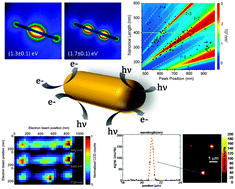
The group from the University of Melbourne used optical and electron microscopy to study the scattering properties of colloidal gold nanorods aligned end-to-end via dithiol coupling at the single particle level. They found that the nanostructures exhibited polarization-dependant optical properties, due to selective excitation of collective bonding and antibonding modes.

The authors were interested in how the angle between plasmonic structures affects coupling. They examined the coupling between both gold nanorod dimers and rod-sphere-rod trimers as a function of subtended angles of the dimer and trimer. They found that the intensity of the resonance in dimers and trimers depends strongly on the angles within the assembled structure. Additionally, they determined that the coupled longitudinal surface plasmon resonance of coupled Au nanorods exhibited a red shift as the number of rods in the chain increased.

Read this HOT article today:

Surface plasmon coupling in end-to-end linked gold nanorod dimers and trimers
Jatish Kumar, Xingzhan Wei, Steven Barrow, Alison M. Funston, K. George Thomas and Paul Mulvaney
DOI: 10.1039/C3CP44657C

If you enjoyed this article you will enjoy our themed issue on optical studies of single metal nanoparticles. Take a look!

Digg This
Reddit This
Stumble Now!
Share on Facebook
Bookmark this on Delicious
Share on LinkedIn
Bookmark this on Technorati
Post on Twitter
Google Buzz (aka. Google Reader)

PCCP themed issue: Superresolution imaging and fabrication with light – deadline approaching

Superresolution imaging and fabrication with light
Guest Editors: Françisco M. Raymo (University of Miami, USA)

Deadline for Submissions: 8 April 2013

Submit using our online submission service

There is still time to contribute to the high-profile themed issue ‘Superresolution imaging and fabrication with light’.

The themed issue will be published in PCCP in  2013. It will receive great exposure, and get significant promotion.

It is essential that all submissions to PCCP should contain new physical insight and contributions to this themed collection will be assessed on this basis.

  • Manuscripts can be submitted in any reasonable format using our online submissions service
  • Submissions should be high quality manuscripts of original, unpublished research
  • Communications and full papers can be submitted for consideration, which will be subject to rigorous peer review
  • Please indicate upon submission that your manuscript is intended for this themed is intended for the themed issue

Please contact the PCCP Editorial Office to let us know you plan to contribute an article.

Digg This
Reddit This
Stumble Now!
Share on Facebook
Bookmark this on Delicious
Share on LinkedIn
Bookmark this on Technorati
Post on Twitter
Google Buzz (aka. Google Reader)

Synthetic lanthanide doped minerals

Figure from PCCP article DOI: 10.1039/C2CP44195KDoping various mineral oxides with lanthanide ions is one of the big trends at the moment. Possibly because of the wide application of lanthanide ions in lighting, bioanalysis and telecommunication, possibly because all you need is an oven and a big laser in order to study something as interesting as the processes in the lanthanide excited state manifold.

Singh and co-workers have doped an yttrium titanium oxide with erbium an ytterbium and studied the luminescence following energy up-conversion. Subsequently, they used laser ablation to pulverise the mineral and studied the powder. Most intriguing, they find that the amount of red and green light emitted vary as a function of laser power.

Lanthanide luminescence, originating from f–f transitions, where the only the f-electron configuration changes, is intriguing as it can occur all across the spectrum, from numerous excited states to multiple other excited states, some of which may even be emissive as well.

While organic chromophores have one ground state, one excited state and a triplet state wherein the molecule may stay for more than picoseconds, lanthanide ions have several if not many. Ytterbium is the only exception, with only one; a consequence of the nearly full f-shell. The shielded nature of the f-orbitals allow for slow processes in the excited state manifold, where the excited states are only quenched by high-energy phonon or vibrational modes in the surroundings. Thus, although energy up-conversion is possible through several pathways, excited state absorption usually dominates.

Structural and up-conversion properties of Er3+ and Yb3+ co-doped Y2Ti2O7 phosphors” by B. P. Singh , A. K. Parchur , R. K. Singh , A. A. Ansari , P. Singh and S. B. Rai is a comprehensive study of the photophysics of erbium and ytterbium doped in a solid state lattice. For the full account see issue 10 of PCCP: Phys. Chem. Chem. Phys., 2013,15, 3480-3489.

by Dr Thomas Just Sørensen

Digg This
Reddit This
Stumble Now!
Share on Facebook
Bookmark this on Delicious
Share on LinkedIn
Bookmark this on Technorati
Post on Twitter
Google Buzz (aka. Google Reader)

PCCP Perspective on single nanoparticle plasmonics

Single nanoparticle plasmonicsEmilie Ringe and co-authors have comprehensively reviewed recent progress in single particle studies of plasmonic nanostructures. They also highlight the exciting and very interdisciplinary future prospects for this field.
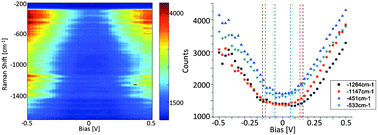

The authors discuss methods of characterisation of single metallic nanoparticles, covering both near-field and far-field approaches. They focus on what can uniquely be learnt from these methods, including the fundamental properties of such particles and their relation to, for example, particle shape and environment. Additionally, they explicate potential applications potential applications, notably in sensing.

Read this timely PCCP Perspective today:

Single nanoparticle plasmonics
Emilie Ringe, Bhavya Sharma, Anne-Isabelle Henry, Laurence D. Marks and Richard P. Van Duyne
DOI: 10.1039/C3CP44574G

Digg This
Reddit This
Stumble Now!
Share on Facebook
Bookmark this on Delicious
Share on LinkedIn
Bookmark this on Technorati
Post on Twitter
Google Buzz (aka. Google Reader)

XAFS study of catalytic NO reduction

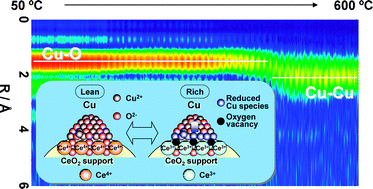
Scientists from Japan have discovered that the synchronization of Cu and Ce valence charge in Cu/CeO2 catalysts can improve the catalytic activity for NO reduction.  They used an operando time-resolved XAFS technique at the Cu and Ce k-edges to study the catalytic NO reduction under periodic (rich-lean cycling) operation.

Read the details in this PCCP communication:

Operando XAFS study of catalytic NO reduction over Cu/CeO2: the effect of copper–ceria interaction under periodic operation
Yasutaka Nagai, Kazuhiko Dohmae, Yusaku F. Nishimura, Hitoshi Kato, Hirohito Hirata and Naoki Takahashi DOI: 10.1039/C3CP44316G

XAFS study of catalytic NO reduction

Digg This
Reddit This
Stumble Now!
Share on Facebook
Bookmark this on Delicious
Share on LinkedIn
Bookmark this on Technorati
Post on Twitter
Google Buzz (aka. Google Reader)

Smog-fog-smog and plants under pressure

Scientists from the USA suggest that plant-derived volatile organic compounds are more likely to react with OH at the air-water interface than inside the bulk of water droplets or in the vapour phase. They carried out molecular dynamics simulations of an organic compound in green leaf volatiles, MBO, and OH radicals at air-water interfaces bringing new insight into their absorption behaviours.

Green leaf volatiles are oxygenated hydrocarbons that are emitted by plants, especially under stress conditions such as mechanical damage and local weather changes. MBO is an unsaturated alcohol which is emitted in large quantities by some species of pine and can be oxidised by radicals including OH. MBO and other green leaf volatiles can be a source of secondary organic aerosols in the atmosphere, which play an important role in climate. Currently secondary organic aerosols are not well understood, and are an important factor in the smog-fog-smog cycle.

Read more in this HOT PCCP article:

Molecular simulations of green leaf volatiles and atmospheric oxidants on air/water interfaces
Thilanga P. Liyana-Arachchi, Christopher Stevens, Amie K. Hansel, Franz S. Ehrenhauser, Kalliat T. Valsaraj and Francisco R. Hung
DOI: 10.1039/C3CP44090G

Digg This
Reddit This
Stumble Now!
Share on Facebook
Bookmark this on Delicious
Share on LinkedIn
Bookmark this on Technorati
Post on Twitter
Google Buzz (aka. Google Reader)

Nanogap structures

In their PCCP perspective on nanogap-enhanced SERS, Natelson, Li and Herzog discuss the rich and fascinating plasmonic physics at work in these systems.

Nanogap structures: combining enhanced Raman spectroscopy and electronic transport

Extended electrode structures incorporating nanogaps provide additional functionality for SERS studies beyond acting purely as plasmonic substrates. In tip-surface systems like those used for TERS, the ability to image the surface through scanned-probe techniques makes it possible to perform single- or few-molecule studies without relying on indirect or statistical arguments.

The authors make the comparison of experimental results with theoretical expectations an important thread in their discussion. Looking to the future, they predict that the bonding of Raman spectroscopy, electronic transport techniques and advanced theoretical treatments will be a profitable union for years to come.

Read this fascinating perspective today:

Nanogap structures: combining enhanced Raman spectroscopy and electronic transport
Douglas Natelson, Yajing Li and Joseph B. Herzog
DOI: 10.1039/C3CP44142C

Digg This
Reddit This
Stumble Now!
Share on Facebook
Bookmark this on Delicious
Share on LinkedIn
Bookmark this on Technorati
Post on Twitter
Google Buzz (aka. Google Reader)

New PCCP Associate Editor: Prof. Rueda

We are delighted to welcome Professor David Rueda as a new Associate Editor for Physical Chemistry Chemical Physics (PCCP). Professor Rueda is Chair of Molecular and Cellular Medicine at the Faculty of Medicine, Imperial College London, UK.

David Rueda new PCCP Associate Editor
Research in the Rueda lab involves the development of quantitative single-molecule approaches to investigate the mechanism of complex biochemical systems, including RNA folding, RNA splicing, DNA replication and ssDNA scanning and deamination.

Professor Rueda was a postdoctoral fellow at the University of Michigan and then an associate professor at Wayne State University, where he was awarded the Outstanding Junior Faculty and the A. Paul Schaap Faculty Scholar awards, before taking up his current position at Imperial College London. He studied for his first degree at the Ecole polytechnique  fédérale de Lausanne.

Professor Rueda will begin handling papers soon and so we encourage you to submit to his editorial office.

Publishing work of the highest quality in the broad fields of physical chemistry, chemical physics and biophysical chemistry, PCCP is the ideal place to publish your research.

Check out our online collection of articles recently published in the fields of biophysics and biophysical chemistry in PCCP here…

Digg This
Reddit This
Stumble Now!
Share on Facebook
Bookmark this on Delicious
Share on LinkedIn
Bookmark this on Technorati
Post on Twitter
Google Buzz (aka. Google Reader)

Surprising differences between macro- and nano-gold

In their recent PCCP communication, Richard Compton et al. explore gold electrocatalytic activity and report very interesting differences between the macro-and nano-scales.

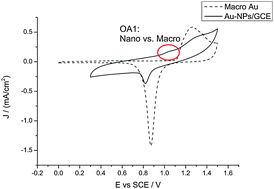
Surface oxidation of gold nanoparticles supported on a glassy carbon electrode in sulphuric acid medium: contrasts with the behaviour of ‘macro’ goldThe researchers from Oxford University, UK, applied the procedure of consecutive electro-oxidation and reduction cycling in sulphuric acid medium to electrodeposited nanoparticles. Whereas this method is commonly used as a cleaning and calibration procedure for gold macro-electrodes, the method was found to have a negative effect on the surface of gold nanoparticles.

It has previously been thought that this surface cleaning method can be effectively applied to gold nanoparticles on the assumption that their behaviour is the same as the bulk behaviour. Compton et al. correctly question this assumption and suggest that changes in the surface morphology and/or composition of the nanoparticles during the cycling treatment may cause the damaging effects on the gold nanoparticle-modified electrode.

Read more detail in this article today:

Surface oxidation of gold nanoparticles supported on a glassy carbon electrode in sulphuric acid medium: contrasts with the behaviour of ‘macro’ gold
Ying Wang, Eduardo Laborda, Alison Crossley and Richard G. Compton
DOI: 10.1039/C3CP44615H

Digg This
Reddit This
Stumble Now!
Share on Facebook
Bookmark this on Delicious
Share on LinkedIn
Bookmark this on Technorati
Post on Twitter
Google Buzz (aka. Google Reader)