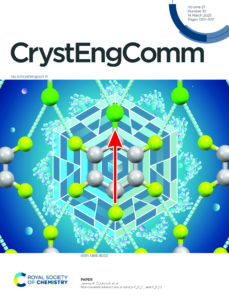
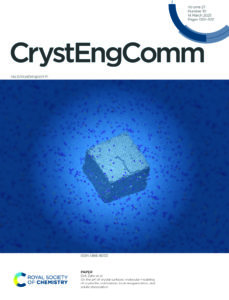
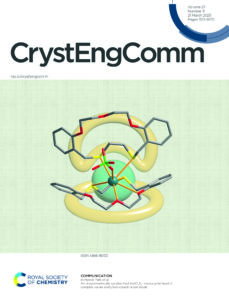
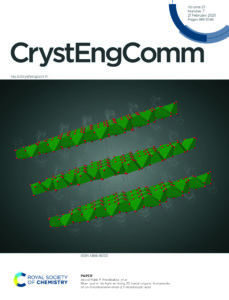
![]() |
![]() |
![]() |
|
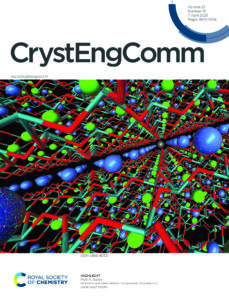
Issue 11 – front cover |
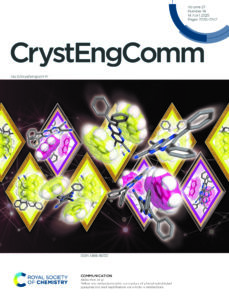
Issue 14 – front cover |
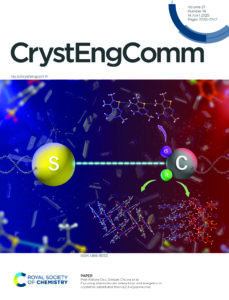
Issue 15 – front cover |
![]() |
![]() |
![]() |
|
Issue 9 – front cover |
Issue 9 – back cover |
Issue 10 – front cover |
![]() |
![]() |
![]() |
|
Issue 8 – front cover |
Issue 8 – inside front cover |
Issue 8 – back cover |
![]() |
![]() |
![]() |
|
Issue 6 – front cover |
Issue 6 – inside front cover |
|
![]() |
![]() |
![]() |
|
Issue 4 – front cover |
Issue 4 – back cover |
|
![]() |
![]() |
![]() |
|
Issue 2 – front cover |
||
![]() |
![]() |
![]() |
|
Issue 1 – front cover |
Issue 1 – inside front cover |
Issue 1 – back cover |
CrystEngComm 2026 Cover Gallery
Introducing the CrystEngComm Emerging Talent Series
We are excited to announce the launch of the CrystEngComm Emerging Talent Series.
With this series we aim to welcome and celebrate the significant contributions of emerging early career researchers from across the globe to the dynamic field of crystal engineering.
To best meet the needs of contributing authors, there will be no fixed deadlines. Papers accepted for publication in the Emerging Talent Series will be published in the earliest available issue and collated together in a dedicated Emerging Talent collection on the journal website at a later date. This allows for continual exposure of exciting work from members of the community who are embarking on their independent research careers, with a focus and emphasis on individual authors and research groups.
The Emerging Talent Series will showcase the full diversity of cutting-edge research carried out by scientists who have the potential to influence future directions in the field of crystal engineering. We will consider applications and nominations on their own merit; please contact crystengcomm-rsc@rsc.org if you are interested in being considered for the series or nominating an exceptional early-career colleague.
All submissions to the Emerging Talent Series will be subject to the journal’s usual high standards of initial assessment and peer review.
What happens now?
In order to be eligible to feature as an Emerging Talent, contributors must:
- Publish research within the journal scope
- Currently be an independent researcher
- Have not been featured in a previous New Talent Collection or CrystEngComm Emerging Talent Series article.
- Have either a) received their PhD no earlier than 01 January of the year 10 years prior to the year of submission, or b) have no more than 10 years of post-PhD research experience on 01 January in the year of submission when taking into account any career breaks.
(For example: for submission in 2026 an eligible contributor must have either a) had their PhD awarded on or after 01 January 2016, or b) no more than a cumulative total of 10 years of post-PhD research experience by 01 January 2026).
Authors previously featured as CrystEngComm New Talent may be co-authors on subsequent papers in the CrystEngComm Emerging Talent Series, but they may not be the sole eligible corresponding author and will not be featured as Emerging Talent in the new series. Eligible authors may be featured only once in the series, unless they are included on another paper which features an additional eligible author. A single paper can feature more than one eligible author as Emerging Talent.
Contributors will be required to confirm their eligibility by sending their CV to the journal editors at crystengcomm-rsc@rsc.org.
Tutorial Review: A beginner’s guide to spin crossover
CrystEngComm Tutorial Reviews are aimed at researchers who are new to the field or are embarking on a new direction of research, giving insight into how crystal engineering techniques underpin certain research areas.
They are focused on the application of crystal engineering techniques and should be comprehensive enough to be used for teaching purposes. They comment on best practice techniques for a given research methodology and how understanding crystal engineering can best serve researchers’ progress on a given topic.
Each Tutorial Review includes up to five ‘key learning points’ that a reader should expect to gain from reading the review.
See our most recent Tutorial Review by Phimphaka Harding and David J. Harding
| A beginner’s guide to spin crossover Phimphaka Harding and David J. Harding CrystEngComm, 2026, 28, 1707-1726 |
![]() |
Key learning points in this Tutorial review:
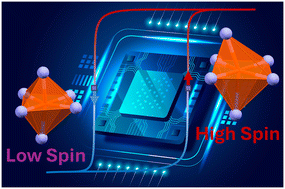
1. Spin crossover (SCO) is the reversible transition between two electronic states, high spin (HS) and low spin (LS) and may be observed in complexes with a d4–d7 electronic configuration.
2. Spin crossover results in substantial structural, magnetic and spectroscopic changes that can be tracked with appropriate techniques.
3. X-ray crystallography allows for a detailed understanding of the spin state at the metal centre, patterning in crystal phases of mixed spin states and the packing in SCO materials.
4. SCO can be induced by changes in pressure or light irradiation with high-pressure single crystal studies and photocrystallography providing new structural insights concerning these pressure- and light-induced states.
5. Careful ligand design and judicious anion choice are required to design SCO materials with favourable magnetic properties.
Meet the authors
![]() |
Associate Professor Dr Phimphaka Harding MRSC studied at Chiang Mai University completing her B.Sc. in Chemistry in 1995. She then completed a Ph.D. at the University of Bristol in 2001, returning to Thailand to work at Walailak University. She now works at Suranaree University of Technology where her research interests include spin crossover materials, nanomaterials and sensors. |
![]() |
Associate Professor Dr David J. Harding FRSC studied Chemistry (B.Sc. Hons.) at the University of Edinburgh graduating in 1997. He then completed a Ph.D. at the University of Bristol and after 2 years as a postdoc moved to Thailand. He now works at Suranaree University of Technology where he continues to explore molecular magnetic materials. |
Tutorial Reviews are normally invited by the Editorial Board, however suggestions are welcome and enquiries, along with a brief synopsis and author credentials, should be directed to the Editors-in-Chief at CrystEngComm-rsc@rsc.org. Readers may nominate themselves, or others, to write a Tutorial Review.
We hope you enjoy reading this Tutorial review!
Tutorial Review: The anti-crystal engineering principles of imidazolium cations for ionic liquids
CrystEngComm Tutorial Reviews are aimed at researchers who are new to the field or are embarking on a new direction of research, giving insight into how crystal engineering techniques underpin certain research areas.
They are focused on the application of crystal engineering techniques and should be comprehensive enough to be used for teaching purposes. They comment on best practice techniques for a given research methodology and how understanding crystal engineering can best serve researchers’ progress on a given topic.
Each Tutorial Review includes up to five ‘key learning points’ that a reader should expect to gain from reading the review.
See our most recent Tutorial Review by Patrick C. Hillesheim and Arsalan Mirjafari
|
The anti-crystal engineering principles of imidazolium cations for ionic liquids |
![]() |
Key learning points in this Tutorial review:
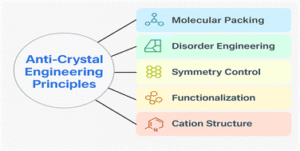
1. Crystal engineering provides a structural framework for understanding ionic liquids. Crystallographic analysis reveals how molecular geometry, packing motifs, and intermolecular forces govern melting points and phase behavior.
2. Disorder can be deliberately engineered. Anti-crystal engineering principles, such as cation asymmetry, conformational flexibility, and weak interactions, show how structural frustration suppresses crystallization to yield stable liquids.
3. Symmetry and shape control lattice energy. Variations in chain length, branching, or methylation alter molecular symmetry and steric balance, tuning lattice enthalpy and entropy to direct solid–liquid transitions.
4. Functionalization of the alkyl chains can lower crystallinity. Addition of functional groups can disrupt chain packing, lower melting points. However, the functional groups can also introduce new interactions which may, conversely, increase cohesion.
5. The parts of the imidazolium cation. The imidazolium cation can be viewed as comprising three regions—the charge-rich heterocycle, the symmetry-breaking domain, and the hydrophobic tail—each serving as a modular platform for introducing anti-crystal engineering features.
Meet the authors
![]() |
Patrick Hillesheim is an Assistant Professor of Chemistry at Illinois State University. He earned his Ph.D. at the University of Florida in 2010 and completed postdoctoral research with Prof. Sheng Dai at Oak Ridge National Laboratory (2010–2013). His research focuses on the development and fundamental studies of novel ionic liquids, with an emphasis on studying the bulk properties. His research combines organic chemistry, materials science, X-ray crystallography, and computational studies to investigate how non-covalent interactions and molecular structure influence macroscopic properties. |
![]() |
Arsalan Mirjafari is the Dr. Richard S. Shineman Endowed Chair and Professor of Chemistry at the State University of New York at Oswego. His research focuses on property-driven design of functional ionic liquids through click-enabled and click-like synthesis. Applications include vaccine preservation, gene delivery, bioinspired organic materials, and thermally robust materials. He earned his Ph.D. in Organic Chemistry from University of Isfahan (2009) and completed postdoctoral training with Prof. Jim Davis at University of South Alabama (2010–2012). His work advances ionic liquid design for biotechnological and materials applications.
|
Tutorial Reviews are normally invited by the Editorial Board, however suggestions are welcome and enquiries, along with a brief synopsis and author credentials, should be directed to the Editors-in-Chief at CrystEngComm-rsc@rsc.org. Readers may nominate themselves, or others, to write a Tutorial Review.
We hope you enjoy reading this Tutorial review and keep an eye out for the next one in the series coming soon: A beginner’s guide to spin crossover by Phimphaka Harding and David J. Harding.
HOT Articles – Online and free to access now
We have updated our reviewer recommended ‘HOT articles’ for 2025.
We update our HOT articles collection quarterly and make the selected articles free to access for 6 weeks! This collection represents the top 10% of research published in CrystEngComm between July – December 2025. Please note that only the HOT articles from October – December 2025 have been made free to access, this will be updated quarterly to reflect our latest HOT articles.
Make the most of the free to access period by browsing the collection today!
Highlights of 2025 from CrystEngComm

Happy New Year from the CrystEngComm Editorial Team!
CrystEngComm published its 27th volume in 2025 with over 700 articles in 48 issues including 80 Highlight review articles, 3 Tutorial reviews and 50 Communications. Research from authors in 53 countries was published with more than 2.3 million downloads, ensuring excellent visibility for the articles.
We are delighted to share some further highlights of CrystEngComm in 2025, including our Outstanding Paper Award winners, the introduction of Tutorial reviews, new Editorial Board members and our most popular articles from the year.
2024 CrystEngComm Outstanding Paper Award
The Outstanding Paper Award is an award aimed at recognising the high-quality work published in CrystEngComm from the previous year. The winners this year were Thomas Pickles, Vaclav Svoboda, Ivan Marziano, Cameron J. Brown and Alastair J. Florence for their work on Integration of a model-driven workflow into an industrial pharmaceutical facility: supporting process development of API crystallisation.
The authors presented a resource-efficient yet scalable pharmaceutical crystallisation process development using a model-driven workflow. CrystEngComm hosted a desktop seminar featuring a presentation on the research behind the winning paper by all the authors of the paper which was well received within the community.
![]() |
Integration of a model-driven workflow into an industrial pharmaceutical facility: supporting process development of API crystallisation
Thomas Pickles, Vaclav Svoboda, Ivan Marziano, Cameron J. Brown and Alastair J. Florence CrystEngComm, 2024, 26, 4678-4689 |
New Editorial Board Members
Earlier this year we were delighted to welcome both Ghazala Sadiq and Sharmarke Mohamed to join our international Editorial Board.
Ghazala is part of the Scientific Leadership Team at the CCDC, managing the Pfizer Solid Form Design Centre Team, where part of her role includes applying the latest knowledge-based informatics techniques to drug development compounds. She has a keen interest in Crystal Engineering, covering a range of topics including polymorphism, co-crystal design, fundamentals of intermolecular interactions, crystallisation, and the importance of molecular self-assembly in the nucleation of crystalline phases.
Sharmarke is an Associate Professor of Chemistry at Khalifa University (KU), Abu Dhabi, UAE, acting as Principal Investigator in the Green Chemistry & Materials Modelling Laboratory. Sharmarke’s research spans chemical crystallography, computational chemistry, and green chemistry.

2025 CrystEngComm journal covers
| We have published 60 covers supplied by authors in 2025. All the covers are available to view in the cover gallery and the articles have all been collected together in our Articles behind the 2025 journal covers collection ensuring great visibility of both the covers and associated articles. | ![]() Issue 46 cover image |
![]() Issue 45 cover image |
Introducing Tutorial reviews to CrystEngComm
We launched our new series of Tutorial reviews in 2025. This new article type is aimed at researchers who are new to the field or are embarking on a new direction of research, giving insight into how crystal engineering techniques underpin certain research areas.
| Useful practices in single crystal diffraction analysis of reticular structures
Stefano Canossa CrystEngComm, 2025, 27, 6556-6571 |
![]() |
![]() |
The impact of crystal habit on the pharmaceutical properties of active pharmaceutical ingredients
Niranj H. Ram, Madhukiran R. Dhondale, Maan Singh, Brahmeshwar Mishra, Ashish Kumar Agrawal, Anne Marie Healy and Dinesh Kumar CrystEngComm, 2025, 27, 4614-4633 |
| Identifying and characterising flexible crystals
Atiqur Rahman, John C. McMurtrie, Sajesh P. Thomas and Jack K. Clegg CrystEngComm, 2025, 27, 7110-7120 |
![]() |
| These articles all free to access until 30th April 2026. | |
Themed collections in 2025
In 2025 we published two themed collections:
MOFs in Asia guest edited by Hoi Ri Moon, Sarah S. Park and Jihye Park, showcasing the recent advances and innovative research in the field of Metal-Organic Frameworks across Asia.
MOFs: three decades of pioneering research a post-publication collection of papers celebrating the research of the winners of the 2025 Nobel Prize in Chemistry, Susumu Kitagawa, Richard Robson and Omar M. Yaghi, and their co-workers.
A selection of the most popular articles in 2025
| The overestimated capability of fluid shear to induce secondary nucleation: an urgent call for diligently executed control experiments
Lorijn De Vrieze and Simon Kuhn CrystEngComm, 2025, 27, 4810-4815 |
![]() |
| A lot to unpack: a decade in high Z′ crystal structures
Paul G. Waddell CrystEngComm, 2025, 27, 578-589 |
![]() |
| Exploring intermolecular interactions and energetics in crystalline substituted thieno[2,3-d]pyrimidines
Pran Kishore Deb, Anila M. Menon, Fathima Nida PSR, Ipsha Shruti, Sara Nidal, Katharigatta N. Venugopala and Deepak Chopra CrystEngComm, 2025, 27, 2070-2085
|
![]() |
We would love you to be part of the future of CrystEngComm so on behalf of the Co-Editors-in-Chief Professors Christian Doonan and C. Malla Reddy, we invite you to submit your research to CrystEngComm. See our author guidelines for information on our article types or find out more about the advantages of publishing in a Royal Society of Chemistry journal.
From all the CrystEngComm team, we thank you for your continued interest in and support of the journal and wish you well for 2026!
CrystEngComm 2025 Cover Gallery
![]() |
||
|
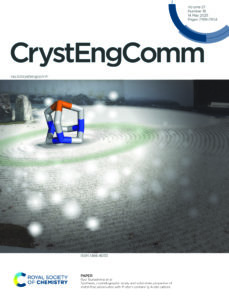
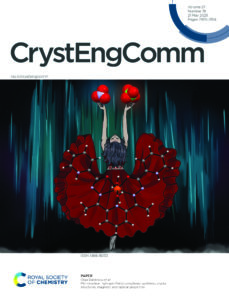
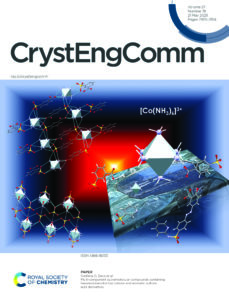
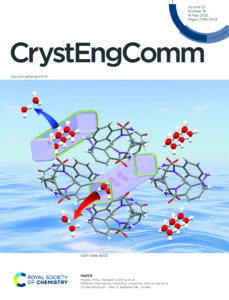
Issue 48 – back cover |
||
![]() |
![]() |
![]() |
|
Issue 47 – outside front cover |
Issue 47 – inside front cover |
Issue 48 – front cover |
![]() |
![]() |
|
|
Issue 45 – inside front cover |
Issue 46 – outside front cover |
Issue 46 – inside front cover |
![]() |
![]() |
|
|
Issue 43 – front cover |
Issue 44 – front cover |
Issue 45 – outside front cover |
![]() |
![]() |
|
|
Issue 40 – front cover |
Issue 41 – front cover |
Issue 42 – front cover |
![]() |
![]() |
|
|
Issue 36 – inside front cover |
Issue 38 – front cover |
Issue 39 – front cover |
![]() |
![]() |
![]() |
|
Issue 33 – outside front cover |
Issue 35 – outside front cover |
Issue 36 – outside front cover |
![]() |
![]() |
![]() |
|
Issue 30 – outside front cover |
Issue 31– outside front cover |
Issue 32– outside front cover |
![]() |
![]() |
![]() |
|
Issue 27 – outside front cover |
Issue 28– outside front cover |
Issue 29– outside front cover |
![]() |
![]() |
![]() |
|
Issue 25 – outside front cover |
Issue 26 – outside front cover |
Issue 26 – outside back cover |
![]() |
![]() |
![]() |
|
Issue 23 – outside front cover |
Issue 23 – inside front cover |
Issue 24 – outside front cover |
![]() |
![]() |
![]() |
|
Issue 21 – outside front cover |
Issue 21 – inside front cover |
Issue 22 – outside front cover |
![]() |
![]() |
![]() |
|
Issue 20 – outside front cover |
Issue 20 – inside front cover |
Issue 20 – outside back cover |
![]() |
![]() |
![]() |
|
Issue 18 – inside front cover |
Issue 19 – outside front cover |
Issue 19 – inside front cover |
![]() |
![]() |
![]() |
|
Issue 16 – back cover |
Issue 17 – front cover |
Issue 18 – outside front cover |
![]() |
![]() |
![]() |
|
Issue 13 – inside front cover |
Issue 14 – outside front cover |
Issue 14 – inside front cover |
![]() |
![]() |
![]() |
|
Issue 12 – outside front cover |
Issue 12 – inside front cover |
Issue 13 – outside front cover |
![]() |
![]() |
![]() |
|
Issue 10 – outside front cover |
Issue 10 – inside front cover |
|
![]() |
![]() |
![]() |
![]() |
![]() |
![]() |
|
Issue 5 – inside front cover |
Issue 6 – outside front cover |
Issue 6 – inside front cover |
![]() |
![]() |
![]() |
| Issue 4 | Issue 5 – outside front cover |
Tutorial Review: Identifying and characterising flexible crystals
CrystEngComm Tutorial Reviews were first commissioned in 2024 and are aimed at researchers who are new to the field or are embarking on a new direction of research, giving insight into how crystal engineering techniques underpin certain research areas.
They are focused on the application of crystal engineering techniques and should be comprehensive enough to be used for teaching purposes. They comment on best practice techniques for a given research methodology and how understanding crystal engineering can best serve researchers’ progress on a given topic.
Each Tutorial Review includes up to five ‘key learning points’ that a reader should expect to gain from reading the review.
See our most recent Tutorial Review by Atiqur Rahman, John C. McMurtrie, Sajesh P. Thomas and Jack K. Clegg
|
Identifying and characterising flexible crystals Atiqur Rahman, John C. McMurtrie, Sajesh P. Thomas and Jack K. Clegg CrystEngComm, 2025, 27, 7110-7120 |
![]() |
Key learning points in this Tutorial review:
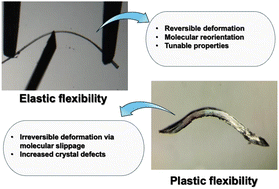
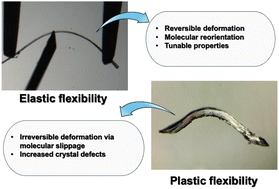
1. Molecular crystals undergo two types of mechanical deformation—elastic (reversible) and plastic (irreversible)—each led by different structural features and intermolecular interactions.
2. Elastic flexibility is often driven by anisotropic interaction topologies and reversible molecular reorientations, whereas plasticity is facilitated by low-energy slip systems (often slip planes).
3. μ-XRD and μ-Raman mapping provide insight into structural changes and local internal stress distribution across the elastically bent crystals.
4. Mechanical deformation affects a range of material properties, including fluorescence, conductivity, and thermal behaviour, highlighting the multifunctionality of flexible crystals.
5. Classical models like Euler–Bernoulli theory are limited due to anisotropic and inhomogeneous deformations in crystals
6. Flexible molecular crystals are promising for next-gen technologies such as piezoelectric actuators and reconfigurable waveguides.
Meet the authors
![]() |
Professor Jack K. Clegg studied Chemistry, History and German graduating with a Bachelor of Liberal Studies (Honours) and a University Medal from the University of Sydney. He went on to complete a PhD in Chemistry (2008) and a Bachelor of Laws (2009) from the same institution graduating with the Convocation Medal. After completing his studies he won a Marie Curie Fellowship to conduct research at the University of Cambridge. Jack returned to Australia to join The University of Queensland in 2012. In 2018 Jack was awarded the Malcolm McIntosh Prize for Physical Scientist of the Year. |
![]() |
Sajesh P. Thomas earned his MSc in Chemistry from Mahatma Gandhi University, Kottayam and his Bachelor’s degree from Kasaragod Government College, Kerala. He completed his PhD in 2014 from the Indian Institute of Science, Bangalore, under the guidance of Prof. T. N. Guru Row, focusing on charge density and crystal engineering studies of pharmaceutical solids. Following his doctorate, he conducted postdoctoral research with Prof. Mark A. Spackman at the University of Western Australia, Perth, and later held a Marie-Curie fellowship with Prof. Bo B. Iversen at Aarhus University, Denmark. He is currently an Associate Professor in the Department of Chemistry at the Indian Institute of Technology Delhi, where he leads Materials and Quantum Crystallography Lab (MQCL). His research interests include quantum crystallography and crystal engineering of pharmaceutical solids and soft piezoelectric materials. |
![]() |
Professor John C. McMurtrie completed his BSc (Hons) at Macquarie University before moving to The University of New South Wales for his doctoral. He then completed a postdoctoral appointment at the University of Sydney (2003–2004). John was appointed Lecturer in Inorganic Chemistry at Queensland University of Technology in 2004 where he remains, now as a Professor of Inorganic Chemistry. |
![]() |
Atiqur Rahman received his BSc (Hons) in Chemistry from Kirori Mal College, University of Delhi and his MSc in Chemistry from Indian Institute of Technology Delhi. He is currently pursuing a joint PhD at IIT Delhi and The University of Queensland under the supervision of Professor Sajesh P. Thomas and Professor Jack K. Clegg. His doctoral research focuses on the structural origins of mechanical flexibility and piezoelectricity in molecular crystals, with an emphasis on structural perturbations induced by bending and high-pressure conditions, employing synchrotron-based micro-focused X-ray diffraction and high-pressure crystallographic techniques. |
Tutorial Reviews are normally invited by the Editorial Board, however suggestions are welcome and enquiries, along with a brief synopsis and author credentials, should be directed to the Editors-in-Chief at CrystEngComm-rsc@rsc.org. Readers may nominate themselves, or others, to write a Tutorial Review.
We hope you enjoy reading this Tutorial review* and if you haven’t already seen them please do read the previous tutorial reviews in our series: Useful practices in single crystal diffraction analysis of reticular structures by Stefano Canossa and The impact of crystal habit on the pharmaceutical properties of active pharmaceutical ingredients by Dinesh Kumar et al.
*Free to access until December 31st 2025.
Themed Collection: MOFs in Asia

We are delighted to share our latest themed collection: MOFs in Asia
This themed collection showcases the recent advances and innovative research in the field of Metal-Organic Frameworks across Asia, highlighting cutting-edge developments in their design, synthesis and application. The collection is guest-edited by Hoi Ri Moon (Ewha Womans University, Republic of Korea), Sarah S. Park (Pohang University of Science and Technology, Republic of Korea) and Jihye Park (University of Colorado Boulder, USA).
Browse a selection of some of the articles in the collection:
Editorial
| MOFs in Asia
Hoi Ri Moon, Sarah S. Park and Jihye Park CrystEngComm, 2025, 27, 6696-6696
|
![]() |
Highlight review articles
|
Recent multifunctional applications of AIE-MOF/COF porous materials Siwen Liu, Guijie Liang, Song Wang and Qingsong Hu
|
![]() |
| MOFs in healthcare diagnostics: shaping the future of biomedical test strips
Vibhav Shukla and Kafeel Ahmad Siddiqui CrystEngComm, 2025, 27, 4443-4452
|
![]() |
Communications
|
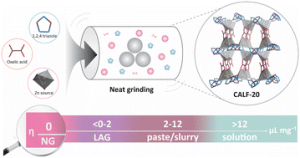
Efficient solvent-free mechanochemical synthesis of CALF-20 for carbon dioxide capture Natchaya Phongsuk, Chalarat Chaemchamrat, Taya Ko Saothayanun, Nopphon Weeranoppanant and Sareeya Bureekaew CrystEngComm, 2025, 27, 5959-5964
|
![]() |
|
Byoung Gwan Lee, Dongwook Kim, Jin Young Bae, Ji Woo Jeong and Dae-Woon Lim CrystEngComm, 2025, 27, 5952-5958
|
![]() |
Research Articles
|
Souvik Pal, Ling-I Hung, Wun-Jing Chen, Jiun-Jen Chen, Chun-Chuen Yang and Chia-Her Lin CrystEngComm, 2025, 27, 6295-6302
|
![]() |
|
Kazuaki Tachimoto, Kanokwan Jumtee Takeno and Rie Makiura CrystEngComm, 2025, 27, 5793-5802
|
![]() |
We hope you enjoy reading these articles along with the rest in the collection. The articles are all free to access until November 30th 2025.
Introducing Tutorial Reviews to CrystEngComm
We are delighted to introduce Tutorial Reviews as a new article type in CrystEngComm
CrystEngComm Tutorial Reviews were first commissioned in 2024 and are aimed at researchers who are new to the field or are embarking on a new direction of research, giving insight into how crystal engineering techniques underpin certain research areas.
They are focused on the application of crystal engineering techniques and should be comprehensive enough to be used for teaching purposes. They comment on best practice techniques for a given research methodology and how understanding crystal engineering can best serve researchers’ progress on a given topic.
Each Tutorial Review will include up to five ‘key learning points’ that a reader should expect to gain from reading the review.
See our most recent Tutorial Review by Stefano Canossa from ETH Zürich
| Useful practices in single crystal diffraction analysis of reticular structures
Stefano Canossa
CrystEngComm, 2025, 27, 6556-6571 |
|
Key learning points in this Tutorial review:
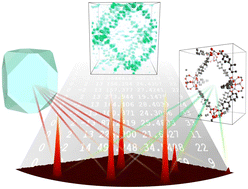
1. Crystal structures are artificial simplifications of the non-periodic structure of real crystals. Nonetheless, these models are key enablers of scientific progress, if they maintain accuracy before precision in describing the average structure.
2. Steps such as sample preparation, data collection, data reduction, and structure modelling should be based on educated intentional choices. Default options provided by software or pre-made routines can be accepted only when their significance has been understood in the appropriate context.
3. Models can be only as reliable as the data allows for, and data can be only as good as the crystal allows for. Investing adequate care firstly on crystal selection, then on data collection and reduction, and ultimately on structure modelling, is a defining aspect of a crystallographer’s work.
4. The distinction between ‘data’, ‘information’ and ‘model’ — herewith provided — is necessary for a correct crystallographic practice and a scientifically rigorous representation of its results.
5. Standard diffraction data provide a wealth of information beyond the simple numerical values of integrated intensities. This information can be found in reciprocal space reconstructions and include aspects such as mosaicity, disorder, and defects.
Meet the author
![]() |
Stefano Canossa is a senior scientist with over a decade of experience in the crystallographic analysis of open-framework compounds using X-ray and electron diffraction. Trained as a coordination chemist, his crystallographic journey began during his MSc research on host–guest chemistry in metal–organic frameworks, and later expanded to include co-crystals, metal complexes, zeolites, and perovskites. Alongside crystal structure determination, his independent research explores the synthesis and characterization of correlated disorder in crystalline materials by leveraging on single crystal total scattering analysis in both real and reciprocal space. |
Tutorial Reviews are normally invited by the Editorial Board, however suggestions are welcome and enquiries, along with a brief synopsis and author credentials, should be directed to the Editors-in-Chief at CrystEngComm-rsc@rsc.org. Readers may nominate themselves, or others, to write a Tutorial Review.
We hope you enjoy reading this Tutorial review and keep an eye out for the next one in the series coming soon: Identifying and Characterising Flexible Crystals by Jack Clegg and colleagues.