


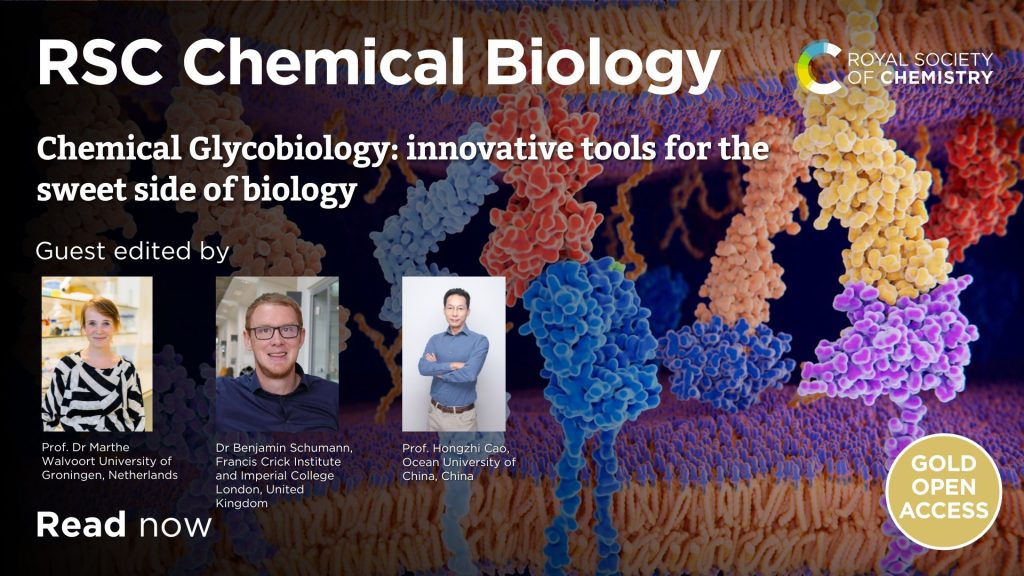
We’re pleased to announce that a new themed collection “Chemical Glycobiology: innovative tools for the sweet side of biology” from RSC Chemical Biology has now been published online.
Glycans have come a long way from their consideration of “decorating” biomolecules to proven, essential modulators of physiology. Chemistry has played an essential part in this process: the non-templated biosynthesis of glycans needed tools for their profiling, perturbation and visualization. The field of glycobiology has thus served as a catalyst to invent new chemistry, recognized through awards by major learned societies as well as the Nobel Prize in Chemistry in 2022.
Through the invention of new tools, their use in understanding critical new biology, and their application in quantitative biology, it is certain that today, chemical glycobiology is advancing the boundaries of science. This themed collection seeks to highlight the use of innovative chemistry in advancing glycobiology in its full breadth. We are excited to share these contributions that feature all aspects of a field that truly tackles the sweet side of biology!
The full line-up of articles has been provided below. All articles in RSC Chemical Biology are open access and free to read. We hope you enjoy this new themed collection from RSC Chemical Biology.
On behalf of the Guest Editors,
Dr Benjamin Schumann (Francis Crick Institute and Imperial College London, United Kingdom)
Prof. Hongzhi Cao (Ocean University of China, China)
Prof. Dr Marthe Walvoort (University of Groningen, Netherlands)
Reviews
Exploring marine glycans: structure, function, and the frontier of chemical synthesis
Sandhya Mardhekar, Phuong Luong and Peter H. Seeberger
RSC. Chem. Biol., 2025, 6, 1195–1213, DOI: 10.1039/D5CB00090D
Achieving cell-type selectivity in metabolic oligosaccharide engineering
Michelle Marie B. Helmeke, Rhianna L. Haynie-Cion and Matthew R. Pratt
RSC. Chem. Biol., 2025, 6, 1506–1520, DOI: 10.1039/D5CB00168D
Communications
Translocation of penetratin-like peptides involving calcium-dependent interactions between glycosaminoglycans and phosphocholine headgroups of the membrane lipid bilayer
Bingwei He, Sonia Khemaissa, Sébastien Cardon, Rodrigue Marquant, Françoise Illien, Delphine Ravault, Fabienne Burlina, Emmanuelle Sachon, Astrid Walrant and Sandrine Sagan
RSC. Chem. Biol., 2025, 6, 1391–1402, DOI: 10.1039/D5CB00099H
Differential melting voltage by tandem-trapped ion mobility spectrometry: glycan structure influences glycoprotein stability
Mengqi Chai, Christian Bleiholder and Fanny C. Liu
RSC. Chem. Biol., 2025, 6, 1711–1715, DOI: 10.1039/D5CB00127G
Alkyne-tagged ribitol-5-phosphate derivatives for metabolic labelling of alpha-dystroglycan
Lloyd D. Murphy, Saeed Akkad, Angelo Lopez, Morgan E. Batiste-Simms, Greg L. McNeil, Eva W. Wan, Kathryn E. Huxley, Luke Julyan, Mia Shandell and Lianne I. Willems
RSC. Chem. Biol., 2025, 6, 1832–1836, DOI: 10.1039/D5CB00187K
Papers
Synthesis of 4-azido sialic acid for testing against Siglec-7 and in metabolic oligosaccharide engineering
Taylor E. Gray, Kristin B. Labasan, Gour C. Daskhan, Duong T. Bui, Maju Joe, Dhanraj Kumawat, Edward N. Schmidt, John S. Klassen and Matthew S. Macauley
RSC. Chem. Biol., 2025, 6, 869–881, DOI: 10.1039/D5CB00030K
A general and accessible approach to enrichment and characterisation of natural anti-Neu5Gc antibodies from human samples
Esme Hutton, Yumiko Uno, Emma Scott, Craig Robson, Martin A. Fascione and Nathalie Signoret
RSC. Chem. Biol., 2025, 6, 1135–1147, DOI: 10.1039/D5CB00073D
A biparatopic HER2-targeting ADC constructed via site-specific glycan conjugation exhibits superior stability, safety, and efficacy
Qi Xue, Jianjian Peng, Wenying Dai, Qingsong Wu, Jinbiao Jiao, Yudi Hu, Wanxing Sha, Yang Yang, Wenhao Yu, Siyang Liu, Ting Xu and Jie P. Li
RSC. Chem. Biol., 2025, 6, 1284–1296, DOI: 10.1039/D5CB00096C
A dual-functional substrate for quantitation of substrate levels and GCase activity in living cells
Ben Tiet, Sha Zhu, Xi Chen, Nadia Anastasi, Nicholas W. See, Matthew C. Deen, Eva Harde and David J. Vocadlo
RSC. Chem. Biol., 2025, 6, 1297–1305, DOI: 10.1039/D5CB00045A
Chemoenzymatic synthesis of sialylated and fucosylated mucin analogs reveals glycan-dependent effects on protein conformation and degradation
Amanda M. Wood, Casia L. Wardzala and Jessica R. Kramer
RSC. Chem. Biol., 2025, 6, 1336–1352, DOI: 10.1039/D5CB00111K
Signals from the sea: the structural peculiarity of lipid A and weak immunostimulatory lipopolysaccharide from Rheinheimera japonica
Stefania De Chiara, Francesca Olmeo, Emanuela Andretta, Luca De Simone Carone, Marcello Mercogliano, Vlada S. Belova, Lyudmila A. Romanenko, Maxim S. Kokoulin, Alba Silipo, Antonio Molinaro and Flaviana Di Lorenzo
RSC. Chem. Biol., 2025, 6, 1414–1425, DOI: 10.1039/D5CB00134J
Synergy of triazolyl substituents at C1 and C3 of galactose for high-affinity and selective galectin-4C inhibition
Alexander Dahlqvist, Rob Marc Go, Chandan Kishor, Hakon Leffler, Helen Blanchard and Ulf J. Nilsson
RSC. Chem. Biol., 2025, 6, 1437–1450, DOI: 10.1039/D5CB00106D
Unravelling structure–function interactions between fluorinated heparan sulfate mimetics and signaling proteins
Virendrasinh Mahida, Rakesh Raigawali, Paula González, Ana Gimeno, Shani Leviatan Ben-Arye, Saurabh Anand, Sandhya Mardhekar, Jesús Jiménez-Barbero, Vered Padler-Karavani and Raghavendra Kikkeri
RSC. Chem. Biol., 2025, 6, 1465–1472, DOI: 10.1039/D5CB00174A
A Lyt at the end of the tunnel? Unraveling the complex interactions of the N-acetylglucosaminidase LytG in cell wall metabolism
Jazmeen Hernandez, Jett Duval, Taryn Rauff, Ethan Hall, Mika Gallati, Brad A. Haubrich, Monica Thoma, Elimelec Aponte, Amit Basu, Joseph A. DeGiorgis and Christopher W. Reid
RSC. Chem. Biol., 2025, 6, 1848–1860, DOI: 10.1039/D5CB00151J
Glyco-functionalization of ECM mimics, influence in morphology and cell behaviour
Maddalena Bracchi, Francesco Nicotra and Laura Russo
RSC. Chem. Biol., 2025, 6, 1893–1908, DOI: 10.1039/D5CB00185D
Selective labeling and visualization of viral and bacterial neuraminidases using ortho-quinone methide-based probes
Erianna I. Alvarado-Melendez, Simon T. Ruessink, Karin Strijbis and Tom Wennekes
RSC. Chem. Biol., 2025, 6, 1909–1919, DOI: 10.1039/D5CB00170F
Investigating the utilization mechanism and kinetics of sialic acid mimetics in mammalian cell lines
Eline A. Visser, Daniël L. A. H. Hornikx, Moritz Rahm, Özden Öztürk, Venetia Psomiadou, Matteo Calzari, Celine Mennen, Sam J. Moons, Martin Jaeger, Dirk J. Lefeber, Christian Büll and Thomas J. Boltje
RSC. Chem. Biol., 2026, 7, 144–152, DOI: 10.1039/D5CB00193E
A novel SadP-scFv UCHT1 lectibody activates T cells and mediates lysis of Burkitt’s lymphoma cells
Jana Tomisch, Jonas Gräber, Olga N. Makshakova, Pavel Salavei, Francesca Rosato, Sarah Frisancho Mariscal, Annabelle Varrot, Anne Imberty and Winfried Römer
RSC. Chem. Biol., 2026, 7, 81–97, DOI: 10.1039/D5CB00027K
Tuning the efficiency of molecular probes via quinone methide-based in situ labeling
Zachary Rabinowitz, Seyedehalaleh Anvar, Jun Liu, Zixin Chen, Yuzhao Zhang, Chao Cui and Ashton Sigler, Lina Cui
RSC. Chem. Biol., 2026, 7, 208–215, DOI: 10.1039/D5CB00138B
A nonavalent BODIPY with a multivalent arrangement of α-mannosides enables lectins recognition in fluorescence-based assays
Giacomo Biagiotti, Edvin Purić, Jacopo Tricomi, Janez Mravljak, Stefano Cicchi, Marco Laurati, Yvette van Kooyk, Fabrizio Chiodo, Iztok Urbančič, Marko Anderluh and Barbara Richichi
RSC. Chem. Biol., 2026, 7, 444–454, DOI: 10.1039/D5CB00190K
Signatures of native-like glycosylation in RNA replicon-derived HIV-1 immunogens
Himanshi Chawla, Jacob T. Willcox, Grace M. Hayes, Murillo Silva, Wen-Hsin Lee, Gabriel Ozorowski, John Butler, Paul F. Mckay, Robin J. Shattock, Andrew B. Ward, Darrell J. Irvine and Max Crispin
RSC. Chem. Biol., 2026, 7, 400–413, DOI: 10.1039/D5CB00165J
Bifunctional glycolipids targeting TLR4·MD-2 and short pentraxins
Daniele Zucchetta, Lena Nuschy, Simon Gumpelmair, Peter Steinberger, Iain Wilson, Holger Heine and Alla Zamyatina
RSC. Chem. Biol., 2026, 7, 820–829, DOI: 10.1039/D5CB00324E