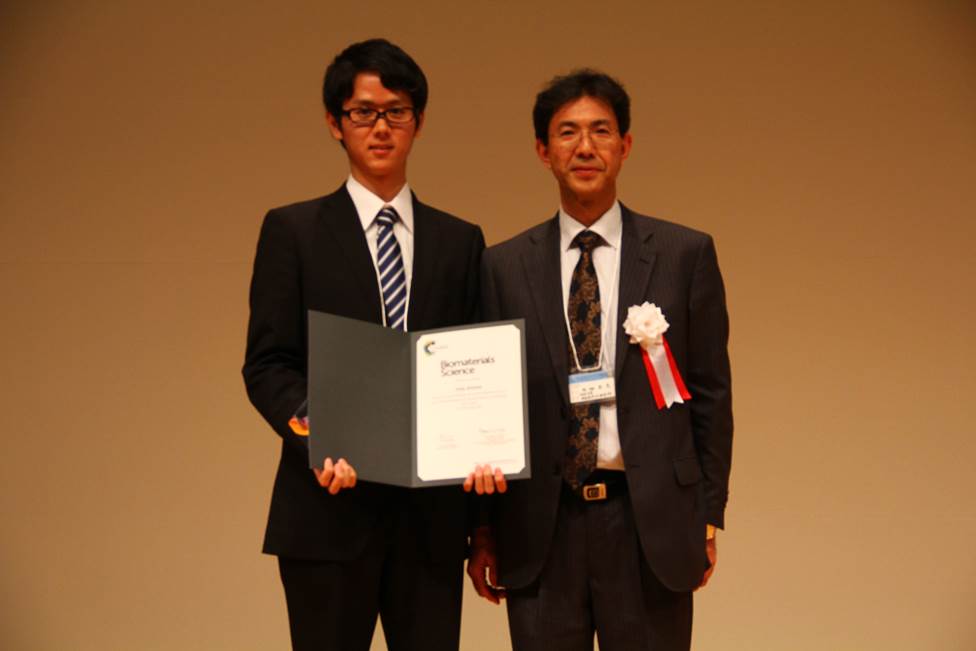
| Congratulations to Yuto Amano, a student in the Michiya Matsusaki group at Osaka University, Japan, who was awarded the Biomaterials Science award for the best student oral presentation at the 37th Annual Meeting of the Japanese Society for Biomaterials.
The meeting was held on 9-10th November 2015, in Kyoto, Japan and Yuto was given the award by Professor Yasuhiko Tabata of Kyoto University and Japanese Society for Biomaterials Committee Chair. |
|
|
Biomaterials Science awards best student talk prize at the 37th Annual Meeting of the Japanese Society for Biomaterials
2016 Biomaterials Science Lectureship now open!
Do you know an early-career researcher who deserves recognition for their contribution to the biomaterials field?
Now is your chance to put them forward for the accolade they deserve.
Biomaterials Science is pleased to announce that nominations are now being accepted for its Biomaterials Science Lectureship 2016. This annual award was established in 2014 to honour an early-stage career scientist who has made a significant contribution to the biomaterials field.
Previous winners
2015 – Joel Collier, University of Chicago, USA
2014 – Suzie Pun, University of Washington, USA
Qualification
To be eligible for the Biomaterials Science Lectureship, the candidate should be in the earlier stages of their scientific career, typically within 7 years of attaining their first independent research position, and will have made a significant contribution to the field.
Description
The recipient of the award will be asked to present a lecture three times, one of which will be located in the home country of the recipient. The Biomaterials Science Editorial Office will provide the sum of £1000 to the recipient for travel and accommodation costs.
The recipient will be presented with the award at one of the three award lectures. They will also be asked to contribute a lead article to the journal and will have their work showcased on the back cover of the issue in which their article is published.
Selection
The recipient of the award will be selected and endorsed by the Biomaterials Science Editorial Board.
Nominations
Those wishing to make a nomination should send details of the nominee, including a brief C.V. (no longer than 2 pages A4) together with a letter (no longer than 1 page A4) supporting the nomination, to the Biomaterials Science Editorial Office by 29th January 2016. Self-nomination is not permitted.
Top 10 Most-accessed Biomaterials Science articles – Q3 2015

This month sees the following articles in Biomaterials Science that are in the top ten most accessed from July – September 2015:
Hydrogel scaffolds as in vitro models to study fibroblast activation in wound healing and disease
Megan E. Smithmyer, Lisa A. Sawicki and April M. Kloxin
Biomater. Sci., 2014,2, 634-650
DOI: 10.1039/C3BM60319A
Supramolecular hydrogels: Synthesis, properties and their biomedical applications
Ruijiao Dong, Yan Pang, Yue Su and Xinyuan Zhu
Biomater. Sci., 2015,3, 937-954
DOI: 10.1039/C4BM00448E
Taking tissue adhesives to the future: from traditional synthetic to newly biomimetic approaches
Lígia Pereira Bré, Yu Zheng, Ana Paula Pêgo and Wenxin Wang
Biomater. Sci., 2013,1, 239-253
DOI: 10.1039/C2BM00121G
Stimuli-Responsive Functionalized Mesoporous Silica Nanoparticles for Drug Release in Response to Various Biological Stimuli
Xin Chen, Xiaoyu Cheng, Alexander H. Soeriyadi, Sharon M. Sagnella, Xun Lu, Jason A. Scott, Stuart B. Lowe, Maria Kavallaris and J. Justin Gooding
Biomater. Sci., 2014,2, 121-130
DOI: 10.1039/C3BM60148J
Mesoporous silica nanoparticles for the design of smart delivery nanodevices
Montserrat Colilla, Blanca González and María Vallet-Regí
Biomater. Sci., 2013,1, 114-134
DOI: 10.1039/C2BM00085G
In situ-forming robust chitosan-poly(ethylene glycol) hydrogels prepared by copper-free azide-alkyne click reaction for tissue engineering
Vinh X. Truong, Matthew P. Ablett, Hamish T. J. Gilbert, James Bowen, Stephen M. Richardson, Judith A. Hoyland and Andrew P. Dove
Biomater. Sci., 2014,2, 167-175
DOI: 10.1039/C3BM60159E
Design of Thiol–ene Photoclick Hydrogels Using Facile Techniques for Cell Culture Applications
Lisa A. Sawicki and April M. Kloxin
Biomater. Sci., 2014,2, 1612-1626
DOI: 10.1039/C4BM00187G
Tailoring the surface charge of dextran coated SPIONs for modulated stem cell uptake and MRI contrast
Michael Barrow, Arthur Taylor, Daniel J. Nieves, Lara K. Bogart, Pranab Mandal, Christopher M. Collins, Lee R. Moore, Jeffrey J. Chalmers, Raphaël Lévy, Steve R. Williams, Patricia Murray, Matthew J. Rosseinsky and Dave J. Adams
Biomater. Sci., 2015,3, 608-616
DOI: 10.1039/C5BM00011D
Cell-derived matrices for tissue engineering and regenerative medicine applications
Lindsay E. Fitzpatrick and Todd C. McDevitt
Biomater. Sci., 2015,3, 12-24
DOI: 10.1039/C4BM00246F
Electrospinning and Additive Manufacturing: Converging Technologies
Paul D. Dalton, Cédryck Vaquette, Brooke L. Farrugia, Tim R. Dargaville, Toby D. Brown and Dietmar W. Hutmacher
Biomater. Sci., 2013,1, 171-185
DOI: 10.1039/C2BM00039C
Why not take a look at the articles today and blog your thoughts and comments below.
Fancy submitting an article to Biomaterials Science? Then why not submit to us today!
2015 World Stem Cell Summit & RegMed Capital Conference
December 10-12, 2015
Hyatt Regency Atlanta
Atlanta, Georgia, USA
The 11th annual World Stem Cell Summit and RegMed Capital Conference is organized by Genetics Policy Institute (GPI) & the Regenerative Medicine Foundation with the Georgia Center for Regenerative Engineering & Medicine (Georgia Tech, University of Georgia & Emory University), Mayo Clinic, Kyoto University Institute for Integrated Cell-Material Sciences (iCeMS), BioBridge Global, New York Stem Cell Foundation and Wake Forest Institute for Regenerative Medicine. The Summit forges collaborations to advance cell therapies, while creating a supportive environment of regulation, legislation, financing, reimbursement and patient advocacy.
Featuring over 250+ speakers, including Biomaterials Science co-Editor-in-Chief Norio Nakatsuji, Anthony Atala, and Todd McDevitt, and 65+ hours of Programming. Tracks include:
Discovery, Translation & Clinical Trials * Innovation Showcase for Cell Manufacturing, Regenerative Engineering & BioBanking * Regenerative Applications & Services * RegMed Capital Conference * Ethics Law & Society * Hot Topics & Future Trends
The RegMed Capital Conference (RMCC) showcases 30+ regenerative medicine company presentations to the investment community. Also included are expert discussions related to funding sources, case studies & trials, IP advice, forecasts and investor insights.
The Summit includes compelling keynotes, plenary sessions, focus sessions. The diverse three-day program includes Expert Lunch Discussion roundtables; a centrally located Exhibit Hall, an Interdisciplinary Poster Forum, The Stem Cell Action Awards Dinner; as well as many networking and partnering opportunities.
View 2014 World Stem Cell Report Table of Content: Acces comprehensive information on the global stem cell research landscape, including articles on key issues affecting translational research.
Register and become a sponsor now.
Poster Abstract Deadline: November 20. You can submit your abstracts here.
Announcing our newest Advisory Board member: Arabinda Chaudhuri
We are delighted to announce that Professor Arabinda Chaudhuri has joined the Advisory Board of Biomaterials Science.
Dr. Chaudhuri is currently Chief Scientist in the Biomaterials Group, LST DIV, CSIR-Indian Institute of Chemical Technology, India, having pursued his post-doctoral research at Harvard Medical School, USA (1991-1994). His group designs efficient receptor specific liposomal drug and gene delivery systems for use in anti-angiogenic cancer therapy and dendritic cell based cancer immunotherapy. He has published over 50 papers in a variety of leading journals such as Biomaterials, Journal of Controlled Release, Chemical Society Reviews and Journal of the American Chemical Society. He was elected as Fellow of the Indian Academy of Sciences in January, 2008.

Dr Chaudhuri brings a wealth of expertise and we are excited to have him join the International Advisory Board of Biomaterials Science.
Top 10 Most-accessed Biomaterials Science articles – Q2 2015
This month sees the following articles in Biomaterials Science that are in the top ten most accessed from April – June 2015:
The synergistic effect of a hybrid graphene oxide–chitosan system and biomimetic mineralization on osteoblast functions
D. Depan, T. C. Pesacreta and R. D. K. Misra
Biomater. Sci., 2014,2, 264-274
DOI: 10.1039/C3BM60192G
Smart hydrogels as functional biomimetic systems
Han L. Lim, Yongsung Hwang, Mrityunjoy Kar and Shyni Varghese
Biomater. Sci., 2014,2, 603-618
DOI: 10.1039/C3BM60288E
The development, characterization, and cellular response of a novel electroactive nanostructured composite for electrical stimulation of neural cells
D. Depan and R. D. K. Misra
Biomater. Sci., 2014,2, 1727-1739
DOI: 10.1039/C4BM00168K
Electrospinning and additive manufacturing: converging technologies
Paul D. Dalton, Cédryck Vaquette, Brooke L. Farrugia, Tim R. Dargaville, Toby D. Brown and Dietmar W. Hutmacher
Biomater. Sci., 2013,1, 171-185
DOI: 10.1039/C2BM00039C
Stimuli-responsive functionalized mesoporous silica nanoparticles for drug release in response to various biological stimuli
Xin Chen, Xiaoyu Cheng, Alexander H. Soeriyadi, Sharon M. Sagnella, Xun Lu, Jason A. Scott, Stuart B. Lowe, Maria Kavallaris and J. Justin Gooding
Biomater. Sci., 2014,2, 121-130
DOI: 10.1039/C3BM60148J
Mesoporous silica nanoparticles for the design of smart delivery nanodevices
Montserrat Colilla, Blanca González and María Vallet-Regí
Biomater. Sci., 2013,1, 114-134
DOI: 10.1039/C2BM00085G
Design of thiol–ene photoclick hydrogels using facile techniques for cell culture applications
Lisa A. Sawicki and April M. Kloxin
Biomater. Sci., 2014,2, 1612-1626
DOI: 10.1039/C4BM00187G
Cell-derived matrices for tissue engineering and regenerative medicine applications
Lindsay E. Fitzpatrick and Todd C. McDevitt
Biomater. Sci., 2015,3, 12-24
DOI: 10.1039/C4BM00246F
DNA origami technology for biomaterials applications
Masayuki Endo, Yangyang Yang and Hiroshi Sugiyama
Biomater. Sci., 2013,1, 347-360
DOI: 10.1039/C2BM00154C
Hydrogel scaffolds as in vitro models to study fibroblast activation in wound healing and disease
Megan E. Smithmyer, Lisa A. Sawicki and April M. Kloxin
Biomater. Sci., 2014,2, 634-650
DOI: 10.1039/C3BM60319A
Why not take a look at the articles today and blog your thoughts and comments below.
Fancy submitting an article to Biomaterials Science? Then why not submit to us today!
Shining light on lung alveoli using photodegradable PEG hydrogels
Brian Aguado highlights a recent hot article in Biomaterials Science

When I was in elementary school, I remember having lots of fun making papier-mâché piñatas. To form a spherical, hollow structure, I would inflate a balloon and layer papier-mâché on top. Once the papier-mâché dried, I popped the balloon with great satisfaction to leave behind a hollow sphere, which I then painted and filled with candy to complete my piñata. The best part of the whole process was enjoying the candy.
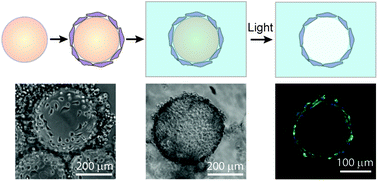
The Anseth Lab at the University of Colorado in Boulder has developed a clever biomaterials technique that reminds me of my favorite arts & crafts activity. In their Biomaterials Science paper Katherine Lewis et al. describe how they used photodegradable PEG microspheres (analogous to balloons) coated with lung epithelial cells (analogous to papier-mâché) to generate cyst structures that mimic lung alveoli in vitro. In alveoli, lung epithelial cells form tight junctions to create a barrier between the airway and blood vessels. To appropriately model this barrier in vitro, the photodegradable microspheres were functionalized with the adhesive peptide CRGDS to allow epithelial cell attachment to the surface of the microsphere. Subsequently, cell-coated microspheres were encapsulated in a PEG hydrogel with stiffness similar to lung tissue, which was functionalized with CRGDS and enzymatically-cleavable peptide cross-linkers. Finally, the photodegradable microspheres were degraded away with cell-compatible light to form cysts, similar to popping the balloon when making a piñata. The cells forming the spherical cysts retained their tight junctions because they also adhered to the surrounding encapsulating hydrogel. The morphology and cell–cell junctions of the cysts were elegantly characterized with confocal microscopy and immuno-staining to demonstrate barrier formation. These 3D models of alveolar cysts demonstrate yet another unique application of photodegradable PEG hydrogels. These cysts may be used to develop models of diseases including pulmonary fibrosis for in vitro screening of potential therapeutics. Discovering treatments to lung-associated diseases using this technology in the future would certainly be a sweeter success than enjoying candy from a piñata.
Check out the June cover article here: In vitro model alveoli from photodegradable microsphere templates by Katherine J.R. Lewis, Mark W. Tibbitt, Yi Zhao, Kelsey Branchfield, Xin Sun, Vivek Balasubramaniam, and Kristi S. Anseth
Dr. Brian Aguado (@BrianAguado) completed his Ph.D. in Biomedical Engineering from Northwestern University as an NSF fellow in 2015. He holds a B.S. degree in Biomechanical Engineering from Stanford University and a M.S. degree in Biomedical Engineering from Northwestern University. Read more about Brian’s research publications here.
Follow the latest journal news on Twitter @BioMaterSci or go to our Facebook page.
Polymers in Medicine and Biology

We are pleased to announce the Polymers in Medicine and Biology meeting to be held in Sonoma Wine Country, California, USA between September 14 – 17, 2015.
The meeting, co-organised by Buddy Ratner (University of Washington, USA), Kathryn Uhrich (Rutgers University, USA) and Judy Riffle (Virginia Tech, USA), will cover a broad range of topics over the 4 days, including advances in drug delivery, novel polymeric biomaterials, surfaces and biointerfaces, and implants and implantable materials.
The programme features a range of top speakers including Biomaterials Science Editor-in-Chief Phil Messersmith, Ali Khademhosseini, Joseph DeSimone, Martina Stenzel, David Grainger and Yukio Nagasaki.
The registration deadline is Monday August 3 2015.
Full location: Hilton Sonoma Wine Country, Santa Rosa, California, USA
Facile Synthesis of Antibacterial Graphene Films Doped with Silver Nanoparticles
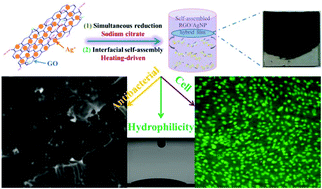
The development of antibacterial materials that can guard against microbial infections during medical procedures has been a topic of increasing interest. In this paper, a team of researchers from Beijing University of Chemical Technology and the University of Bremen describe a facile synthesis method for a hybrid nanomaterial that has previously demonstrated excellent antibacterial activity: reduced graphene oxide films decorated with silver nanoparticles. The efficient, dimensionally scalable, and environmentally friendly nature of this method make it a potentially valuable tool for other groups interested in fabricating these hybrid films for applications ranging from medical biomaterials, to cell culture scaffolds, to drug delivery platforms, to environmental remediation.
- Schematic model for fabricating RGO/AgNP hybrid film
Zhang et al. created these hybrid films by using sodium citrate to simultaneously reduce aqueous graphene oxide (GO) and aqueous silver nitrate to reduced graphene oxide (RGO) and silver nanoparticles (AgNPs), respectively. This was followed by a prolonged incubation at 80°C to induce thermal evaporation-driven self-assembly of the hybrid RGO/AgNP films. The mass ratio of silver nitrate to GO in the initial solution could be adjusted to produce films with varying densities of AgNPs. In addition, this mass ratio as well the thermal evaporation duration provided some control over the thickness of the resulting hybrid film. The film’s size could be readily changed via adjustments to the dimensions of the reaction container and the film could be later transferred to other substrates without any additional post processing steps.
Subsequent characterisation of the film confirmed the successful reduction of GO as well as the formation of primarily spherical AgNPs between 12 and 30 nm in size on the surface of the film. The resulting material was found to be very hydrophilic and supported the adhesion and proliferation of mouse osteoblasts. An antibacterial assay measuring E. coli adhesion on the surface of silicon wafers coated with these RGO/AgNP films found that the few bacteria that did manage to adhere to the film’s surface exhibited damaged cell walls. A subsequent E. coli colony viability assay proved that no living bacterial colonies were present on the surface of the hybrid film, a result that could not be obtained when using either an uncoated silicon wafer or a pure RGO film.
The biocompatibility, hydrophilicity, durability, and antibacterial activity of these RGO/AgNP hybrid films make them intriguing candidates for a number of medical and environmental applications. The simple, dimension-scalable, and environmental friendly synthesis method presented by Zhang et al. in this paper opens up new avenues for the creation and widespread use of these versatile hybrid films.
Check out the full article:
Graphene film doped with silver nanoparticles: self-assembly formation, structural characterizations, antibacterial ability, and biocompatibility by Panpan Zhang, Haixia Wang, Xiaoyuan Zhang, Wei Xu, Yang Li, Qing Li, Gang Wei, and Zhiqiang Su
Ellen Tworkoski is a Web Writer for Biomaterials Science and is currently a graduate student in the biomedical engineering department at Northwestern University (Evanston, IL, US).
Follow the latest journal news on Twitter @BioMaterSci or go to our Facebook page.
Polymeric biomaterials for cancer nanotechnology themed issue now online
We are delighted to announce that the Polymeric biomaterials for cancer nanotechnology themed issue is now available online.

Guest Edited by Jianjun Cheng (University of Illinois at Urbana-Champaign, USA) and Suzie H. Pun (University of Washington, USA), this themed issue highlights the latest discoveries and innovations in polymeric biomaterials for cancer nanotechnology.
Polymeric biomaterials have been extensively used in nanomedicine formulations for cancer therapy. Preclinical and clinical studies have in general revealed that polymeric nanocarriers, when used for chemotherapeutic drug delivery, reduce systemic toxicity and thus mitigate adverse side effects of the drug. This themed issue contains reviews and research articles in the areas of: (i) expanding the available suite of polymeric biomaterials that can be reproducibly and controllably manufactured at a suitable scale, (ii) designing carriers with improved biodistribution to tumour sites, (iii) increasing tumour distribution and penetration of polymeric nanocarriers, and (iv) controlling efficient drug release at a desired location and with optimal kinetics.
Read all the themed issue papers here
A few articles from the themed issue are highlighted below:
Drug-free macromolecular therapeutics – a new paradigm in polymeric nanomedicines
Te-Wei Chu and Jindřich Kopeček
Biomater. Sci., 2015,3, 908-922
Lipid-coated polymeric nanoparticles for cancer drug delivery
Sangeetha Krishnamurthy, Rajendran Vaiyapuri, Liangfang Zhang and Juliana M. Chan
Biomater. Sci., 2015, 3, 923-936
Enhanced transcellular penetration and drug delivery by crosslinked polymeric micelles into pancreatic multicellular tumor spheroids
Hongxu Lu, Robert H. Utama, Uraiphan Kitiyotsawat, Krzysztof Babiuch, Yanyan Jiang and Martina H. Stenzel
Biomater. Sci., 2015, 3, 1085-1095
Polymeric assembly of hyperbranched building blocks to establish tunable nanoplatforms for lysosome acidity-responsive gene/drug co-delivery
Hui-Zhen Jia, Wei Zhang, Xu-Li Wang, Bin Yang, Wei-Hai Chen, Si Chen, Gang Chen, Yi-Fang Zhao, Ren-Xi Zhuo, Jun Feng and Xian-Zheng Zhang
Biomater. Sci., 2015,3, 1066-1077